Ukraine Magnesium Metal Market Size, Share & Growth Rate
The Ukraine Magnesium Metal Market was estimated at USD 1391 Million in 2025 and is projected to reach USD 1991 Million by 2032, growing at a CAGR of 5.3% from 2026 to 2032. This growth trajectory is primarily driven by the increased utilization of magnesium in lightweight automotive components, propelled by the industry's push for fuel efficiency and reduced emissions. Additionally, technological innovations in extraction and processing are enhancing the competitive landscape of the market.
Ukraine Magnesium Metal Market Year-wise Growth Rate and Key Drivers
This graph highlights how the Ukraine Magnesium Metal Market has steadily grown over the years, supported by major growth factors.
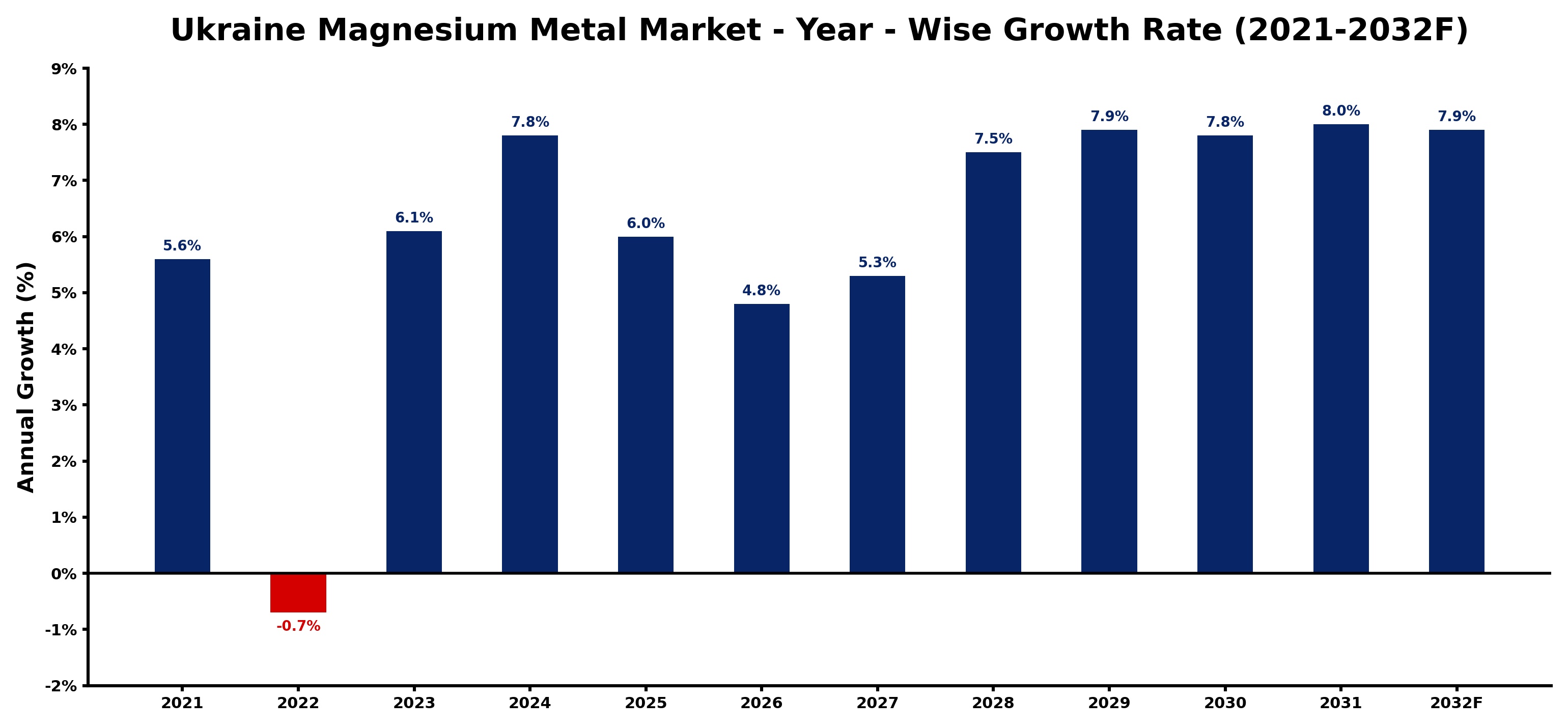
The table below presents the year‑wise growth rates along with the key drivers influencing the market
| Year | Growth Rate | Major Drivers |
| 2021 | 5.6% | Increased industrial production demand |
| 2022 | -0.7% | Export restrictions limited availability |
| 2023 | 6.1% | Investment in manufacturing capacity |
| 2024 | 7.8% | Technological advancements enhanced efficiency |
| 2025 | 6.0% | Rising automotive sector requirements |
| 2026 | 4.8% | Construction industry growth accelerated |
| 2027 | 5.3% | Demand for lightweight materials increased |
| 2028 | 7.5% | Sustainability initiatives drove usage |
| 2029 | 7.9% | New applications in aerospace emerged |
| 2030 | 7.8% | Strategic partnerships expanded market reach |
| 2031 | 8.0% | Rising demand for renewable energy |
| 2032 | 7.9% | Innovative alloys gained market traction |
Note - Market size estimations and growth projections presented in this report are based on 6Wresearch’s advanced forecasting approach, validated with industry datasets as of June 2026.
Ukraine Magnesium Metal Market Synopsis
Recent momentum in the Ukraine Magnesium Metal Market is largely attributed to rising demands from automotive and aerospace sectors, as well as ongoing advancements in eco-friendly production practices. As these industries increasingly prioritize lightweight materials, the outlook for magnesium metal appears robust.
However, as the market moves forward, it faces challenges such as global price fluctuations and competition from alternative materials. Addressing these factors will be vital for maintaining growth and ensuring the industry's long-term sustainability.
Ukraine Magnesium Metal Market Key Takeaways
- The Ukraine Magnesium Metal Market is projected to experience steady growth through 2032.
- Key industries driving demand include automotive, aerospace, and electronics.
- Technological advancements are enhancing extraction and processing efficiency.
- Government policies are increasingly supportive of domestic production and sustainability initiatives.
- Investment opportunities are ripe in magnesium production and eco-friendly practices.
Evaluation of Restraints in Ukraine Magnesium Metal Market
While the Ukraine Magnesium Metal Market is on an upward trajectory, several constraints limit its full potential. Fluctuating global demand and pricing can create uncertainty for producers, making it difficult to plan for the future. Additionally, competition from countries with established magnesium industries could hinder Ukraine's market share. Geopolitical tensions also present risks that could disrupt supply chains and trade relations. Companies will need to navigate these complexities and invest strategically in modernizing production to maintain a competitive edge.
Ukraine Magnesium Metal Market Trends
A key trend in the Ukraine Magnesium Metal Market is the increased adoption of magnesium in various sectors due to its lightweight and high-strength properties. Manufacturers are increasingly recognizing the benefits of magnesium over traditional materials, particularly in automotive applications aimed at enhancing fuel efficiency. Moreover, the growing emphasis on sustainable practices is pushing industries toward adopting magnesium, known for its recyclability and lower environmental impact.
Ukraine Magnesium Metal Market Opportunities
Investment opportunities abound in the Ukraine Magnesium Metal Market, primarily due to the country's substantial magnesium reserves and established production capabilities. Expanding production facilities, adopting advanced processing technologies, and focusing on eco-friendly manufacturing solutions present attractive options for investors. As industries increasingly seek sustainable materials, initiatives that prioritize environmentally friendly practices in magnesium production could yield significant returns.
Government Initiatives in the Ukraine Magnesium Metal Market
Government policies play a pivotal role in shaping the Ukraine Magnesium Metal Market. The Ukrainian government has implemented various initiatives aimed at bolstering domestic production, including offering incentives and subsidies to manufacturers. Regulations are also in place to ensure that production practices comply with environmental sustainability standards. These efforts not only support local industries but also aim to enhance Ukraine's competitiveness in the global magnesium market.
Future Insights of the Ukraine Magnesium Metal Market
The future of the Ukraine Magnesium Metal Market looks promising as demand continues to surge, particularly driven by advancements in automotive and aerospace technologies. The emphasis on lightweight materials is expected to intensify, further boosting magnesium's appeal. However, the market must remain vigilant in addressing challenges such as pricing volatility and competition from alternative materials. With proactive strategies and investment in modernization, the market is well-positioned for continued growth through 2032.
Ukraine Magnesium Metal Market Latest Developments (May 2025 - June 2026)
In recent months, the Ukraine Magnesium Metal Market has seen a notable uptick in investments aimed at expanding production capabilities and enhancing processing technologies. Several initiatives have been launched focusing on sustainable manufacturing practices, as companies seek to align with environmental regulations and consumer preferences. Additionally, partnerships between local producers and international investors are emerging to bolster supply chain stability and optimize production efficiency.
Ukraine Magnesium Metal Market - Key Attractiveness of the Report
- 10 Years of Market Numbers
- Historical Data Starting from 2022 to 2025
- Base Year: 2025
- Forecast Data until 2032
- Key Performance Indicators Impacting the Market
- Major Upcoming Developments and Projects
Key Highlights of the Report:
- Ukraine Magnesium Metal Market Outlook
- Market Size of Ukraine Magnesium Metal Market, 2025
- Forecast of Ukraine Magnesium Metal Market, 2032
- Historical Data and Forecast of Ukraine Magnesium Metal Revenues & Volume for the Period 2022-2032F
- Ukraine Magnesium Metal Market Trend Evolution
- Ukraine Magnesium Metal Market Drivers and Challenges
- Ukraine Magnesium Metal Price Trends
- Ukraine Magnesium Metal Porter's Five Forces
- Ukraine Magnesium Metal Industry Life Cycle
- Historical Data and Forecast of Ukraine Magnesium Metal Market Revenues & Volume By Application for the Period 2022-2032F
- Historical Data and Forecast of Ukraine Magnesium Metal Market Revenues & Volume By Die Casting for the Period 2022-2032F
- Historical Data and Forecast of Ukraine Magnesium Metal Market Revenues & Volume By Aluminum Alloys for the Period 2022-2032F
- Historical Data and Forecast of Ukraine Magnesium Metal Market Revenues & Volume By Titanium Reduction for the Period 2022-2032F
- Historical Data and Forecast of Ukraine Magnesium Metal Market Revenues & Volume By Iron & Steel Making for the Period 2022-2032F
- Historical Data and Forecast of Ukraine Magnesium Metal Market Revenues & Volume By Others for the Period 2022-2032F
- Historical Data and Forecast of Ukraine Magnesium Metal Market Revenues & Volume By End-user Industry for the Period 2022-2032F
- Historical Data and Forecast of Ukraine Magnesium Metal Market Revenues & Volume By Automotive for the Period 2022-2032F
- Historical Data and Forecast of Ukraine Magnesium Metal Market Revenues & Volume By Aerospace for the Period 2022-2032F
- Historical Data and Forecast of Ukraine Magnesium Metal Market Revenues & Volume By Electronics for the Period 2022-2032F
- Historical Data and Forecast of Ukraine Magnesium Metal Market Revenues & Volume By Sports for the Period 2022-2032F
- Historical Data and Forecast of Ukraine Magnesium Metal Market Revenues & Volume By Medical for the Period 2022-2032F
- Historical Data and Forecast of Ukraine Magnesium Metal Market Revenues & Volume By Others for the Period 2022-2032F
- Ukraine Magnesium Metal Import Export Trade Statistics
- Market Opportunity Assessment By Application
- Market Opportunity Assessment By End-user Industry
- Ukraine Magnesium Metal Top Companies Market Share
- Ukraine Magnesium Metal Competitive Benchmarking By Technical and Operational Parameters
- Ukraine Magnesium Metal Company Profiles
- Ukraine Magnesium Metal Key Strategic Recommendations






































