Ukraine Middleware Market Size & Growth Rate (2026-2032)
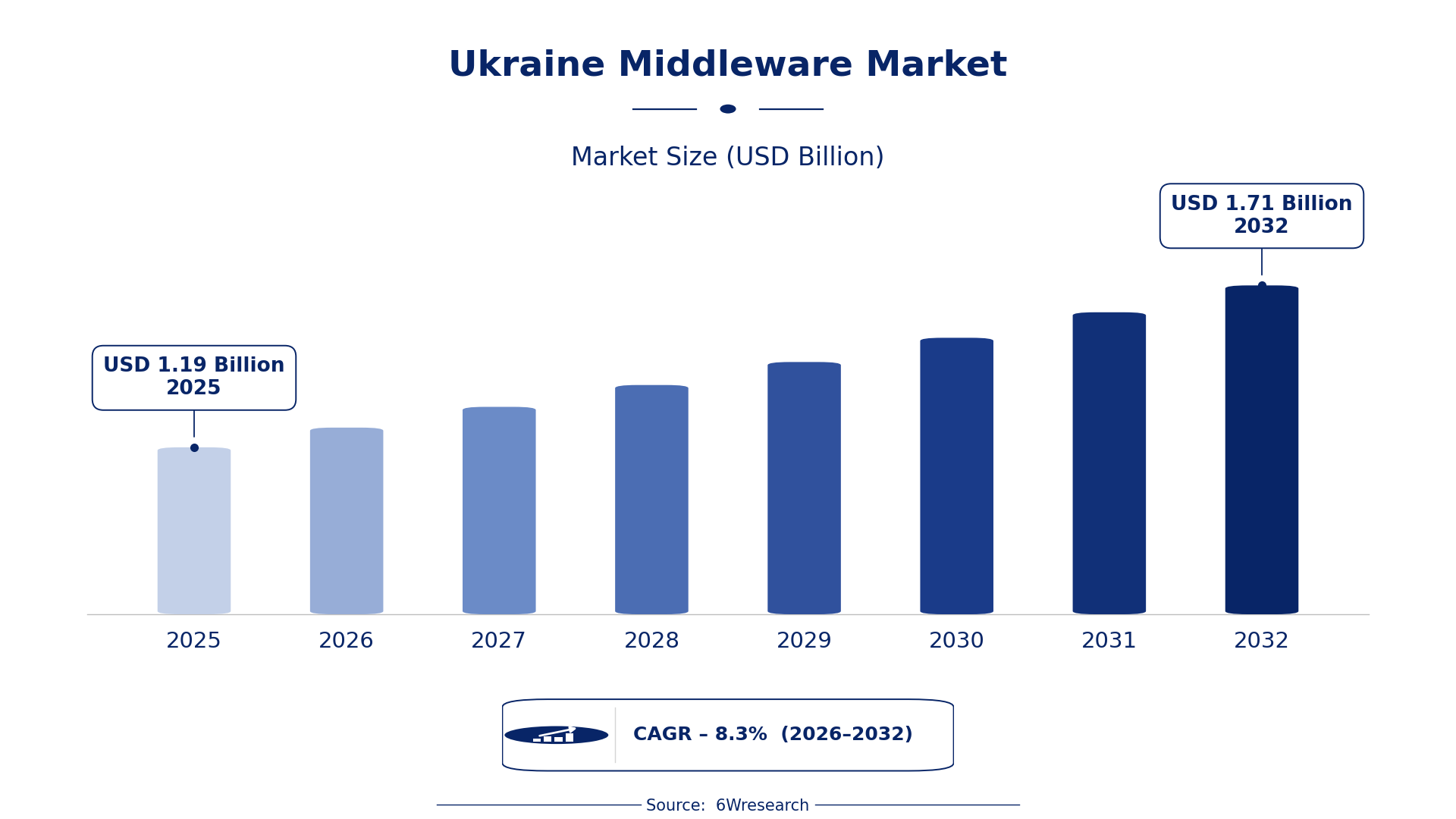
The Ukraine Middleware Market was estimated at USD 1187 Million in 2025 and is projected to reach USD 1705 Million by 2032, growing at a CAGR of 8.3% from 2026 to 2032.
Ukraine Middleware Market Synopsis
The Ukraine Middleware Market is on an upward trajectory, driven by a surge in cloud adoption and the push for digital transformation across various sectors. As organizations increasingly seek to integrate their disparate systems and enhance operational efficiency, middleware solutions have become essential tools in their IT arsenals.
The market is witnessing a notable shift towards open-source solutions, as businesses aim for flexibility and cost-effectiveness. The rise of e-commerce and IoT technologies is further amplifying the demand for middleware, which facilitates communication between diverse applications and devices. This growing necessity positions middleware as a critical component of Ukraine’s evolving digital infrastructure.
Ukraine Middleware Market Year-wise Growth Rate and Key Drivers
This graph illustrates the annual growth rates of the Ukraine Middleware Market from 2021 to 2032, highlighting a steady upward trajectory and projected expansion over the forecast period.
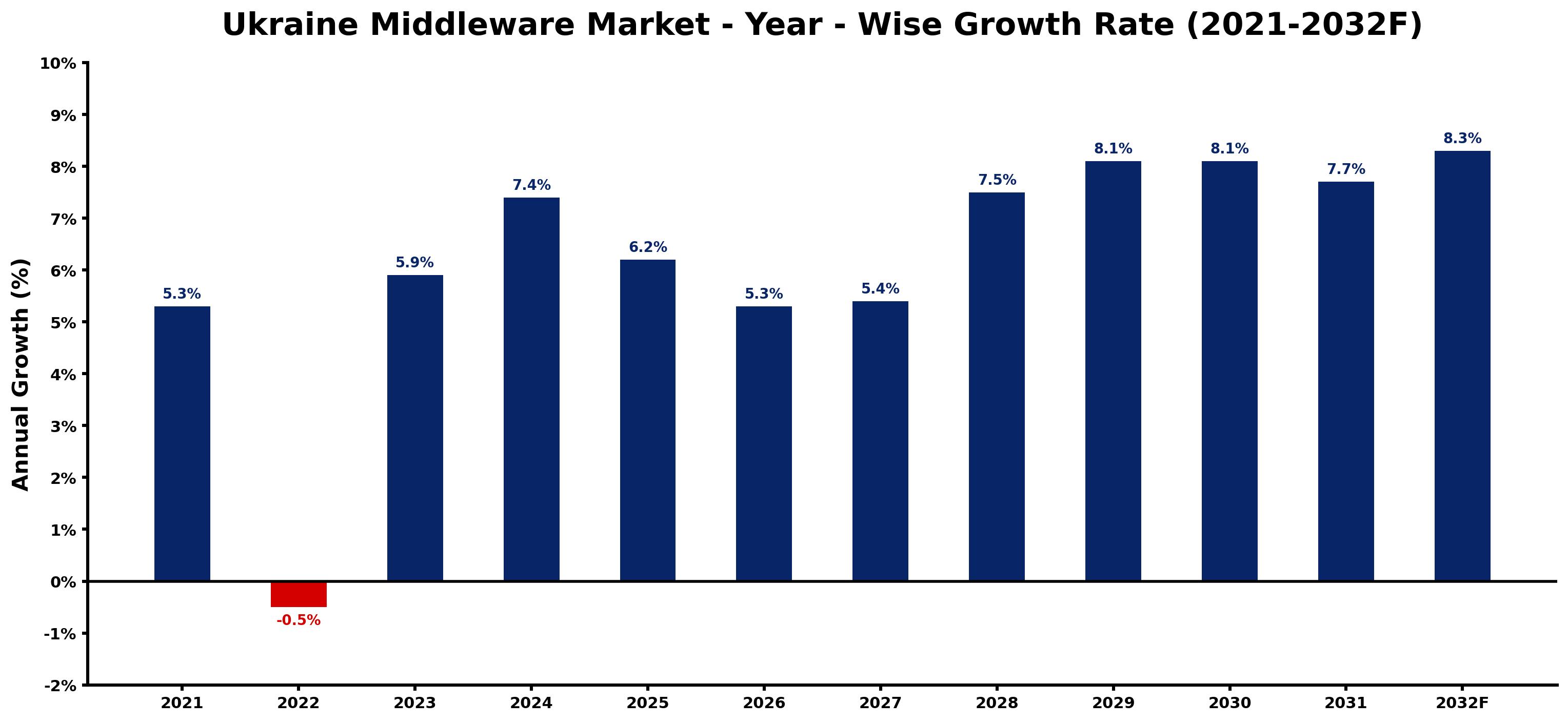
The table below presents the year‑wise growth rates along with the key drivers influencing the market
| Year | Growth Rate | Major Drivers |
| 2021 | 5.3% | Increased government IT modernization budget allocations. |
| 2022 | -0.5% | Russian invasion disrupted telecommunications infrastructure and services |
| 2023 | 5.9% | Growing interest in cloud solutions post-war recovery. |
| 2024 | 7.4% | Rise in local startups focusing on fintech innovation. |
| 2025 | 6.2% | Adoption of real-time data processing in enterprises. |
| 2026 | 5.3% | Expanding AI applications driving middleware integration. |
| 2027 | 5.4% | Strengthening cybersecurity regulations boosting compliance middleware. |
| 2028 | 7.5% | Increased mobile application development stimulating middleware use. |
| 2029 | 8.1% | Enhanced remote work policies necessitating better connectivity. |
| 2030 | 8.1% | Public sector digitalization efforts increasing system interoperability. |
| 2031 | 7.7% | Growing need for API management amid rapid tech growth. |
| 2032 | 8.3% | Proliferation of IoT devices requiring robust data handling. |
Note: Market size estimations and growth projections presented in this report are based on 6Wresearch's proprietary forecasting methodology, utilizing the latest available industry data, government publications, and primary research inputs.
Ukraine Middleware Market Key Takeaways
Below are some of the specific key takeaways from the market, including:
- Increased cloud adoption is a primary driver for middleware growth in Ukraine.
- Open-source middleware solutions are gaining traction due to their cost-effectiveness.
- Integration platforms are becoming vital for connecting disparate systems and applications.
- Real-time data processing demands are pushing organizations to adopt middleware technologies.
- Government initiatives are fostering a supportive environment for IT innovation and middleware deployment.
Evaluation of Restraints in Ukraine Middleware Market
Despite its growth potential, the Ukraine Middleware Market faces several restraints. A significant barrier is the limited awareness among businesses regarding the strategic importance of middleware solutions. Many companies continue to rely on outdated, fragmented IT systems, which hampers their ability to respond to changing market dynamics effectively. Additionally, challenges related to data security and compliance remain pressing, as organizations must adhere to stringent regulations. The scarcity of skilled IT professionals proficient in middleware technologies further compounds these issues, making it difficult for companies to implement and manage effective middleware solutions.
Ukraine Middleware Market Trends
A few key trends are shaping the Ukraine Middleware Market. The rising popularity of hybrid cloud solutions stands out, allowing organizations to blend on-premises and cloud resources seamlessly. Integration platforms are increasingly in demand as businesses seek to link various applications and streamline operations. Enhanced security features are becoming non-negotiable, reflecting heightened awareness of data protection. Finally, the emergence of low-code development platforms is simplifying middleware deployment, making it accessible to a broader range of businesses.
Ukraine Middleware Market Opportunities
The market presents considerable growth opportunities for middleware providers. Innovations such as AI-driven integration tools offer pathways to enhance data management and operational efficiency. Partnerships with local businesses can help tap into specific industry needs, catering to various sectors seeking robust middleware solutions. As organizations focus on digital transformation, those offering tailored, innovative middleware solutions stand to benefit significantly in the coming years.
Government Initiatives in the Ukraine Middleware Market
Government policies are playing a crucial role in shaping the Ukraine Middleware Market. The Ukrainian government is committed to promoting digital transformation and enhancing the competitiveness of its IT sector. Recent initiatives focus on supporting the development of digital infrastructure and fostering an environment conducive to innovation.
- A national digital infrastructure upgrade programme was completed in early 2025, improving connectivity across urban and rural areas.
- The introduction of tax incentives for technology firms is currently underway, aimed at attracting foreign investment and encouraging local startups.
- A regulatory framework introduced in 2025 mandates data security compliance in middleware solutions, aligning with international standards.
- Plans for a public-private initiative to enhance cloud service accessibility are expected to be rolled out by 2028.
Future Insights of the Ukraine Middleware Market
Looking ahead to 2026-2032, the Ukraine Middleware Market is set to expand as organizations prioritize modernizing their IT infrastructure. The ongoing digital transformation will drive demand for innovative middleware solutions that enable real-time data processing and integration. As emerging technologies like IoT and AI gain traction, middleware will play an increasingly vital role in facilitating connectivity and enhancing business agility. Challenges such as security and compliance will persist, but the market's focus on innovation and addressing evolving business needs will foster continued growth.
Ukraine Middleware Market Latest Developments
Over the last 12-14 months, the Ukraine Middleware Market has seen significant activity, reflecting a strong commitment to digital innovation. Companies are increasingly investing in middleware solutions to enhance their operational capabilities and integrate new technologies.
- A major technology vendor launched a new middleware platform in Q3 2025, designed to improve interoperability among existing IT systems.
- An initiative that began in early 2025 focuses on developing AI-driven middleware solutions, with pilot projects currently underway.
- Plans for a middleware-focused conference in mid-2026 aim to gather industry experts to discuss trends and innovations.
- A partnership between local IT firms is expected to enhance middleware integration capabilities by late 2026.
Ukraine Middleware Market - Key Attractiveness of the Report
- 10 Years of Market Numbers
- Historical Data Starting from 2022 to 2025
- Base Year: 2025
- Forecast Data until 2032
- Key Performance Indicators Impacting the Market
- Major Upcoming Developments and Projects
Key Highlights of the Report:
- Ukraine Middleware Market Outlook
- Market Size of Ukraine Middleware Market, 2025
- Forecast of Ukraine Middleware Market, 2032
- Historical Data and Forecast of Ukraine Middleware Revenues & Volume for the Period 2022-2032F
- Ukraine Middleware Market Trend Evolution
- Ukraine Middleware Market Drivers and Challenges
- Ukraine Middleware Price Trends
- Ukraine Middleware Porter's Five Forces
- Ukraine Middleware Industry Life Cycle
- Historical Data and Forecast of Ukraine Middleware Market Revenues & Volume By Product Type for the Period 2022-2032F
- Historical Data and Forecast of Ukraine Middleware Market Revenues & Volume By Communication Middleware for the Period 2022-2032F
- Historical Data and Forecast of Ukraine Middleware Market Revenues & Volume By Platform Middleware for the Period 2022-2032F
- Historical Data and Forecast of Ukraine Middleware Market Revenues & Volume By Integration Middleware for the Period 2022-2032F
- Historical Data and Forecast of Ukraine Middleware Market Revenues & Volume By Others for the Period 2022-2032F
- Historical Data and Forecast of Ukraine Middleware Market Revenues & Volume By Deployment Types for the Period 2022-2032F
- Historical Data and Forecast of Ukraine Middleware Market Revenues & Volume By On-Premise for the Period 2022-2032F
- Historical Data and Forecast of Ukraine Middleware Market Revenues & Volume By Hosted for the Period 2022-2032F
- Historical Data and Forecast of Ukraine Middleware Market Revenues & Volume By Hybrid for the Period 2022-2032F
- Historical Data and Forecast of Ukraine Middleware Market Revenues & Volume By Organization Size for the Period 2022-2032F
- Historical Data and Forecast of Ukraine Middleware Market Revenues & Volume By Small businesses for the Period 2022-2032F
- Historical Data and Forecast of Ukraine Middleware Market Revenues & Volume By Medium businesses for the Period 2022-2032F
- Historical Data and Forecast of Ukraine Middleware Market Revenues & Volume By Enterprises for the Period 2022-2032F
- Historical Data and Forecast of Ukraine Middleware Market Revenues & Volume By Large enterprises for the Period 2022-2032F
- Historical Data and Forecast of Ukraine Middleware Market Revenues & Volume By Verticals for the Period 2022-2032F
- Historical Data and Forecast of Ukraine Middleware Market Revenues & Volume By Banking, financial services and insurance (BFSI) for the Period 2022-2032F
- Historical Data and Forecast of Ukraine Middleware Market Revenues & Volume By Consumer Goods and Retail for the Period 2022-2032F
- Historical Data and Forecast of Ukraine Middleware Market Revenues & Volume By IT and telecom for the Period 2022-2032F
- Historical Data and Forecast of Ukraine Middleware Market Revenues & Volume By Manufacturing for the Period 2022-2032F
- Historical Data and Forecast of Ukraine Middleware Market Revenues & Volume By Oil and Gas for the Period 2022-2032F
- Historical Data and Forecast of Ukraine Middleware Market Revenues & Volume By Healthcare for the Period 2022-2032F
- Historical Data and Forecast of Ukraine Middleware Market Revenues & Volume By Government for the Period 2022-2032F
- Ukraine Middleware Import Export Trade Statistics
- Market Opportunity Assessment By Product Type
- Market Opportunity Assessment By Deployment Types
- Market Opportunity Assessment By Organization Size
- Market Opportunity Assessment By Verticals
- Ukraine Middleware Top Companies Market Share
- Ukraine Middleware Competitive Benchmarking By Technical and Operational Parameters
- Ukraine Middleware Company Profiles
- Ukraine Middleware Key Strategic Recommendations






































