Ukraine Network Slicing Market Size, Share & Growth Rate
The Ukraine Network Slicing Market was estimated at USD 1266 Million in 2025 and is projected to reach USD 1810 Million by 2032, growing at a CAGR of 5.2% from 2026 to 2032. This robust growth trajectory is propelled by the increasing demand for tailored network solutions across diverse sectors, including healthcare, manufacturing, and transportation. As 5G technology proliferates, operators are keen to leverage network slicing for enhanced resource allocation and to meet the unique demands of various applications.
Ukraine Network Slicing Market Year-wise Growth Rate and Key Drivers
This graph highlights how the Ukraine Network Slicing Market has steadily grown over the years, supported by major growth factors.
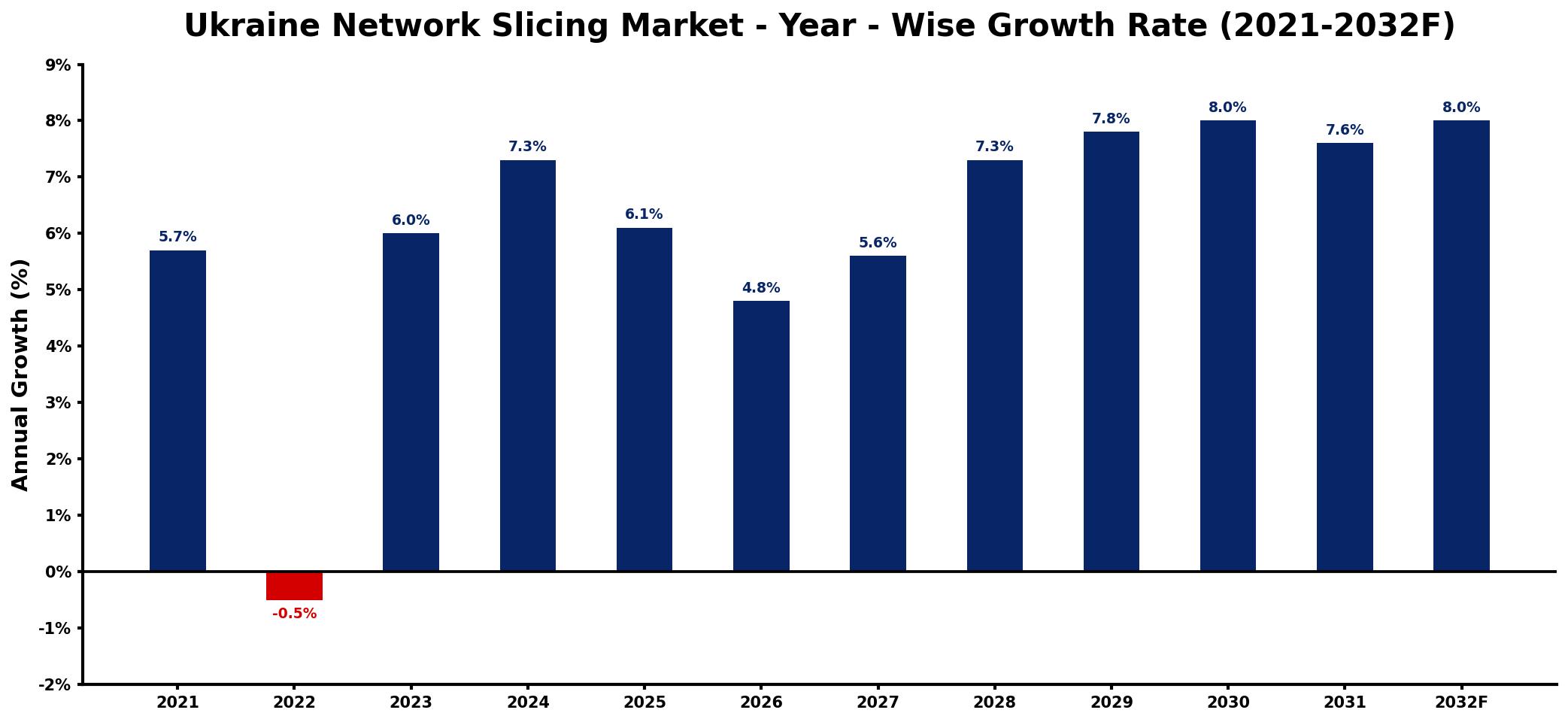
The table below presents the year‑wise growth rates along with the key drivers influencing the market
| Year | Growth Rate | Major Drivers |
| 2021 | 5.7% | Increased demand for connectivity solutions |
| 2022 | -0.5% | Decreased investments in technology infrastructure |
| 2023 | 6.0% | Expansion of 5G applications market |
| 2024 | 7.3% | Rising adoption of IoT devices |
| 2025 | 6.1% | Growth in cloud computing services |
| 2026 | 4.8% | Enhanced focus on edge computing |
| 2027 | 5.6% | Increase in digital transformation initiatives |
| 2028 | 7.3% | Surge in smart city projects |
| 2029 | 7.8% | Boost in telecom industry investments |
| 2030 | 8.0% | Growing need for customized services |
| 2031 | 7.6% | Rising interest in automation technologies |
| 2032 | 8.0% | improved raw material availability |
Note: Market size estimations and growth projections presented in this report are based on 6Wresearch's proprietary forecasting methodology, utilizing the latest available industry data, government publications, and primary research inputs.
Ukraine Network Slicing Market Synopsis
The adoption of network slicing in Ukraine is increasingly seen as a vital strategy for telecom operators aiming to provide specialized services that align with customer needs. This technology allows for the creation of virtual networks optimized for different requirements, ensuring that applications, such as IoT and virtual reality, function seamlessly.
As the market evolves, the collaboration between telecommunications providers and technology vendors is becoming more pronounced, leading to innovations that are both industry-specific and scalable. This collaborative spirit is crucial for advancing network slicing capabilities in the context of Ukraine's digital transformation initiatives.
Ukraine Network Slicing Market Key Takeaways
- The market is set for substantial growth as 5G technology continues to expand.
- Operators are investing significantly in network slicing to enhance service performance and customer satisfaction.
- Healthcare and transportation sectors are key drivers of network slicing demand.
- Government initiatives are facilitating the implementation of advanced network technologies.
- Collaboration between telecom operators and technology providers is fostering innovation and market expansion.
Evaluation of Restraints in Ukraine Network Slicing Market
Despite its promising outlook, the Ukraine Network Slicing Market faces several constraints. Regulatory challenges are a significant factor, as operators must navigate complex compliance requirements regarding data privacy and security. Moreover, the lack of standardized frameworks for network slicing leads to integration difficulties across different networks and service providers. Interoperability issues persist due to the varied network technologies currently in use, creating barriers to seamless communication between slices. Additionally, the substantial investment needed to upgrade infrastructure poses a financial burden for many market participants. Addressing these challenges is essential for the market to reach its full potential.
Ukraine Network Slicing Market Trends
Current trends in the Ukraine Network Slicing Market reveal a strong inclination toward personalized and flexible service offerings. The increasing adoption of IoT technologies, smart cities, and industrial automation are pivotal in driving the need for network slicing. Operators are realizing the importance of delivering high-quality services tailored to the specific demands of different sectors. Furthermore, emerging technologies, such as artificial intelligence and machine learning, are being integrated with network slicing to enhance operational efficiencies and improve customer experiences.
Ukraine Network Slicing Market Opportunities
Investment opportunities in the Ukraine Network Slicing Market are abundant, particularly as the demand for customized solutions grows. The deployment of 5G technology opens avenues for operators and infrastructure providers to develop innovative slicing solutions that cater to various applications and industries. Additionally, the emphasis on smart city initiatives and Industry 4.0 solutions presents lucrative prospects for stakeholders looking to invest in cutting-edge technologies. The growing recognition of network slicings benefits among enterprises further bolsters the market's attractiveness for investment.
Government Initiatives in the Ukraine Network Slicing Market
The Ukrainian government has been proactive in fostering the development of the network slicing market through a series of strategic policies. The National Strategy for the Development of 5G Networks, launched in 2020, emphasizes the implementation of network slicing technology to facilitate efficient, customized services. Additionally, the government aims to establish a regulatory framework that supports the deployment of such technologies, providing operators with necessary guidelines and incentives to invest in network slicing capabilities. Collaborative efforts with industry stakeholders are also underway to bolster innovation and competitiveness.
Future Insights of the Ukraine Network Slicing Market
Looking ahead, the Ukraine Network Slicing Market is poised for significant evolution from 2026 to 2032. The increasing demand for high-speed, reliable connectivity combined with the rapid adoption of advanced technologies will drive the market forward. Network slicing is expected to become integral for telecom operators as they strive to optimize their resources and deliver enhanced services that are aligned with the diverse needs of users. As the IoT ecosystem expands and digital transformation initiatives gain momentum, the market is likely to experience considerable growth, paving the way for innovative solutions and strategies.
Ukraine Network Slicing Market Latest Developments (2025 - 2026)
Recent industry developments in the Ukraine Network Slicing Market indicate a concerted effort toward innovation and collaboration among telecom operators and technology vendors. Companies are actively working on the development of customized network slicing solutions tailored to various sectors. Additionally, new partnerships are being formed to enhance infrastructure capabilities and improve service offerings. As market players focus on integrating advanced technologies with network slicing, the landscape is rapidly evolving to accommodate the growing demands of both enterprises and consumers.
Ukraine Network Slicing Market - Key Attractiveness of the Report
- 10 Years of Market Numbers
- Historical Data Starting from 2022 to 2025
- Base Year: 2025
- Forecast Data until 2032
- Key Performance Indicators Impacting the Market
- Major Upcoming Developments and Projects
Key Highlights of the Report:
- Ukraine Network Slicing Market Outlook
- Market Size of Ukraine Network Slicing Market, 2025
- Forecast of Ukraine Network Slicing Market, 2032
- Historical Data and Forecast of Ukraine Network Slicing Revenues & Volume for the Period 2022-2032F
- Ukraine Network Slicing Market Trend Evolution
- Ukraine Network Slicing Market Drivers and Challenges
- Ukraine Network Slicing Price Trends
- Ukraine Network Slicing Porter's Five Forces
- Ukraine Network Slicing Industry Life Cycle
- Historical Data and Forecast of Ukraine Network Slicing Market Revenues & Volume By Component for the Period 2022-2032F
- Historical Data and Forecast of Ukraine Network Slicing Market Revenues & Volume By Solution for the Period 2022-2032F
- Historical Data and Forecast of Ukraine Network Slicing Market Revenues & Volume By Services (Professional & Managed) for the Period 2022-2032F
- Historical Data and Forecast of Ukraine Network Slicing Market Revenues & Volume By End User for the Period 2022-2032F
- Historical Data and Forecast of Ukraine Network Slicing Market Revenues & Volume By Telecom Operators for the Period 2022-2032F
- Historical Data and Forecast of Ukraine Network Slicing Market Revenues & Volume By Enterprises for the Period 2022-2032F
- Historical Data and Forecast of Ukraine Network Slicing Market Revenues & Volume By Application for the Period 2022-2032F
- Historical Data and Forecast of Ukraine Network Slicing Market Revenues & Volume By Manufacturing for the Period 2022-2032F
- Historical Data and Forecast of Ukraine Network Slicing Market Revenues & Volume By Government for the Period 2022-2032F
- Historical Data and Forecast of Ukraine Network Slicing Market Revenues & Volume By Automotive for the Period 2022-2032F
- Historical Data and Forecast of Ukraine Network Slicing Market Revenues & Volume By Media and Entertainment for the Period 2022-2032F
- Ukraine Network Slicing Import Export Trade Statistics
- Market Opportunity Assessment By Component
- Market Opportunity Assessment By End User
- Market Opportunity Assessment By Application
- Ukraine Network Slicing Top Companies Market Share
- Ukraine Network Slicing Competitive Benchmarking By Technical and Operational Parameters
- Ukraine Network Slicing Company Profiles
- Ukraine Network Slicing Key Strategic Recommendations






































