United Arab Emirates (UAE) AC Power Sources Market Size, Share & Growth Rate
The United Arab Emirates (UAE) AC Power Sources Market was estimated at USD 224 Million in 2025 and is projected to reach USD 317 Million by 2032, growing at a CAGR of 5.1% from 2026 to 2032. This growth trajectory is primarily driven by rapid urbanization and industrialization, which are increasing the demand for reliable and efficient power solutions. Additionally, governmental initiatives aimed at diversifying the economy and promoting sustainable energy sources are further enhancing the market landscape.
United Arab Emirates (UAE) AC Power Sources Market Year-wise Growth Rate and Key Drivers
This graph highlights how the United Arab Emirates (UAE) AC Power Sources Market has steadily grown over the years, supported by major growth factors.
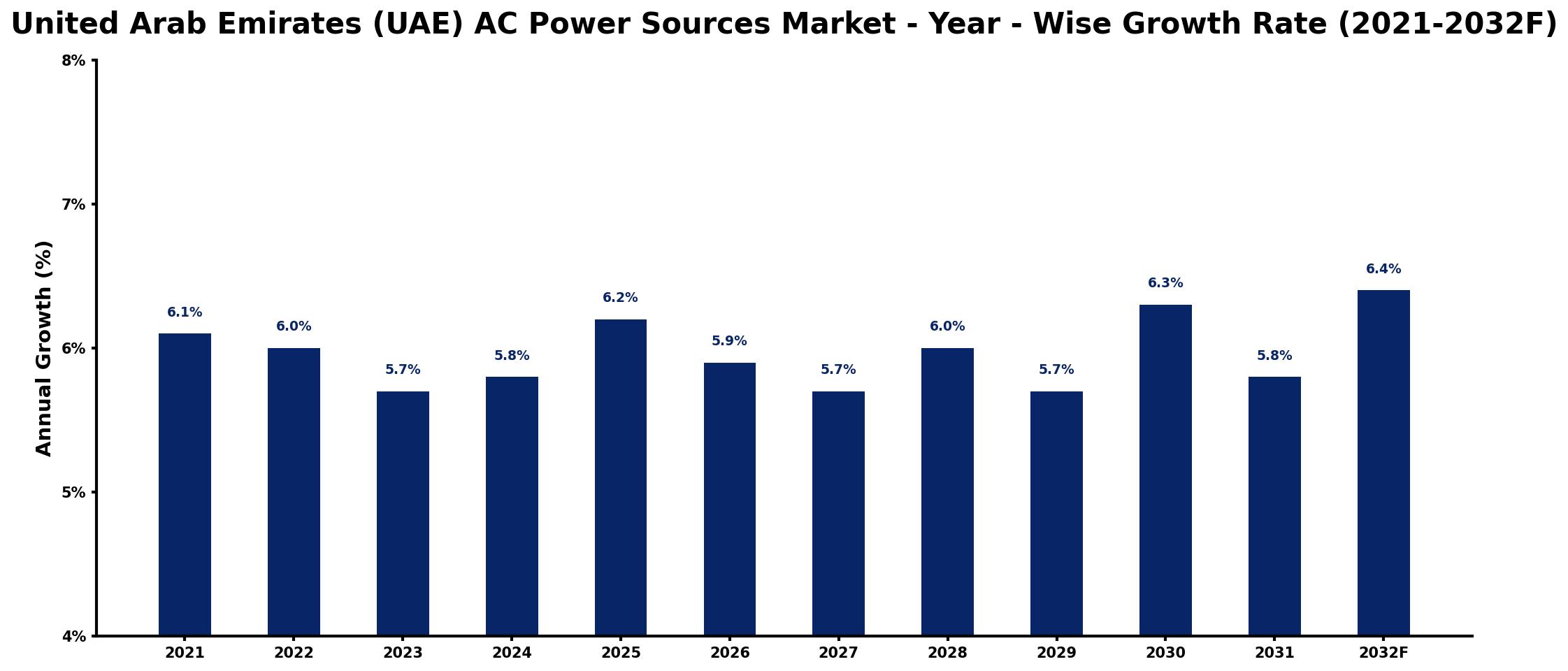
The table below presents the year‑wise growth rates along with the key drivers influencing the market
| Year | Growth Rate | Major Drivers |
| 2021 | 6.1% | Rising construction sector investments |
| 2022 | 6.0% | Increased renewable energy initiatives |
| 2023 | 5.7% | Growing urban infrastructure projects |
| 2024 | 5.8% | Expansion of manufacturing capabilities |
| 2025 | 6.2% | Surge in commercial developments |
| 2026 | 5.9% | Technological advancements in efficiency |
| 2027 | 5.7% | Higher residential energy demands |
| 2028 | 6.0% | Boost in tourism-related projects |
| 2029 | 5.7% | Strengthened logistics and transportation |
| 2030 | 6.3% | Development of smart city initiatives |
| 2031 | 5.8% | Increased focus on sustainability |
| 2032 | 6.4% | growing downstream application demand |
Note: Market size estimations and growth projections presented in this report are based on 6Wresearch's proprietary forecasting methodology, utilizing the latest available industry data, government publications, and primary research inputs.
United Arab Emirates (UAE) AC Power Sources Market Synopsis
The UAE AC Power Sources Market has witnessed significant momentum in recent years, fueled by ongoing infrastructure development and the rising need for uninterrupted power supply across various sectors. However, as technology evolves rapidly, the market is at a crossroads, where innovation will be critical to meeting future demands and ensuring long-term viability.
Looking forward, the market is expected to adapt and thrive amidst challenges presented by technological advancements and regulatory changes. Stakeholders must focus on enhancing the performance and efficiency of AC power solutions to not only meet current needs but also align with future energy policies and sustainability goals.
United Arab Emirates (UAE) AC Power Sources Market Key Takeaways
- The market is projected to grow significantly, reaching USD 317 Million by 2032.
- Urbanization and industrialization are primary growth drivers for the market.
- Technological advancements are crucial for maintaining market relevance.
- Governmental policies focusing on sustainable energy are reshaping the market landscape.
- The COVID-19 pandemic has accelerated the demand for reliable power solutions across industries.
Evaluation of Restraints in United Arab Emirates (UAE) AC Power Sources Market
Despite the robust growth potential, the UAE AC Power Sources Market faces real constraints that could impede progress. Rapid technological changes lead to product obsolescence, necessitating continuous innovation from manufacturers to stay competitive. Additionally, stringent regulations regarding energy efficiency and grid integration require ongoing investment in both research and development, creating financial pressure on companies striving to comply with evolving standards. As these dynamics play out, the market must balance innovation with economic viability to ensure sustainable growth.
United Arab Emirates (UAE) AC Power Sources Market Trends
Current trends in the UAE AC Power Sources Market showcase a shift towards smart power management systems. These innovations are becoming increasingly popular as they enhance efficiency and facilitate better monitoring of energy consumption. Furthermore, the integration of renewable energy sources into the grid is gaining traction, aligning with global sustainability goals. This shift not only meets regulatory requirements but also addresses growing consumer expectations for greener energy solutions.
United Arab Emirates (UAE) AC Power Sources Market Opportunities
The market presents genuine growth opportunities, particularly in sectors undergoing digital transformation. Companies can capitalize on the growing demand for energy-efficient solutions, especially in industries heavily reliant on continuous power supply. Investment in smart technologies, including IoT-enabled devices, also represents a significant opportunity for differentiation. Additionally, partnerships with government initiatives focused on sustainable infrastructure can further enhance market reach and potential profitability.
Government Initiatives in the United Arab Emirates (UAE) AC Power Sources Market
The UAE government is actively investing in initiatives designed to diversify its economy and support the energy sector. Policies encouraging sustainable energy development are central to this strategy. Programs aimed at enhancing energy efficiency, along with public spending in infrastructure projects, are pivotal in driving demand for advanced AC power sources. These initiatives are not only critical for achieving national goals but also provide a supportive environment for market growth.
Future Insights of the United Arab Emirates (UAE) AC Power Sources Market
Looking ahead to 2026-2032, the UAE AC Power Sources Market is set to evolve in response to technological advances and regulatory shifts. The emphasis on smart energy solutions and renewables will likely shape product offerings, driving innovation and investment. As businesses adapt to a more digitized landscape, the integration of smart technologies will become increasingly essential, positioning the market for sustained growth and resilience in the coming years.
United Arab Emirates (UAE) AC Power Sources Market Latest Developments (2025 - 2026)
Recent developments in the UAE AC Power Sources Market indicate a growing focus on enhancing the reliability and efficiency of power solutions. Industry players are investing in R&D to explore advancements in energy storage and distribution technologies, aligning with global trends towards sustainability. The increased collaboration between public and private sectors aims to bolster infrastructure projects that support the evolving energy landscape, ensuring that the market remains competitive and capable of meeting future demands.
United Arab Emirates (UAE) AC Power Sources Market - Key Attractiveness of the Report
- 10 Years of Market Numbers
- Historical Data Starting from 2022 to 2025
- Base Year: 2025
- Forecast Data until 2032
- Key Performance Indicators Impacting the Market
- Major Upcoming Developments and Projects
Key Highlights of the Report:
- United Arab Emirates (UAE) AC Power Sources Market Outlook
- Market Size of United Arab Emirates (UAE) AC Power Sources Market, 2025
- Forecast of United Arab Emirates (UAE) AC Power Sources Market, 2032
- Historical Data and Forecast of United Arab Emirates (UAE) AC Power Sources Revenues & Volume for the Period 2022-2032F
- United Arab Emirates (UAE) AC Power Sources Market Trend Evolution
- United Arab Emirates (UAE) AC Power Sources Market Drivers and Challenges
- United Arab Emirates (UAE) AC Power Sources Price Trends
- United Arab Emirates (UAE) AC Power Sources Porter's Five Forces
- United Arab Emirates (UAE) AC Power Sources Industry Life Cycle
- Historical Data and Forecast of United Arab Emirates (UAE) AC Power Sources Market Revenues & Volume By Phase Type for the Period 2022-2032F
- Historical Data and Forecast of United Arab Emirates (UAE) AC Power Sources Market Revenues & Volume By Single-phase for the Period 2022-2032F
- Historical Data and Forecast of United Arab Emirates (UAE) AC Power Sources Market Revenues & Volume By Three-phase for the Period 2022-2032F
- Historical Data and Forecast of United Arab Emirates (UAE) AC Power Sources Market Revenues & Volume By Modulation Type for the Period 2022-2032F
- Historical Data and Forecast of United Arab Emirates (UAE) AC Power Sources Market Revenues & Volume By PWM for the Period 2022-2032F
- Historical Data and Forecast of United Arab Emirates (UAE) AC Power Sources Market Revenues & Volume By Linear for the Period 2022-2032F
- Historical Data and Forecast of United Arab Emirates (UAE) AC Power Sources Market Revenues & Volume By Application for the Period 2022-2032F
- Historical Data and Forecast of United Arab Emirates (UAE) AC Power Sources Market Revenues & Volume By Aerospace for the Period 2022-2032F
- Historical Data and Forecast of United Arab Emirates (UAE) AC Power Sources Market Revenues & Volume By Defense & Government Services for the Period 2022-2032F
- Historical Data and Forecast of United Arab Emirates (UAE) AC Power Sources Market Revenues & Volume By Energy for the Period 2022-2032F
- Historical Data and Forecast of United Arab Emirates (UAE) AC Power Sources Market Revenues & Volume By Wireless Communication & Infrastructure for the Period 2022-2032F
- Historical Data and Forecast of United Arab Emirates (UAE) AC Power Sources Market Revenues & Volume By Consumer Electronics & Appliances for the Period 2022-2032F
- Historical Data and Forecast of United Arab Emirates (UAE) AC Power Sources Market Revenues & Volume By Others for the Period 2022-2032F
- United Arab Emirates (UAE) AC Power Sources Import Export Trade Statistics
- Market Opportunity Assessment By Phase Type
- Market Opportunity Assessment By Modulation Type
- Market Opportunity Assessment By Application
- United Arab Emirates (UAE) AC Power Sources Top Companies Market Share
- United Arab Emirates (UAE) AC Power Sources Competitive Benchmarking By Technical and Operational Parameters
- United Arab Emirates (UAE) AC Power Sources Company Profiles
- United Arab Emirates (UAE) AC Power Sources Key Strategic Recommendations






































