United Arab Emirates (UAE) Accumulator Market Size, Share & Growth Rate
The United Arab Emirates (UAE) Accumulator Market was estimated at USD 155 Million in 2025 and is projected to reach USD 205 Million by 2032, growing at a CAGR of 4.1% from 2026 to 2032. This growth trajectory is primarily driven by the surging demand from the automotive sector, coupled with the increasing integration of renewable energy solutions. As the UAE continues to diversify its economy, energy storage solutions will play a pivotal role in ensuring grid stability and supporting the nations ambitious sustainability goals.
United Arab Emirates (UAE) Accumulator Market Year-wise Growth Rate and Key Drivers
This graph highlights how the United Arab Emirates (UAE) Accumulator Market has steadily grown over the years, supported by major growth factors.
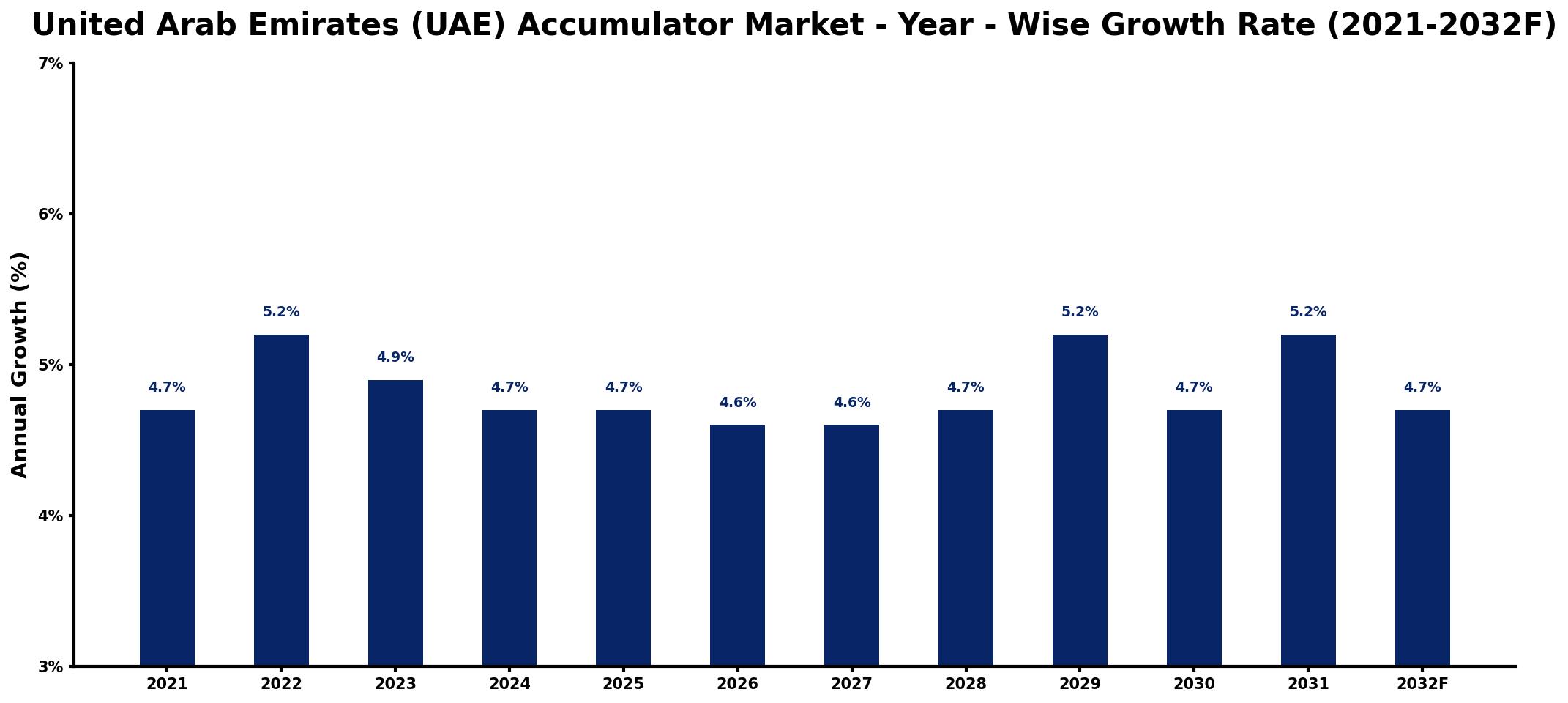
The table below presents the year‑wise growth rates along with the key drivers influencing the market
| Year | Growth Rate | Major Drivers |
| 2021 | 4.7% | Increased demand for renewable energy |
| 2022 | 5.2% | Growth in electric vehicle sector |
| 2023 | 4.9% | Expansion of energy storage solutions |
| 2024 | 4.7% | Rising investments in infrastructure projects |
| 2025 | 4.7% | Surge in solar power adoption |
| 2026 | 4.6% | Advancements in battery technology |
| 2027 | 4.6% | Growing interest in sustainable solutions |
| 2028 | 4.7% | Increased focus on energy efficiency |
| 2029 | 5.2% | Emergence of smart grid technologies |
| 2030 | 4.7% | Heightened demand for backup power |
| 2031 | 5.2% | increased pharmaceutical industry usage |
| 2032 | 4.7% | Rising popularity of hybrid systems |
Note: Market size estimations and growth projections presented in this report are based on 6Wresearch's proprietary forecasting methodology, utilizing the latest available industry data, government publications, and primary research inputs.
United Arab Emirates (UAE) Accumulator Market Synopsis
The UAE Accumulator Market is experiencing a robust expansion, fueled by heightened interest in energy storage technologies across various industries. With innovations enhancing the efficiency and lifespan of accumulators, businesses increasingly recognize the value these solutions provide in both automotive and industrial applications.
Furthermore, the ongoing shift toward renewable energy sources necessitates reliable energy storage solutions, positioning accumulators as essential components of the energy landscape. As governmental policies advocate for greener initiatives, the demand for advanced accumulator systems is set to escalate, marking a significant trend in the UAE's energy sector.
United Arab Emirates (UAE) Accumulator Market Key Takeaways
- The market is driven by growth in automotive and renewable energy sectors.
- Technological advancements are enhancing the efficiency of accumulator products.
- Increasing reliance on uninterruptible power supplies (UPS) across various industries is propelling demand.
- Key players are focused on sustainability and environmental compliance.
- Government policies are aligning to support the expansion of energy storage solutions.
Evaluation of Restraints in United Arab Emirates (UAE) Accumulator Market
Despite its growth potential, the UAE Accumulator Market faces several restraints that could impede its progress. Notably, the rapid pace of technological advancements in competing energy storage solutions, such as lithium-ion batteries, poses a challenge to traditional accumulator systems. To remain competitive, manufacturers must continuously innovate and enhance their products energy density and charging efficiency while also mitigating environmental impacts. Additionally, fluctuating geopolitical conditions can affect the sourcing of essential raw materials, adding another layer of complexity to market operations.
United Arab Emirates (UAE) Accumulator Market Trends
Currently, there is a notable trend towards integrating smart technologies within accumulator systems, which enhances monitoring and management capabilities. As companies adopt Internet of Things (IoT) solutions, accumulators equipped with smart features can provide real-time data analytics and predictive maintenance insights, thus improving operational efficiency. Furthermore, the emphasis on sustainability is driving demand for eco-friendly accumulator solutions, as businesses seek to reduce their carbon footprint and comply with stringent regulatory frameworks.
United Arab Emirates (UAE) Accumulator Market Opportunities
The burgeoning need for energy storage solutions in renewable energy projects presents significant growth opportunities for the UAE Accumulator Market. Investments in solar and wind energy infrastructure are expanding, necessitating advanced accumulator systems capable of stabilizing energy outputs. Additionally, as the automotive industry pivots toward electric vehicles, there is an increasing demand for high-capacity accumulators to support this shift. Market players that innovate and adapt to these changing dynamics will likely capture substantial market share.
Government Initiatives in the United Arab Emirates (UAE) Accumulator Market
The UAE government has been proactive in establishing policies and initiatives that foster the growth of the accumulator market. Investments in renewable energy projects are complemented by incentives for companies that adopt clean energy technologies. Programs promoting sustainability and energy efficiency are being implemented, reinforcing the country's commitment to achieving its climate goals. Furthermore, public spending in infrastructure development includes a focus on enhancing energy storage capabilities, creating a conducive environment for market growth.
Future Insights of the United Arab Emirates (UAE) Accumulator Market
Looking ahead to the period from 2026 to 2032, the UAE Accumulator Market is poised for continued growth. As the country intensifies its focus on renewable energy integration, the demand for reliable energy storage solutions will escalate. Innovations aimed at improving accumulator efficiency and lifespan will become increasingly crucial, especially in a market that prioritizes sustainability. The intersection of technology and renewable energy will define the future landscape of this market, presenting exciting prospects for stakeholders.
United Arab Emirates (UAE) Accumulator Market Latest Developments (2025 - 2026)
In recent months, the UAE Accumulator Market has witnessed several key developments aimed at enhancing product offerings and technological capabilities. Companies are increasingly collaborating with research institutions to drive innovation in accumulator technologies, focusing on sustainability and efficiency. Additionally, there is a heightened emphasis on the integration of smart technologies within accumulators, enabling better performance monitoring and management. Overall, the market is actively evolving in response to emerging energy demands and sustainability initiatives.
United Arab Emirates (UAE) Accumulator Market - Key Attractiveness of the Report
- 10 Years of Market Numbers
- Historical Data Starting from 2022 to 2025
- Base Year: 2025
- Forecast Data until 2032
- Key Performance Indicators Impacting the Market
- Major Upcoming Developments and Projects
Key Highlights of the Report:
- United Arab Emirates (UAE) Accumulator Market Outlook
- Market Size of United Arab Emirates (UAE) Accumulator Market, 2025
- Forecast of United Arab Emirates (UAE) Accumulator Market, 2032
- Historical Data and Forecast of United Arab Emirates (UAE) Accumulator Revenues & Volume for the Period 2022-2032F
- United Arab Emirates (UAE) Accumulator Market Trend Evolution
- United Arab Emirates (UAE) Accumulator Market Drivers and Challenges
- United Arab Emirates (UAE) Accumulator Price Trends
- United Arab Emirates (UAE) Accumulator Porter's Five Forces
- United Arab Emirates (UAE) Accumulator Industry Life Cycle
- Historical Data and Forecast of United Arab Emirates (UAE) Accumulator Market Revenues & Volume By Type for the Period 2022-2032F
- Historical Data and Forecast of United Arab Emirates (UAE) Accumulator Market Revenues & Volume By Bladder Accumulator for the Period 2022-2032F
- Historical Data and Forecast of United Arab Emirates (UAE) Accumulator Market Revenues & Volume By Piston Accumulator for the Period 2022-2032F
- Historical Data and Forecast of United Arab Emirates (UAE) Accumulator Market Revenues & Volume By Diaphragm Accumulator for the Period 2022-2032F
- Historical Data and Forecast of United Arab Emirates (UAE) Accumulator Market Revenues & Volume By Application for the Period 2022-2032F
- Historical Data and Forecast of United Arab Emirates (UAE) Accumulator Market Revenues & Volume By Automobile Industry for the Period 2022-2032F
- Historical Data and Forecast of United Arab Emirates (UAE) Accumulator Market Revenues & Volume By Construction and Agricultural for the Period 2022-2032F
- Historical Data and Forecast of United Arab Emirates (UAE) Accumulator Market Revenues & Volume By Machinery for the Period 2022-2032F
- Historical Data and Forecast of United Arab Emirates (UAE) Accumulator Market Revenues & Volume By Plastics Industry for the Period 2022-2032F
- Historical Data and Forecast of United Arab Emirates (UAE) Accumulator Market Revenues & Volume By Marine Industry for the Period 2022-2032F
- Historical Data and Forecast of United Arab Emirates (UAE) Accumulator Market Revenues & Volume By Oil and Gas Industry for the Period 2022-2032F
- Historical Data and Forecast of United Arab Emirates (UAE) Accumulator Market Revenues & Volume By Sales Channel for the Period 2022-2032F
- Historical Data and Forecast of United Arab Emirates (UAE) Accumulator Market Revenues & Volume By Direct Channel for the Period 2022-2032F
- Historical Data and Forecast of United Arab Emirates (UAE) Accumulator Market Revenues & Volume By Indirect Channel for the Period 2022-2032F
- United Arab Emirates (UAE) Accumulator Import Export Trade Statistics
- Market Opportunity Assessment By Type
- Market Opportunity Assessment By Application
- Market Opportunity Assessment By Sales Channel
- United Arab Emirates (UAE) Accumulator Top Companies Market Share
- United Arab Emirates (UAE) Accumulator Competitive Benchmarking By Technical and Operational Parameters
- United Arab Emirates (UAE) Accumulator Company Profiles
- United Arab Emirates (UAE) Accumulator Key Strategic Recommendations






































