United Arab Emirates (UAE) Active Space Debris Removal Market Size, Share & Growth Rate
The United Arab Emirates (UAE) Active Space Debris Removal Market was estimated at USD 343 Million in 2025 and is projected to reach USD 457 Million by 2032, growing at a CAGR of 4.2% from 2026 to 2032. This growth trajectory is fueled by the UAE's expanding ambitions in space exploration and technology, with initiatives like the successful Mars mission underscoring its commitment to sustainable space practices. As the UAE positions itself as a key player in the global space economy, addressing space debris becomes a paramount concern for safeguarding its investments in space assets.
United Arab Emirates (UAE) Active Space Debris Removal Market Year-wise Growth Rate and Key Drivers
This graph highlights how the United Arab Emirates (UAE) Active Space Debris Removal Market has steadily grown over the years, supported by major growth factors.
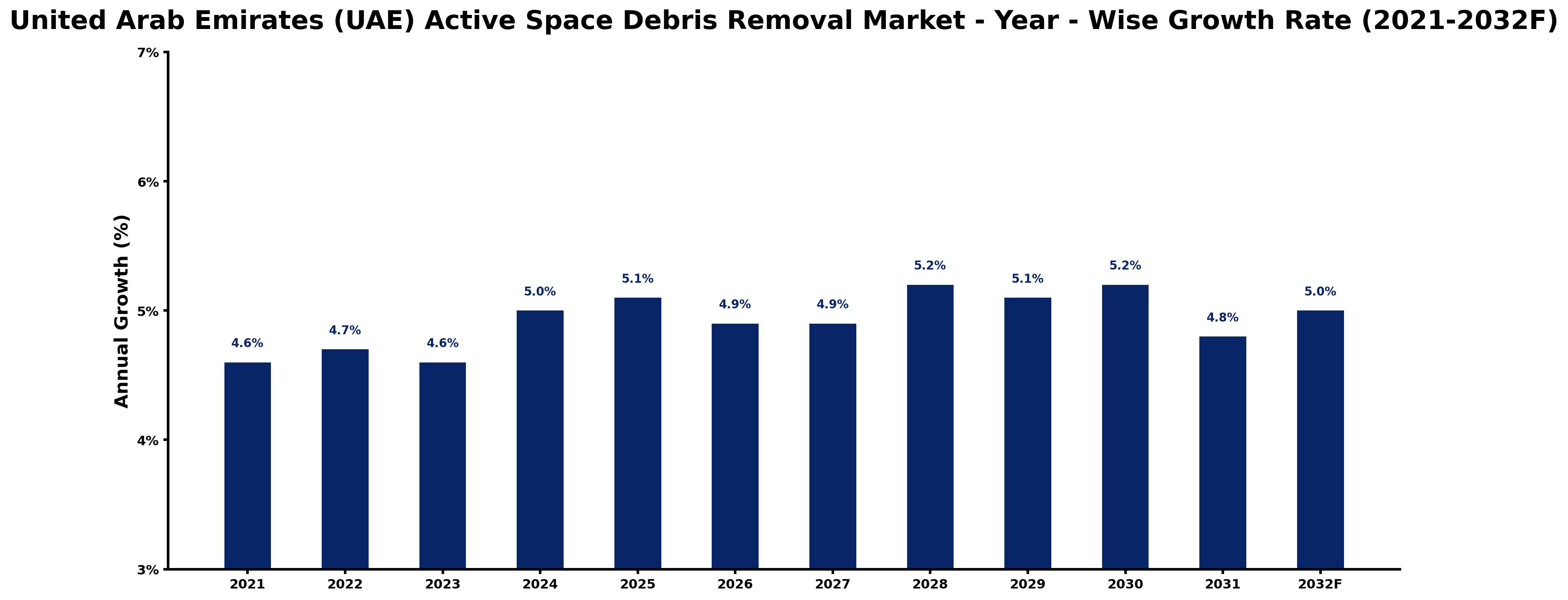
The table below presents the year‑wise growth rates along with the key drivers influencing the market
| Year | Growth Rate | Major Drivers |
| 2021 | 4.6% | Increasing adoption of advanced technologies |
| 2022 | 4.7% | Increasing adoption of advanced technologies |
| 2023 | 4.6% | Increasing adoption of advanced technologies |
| 2024 | 5.0% | Increasing adoption of advanced technologies |
| 2025 | 5.1% | Growing renewable energy integration projects |
| 2026 | 4.9% | Expansion of commercial construction activities |
| 2027 | 4.9% | Expansion of transportation and logistics networks |
| 2028 | 5.2% | Increasing industrial infrastructure investments |
| 2029 | 5.1% | Increasing smart city development projects |
| 2030 | 5.2% | Expansion of transportation and logistics networks |
| 2031 | 4.8% | Expansion of transportation and logistics networks |
| 2032 | 5.0% | Increasing industrial automation investments |
Note - Market size estimations and growth projections presented in this report are based on 6Wresearch's advanced forecasting approach, validated with industry datasets as of June 2026.
United Arab Emirates (UAE) Active Space Debris Removal Market Synopsis
The UAE is actively developing advanced technologies to combat the pressing issue of space debris, which poses risks to operational satellites and future missions. With the establishment of the UAE Space Agency, the country is pioneering initiatives that emphasize the importance of space sustainability as a vital component of its space strategy.
This market is characterized by a growing recognition of the need for active debris removal technologies. As the UAE's space industry expands, it aims to align with international best practices to mitigate risks associated with space debris while fostering a safer orbital environment.
United Arab Emirates (UAE) Active Space Debris Removal Market Key Takeaways
- The market is witnessing robust growth due to the UAE's commitment to addressing space sustainability.
- Technological advancements are key to developing effective space debris removal solutions.
- The UAE aims to establish itself as a leader in responsible space practices on a global scale.
- Collaborations among various stakeholders are essential for overcoming technological and regulatory challenges.
- The evolving regulatory landscape presents both opportunities and hurdles in the space debris removal sector.
Evaluation of Restraints in United Arab Emirates (UAE) Active Space Debris Removal Market
Despite its promising outlook, the UAE active space debris removal market is hindered by several key restraints. The technological complexity involved in developing effective debris removal systems is significant, often requiring considerable investment in research and development. Moreover, the fragmented nature of space debris across multiple orbits complicates removal efforts. Coordinating international regulations and obtaining necessary approvals for debris removal missions can also pose substantial challenges. As the market matures, establishing a cohesive regulatory framework will be essential for its sustainable growth.
United Arab Emirates (UAE) Active Space Debris Removal Market Trends
The active space debris removal market in the UAE is currently shaped by emerging trends emphasizing technological innovation and international collaboration. Notably, there is a rising interest in utilizing autonomous systems for debris capture, including robotic arms and specialized spacecraft designed for this purpose. Additionally, partnerships with academic institutions are fostering research efforts to develop cutting-edge debris removal technologies. The focus on sustainability is increasingly influencing investment decisions, as stakeholders recognize the long-term benefits of maintaining a cleaner orbital environment.
United Arab Emirates (UAE) Active Space Debris Removal Market Opportunities
Opportunities in the UAE active space debris removal market are vast, primarily revolving around technological innovations and strategic partnerships. As the market matures, companies that invest in developing scalable and cost-effective solutions for debris removal will find ample avenues for growth. Furthermore, collaboration with international space agencies can enhance the effectiveness of removal operations while bolstering the UAE's reputation as a responsible space-faring nation. Public-private partnerships can also play a critical role in advancing research initiatives and technology development in this niche sector.
Government Initiatives in the United Arab Emirates (UAE) Active Space Debris Removal Market
The UAE government has established several initiatives aimed at promoting sustainable practices in space exploration, including programs that specifically address space debris challenges. By investing in research and development, the government encourages the creation of innovative technologies for debris removal. Additionally, the UAE Space Agency is actively involved in fostering international cooperation, facilitating dialogues and partnerships that align with global efforts to mitigate space debris risks. Such proactive measures not only enhance safety in space operations but also position the UAE as a leader in responsible space governance.
Future Insights of the United Arab Emirates (UAE) Active Space Debris Removal Market
Looking ahead to 2026-2032, the UAE active space debris removal market is expected to experience significant advancements driven by technological innovations and increasing regulatory focus on sustainability. The global dialogue on space traffic management will likely lead to enhanced cooperation among nations, paving the way for more coordinated efforts in debris mitigation. As the UAE solidifies its space exploration ambitions, proactive measures in debris management will become increasingly integral to its strategy, ultimately fostering a safer orbital environment for future missions.
United Arab Emirates (UAE) Active Space Debris Removal Market Latest Developments (May 2025 - June 2026)
In the past year, the UAE has made notable strides in the active space debris removal domain, with various initiatives focusing on technological advancements and international collaborations. There has been an increased emphasis on developing autonomous systems for debris capture, which has generated significant interest within the industry. Furthermore, partnerships with global organizations have been established to share knowledge and best practices, enhancing the UAE's capability to tackle the challenges posed by space debris.
United Arab Emirates (UAE) Active Space Debris Removal Market - Key Attractiveness of the Report
- 10 Years of Market Numbers
- Historical Data Starting from 2022 to 2025
- Base Year: 2025
- Forecast Data until 2032
- Key Performance Indicators Impacting the Market
- Major Upcoming Developments and Projects
Key Highlights of the Report:
- United Arab Emirates (UAE) Active Space Debris Removal Market Outlook
- Market Size of United Arab Emirates (UAE) Active Space Debris Removal Market, 2025
- Forecast of United Arab Emirates (UAE) Active Space Debris Removal Market, 2032
- Historical Data and Forecast of United Arab Emirates (UAE) Active Space Debris Removal Revenues & Volume for the Period 2022-2032F
- United Arab Emirates (UAE) Active Space Debris Removal Market Trend Evolution
- United Arab Emirates (UAE) Active Space Debris Removal Market Drivers and Challenges
- United Arab Emirates (UAE) Active Space Debris Removal Price Trends
- United Arab Emirates (UAE) Active Space Debris Removal Porter's Five Forces
- United Arab Emirates (UAE) Active Space Debris Removal Industry Life Cycle
- Historical Data and Forecast of United Arab Emirates (UAE) Active Space Debris Removal Market Revenues & Volume By Debris Size for the Period 2022-2032F
- Historical Data and Forecast of United Arab Emirates (UAE) Active Space Debris Removal Market Revenues & Volume By Between 1 mm and 1 cm for the Period 2022-2032F
- Historical Data and Forecast of United Arab Emirates (UAE) Active Space Debris Removal Market Revenues & Volume By Between 1 cm to 10 cm for the Period 2022-2032F
- Historical Data and Forecast of United Arab Emirates (UAE) Active Space Debris Removal Market Revenues & Volume By More than 10 cm for the Period 2022-2032F
- Historical Data and Forecast of United Arab Emirates (UAE) Active Space Debris Removal Market Revenues & Volume By End-users for the Period 2022-2032F
- Historical Data and Forecast of United Arab Emirates (UAE) Active Space Debris Removal Market Revenues & Volume By Commercial for the Period 2022-2032F
- Historical Data and Forecast of United Arab Emirates (UAE) Active Space Debris Removal Market Revenues & Volume By Defense for the Period 2022-2032F
- United Arab Emirates (UAE) Active Space Debris Removal Import Export Trade Statistics
- Market Opportunity Assessment By Debris Size
- Market Opportunity Assessment By End-users
- United Arab Emirates (UAE) Active Space Debris Removal Top Companies Market Share
- United Arab Emirates (UAE) Active Space Debris Removal Competitive Benchmarking By Technical and Operational Parameters
- United Arab Emirates (UAE) Active Space Debris Removal Company Profiles
- United Arab Emirates (UAE) Active Space Debris Removal Key Strategic Recommendations






































