United Arab Emirates (UAE) Aerostat Systems Market Size, Share & Growth Rate
The United Arab Emirates (UAE) Aerostat Systems Market was estimated at USD 240 Million in 2025 and is projected to reach USD 324 Million by 2032, growing at a CAGR of 4.4% from 2026 to 2032. This growth trajectory is underscored by the escalating focus on enhancing national security through advanced surveillance technologies. The UAE government's strategic initiatives to bolster border security and critical infrastructure protection further fuel demand for aerostat systems, reinforcing their significance in the defense landscape.
United Arab Emirates (UAE) Aerostat Systems Market Year-wise Growth Rate and Key Drivers
This graph highlights how the United Arab Emirates (UAE) Aerostat Systems Market has steadily grown over the years, supported by major growth factors.
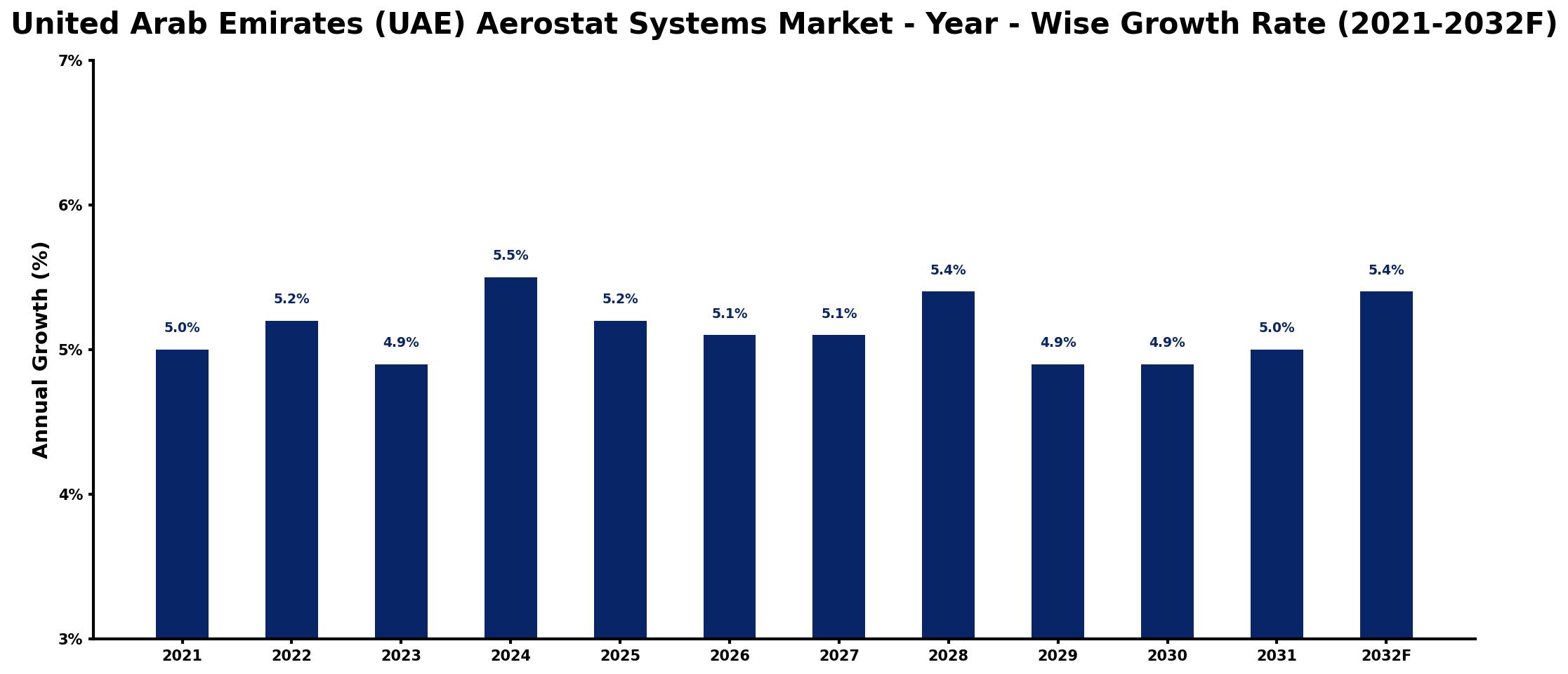
The table below presents the year‑wise growth rates along with the key drivers influencing the market
| Year | Growth Rate | Major Drivers |
| 2021 | 5.0% | Increased defense sector investments |
| 2022 | 5.2% | Growing surveillance and monitoring needs |
| 2023 | 4.9% | Rising demand for communication solutions |
| 2024 | 5.5% | Expansion of tourism and events |
| 2025 | 5.2% | Enhanced public safety initiatives |
| 2026 | 5.1% | Boost in research and development |
| 2027 | 5.1% | Emergence of smart city projects |
| 2028 | 5.4% | Adoption of innovative technology solutions |
| 2029 | 4.9% | Strengthening regional security collaborations |
| 2030 | 4.9% | Increase in environmental monitoring efforts |
| 2031 | 5.0% | Demand for disaster management tools |
| 2032 | 5.4% | Growth in commercial applications |
Note: Market size estimations and growth projections presented in this report are based on 6Wresearch's proprietary forecasting methodology, utilizing the latest available industry data, government publications, and primary research inputs.
United Arab Emirates (UAE) Aerostat Systems Market Synopsis
The UAE aerostat systems market is on a notable upward trajectory, driven largely by the nation's commitment to incorporating cutting-edge technologies in its defense operations. Aerostats, serving as a critical component of the surveillance arsenal, offer robust capabilities for monitoring extensive borders and vital assets. Their utility in providing persistent aerial coverage is revolutionizing traditional surveillance methods.
As the region faces diverse security challenges, the importance of aerostat systems continues to rise. The integration of these systems not only enhances situational awareness but also enables timely response to threats, aligning with the UAE's broader defense strategy. The emphasis on state-of-the-art surveillance capabilities positions the UAE as a leader in adopting innovative defense solutions.
United Arab Emirates (UAE) Aerostat Systems Market Key Takeaways
- The market reflects the UAE's dedication to national security through advanced aerostat systems.
- Strong growth anticipated in surveillance and border security applications.
- Technological advancements are pivotal to maintaining competitiveness in the aerostat market.
- Government initiatives and strategic investments are driving market demand.
- Despite challenges, the potential for growth remains robust in the face of evolving threats.
Evaluation of Restraints in United Arab Emirates (UAE) Aerostat Systems Market
While the UAE aerostat systems market presents compelling opportunities, several factors may inhibit its full potential. The rapid pace of technological innovation in aerial surveillance necessitates continuous investment in research and development from manufacturers. This can strain budgets, particularly in an environment where defense spending is carefully scrutinized. Moreover, there are inherent complexities associated with integrating new technologies into existing defense frameworks, which may cause delays and operational challenges. Addressing these constraints is vital for players looking to thrive in this evolving market.
United Arab Emirates (UAE) Aerostat Systems Market Trends
The UAE aerostat systems market is witnessing significant trends that are reshaping its landscape. Notably, there is a growing integration of artificial intelligence and machine learning technologies, which are enhancing surveillance capabilities and data processing efficiency. Furthermore, an increase in public-private partnerships is facilitating innovation and investment, enabling quicker deployment of advanced systems. As regional conflicts and security threats continue to evolve, the demand for versatile and adaptive aerostat solutions is expected to intensify, driving market growth.
United Arab Emirates (UAE) Aerostat Systems Market Opportunities
The market presents numerous growth and investment opportunities, particularly in the realm of government contracts and public sector initiatives focused on national security. As the UAE expands its defense procurement strategies, there is a palpable opportunity for industry players to collaborate on innovative projects. Additionally, the rising interest in dual-use technologies—capable of serving both civilian and military applications—offers avenues for market diversification. Fostering strong relationships with government entities will be crucial for stakeholders aiming to capitalize on these emerging prospects.
Government Initiatives in the United Arab Emirates (UAE) Aerostat Systems Market
The UAE government has prioritized defense modernization as part of its broader strategic vision. Significant public spending is being directed towards enhancing surveillance capabilities, with aerostat systems featuring prominently in this agenda. Government-led programs aim to encourage local innovation and technology transfer, incentivizing partnerships with established defense manufacturers. These initiatives not only aim to strengthen national security but also support the development of a sustainable defense ecosystem within the UAE.
Future Insights of the United Arab Emirates (UAE) Aerostat Systems Market
Looking ahead to 2026-2032, the UAE aerostat systems market is poised for significant advancement as national security demands evolve. The anticipated growth will be driven by advancements in aerostat technology, particularly in terms of endurance, payload capacity, and operational flexibility. Increased government investment in defense procurement, coupled with a focus on integrating next-generation technologies, will set the stage for sustained market expansion. As geopolitical challenges continue to prompt a reevaluation of defense strategies, aerostat systems will play an increasingly vital role in securing the UAE's borders and assets.
United Arab Emirates (UAE) Aerostat Systems Market Latest Developments (2025 - 2026)
Recent developments in the UAE aerostat systems market indicate a shift towards more advanced surveillance solutions, with a notable focus on enhancing capabilities for real-time data collection and analysis. There is growing collaboration between local and international firms to innovate and tailor solutions that meet specific defense needs. Additionally, the integration of renewable energy sources into aerostat operations is gaining traction, reflecting a broader commitment to sustainable practices in defense technology.
United Arab Emirates (UAE) Aerostat Systems Market - Key Attractiveness of the Report
- 10 Years of Market Numbers
- Historical Data Starting from 2022 to 2025
- Base Year: 2025
- Forecast Data until 2032
- Key Performance Indicators Impacting the Market
- Major Upcoming Developments and Projects
Key Highlights of the Report:
- United Arab Emirates (UAE) Aerostat Systems Market Outlook
- Market Size of United Arab Emirates (UAE) Aerostat Systems Market, 2025
- Forecast of United Arab Emirates (UAE) Aerostat Systems Market, 2032
- Historical Data and Forecast of United Arab Emirates (UAE) Aerostat Systems Revenues & Volume for the Period 2022-2032F
- United Arab Emirates (UAE) Aerostat Systems Market Trend Evolution
- United Arab Emirates (UAE) Aerostat Systems Market Drivers and Challenges
- United Arab Emirates (UAE) Aerostat Systems Price Trends
- United Arab Emirates (UAE) Aerostat Systems Porter's Five Forces
- United Arab Emirates (UAE) Aerostat Systems Industry Life Cycle
- Historical Data and Forecast of United Arab Emirates (UAE) Aerostat Systems Market Revenues & Volume By Product Type for the Period 2022-2032F
- Historical Data and Forecast of United Arab Emirates (UAE) Aerostat Systems Market Revenues & Volume By Balloon for the Period 2022-2032F
- Historical Data and Forecast of United Arab Emirates (UAE) Aerostat Systems Market Revenues & Volume By Airship for the Period 2022-2032F
- Historical Data and Forecast of United Arab Emirates (UAE) Aerostat Systems Market Revenues & Volume By Hybrid for the Period 2022-2032F
- Historical Data and Forecast of United Arab Emirates (UAE) Aerostat Systems Market Revenues & Volume By Propulsion System for the Period 2022-2032F
- Historical Data and Forecast of United Arab Emirates (UAE) Aerostat Systems Market Revenues & Volume By Powered for the Period 2022-2032F
- Historical Data and Forecast of United Arab Emirates (UAE) Aerostat Systems Market Revenues & Volume By Unpowered for the Period 2022-2032F
- Historical Data and Forecast of United Arab Emirates (UAE) Aerostat Systems Market Revenues & Volume By Class for the Period 2022-2032F
- Historical Data and Forecast of United Arab Emirates (UAE) Aerostat Systems Market Revenues & Volume By Compact-sized for the Period 2022-2032F
- Historical Data and Forecast of United Arab Emirates (UAE) Aerostat Systems Market Revenues & Volume By Mid-sized for the Period 2022-2032F
- Historical Data and Forecast of United Arab Emirates (UAE) Aerostat Systems Market Revenues & Volume By Large Sized for the Period 2022-2032F
- Historical Data and Forecast of United Arab Emirates (UAE) Aerostat Systems Market Revenues & Volume By Payload for the Period 2022-2032F
- Historical Data and Forecast of United Arab Emirates (UAE) Aerostat Systems Market Revenues & Volume By Electro-optic/infrared Sensors for the Period 2022-2032F
- Historical Data and Forecast of United Arab Emirates (UAE) Aerostat Systems Market Revenues & Volume By Communication Intelligence for the Period 2022-2032F
- Historical Data and Forecast of United Arab Emirates (UAE) Aerostat Systems Market Revenues & Volume By Cameras for the Period 2022-2032F
- Historical Data and Forecast of United Arab Emirates (UAE) Aerostat Systems Market Revenues & Volume By Electronic Intelligence for the Period 2022-2032F
- Historical Data and Forecast of United Arab Emirates (UAE) Aerostat Systems Market Revenues & Volume By Surveillance Radar for the Period 2022-2032F
- Historical Data and Forecast of United Arab Emirates (UAE) Aerostat Systems Market Revenues & Volume By Inertial Navigation System for the Period 2022-2032F
- United Arab Emirates (UAE) Aerostat Systems Import Export Trade Statistics
- Market Opportunity Assessment By Product Type
- Market Opportunity Assessment By Propulsion System
- Market Opportunity Assessment By Class
- Market Opportunity Assessment By Payload
- United Arab Emirates (UAE) Aerostat Systems Top Companies Market Share
- United Arab Emirates (UAE) Aerostat Systems Competitive Benchmarking By Technical and Operational Parameters
- United Arab Emirates (UAE) Aerostat Systems Company Profiles
- United Arab Emirates (UAE) Aerostat Systems Key Strategic Recommendations






































