United Arab Emirates (UAE) Air Traffic Control (ATC) Equipment Market Size, Share & Growth Rate
The United Arab Emirates (UAE) Air Traffic Control (ATC) Equipment Market was estimated at USD 810 Million in 2025 and is projected to reach USD 1434 Million by 2032, growing at a CAGR of 8.5% from 2026 to 2032. This impressive growth trajectory is largely driven by the UAE's commitment to enhancing its aviation infrastructure, evident in the expansion of existing airports and the development of new facilities to cater to an increasingly global air travel demand. Additionally, as air traffic volume rises, the urgent need for advanced ATC systems becomes critical in ensuring safety and operational efficiency within the region's busy airspace.
United Arab Emirates (UAE) Air Traffic Control (ATC) Equipment Market Year-wise Growth Rate and Key Drivers
This graph highlights how the United Arab Emirates (UAE) Air Traffic Control (ATC) Equipment Market has steadily grown over the years, supported by major growth factors.
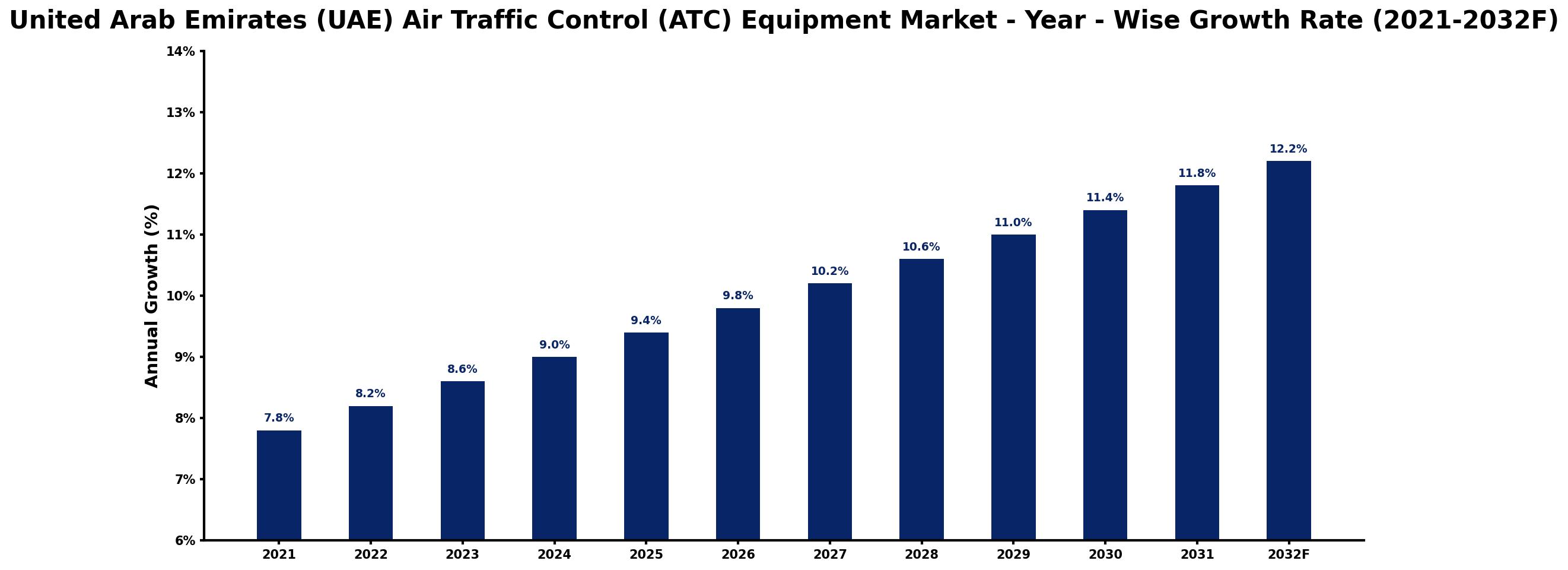
The table below presents the year‑wise growth rates along with the key drivers influencing the market
| Year | Growth Rate | Major Drivers |
| 2021 | 7.8% | Rising demand for aviation services |
| 2022 | 8.2% | Government investments in infrastructure |
| 2023 | 8.6% | growing automotive sector requirements |
| 2024 | 9.0% | Technological advancements in navigation |
| 2025 | 9.4% | Increased passenger travel expectations |
| 2026 | 9.8% | stronger distribution network expansion |
| 2027 | 10.2% | Growing focus on safety standards |
| 2028 | 10.6% | Emerging markets boosting connectivity |
| 2029 | 11.0% | Sustainability initiatives gaining traction |
| 2030 | 11.4% | Partnerships enhancing operational efficiency |
| 2031 | 11.8% | Digital transformation of aviation processes |
| 2032 | 12.2% | Global tourism recovery driving growth |
Note: Market size estimations and growth projections presented in this report are based on 6Wresearch's proprietary forecasting methodology, utilizing the latest available industry data, government publications, and primary research inputs.
United Arab Emirates (UAE) Air Traffic Control (ATC) Equipment Market Synopsis
The UAE serves as a pivotal hub for international air travel, making its air traffic control systems essential for safe and efficient operations. The ongoing modernization of ATC equipment is a response to the rapid evolution of air travel and the growing complexity of airspace management in the region. Enhanced technologies are being embraced to maintain the highest standards of safety and efficiency.
Recent investments in ATC infrastructure reflect not only technological advancements but also a strategic push to accommodate future air traffic demands. With increased passenger numbers and cargo flights, the UAE's ATC equipment market is positioned for robust growth as stakeholders seek innovative solutions to handle evolving air traffic scenarios.
United Arab Emirates (UAE) Air Traffic Control (ATC) Equipment Market Key Takeaways
- The UAE ATC equipment market is experiencing significant growth, driven by increased air travel and airport expansions.
- Technological advancements play a crucial role in enhancing air traffic management efficiency and safety.
- COVID-19 prompted a reevaluation of ATC strategies, emphasizing adaptability and improved resource management.
- Geopolitical dynamics in the region may influence operational strategies in airspace management.
- Leading companies in the ATC equipment sector are focused on providing state-of-the-art solutions for future demands.
Evaluation of Restraints in United Arab Emirates (UAE) Air Traffic Control (ATC) Equipment Market
Despite its growth prospects, the UAE Air Traffic Control equipment market faces notable challenges. Rapidly increasing air traffic poses significant pressures on existing infrastructure, necessitating large-scale investments in new technologies and systems to ensure operational safety. Compliance with international aviation regulations further complicates the landscape, as stakeholders must continuously adapt to evolving standards. Additionally, regional geopolitical tensions may impact collaborative airspace management efforts, adding another layer of complexity to market dynamics.
United Arab Emirates (UAE) Air Traffic Control (ATC) Equipment Market Trends
A key trend shaping the UAE ATC equipment market is the increasing adoption of automated and AI-driven solutions. These technologies promise to enhance decision-making processes and improve overall efficiency in air traffic management. Moreover, a shift towards integrated systems is gaining traction, allowing for seamless communication between various stakeholders in aviation. Additionally, there is a growing focus on sustainability, with advancements aimed at reducing the environmental impact of air traffic operations.
United Arab Emirates (UAE) Air Traffic Control (ATC) Equipment Market Opportunities
The UAE's ambitious plans for expanding its aviation sector present a wealth of opportunities in the ATC equipment market. Investments in smart technology can lead to more efficient airspace utilization and improved safety measures. Furthermore, as more global airlines establish routes in the UAE, there will be increasing demand for high-quality ATC systems. Public-private partnerships may also emerge as a crucial avenue for funding innovative projects aimed at modernizing air traffic management systems.
Government Initiatives in the United Arab Emirates (UAE) Air Traffic Control (ATC) Equipment Market
The UAE government has made significant strides in enhancing its aviation framework, emphasizing safety and efficiency in air traffic management. Initiatives include substantial public investments in airport infrastructure and ATC systems, supporting the development of cutting-edge technologies. Additionally, policies promoting cooperation with international aviation bodies aim to ensure compliance with global standards, fostering an environment that encourages innovation and improvement in air traffic control.
Future Insights of the United Arab Emirates (UAE) Air Traffic Control (ATC) Equipment Market
Looking ahead to the period of 2026-2032, the UAE Air Traffic Control equipment market is poised for transformative growth. The increasing volume of air traffic, combined with a commitment to technological innovation, will drive the sector forward. As stakeholders embrace advancements in automation and integrated systems, the focus will remain on enhancing operational efficiency and ensuring passenger safety. The strategic plans to further expand airport capacities will also contribute to a favorable environment for investment and growth.
United Arab Emirates (UAE) Air Traffic Control (ATC) Equipment Market Latest Developments (2025 - 2026)
In the recent months, the UAE ATC equipment market has witnessed a surge in interest towards next-generation radar systems and surveillance technology. Various stakeholders are exploring collaborative initiatives aimed at fostering innovation and improving air traffic management practices. Furthermore, discussions are underway regarding the integration of AI solutions within existing frameworks, signaling a shift towards more adaptive and responsive ATC capabilities to meet rising demands.
United Arab Emirates (UAE) Air Traffic Control (ATC) Equipment Market - Key Attractiveness of the Report
- 10 Years of Market Numbers
- Historical Data Starting from 2022 to 2025
- Base Year: 2025
- Forecast Data until 2032
- Key Performance Indicators Impacting the Market
- Major Upcoming Developments and Projects
Key Highlights of the Report:
- United Arab Emirates (UAE) Air Traffic Control (ATC) Equipment Market Outlook
- Market Size of United Arab Emirates (UAE) Air Traffic Control (ATC) Equipment Market, 2025
- Forecast of United Arab Emirates (UAE) Air Traffic Control (ATC) Equipment Market, 2032
- Historical Data and Forecast of United Arab Emirates (UAE) Air Traffic Control (ATC) Equipment Revenues & Volume for the Period 2022-2032F
- United Arab Emirates (UAE) Air Traffic Control (ATC) Equipment Market Trend Evolution
- United Arab Emirates (UAE) Air Traffic Control (ATC) Equipment Market Drivers and Challenges
- United Arab Emirates (UAE) Air Traffic Control (ATC) Equipment Price Trends
- United Arab Emirates (UAE) Air Traffic Control (ATC) Equipment Porter's Five Forces
- United Arab Emirates (UAE) Air Traffic Control (ATC) Equipment Industry Life Cycle
- Historical Data and Forecast of United Arab Emirates (UAE) Air Traffic Control (ATC) Equipment Market Revenues & Volume By Product for the Period 2022-2032F
- Historical Data and Forecast of United Arab Emirates (UAE) Air Traffic Control (ATC) Equipment Market Revenues & Volume By Communications Equipment for the Period 2022-2032F
- Historical Data and Forecast of United Arab Emirates (UAE) Air Traffic Control (ATC) Equipment Market Revenues & Volume By Navigation Equipment for the Period 2022-2032F
- Historical Data and Forecast of United Arab Emirates (UAE) Air Traffic Control (ATC) Equipment Market Revenues & Volume By Surveillance Equipment for the Period 2022-2032F
- Historical Data and Forecast of United Arab Emirates (UAE) Air Traffic Control (ATC) Equipment Market Revenues & Volume By Air Traffic Control Equipment Application Outlook (USD Million, 2023-2032) for the Period 2022-2032F
- Historical Data and Forecast of United Arab Emirates (UAE) Air Traffic Control (ATC) Equipment Market Revenues & Volume By Commercial Aircraft for the Period 2022-2032F
- Historical Data and Forecast of United Arab Emirates (UAE) Air Traffic Control (ATC) Equipment Market Revenues & Volume By Private Aircraft for the Period 2022-2032F
- Historical Data and Forecast of United Arab Emirates (UAE) Air Traffic Control (ATC) Equipment Market Revenues & Volume By Military Aircraft for the Period 2022-2032F
- United Arab Emirates (UAE) Air Traffic Control (ATC) Equipment Import Export Trade Statistics
- Market Opportunity Assessment By Product
- United Arab Emirates (UAE) Air Traffic Control (ATC) Equipment Top Companies Market Share
- United Arab Emirates (UAE) Air Traffic Control (ATC) Equipment Competitive Benchmarking By Technical and Operational Parameters
- United Arab Emirates (UAE) Air Traffic Control (ATC) Equipment Company Profiles
- United Arab Emirates (UAE) Air Traffic Control (ATC) Equipment Key Strategic Recommendations






































