United Arab Emirates (UAE) Aluminium Mesh Market Size, Share & Growth Rate
The United Arab Emirates (UAE) Aluminium Mesh Market was estimated at USD 253 Million in 2025 and is projected to reach USD 336 Million by 2032, growing at a CAGR of 4.1% from 2026 to 2032. This growth is primarily fueled by the ongoing expansion in construction and infrastructure projects across the UAE, driven by both public and private sector investments. As urban development accelerates, the demand for aluminium mesh in safety, decoration, and utility applications continues to increase.
United Arab Emirates (UAE) Aluminium Mesh Market Year-wise Growth Rate and Key Drivers
This graph highlights how the United Arab Emirates (UAE) Aluminium Mesh Market has steadily grown over the years, supported by major growth factors.
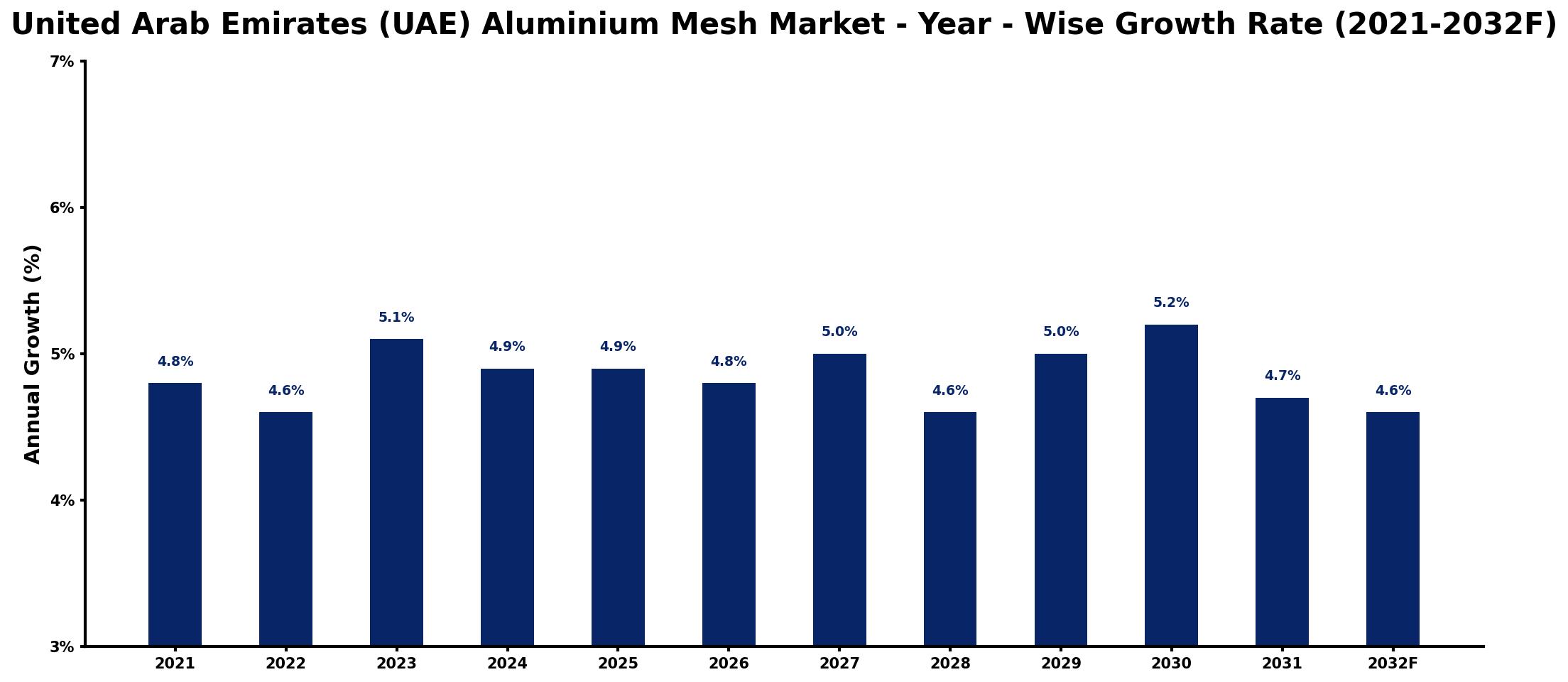
The table below presents the year‑wise growth rates along with the key drivers influencing the market
| Year | Growth Rate | Major Drivers |
| 2021 | 4.8% | Construction sector expansion initiatives |
| 2022 | 4.6% | Infrastructure projects driving demand |
| 2023 | 5.1% | Growing urbanization increasing requirements |
| 2024 | 4.9% | Rising energy efficiency regulations |
| 2025 | 4.9% | Increased investments in construction |
| 2026 | 4.8% | Technological advancements in production |
| 2027 | 5.0% | Sustainable building practices adoption |
| 2028 | 4.6% | Diversification of industrial applications |
| 2029 | 5.0% | Infrastructure upgrades for modernization |
| 2030 | 5.2% | Heightened focus on lightweight materials |
| 2031 | 4.7% | Emerging markets enhancing consumption |
| 2032 | 4.6% | Government initiatives promoting innovation |
Note: Market size estimations and growth projections presented in this report are based on 6Wresearch's proprietary forecasting methodology, utilizing the latest available industry data, government publications, and primary research inputs.
United Arab Emirates (UAE) Aluminium Mesh Market Synopsis
In the UAE, aluminium mesh is rapidly becoming a staple in various sectors, particularly construction, architecture, and interior design. Its inherent qualities of strength, lightweight, and corrosion resistance make it an ideal choice for a range of applications from fencing to filtration systems.
Recent trends show a growing preference for aesthetically pleasing designs alongside functional elements. As such, local manufacturers are innovating to cater to the evolving needs of designers and builders, ensuring that the UAE Aluminium Mesh Market remains competitive and forward-thinking.
United Arab Emirates (UAE) Aluminium Mesh Market Key Takeaways
- Robust growth driven by extensive construction and infrastructure development.
- Increasing demand for aesthetically versatile aluminium mesh in architecture and design.
- Competitive landscape challenged by alternatives like steel and synthetic materials.
- Significant opportunities for innovation to meet evolving consumer needs.
- Influence of fluctuating global aluminium prices on market stability.
Evaluation of Restraints in United Arab Emirates (UAE) Aluminium Mesh Market
The growth of the UAE aluminium mesh market is not without its challenges. One of the primary restraints is the fierce competition posed by alternative materials, such as steel and various synthetic polymers, which often provide comparable strength at a lower cost. Furthermore, global fluctuations in aluminium prices can create uncertainties for manufacturers, impacting their pricing strategies and profit margins. Additionally, navigating the complex landscape of regulatory requirements regarding environmental impact and recycling practices can also present hurdles. Manufacturers must consistently innovate to stay relevant and address the dynamic demands of consumers, adding another layer of complexity to the market's growth trajectory.
United Arab Emirates (UAE) Aluminium Mesh Market Trends
Several trends are shaping the UAE aluminium mesh market, including a rising preference for eco-friendly materials and practices. With sustainability becoming a focal point for many industries, manufacturers are increasingly exploring ways to enhance the recyclability of their products. Additionally, technological advancements in mesh production processes are leading to improved quality and reduced costs. The integration of aluminium mesh in modern architectural designs is also on the rise, with designers incorporating it not just for function but also for visual appeal.
United Arab Emirates (UAE) Aluminium Mesh Market Opportunities
The UAE aluminium mesh market presents numerous growth and investment opportunities. As urbanization accelerates, the demand for high-quality, versatile materials in construction and design will continue to rise. Innovations in product development, particularly in custom designs and specialty applications, can also open up new revenue streams for manufacturers. Additionally, expanding into sectors such as renewable energy and environmental solutions offers potential avenues for market expansion.
Government Initiatives in the United Arab Emirates (UAE) Aluminium Mesh Market
The UAE government is actively promoting infrastructure development through various initiatives and investments, creating a favorable environment for the aluminium mesh market. Policies encouraging sustainable construction practices and investments in modern architectural projects further bolster demand. Moreover, public spending on large-scale infrastructure and community projects remains a critical driver for the continued growth of the aluminium mesh sector.
Future Insights of the United Arab Emirates (UAE) Aluminium Mesh Market
Looking ahead to the period from 2026 to 2032, the UAE aluminium mesh market is expected to thrive as construction activities ramp up and innovative applications expand. A heightened focus on design and sustainability will likely propel the introduction of advanced products, positioning manufacturers to capitalize on emerging opportunities. As technology continues to evolve, the market is poised for significant transformation, ensuring its relevance in the face of changing consumer demands.
United Arab Emirates (UAE) Aluminium Mesh Market Latest Developments (2025 - 2026)
Recent developments in the UAE aluminium mesh market indicate a trend towards increased collaboration between manufacturers and technology providers. This collaboration is focused on developing innovative mesh products that meet both aesthetic and functional requirements. Additionally, there has been a notable uptick in projects integrating advanced filtration systems, leveraging aluminium mesh for improved efficiency and effectiveness. Overall, the market is adapting to changing demands, showcasing resilience amid ongoing challenges.
United Arab Emirates (UAE) Aluminium Mesh Market - Key Attractiveness of the Report
- 10 Years of Market Numbers
- Historical Data Starting from 2022 to 2025
- Base Year: 2025
- Forecast Data until 2032
- Key Performance Indicators Impacting the Market
- Major Upcoming Developments and Projects
Key Highlights of the Report:
- United Arab Emirates (UAE) Aluminium Mesh Market Outlook
- Market Size of United Arab Emirates (UAE) Aluminium Mesh Market, 2025
- Forecast of United Arab Emirates (UAE) Aluminium Mesh Market, 2032
- Historical Data and Forecast of United Arab Emirates (UAE) Aluminium Mesh Revenues & Volume for the Period 2022-2032F
- United Arab Emirates (UAE) Aluminium Mesh Market Trend Evolution
- United Arab Emirates (UAE) Aluminium Mesh Market Drivers and Challenges
- United Arab Emirates (UAE) Aluminium Mesh Price Trends
- United Arab Emirates (UAE) Aluminium Mesh Porter's Five Forces
- United Arab Emirates (UAE) Aluminium Mesh Industry Life Cycle
- Historical Data and Forecast of United Arab Emirates (UAE) Aluminium Mesh Market Revenues & Volume By Type for the Period 2022-2032F
- Historical Data and Forecast of United Arab Emirates (UAE) Aluminium Mesh Market Revenues & Volume By Stretched Aluminum Mesh for the Period 2022-2032F
- Historical Data and Forecast of United Arab Emirates (UAE) Aluminium Mesh Market Revenues & Volume By Wavy Aluminum Mesh for the Period 2022-2032F
- Historical Data and Forecast of United Arab Emirates (UAE) Aluminium Mesh Market Revenues & Volume By Other for the Period 2022-2032F
- Historical Data and Forecast of United Arab Emirates (UAE) Aluminium Mesh Market Revenues & Volume By Application for the Period 2022-2032F
- Historical Data and Forecast of United Arab Emirates (UAE) Aluminium Mesh Market Revenues & Volume By Aerospace for the Period 2022-2032F
- Historical Data and Forecast of United Arab Emirates (UAE) Aluminium Mesh Market Revenues & Volume By Vehicle for the Period 2022-2032F
- Historical Data and Forecast of United Arab Emirates (UAE) Aluminium Mesh Market Revenues & Volume By Ship for the Period 2022-2032F
- Historical Data and Forecast of United Arab Emirates (UAE) Aluminium Mesh Market Revenues & Volume By Electronic Device for the Period 2022-2032F
- Historical Data and Forecast of United Arab Emirates (UAE) Aluminium Mesh Market Revenues & Volume By Other for the Period 2022-2032F
- United Arab Emirates (UAE) Aluminium Mesh Import Export Trade Statistics
- Market Opportunity Assessment By Type
- Market Opportunity Assessment By Application
- United Arab Emirates (UAE) Aluminium Mesh Top Companies Market Share
- United Arab Emirates (UAE) Aluminium Mesh Competitive Benchmarking By Technical and Operational Parameters
- United Arab Emirates (UAE) Aluminium Mesh Company Profiles
- United Arab Emirates (UAE) Aluminium Mesh Key Strategic Recommendations






































