United Arab Emirates (UAE) Anise Seed Market Size, Share & Growth Rate
The United Arab Emirates (UAE) Anise Seed Market was estimated at USD 1295 Million in 2025 and is projected to reach USD 1855 Million by 2032, growing at a CAGR of 5.3% from 2026 to 2032. This promising trajectory is largely fueled by the region's rich culinary heritage and the increasing interest in wellness trends, including herbal remedies. As consumers increasingly prioritize unique flavor profiles and health benefits in their dietary choices, anise seeds are becoming a staple ingredient in both traditional and contemporary recipes throughout the UAE.
United Arab Emirates (UAE) Anise Seed Market Growth Rate Analysis (2021-2032)
The Anise Seed market in the UAE has demonstrated resilience with a stable growth average, registering 6.5% in 2021, followed by a slight decline to 5.9% in 2022. The market rebounded to 6.1% in 2023 and is expected to maintain this rate through 2024 and 2025. Factors such as increasing consumer demand, particularly in the food and beverage sector, have driven expansion. Moreover, investments in agricultural technology are enhancing productivity and sustainability. The growth rate is projected to fluctuate slightly, reaching 6.5% in 2026 before settling at around 6.0% by 2029. The steady interest in health and wellness products, coupled with supportive government policies, fortifies this market's outlook.
United Arab Emirates (UAE) Anise Seed Market Year-wise Growth Rate and Key Drivers
This graph highlights how the United Arab Emirates (UAE) Anise Seed Market has steadily grown over the past five years, supported by major growth factors.
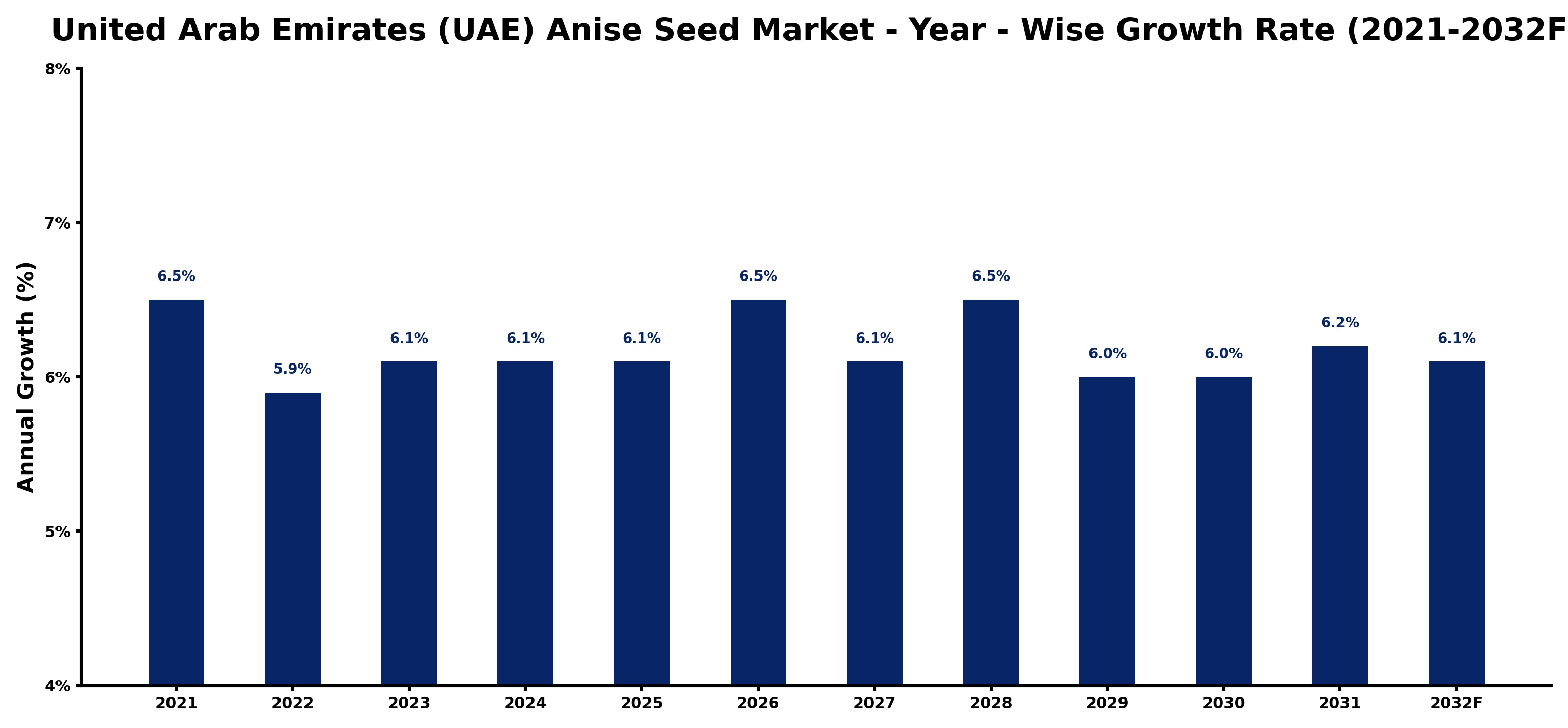
The table below presents the year‑wise growth rates along with the key drivers influencing the market
| Year | Growth Rate | Major Drivers |
| 2021 | 6.5% | Rising health awareness among consumers |
| 2022 | 5.9% | Culinary diversity enhanced market demand |
| 2023 | 6.1% | E-commerce growth expanded reach |
| 2024 | 6.1% | Increased export opportunities emerged |
| 2025 | 6.1% | Organic product popularity surged |
| 2026 | 6.5% | Cultural festivals promoted usage |
| 2027 | 6.1% | Innovative product development attracted interest |
| 2028 | 6.5% | Sustainable sourcing gained traction |
| 2029 | 6.0% | Consumer education improved product knowledge |
| 2030 | 6.0% | New culinary trends influenced preferences |
| 2031 | 6.2% | Increased food safety regulations enforced |
| 2032 | 6.1% | Collaboration with local farmers strengthened |
Note - Market size estimations and growth projections presented in this report are based on 6Wresearch's advanced forecasting approach, validated with industry datasets as of June 2026.
United Arab Emirates (UAE) Anise Seed Market Synopsis
Currently, the UAE anise seed market is witnessing a surge in popularity, driven by the nation's multicultural demographic and its robust culinary scene. The distinct licorice-like flavor of anise seeds is resonating with a diverse array of consumers, enhancing their appeal across both traditional Emirati dishes and international cuisines.
Additionally, the market is benefitting from the growing trend towards natural and herbal products. With an increasing number of consumers opting for herbal teas and health-focused beverages, anise seeds are being embraced not only for their unique taste but also for their potential wellness benefits, further solidifying their place in the market.
United Arab Emirates (UAE) Anise Seed Market Key Takeaways
- Strong growth trajectory driven by culinary diversity and wellness trends.
- Increasing consumer interest in unique and aromatic flavor profiles.
- Expansion in the use of anise seeds for herbal teas and natural remedies.
- Robust demand from both households and the food & beverage industry.
- Opportunities arising from multicultural influences shaping food preferences.
Evaluation of Restraints in United Arab Emirates (UAE) Anise Seed Market
While the UAE anise seed market displays significant potential, several restraints could impede its growth. A primary concern revolves around the consistent supply and quality of anise seeds, which is vital for meeting the increasing consumer demand. Additionally, the challenge of sourcing sustainable, high-quality seeds is critical, as consumers become more conscious of the origins of their food. Furthermore, educating the market about the versatile applications of anise seeds remains essential for businesses aiming to expand their customer base.
United Arab Emirates (UAE) Anise Seed Market Trends
Emerging trends in the UAE anise seed market include a heightened focus on health and wellness, with consumers gravitating towards products that promote well-being. This shift is catalyzing a demand for herbal remedies and natural ingredients, leading to the increased use of anise seeds in teas and health-focused snacks. Additionally, culinary experimentation is on the rise, with chefs and home cooks alike looking to incorporate unique flavors into their dishes, further driving the use of anise seeds in innovative ways.
United Arab Emirates (UAE) Anise Seed Market Opportunities
The growth of the UAE anise seed market presents numerous investment opportunities. Companies can capitalize on the rising trend of health and wellness by developing new products that feature anise seeds as a key ingredient. Furthermore, enhancing consumer education through workshops and cooking classes can create a deeper appreciation for the versatility of anise seeds, opening doors for increased sales across both retail and culinary sectors. Additionally, establishing reliable sourcing channels for high-quality seeds could strengthen market positioning.
Government Initiatives in the United Arab Emirates (UAE) Anise Seed Market
The UAE government has been actively promoting agriculture and sustainability initiatives that could benefit the anise seed market. Programs aimed at enhancing local farming practices and ensuring food security provide a favorable environment for the growth of spice markets. Additionally, initiatives designed to encourage the use of traditional herbs in modern cuisine align with current trends, thus fostering greater consumer awareness and engagement with products like anise seeds.
Future Insights of the United Arab Emirates (UAE) Anise Seed Market
Looking ahead to 2026-2032, the UAE anise seed market is poised for substantial growth. Increasing globalization will continue to influence consumer tastes, leading to greater experimentation with international flavors in local cuisines. Additionally, the ongoing health and wellness movement is likely to sustain the demand for natural ingredients like anise seeds, thereby positioning them as a staple in both household kitchens and commercial establishments. As innovation in product offerings unfolds, stakeholders can expect a dynamic and evolving market landscape.
United Arab Emirates (UAE) Anise Seed Market Latest Developments (May 2025 - June 2026)
Recent developments within the UAE anise seed market highlight a significant uptick in product diversification. Companies are increasingly introducing innovative product lines featuring anise seeds, ranging from herbal infusions to culinary seasonings. Additionally, a noticeable rise in online platforms dedicated to selling specialty herbs and spices has emerged, reflecting shifting consumer buying habits post-Covid-19. This pivot towards e-commerce suggests that accessibility and convenience are becoming paramount for consumers seeking quality ingredients.
United Arab Emirates (UAE) Anise Seed Market - Key Attractiveness of the Report
- 10 Years of Market Numbers
- Historical Data Starting from 2022 to 2025
- Base Year: 2025
- Forecast Data until 2032
- Key Performance Indicators Impacting the Market
- Major Upcoming Developments and Projects
Key Highlights of the Report:
- United Arab Emirates (UAE) Anise Seed Market Outlook
- Market Size of United Arab Emirates (UAE) Anise Seed Market, 2025
- Forecast of United Arab Emirates (UAE) Anise Seed Market, 2032F
- Historical Data and Forecast of United Arab Emirates (UAE) Anise Seed Revenues & Volume for the Period 2022-2032F
- United Arab Emirates (UAE) Anise Seed Market Trend Evolution
- United Arab Emirates (UAE) Anise Seed Market Drivers and Challenges
- United Arab Emirates (UAE) Anise Seed Price Trends
- United Arab Emirates (UAE) Anise Seed Porter's Five Forces
- United Arab Emirates (UAE) Anise Seed Industry Life Cycle
- Historical Data and Forecast of United Arab Emirates (UAE) Anise Seed Market Revenues & Volume By Form for the Period 2022-2032F
- Historical Data and Forecast of United Arab Emirates (UAE) Anise Seed Market Revenues & Volume By Whole for the Period 2022-2032F
- Historical Data and Forecast of United Arab Emirates (UAE) Anise Seed Market Revenues & Volume By Ground for the Period 2022-2032F
- Historical Data and Forecast of United Arab Emirates (UAE) Anise Seed Market Revenues & Volume By Oil for the Period 2022-2032F
- Historical Data and Forecast of United Arab Emirates (UAE) Anise Seed Market Revenues & Volume By Application for the Period 2022-2032F
- Historical Data and Forecast of United Arab Emirates (UAE) Anise Seed Market Revenues & Volume By Pharma for the Period 2022-2032F
- Historical Data and Forecast of United Arab Emirates (UAE) Anise Seed Market Revenues & Volume By Food and beverages for the Period 2022-2032F
- Historical Data and Forecast of United Arab Emirates (UAE) Anise Seed Market Revenues & Volume By Personal care & Cosmetic for the Period 2022-2032F
- Historical Data and Forecast of United Arab Emirates (UAE) Anise Seed Market Revenues & Volume By Others for the Period 2022-2032F
- Historical Data and Forecast of United Arab Emirates (UAE) Anise Seed Market Revenues & Volume By Distribution Channel for the Period 2022-2032F
- Historical Data and Forecast of United Arab Emirates (UAE) Anise Seed Market Revenues & Volume By Business to Business (B2B) for the Period 2022-2032F
- Historical Data and Forecast of United Arab Emirates (UAE) Anise Seed Market Revenues & Volume By Business to Consumers (B2C) for the Period 2022-2032F
- United Arab Emirates (UAE) Anise Seed Import Export Trade Statistics
- Market Opportunity Assessment By Form
- Market Opportunity Assessment By Application
- Market Opportunity Assessment By Distribution Channel
- United Arab Emirates (UAE) Anise Seed Top Companies Market Share
- United Arab Emirates (UAE) Anise Seed Competitive Benchmarking By Technical and Operational Parameters
- United Arab Emirates (UAE) Anise Seed Company Profiles
- United Arab Emirates (UAE) Anise Seed Key Strategic Recommendations






































