United Arab Emirates (UAE) Apparel Accessories Market Size, Share & Growth Rate
The United Arab Emirates (UAE) Apparel Accessories Market was estimated at USD 249 Million in 2025 and is projected to reach USD 333 Million by 2032, growing at a CAGR of 4.2% from 2026 to 2032. This robust growth trajectory is fueled by a burgeoning fashion-conscious population, an expanding retail landscape, and the UAE's unique position as a global fashion hub. Consumer preferences for high-quality, trendy accessories further bolster market demand, creating ample opportunities for both local and international brands.
United Arab Emirates (UAE) Apparel Accessories Market Year-wise Growth Rate and Key Drivers
This graph highlights how the United Arab Emirates (UAE) Apparel Accessories Market has steadily grown over the years, supported by major growth factors.
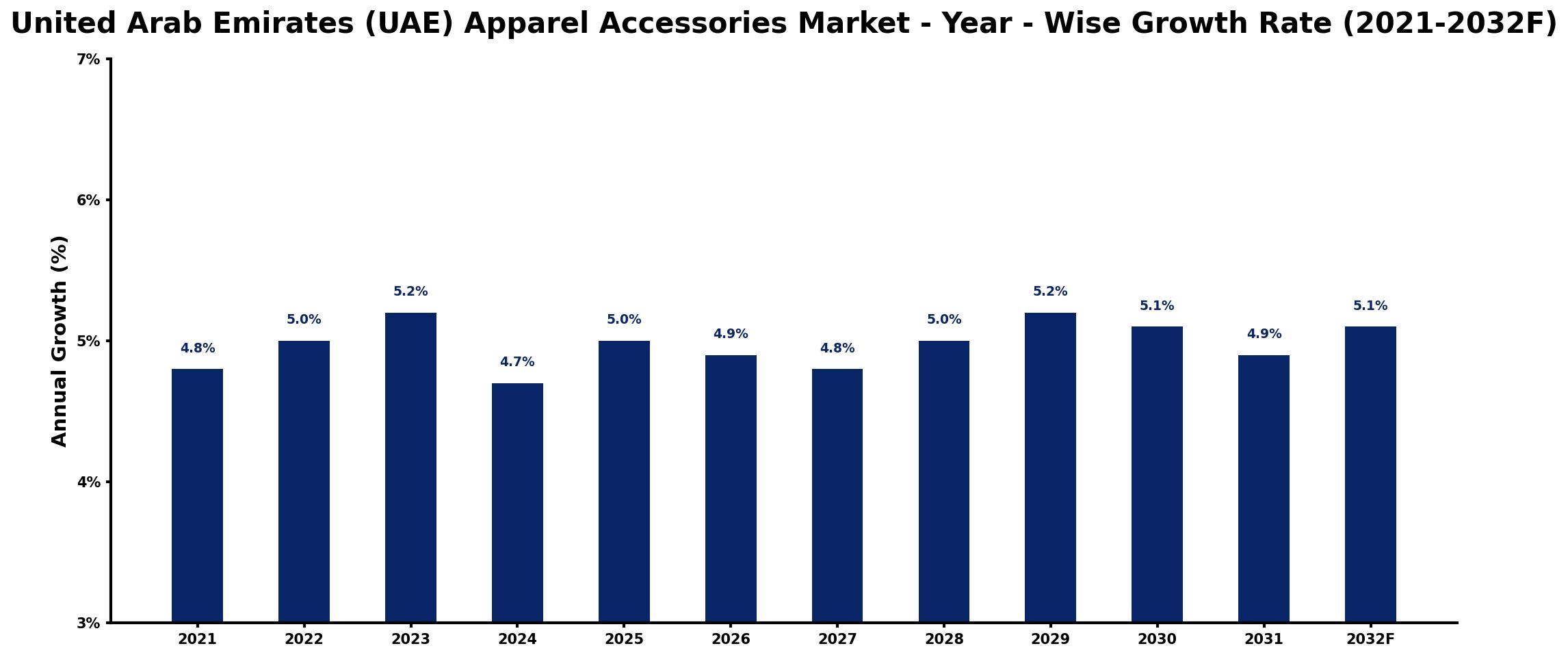
The table below presents the year‑wise growth rates along with the key drivers influencing the market
| Year | Growth Rate | Major Drivers |
| 2021 | 4.8% | Rising consumer spending trends |
| 2022 | 5.0% | E-commerce platform expansion growth |
| 2023 | 5.2% | Increased tourism and travel demand |
| 2024 | 4.7% | Growing local manufacturing capabilities |
| 2025 | 5.0% | Emergence of sustainability initiatives |
| 2026 | 4.9% | Technological advancements in production |
| 2027 | 4.8% | Youth demographic fashion influence |
| 2028 | 5.0% | Social media marketing effectiveness |
| 2029 | 5.2% | Global fashion trends adoption |
| 2030 | 5.1% | Investment in retail infrastructure |
| 2031 | 4.9% | Strengthened supply chain networks |
| 2032 | 5.1% | Collaborations with international brands |
Note: Market size estimations and growth projections presented in this report are based on 6Wresearch's proprietary forecasting methodology, utilizing the latest available industry data, government publications, and primary research inputs.
United Arab Emirates (UAE) Apparel Accessories Market Synopsis
At the heart of the UAE Apparel Accessories Market is its vibrant fashion scene, which draws inspiration from both local heritage and international trends. This rich cultural tapestry influences consumer behavior, leading to an insatiable appetite for diverse and stylish accessories that complement various outfits.
The market is characterized by an influx of both local talent and renowned international designers. This dynamic blend enriches the product offerings and ensures consumers can find accessories that resonate with their personal style, while also reflecting the UAE's cosmopolitan identity.
United Arab Emirates (UAE) Apparel Accessories Market Key Takeaways
- Fashion-conscious consumers are driving demand for a wide array of apparel accessories.
- The retail sector's growth plays a pivotal role in enhancing market accessibility and options.
- Local designers are gaining recognition, influencing trends and consumer preferences.
- E-commerce has become essential for reaching consumers post-COVID-19, shaping buying behaviors.
- Diverse consumer preferences necessitate a broad range of product offerings from market players.
Evaluation of Restraints in United Arab Emirates (UAE) Apparel Accessories Market
Despite its growth, the UAE Apparel Accessories Market faces significant restraints. Intense competition from established international brands compels local players to innovate continually. Moreover, the necessity to meet the diverse preferences of consumers complicates the product development process. Adapting to rapidly changing fashion trends while balancing quality and affordability remains a challenge that requires strategic foresight.
United Arab Emirates (UAE) Apparel Accessories Market Trends
Several trends are currently shaping the UAE Apparel Accessories Market. Sustainability is becoming increasingly important, with consumers seeking ethically produced items. Additionally, digitalization is influencing how consumers shop, with online platforms gaining traction alongside traditional retail outlets. The rise of social media influencers is also impacting purchasing decisions, as consumers look to align with contemporary styles promoted through these channels.
United Arab Emirates (UAE) Apparel Accessories Market Opportunities
The UAE Apparel Accessories Market offers various growth and investment opportunities. Capitalizing on e-commerce can unlock access to a broader consumer base, especially as online shopping continues to thrive. Furthermore, tapping into the demand for sustainable and locally sourced products can enhance brand loyalty and attract discerning customers. Collaborations with influential local designers may provide unique product offerings that resonate with the market's aspirations.
Government Initiatives in the United Arab Emirates (UAE) Apparel Accessories Market
The UAE government has undertaken various initiatives aimed at fostering the growth of the fashion industry, which includes the apparel accessories market. Programs to support local artisans and designers promote domestic talent, while policies encouraging foreign investment enhance the competitive landscape. Public spending on infrastructure and marketing for tourism also indirectly benefits retail and fashion sectors, creating a vibrant environment for accessories sales.
Future Insights of the United Arab Emirates (UAE) Apparel Accessories Market
Looking ahead to 2026-2032, the UAE Apparel Accessories Market is poised for significant evolution. As consumer awareness around sustainability grows, brands that prioritize eco-friendly practices are likely to gain a competitive edge. Moreover, the integration of technology in retail, such as augmented reality in online shopping experiences, will likely reshape consumer interactions. Ultimately, an increasingly diverse consumer base will drive innovation and expansion, solidifying the UAE's position as a global fashion destination.
United Arab Emirates (UAE) Apparel Accessories Market Latest Developments (2025 - 2026)
In recent months, the UAE Apparel Accessories Market has witnessed notable shifts driven by evolving consumer preferences. Increased emphasis on sustainability has prompted many brands to re-evaluate their supply chains and product offerings. Additionally, digital transformation initiatives have accelerated, with more brands investing in user-friendly online platforms and enhancing their social media presence to engage younger audiences effectively. Collaborative collections featuring local artists have also gained popularity, reflecting the unique cultural essence of the region.
United Arab Emirates (UAE) Apparel Accessories Market - Key Attractiveness of the Report
- 10 Years of Market Numbers
- Historical Data Starting from 2022 to 2025
- Base Year: 2025
- Forecast Data until 2032
- Key Performance Indicators Impacting the Market
- Major Upcoming Developments and Projects
Key Highlights of the Report:
- United Arab Emirates (UAE) Apparel Accessories Market Outlook
- Market Size of United Arab Emirates (UAE) Apparel Accessories Market, 2025
- Forecast of United Arab Emirates (UAE) Apparel Accessories Market, 2032
- Historical Data and Forecast of United Arab Emirates (UAE) Apparel Accessories Revenues & Volume for the Period 2022-2032F
- United Arab Emirates (UAE) Apparel Accessories Market Trend Evolution
- United Arab Emirates (UAE) Apparel Accessories Market Drivers and Challenges
- United Arab Emirates (UAE) Apparel Accessories Price Trends
- United Arab Emirates (UAE) Apparel Accessories Porter's Five Forces
- United Arab Emirates (UAE) Apparel Accessories Industry Life Cycle
- Historical Data and Forecast of United Arab Emirates (UAE) Apparel Accessories Market Revenues & Volume By Product for the Period 2022-2032F
- Historical Data and Forecast of United Arab Emirates (UAE) Apparel Accessories Market Revenues & Volume By Belts for the Period 2022-2032F
- Historical Data and Forecast of United Arab Emirates (UAE) Apparel Accessories Market Revenues & Volume By Handbags for the Period 2022-2032F
- Historical Data and Forecast of United Arab Emirates (UAE) Apparel Accessories Market Revenues & Volume By Scarves for the Period 2022-2032F
- Historical Data and Forecast of United Arab Emirates (UAE) Apparel Accessories Market Revenues & Volume By Eye wear for the Period 2022-2032F
- Historical Data and Forecast of United Arab Emirates (UAE) Apparel Accessories Market Revenues & Volume By Jewelry for the Period 2022-2032F
- Historical Data and Forecast of United Arab Emirates (UAE) Apparel Accessories Market Revenues & Volume By Neckties for the Period 2022-2032F
- Historical Data and Forecast of United Arab Emirates (UAE) Apparel Accessories Market Revenues & Volume By Gloves for the Period 2022-2032F
- Historical Data and Forecast of United Arab Emirates (UAE) Belts Apparel Accessories Market Revenues & Volume By Others for the Period 2022-2032F
- Historical Data and Forecast of United Arab Emirates (UAE) Apparel Accessories Market Revenues & Volume By Demographic for the Period 2022-2032F
- Historical Data and Forecast of United Arab Emirates (UAE) Apparel Accessories Market Revenues & Volume By Men for the Period 2022-2032F
- Historical Data and Forecast of United Arab Emirates (UAE) Apparel Accessories Market Revenues & Volume By Women for the Period 2022-2032F
- Historical Data and Forecast of United Arab Emirates (UAE) Apparel Accessories Market Revenues & Volume By Children for the Period 2022-2032F
- Historical Data and Forecast of United Arab Emirates (UAE) Apparel Accessories Market Revenues & Volume By Price for the Period 2022-2032F
- Historical Data and Forecast of United Arab Emirates (UAE) Apparel Accessories Market Revenues & Volume By Economical Apparel Accessories for the Period 2022-2032F
- Historical Data and Forecast of United Arab Emirates (UAE) Apparel Accessories Market Revenues & Volume By Mid-range Apparel Accessories for the Period 2022-2032F
- Historical Data and Forecast of United Arab Emirates (UAE) Apparel Accessories Market Revenues & Volume By Premium Apparel Accessories for the Period 2022-2032F
- Historical Data and Forecast of United Arab Emirates (UAE) Apparel Accessories Market Revenues & Volume By Super-premium Apparel Accessories for the Period 2022-2032F
- Historical Data and Forecast of United Arab Emirates (UAE) Apparel Accessories Market Revenues & Volume By Sales Channel for the Period 2022-2032F
- Historical Data and Forecast of United Arab Emirates (UAE) Apparel Accessories Market Revenues & Volume By Apparel Accessories Sold through Modern Trade for the Period 2022-2032F
- Historical Data and Forecast of United Arab Emirates (UAE) Apparel Accessories Market Revenues & Volume By Apparel Accessories Sold at Franchise Outlets for the Period 2022-2032F
- Historical Data and Forecast of United Arab Emirates (UAE) Apparel Accessories Market Revenues & Volume By Apparel Accessories Sold at Specialty Stores for the Period 2022-2032F
- Historical Data and Forecast of United Arab Emirates (UAE) Apparel Accessories Market Revenues & Volume By Others for the Period 2022-2032F
- United Arab Emirates (UAE) Apparel Accessories Import Export Trade Statistics
- Market Opportunity Assessment By Product
- Market Opportunity Assessment By Demographic
- Market Opportunity Assessment By Price
- Market Opportunity Assessment By Sales Channel
- United Arab Emirates (UAE) Apparel Accessories Top Companies Market Share
- United Arab Emirates (UAE) Apparel Accessories Competitive Benchmarking By Technical and Operational Parameters
- United Arab Emirates (UAE) Apparel Accessories Company Profiles
- United Arab Emirates (UAE) Apparel Accessories Key Strategic Recommendations






































