United Arab Emirates (UAE) Armored Vehicle Market Size, Share & Growth Rate
The United Arab Emirates (UAE) Armored Vehicle Market was estimated at USD 556 Million in 2025 and is projected to reach USD 789 Million by 2032, growing at a CAGR of 5.1% from 2026 to 2032. This growth is underpinned by the nation's strategic investments in modernizing its defense and security capabilities amid escalating geopolitical tensions. Furthermore, an increasingly robust domestic manufacturing base coupled with strong import channels enhances the sector's competitiveness and responsiveness to evolving military requirements.
United Arab Emirates (UAE) Armored Vehicle Market Year-wise Growth Rate and Key Drivers
This graph highlights how the United Arab Emirates (UAE) Armored Vehicle Market has steadily grown over the years, supported by major growth factors.
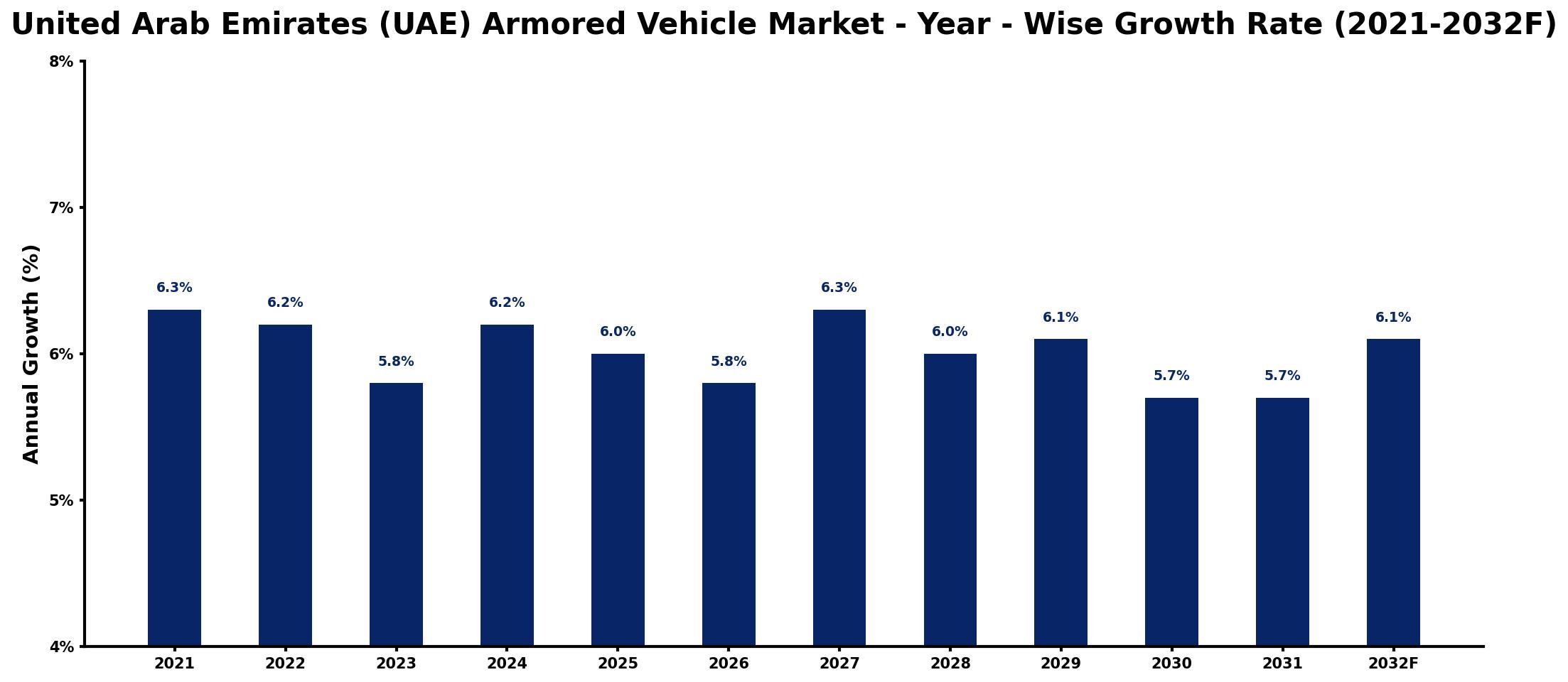
The table below presents the year‑wise growth rates along with the key drivers influencing the market
| Year | Growth Rate | Major Drivers |
| 2021 | 6.3% | Increased military expenditure initiatives |
| 2022 | 6.2% | Growing regional security collaborations |
| 2023 | 5.8% | Expansion of defense technology investments |
| 2024 | 6.2% | Rising demand for border protection |
| 2025 | 6.0% | Enhanced focus on urban safety |
| 2026 | 5.8% | Strengthened law enforcement capabilities |
| 2027 | 6.3% | Emerging threats prompting upgrades |
| 2028 | 6.0% | Advancements in defense manufacturing technology |
| 2029 | 6.1% | Growing interest in private security |
| 2030 | 5.7% | Increased demand for emergency response |
| 2031 | 5.7% | Strengthening alliances with defense contractors |
| 2032 | 6.1% | stronger distribution network expansion |
Note: Market size estimations and growth projections presented in this report are based on 6Wresearch's proprietary forecasting methodology, utilizing the latest available industry data, government publications, and primary research inputs.
United Arab Emirates (UAE) Armored Vehicle Market Synopsis
The UAE armored vehicle market has emerged as a pivotal segment within the regional defense landscape, driven by the country's commitment to advancing its military preparedness and security infrastructure. With persistent geopolitical challenges, the demand for armored personnel carriers, tanks, and MRAPs is surging, reflecting the urgency of modern defense solutions.
Current trends reveal a robust interplay between domestic production and international partnerships, fostering innovation and technological advancement. Notably, companies are increasingly focusing on integrating advanced weaponry and protective features into their vehicles, ensuring they meet the sophisticated needs of both military and law enforcement applications.
United Arab Emirates (UAE) Armored Vehicle Market Key Takeaways
- The market is projected to grow significantly, reaching USD 789 Million by 2032.
- Geopolitical tensions in the Middle East are driving demand for advanced armored vehicles.
- Both domestic manufacturing and imports are critical in fulfilling market demand.
- Technological advancements are essential for maintaining competitive edge in vehicle capabilities.
- Robust government support is fostering growth in defense expenditures and initiatives.
Evaluation of Restraints in United Arab Emirates (UAE) Armored Vehicle Market
Despite the growth potential, the UAE armored vehicle market faces several constraints that could limit its trajectory. Technological advancements in military hardware require continuous investment to stay competitive, and companies must adapt their offerings to align with evolving security threats. Furthermore, compliance with international arms regulations can complicate operational dynamics, creating additional hurdles for both domestic manufacturers and foreign suppliers seeking market access.
United Arab Emirates (UAE) Armored Vehicle Market Trends
A key trend shaping the UAE armored vehicle market is the emphasis on integrating cutting-edge technology into defense solutions. Innovations such as autonomous capabilities, enhanced surveillance systems, and better mobility features are becoming standard expectations among defense contractors. Additionally, there is a growing focus on sustainability, pushing companies to explore environmentally friendly materials and technologies to meet modern military demands.
United Arab Emirates (UAE) Armored Vehicle Market Opportunities
The landscape presents numerous opportunities for growth and investment within the UAE armored vehicle market. With the government's ongoing commitment to boosting defense capabilities, there is a pronounced demand for advanced armored solutions that can withstand diverse threats. Moreover, strategic partnerships with international defense firms could facilitate technology transfers and foster innovation in local manufacturing, further enhancing competitive positioning in the region.
Government Initiatives in the United Arab Emirates (UAE) Armored Vehicle Market
The UAE government is deeply invested in bolstering national security and defense spending. Through various initiatives, the government aims to create a self-sufficient defense ecosystem that encourages local production of armored vehicles. This includes funding programs and incentives designed to foster innovation and technological advancements within the defense sector, promoting partnerships between local manufacturers and global defense contractors.
Future Insights of the United Arab Emirates (UAE) Armored Vehicle Market
Looking ahead to the period from 2026 to 2032, the UAE armored vehicle market is poised for significant evolution, primarily driven by advancements in military technology and increasing regional security concerns. The shift towards smart defense solutions will likely reshape procurement strategies, with a greater emphasis on versatile, multifunctional armored vehicles. As local manufacturers rise to prominence, the market dynamics will become increasingly competitive, offering diverse solutions tailored to the needs of military and law enforcement agencies.
United Arab Emirates (UAE) Armored Vehicle Market Latest Developments (2025 - 2026)
Recent developments in the UAE armored vehicle market have underscored a shift towards modernization and enhanced capability integration. Defense contractors are ramping up efforts to innovate and improve vehicle performance, focusing on advanced protection systems and communication technologies. Additionally, collaborations between local firms and foreign defense entities are being witnessed, aimed at fostering innovation while also adhering to strict regulatory frameworks. Such trends indicate a proactive approach to meeting both domestic and international defense requirements.
United Arab Emirates (UAE) Armored Vehicle Market - Key Attractiveness of the Report
- 10 Years of Market Numbers
- Historical Data Starting from 2022 to 2025
- Base Year: 2025
- Forecast Data until 2032
- Key Performance Indicators Impacting the Market
- Major Upcoming Developments and Projects
Key Highlights of the Report:
- United Arab Emirates (UAE) Armored Vehicle Market Outlook
- Market Size of United Arab Emirates (UAE) Armored Vehicle Market, 2025
- Forecast of United Arab Emirates (UAE) Armored Vehicle Market, 2032
- Historical Data and Forecast of United Arab Emirates (UAE) Armored Vehicle Revenues & Volume for the Period 2022-2032F
- United Arab Emirates (UAE) Armored Vehicle Market Trend Evolution
- United Arab Emirates (UAE) Armored Vehicle Market Drivers and Challenges
- United Arab Emirates (UAE) Armored Vehicle Price Trends
- United Arab Emirates (UAE) Armored Vehicle Porter's Five Forces
- United Arab Emirates (UAE) Armored Vehicle Industry Life Cycle
- Historical Data and Forecast of United Arab Emirates (UAE) Armored Vehicle Market Revenues & Volume By Platform for the Period 2022-2032F
- Historical Data and Forecast of United Arab Emirates (UAE) Armored Vehicle Market Revenues & Volume By Combat Vehicles for the Period 2022-2032F
- Historical Data and Forecast of United Arab Emirates (UAE) Armored Vehicle Market Revenues & Volume By Combat Support Vehicles for the Period 2022-2032F
- Historical Data and Forecast of United Arab Emirates (UAE) Armored Vehicle Market Revenues & Volume By Unmanned Armored Ground Vehicles for the Period 2022-2032F
- Historical Data and Forecast of United Arab Emirates (UAE) Armored Vehicle Market Revenues & Volume By Mobility for the Period 2022-2032F
- Historical Data and Forecast of United Arab Emirates (UAE) Armored Vehicle Market Revenues & Volume By Wheeled for the Period 2022-2032F
- Historical Data and Forecast of United Arab Emirates (UAE) Armored Vehicle Market Revenues & Volume By Tracked for the Period 2022-2032F
- Historical Data and Forecast of United Arab Emirates (UAE) Armored Vehicle Market Revenues & Volume By System for the Period 2022-2032F
- Historical Data and Forecast of United Arab Emirates (UAE) Armored Vehicle Market Revenues & Volume By Engine for the Period 2022-2032F
- Historical Data and Forecast of United Arab Emirates (UAE) Armored Vehicle Market Revenues & Volume By Drive System for the Period 2022-2032F
- Historical Data and Forecast of United Arab Emirates (UAE) Armored Vehicle Market Revenues & Volume By Ballistic Armor for the Period 2022-2032F
- Historical Data and Forecast of United Arab Emirates (UAE) Armored Vehicle Market Revenues & Volume By Turret Drives for the Period 2022-2032F
- Historical Data and Forecast of United Arab Emirates (UAE) Armored Vehicle Market Revenues & Volume By Ammunition Handling System for the Period 2022-2032F
- Historical Data and Forecast of United Arab Emirates (UAE) Armored Vehicle Market Revenues & Volume By Fire Control Systems (FCS) for the Period 2022-2032F
- Historical Data and Forecast of United Arab Emirates (UAE) Armored Vehicle Market Revenues & Volume By Armaments for the Period 2022-2032F
- Historical Data and Forecast of United Arab Emirates (UAE) Armored Vehicle Market Revenues & Volume By Countermeasure System for the Period 2022-2032F
- United Arab Emirates (UAE) Armored Vehicle Import Export Trade Statistics
- Market Opportunity Assessment By Platform
- Market Opportunity Assessment By Mobility
- Market Opportunity Assessment By System
- United Arab Emirates (UAE) Armored Vehicle Top Companies Market Share
- United Arab Emirates (UAE) Armored Vehicle Competitive Benchmarking By Technical and Operational Parameters
- United Arab Emirates (UAE) Armored Vehicle Company Profiles
- United Arab Emirates (UAE) Armored Vehicle Key Strategic Recommendations






































