United Arab Emirates (UAE) Base Metals Market Size, Share & Growth Rate
The United Arab Emirates (UAE) Base Metals Market was estimated at USD 380 Million in 2025 and is projected to reach USD 523 Million by 2032, growing at a CAGR of 4.7% from 2026 to 2032. This growth trajectory is significantly fueled by the UAEs ambitious infrastructure projects and robust industrial development. Demand for key base metals, particularly aluminum and copper, is being driven by the construction and electrical sectors, which are expected to expand alongside the nations economic diversification efforts.
United Arab Emirates (UAE) Base Metals Market Year-wise Growth Rate and Key Drivers
This graph highlights how the United Arab Emirates (UAE) Base Metals Market has steadily grown over the years, supported by major growth factors.
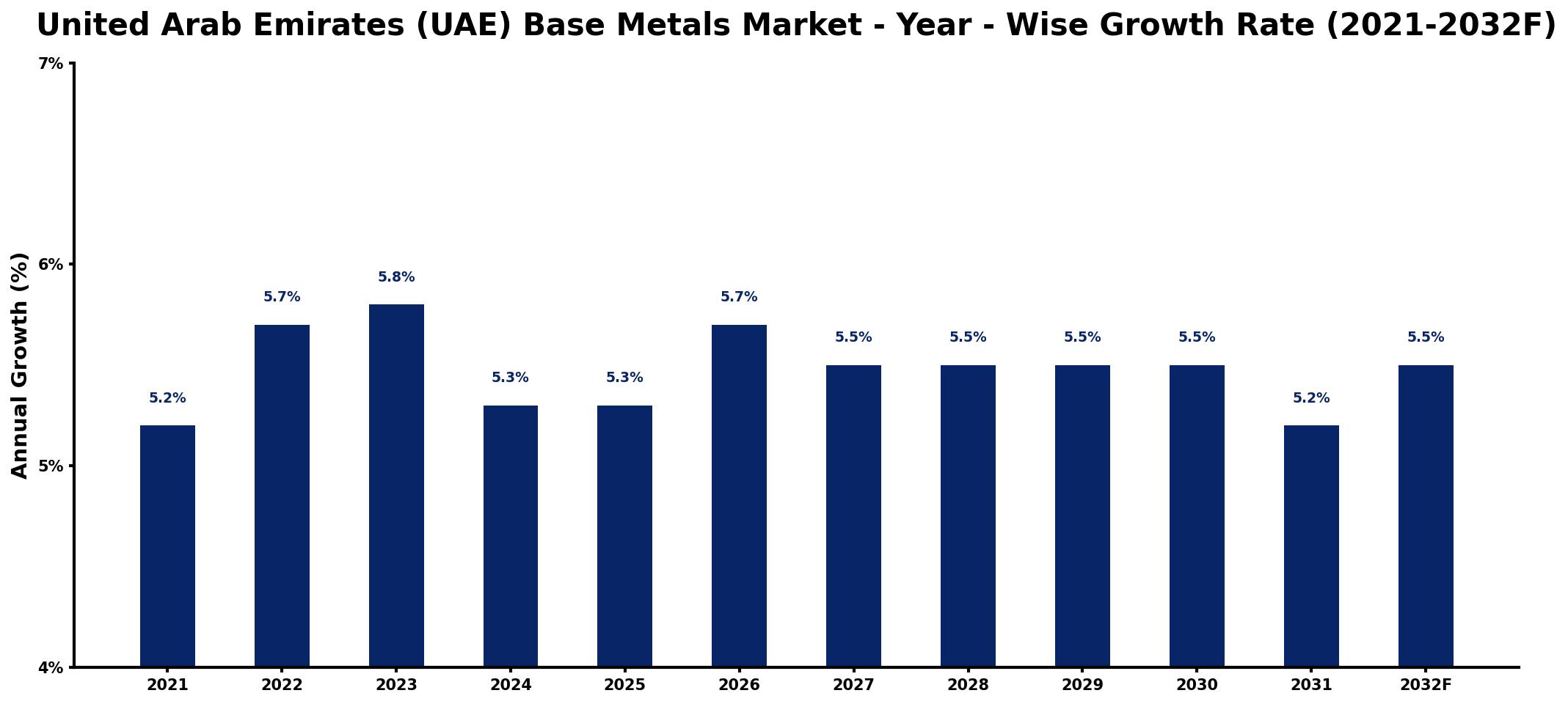
The table below presents the year‑wise growth rates along with the key drivers influencing the market
| Year | Growth Rate | Major Drivers |
| 2021 | 5.2% | Construction sector expansion initiatives |
| 2022 | 5.7% | Increased infrastructure project investments |
| 2023 | 5.8% | Rising demand from manufacturing |
| 2024 | 5.3% | Growing renewable energy projects |
| 2025 | 5.3% | Automotive industry production growth |
| 2026 | 5.7% | Technological advancements in construction |
| 2027 | 5.5% | Expansion of logistics and transportation |
| 2028 | 5.5% | Increased residential building projects |
| 2029 | 5.5% | Investment in green technologies |
| 2030 | 5.5% | Urbanization driving construction demand |
| 2031 | 5.2% | Strong export market opportunities |
| 2032 | 5.5% | Ongoing industrial sector developments |
Note: Market size estimations and growth projections presented in this report are based on 6Wresearch's proprietary forecasting methodology, utilizing the latest available industry data, government publications, and primary research inputs.
United Arab Emirates (UAE) Base Metals Market Synopsis
At the heart of the UAE Base Metals Market is the ongoing expansion in infrastructure and construction activities. As the UAE continues to invest heavily in its urban landscape, base metals are increasingly pivotal to realizing these ambitious projects. This surge in demand is not just limited to the construction sector but extends into electrical manufacturing, where these metals are indispensable.
However, the market is also sensitive to global economic conditions, with fluctuations in demand often influenced by international trends. As industries globally adjust to economic changes and geopolitical factors, the UAE's base metals sector must navigate these complexities while pushing for innovation and sustainability within its practices.
United Arab Emirates (UAE) Base Metals Market Key Takeaways
- The market is experiencing growth primarily due to infrastructure development and industrial expansion.
- Price volatility and supply chain dynamics significantly influence market stability.
- Sustainability practices are becoming increasingly important within the base metals industry.
- The demand for base metals like aluminum and copper is set to rise with the UAEs ongoing economic diversification.
- Key players are focusing on technological advancements to enhance efficiency and environmental impact.
Evaluation of Restraints in United Arab Emirates (UAE) Base Metals Market
Several restraints challenge the growth of the UAE Base Metals Market. Price fluctuations caused by global economic uncertainties can destabilize planning and investment strategies. Moreover, geopolitical tensions may affect trade relations, resulting in supply chain disruptions that could hinder the timely availability of essential base metals. This unpredictability can lead businesses to hesitate in their procurement, ultimately slowing down industrial progress. There is also an increasing pressure to adopt sustainable practices, requiring significant investment in new technologies and processes.
United Arab Emirates (UAE) Base Metals Market Trends
The current trend in the UAE Base Metals Market is marked by a pronounced shift towards sustainability and circular economy practices. Companies are increasingly adopting recycling techniques to minimize waste and enhance the lifecycle of base metals. Additionally, automation and digitalization are gaining traction, driving efficiency and reducing operational costs. Innovations in extraction and processing technologies are also anticipated to reshape the market landscape, allowing for a more sustainable approach to production while maintaining output levels.
United Arab Emirates (UAE) Base Metals Market Opportunities
There are significant growth opportunities within the UAE Base Metals Market, particularly in expanding recycling initiatives and developing eco-friendly technologies. The shift towards renewable energy projects creates a demand for specific base metals, thus positioning companies to align their offerings with this growing sector. Furthermore, as the government amplifies its focus on sustainability, there is potential for enhanced investment in innovative metal processing techniques that can lead to greater market resilience.
Government Initiatives in the United Arab Emirates (UAE) Base Metals Market
The UAE government has been proactive in supporting the base metals sector through various initiatives aimed at fostering industrial growth and sustainability. Public spending on infrastructure and modernization projects has created a robust demand for base metals. Additionally, policies promoting recycling and the use of sustainable materials are shaping the industry's direction. The government also encourages investments in technological advancements to boost productivity and reduce environmental impacts.
Future Insights of the United Arab Emirates (UAE) Base Metals Market
Looking ahead to 2026-2032, the UAE Base Metals Market is poised for significant transformations. Continued investment in infrastructure and the strategic emphasis on sustainability will dictate future growth paths. The market is likely to see a shift towards greater integration of digital technologies and automation in production processes, which will enhance operational efficiency. Moreover, the global focus on green initiatives may further bolster the demand for specific base metals, particularly those integral to renewable energy technologies.
United Arab Emirates (UAE) Base Metals Market Latest Developments (2025 - 2026)
In the recent months, the UAE Base Metals Market has seen a notable focus on enhancing production capabilities and sustainability efforts. Industry players are exploring partnerships to innovate recycling processes and improve the overall environmental impact of metal production. Furthermore, there is an observable increase in governmental support for initiatives aimed at reducing carbon footprints within the sector, aligning with broader national sustainability objectives.
United Arab Emirates (UAE) Base Metals Market - Key Attractiveness of the Report
- 10 Years of Market Numbers
- Historical Data Starting from 2022 to 2025
- Base Year: 2025
- Forecast Data until 2032
- Key Performance Indicators Impacting the Market
- Major Upcoming Developments and Projects
Key Highlights of the Report:
- United Arab Emirates (UAE) Base Metals Market Outlook
- Market Size of United Arab Emirates (UAE) Base Metals Market, 2025
- Forecast of United Arab Emirates (UAE) Base Metals Market, 2032
- Historical Data and Forecast of United Arab Emirates (UAE) Base Metals Revenues & Volume for the Period 2022-2032F
- United Arab Emirates (UAE) Base Metals Market Trend Evolution
- United Arab Emirates (UAE) Base Metals Market Drivers and Challenges
- United Arab Emirates (UAE) Base Metals Price Trends
- United Arab Emirates (UAE) Base Metals Porter's Five Forces
- United Arab Emirates (UAE) Base Metals Industry Life Cycle
- Historical Data and Forecast of United Arab Emirates (UAE) Base Metals Market Revenues & Volume By Type for the Period 2022-2032F
- Historical Data and Forecast of United Arab Emirates (UAE) Base Metals Market Revenues & Volume By Copper for the Period 2022-2032F
- Historical Data and Forecast of United Arab Emirates (UAE) Base Metals Market Revenues & Volume By Zinc for the Period 2022-2032F
- Historical Data and Forecast of United Arab Emirates (UAE) Base Metals Market Revenues & Volume By Lead for the Period 2022-2032F
- Historical Data and Forecast of United Arab Emirates (UAE) Base Metals Market Revenues & Volume By Nickel for the Period 2022-2032F
- Historical Data and Forecast of United Arab Emirates (UAE) Base Metals Market Revenues & Volume By Aluminum for the Period 2022-2032F
- Historical Data and Forecast of United Arab Emirates (UAE) Base Metals Market Revenues & Volume By Tin for the Period 2022-2032F
- Historical Data and Forecast of United Arab Emirates (UAE) Base Metals Market Revenues & Volume By End-user Industry for the Period 2022-2032F
- Historical Data and Forecast of United Arab Emirates (UAE) Base Metals Market Revenues & Volume By Construction for the Period 2022-2032F
- Historical Data and Forecast of United Arab Emirates (UAE) Base Metals Market Revenues & Volume By Automotive and Transportation for the Period 2022-2032F
- Historical Data and Forecast of United Arab Emirates (UAE) Base Metals Market Revenues & Volume By Electrical and Electronics for the Period 2022-2032F
- Historical Data and Forecast of United Arab Emirates (UAE) Base Metals Market Revenues & Volume By Consumer Products for the Period 2022-2032F
- Historical Data and Forecast of United Arab Emirates (UAE) Base Metals Market Revenues & Volume By Medical Devices for the Period 2022-2032F
- Historical Data and Forecast of United Arab Emirates (UAE) Base Metals Market Revenues & Volume By Others for the Period 2022-2032F
- United Arab Emirates (UAE) Base Metals Import Export Trade Statistics
- Market Opportunity Assessment By Type
- Market Opportunity Assessment By End-user Industry
- United Arab Emirates (UAE) Base Metals Top Companies Market Share
- United Arab Emirates (UAE) Base Metals Competitive Benchmarking By Technical and Operational Parameters
- United Arab Emirates (UAE) Base Metals Company Profiles
- United Arab Emirates (UAE) Base Metals Key Strategic Recommendations






































