United Arab Emirates (UAE) Building Construction Market Size, Share & Growth Rate
The United Arab Emirates (UAE) Building Construction Market was estimated at USD 615 Million in 2025 and is projected to reach USD 888 Million by 2032, growing at a CAGR of 5.4% from 2026 to 2032. This promising trajectory is primarily driven by robust urbanization efforts, extensive infrastructure projects, and the UAE's strategic positioning as a global business and tourism hub. The government's proactive approach to facilitating investments and enhancing modern infrastructure further bolsters this growth.
United Arab Emirates (UAE) Building Construction Market Year-wise Growth Rate and Key Drivers
This graph highlights how the United Arab Emirates (UAE) Building Construction Market has steadily grown over the years, supported by major growth factors.
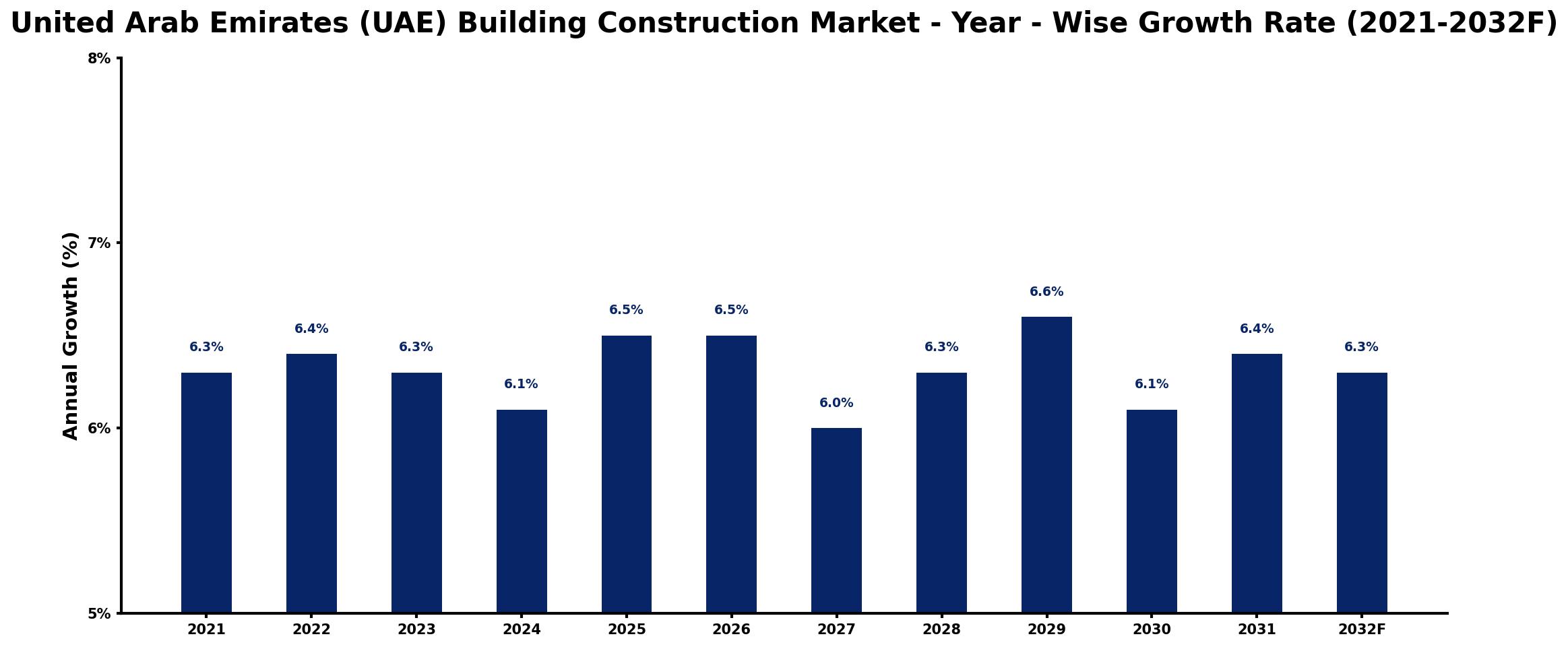
The table below presents the year‑wise growth rates along with the key drivers influencing the market
| Year | Growth Rate | Major Drivers |
| 2021 | 6.3% | increased infrastructure development projects |
| 2022 | 6.4% | expansion of tourism sector investments |
| 2023 | 6.3% | growing population driving housing demand |
| 2024 | 6.1% | government initiatives for urban renewal |
| 2025 | 6.5% | rising foreign direct investments influx |
| 2026 | 6.5% | advancements in sustainable technologies adoption |
| 2027 | 6.0% | increased public-private partnership collaborations |
| 2028 | 6.3% | enhanced logistics and transport networks |
| 2029 | 6.6% | demand for smart city solutions |
| 2030 | 6.1% | rising procurement volume requirements |
| 2031 | 6.4% | increased residential property developments |
| 2032 | 6.3% | growing emerging market penetration |
Note: Market size estimations and growth projections presented in this report are based on 6Wresearch's proprietary forecasting methodology, utilizing the latest available industry data, government publications, and primary research inputs.
United Arab Emirates (UAE) Building Construction Market Synopsis
In recent years, the UAE Building Construction Market has exhibited impressive momentum, buoyed by significant investments in diverse construction activities ranging from residential to commercial projects. However, as the market evolves, it faces complex challenges and regulatory landscapes that may influence its future trajectory.
Looking ahead, the market is expected to pivot towards sustainable practices and innovative building technologies. With a growing population and heightened demand for modern infrastructure, the construction sector will need to adapt quickly to maintain its contribution to the UAE's economic growth.
United Arab Emirates (UAE) Building Construction Market Key Takeaways
- The market is projected to grow at a CAGR of 5.4% from 2026 to 2032, indicating sustained demand.
- Major government initiatives are driving infrastructure investments, particularly in preparation for global events.
- A growing emphasis on sustainability and innovative materials is reshaping construction practices.
- Despite challenges, the recovery post-COVID-19 is setting the stage for accelerated growth.
- Competitive dynamics within the market are intensifying as new players enter and established firms innovate.
Evaluation of Restraints in United Arab Emirates (UAE) Building Construction Market
The UAE Building Construction Market encounters several real restraints that could hinder its potential growth. Rising construction costs have emerged as a critical concern, driven largely by fluctuating material prices and supply chain disruptions. Labor shortages, exacerbated by regulatory complexities and permit processes, further contribute to project delays. Economic fluctuations and geopolitical uncertainties also pose risks to investment stability, making it imperative for stakeholders to navigate these challenges effectively.
United Arab Emirates (UAE) Building Construction Market Trends
Current trends are heavily leaning toward sustainable construction methods and the use of advanced technologies, such as building information modeling (BIM) and prefabrication. The adoption of smart building solutions that enhance energy efficiency and reduce waste is becoming increasingly popular. Additionally, there is a growing demand for mixed-use developments that integrate residential, commercial, and leisure spaces, responding to the lifestyle preferences of a dynamic population.
United Arab Emirates (UAE) Building Construction Market Opportunities
Significant growth and investment opportunities lie in sectors focused on sustainability and innovative construction solutions. As the UAE intensifies its focus on environmentally friendly practices, companies that specialize in green building certifications, energy-efficient technologies, and waste-reduction strategies stand to gain. Furthermore, urban revitalization projects and the expansion of smart cities present lucrative prospects for stakeholders looking to innovate within the built environment.
Government Initiatives in the United Arab Emirates (UAE) Building Construction Market
The UAE government is actively promoting various initiatives aimed at bolstering the construction sector. Public spending on infrastructure is being ramped up, particularly in the lead-up to major global events like Expo 2025. Various programs are being introduced to streamline permitting processes, and incentives are being offered to attract foreign investments. These efforts are geared towards enhancing the UAE's competitive edge and ensuring sustainable urban development.
Future Insights of the United Arab Emirates (UAE) Building Construction Market
The outlook for the UAE Building Construction Market from 2026 to 2032 appears optimistic, with substantial growth anticipated as the economy continues to rebound. A notable increase in investment in smart infrastructure and sustainability initiatives will likely redefine traditional construction practices. As the demand for modern living and working spaces grows, the sector's adaptability to emerging trends will be critical for maintaining its growth momentum.
United Arab Emirates (UAE) Building Construction Market Latest Developments (2025 - 2026)
In the recent period, the UAE Building Construction Market has seen a surge in infrastructure projects aimed at enhancing urban environments. Emerging technologies are gaining traction, with several firms investing in automation and digital tools to optimize project efficiency. Additionally, there have been discussions regarding new partnerships and collaborations designed to address labor shortages and supply chain issues, reflecting the market's resilience and adaptability.
United Arab Emirates (UAE) Building Construction Market - Key Attractiveness of the Report
- 10 Years of Market Numbers
- Historical Data Starting from 2022 to 2025
- Base Year: 2025
- Forecast Data until 2032
- Key Performance Indicators Impacting the Market
- Major Upcoming Developments and Projects
Key Highlights of the Report:
- United Arab Emirates (UAE) Building Construction Market Outlook
- Market Size of United Arab Emirates (UAE) Building Construction Market, 2025
- Forecast of United Arab Emirates (UAE) Building Construction Market, 2032
- Historical Data and Forecast of United Arab Emirates (UAE) Building Construction Revenues & Volume for the Period 2022-2032F
- United Arab Emirates (UAE) Building Construction Market Trend Evolution
- United Arab Emirates (UAE) Building Construction Market Drivers and Challenges
- United Arab Emirates (UAE) Building Construction Price Trends
- United Arab Emirates (UAE) Building Construction Porter's Five Forces
- United Arab Emirates (UAE) Building Construction Industry Life Cycle
- Historical Data and Forecast of United Arab Emirates (UAE) Building Construction Market Revenues & Volume By Type for the Period 2022-2032F
- Historical Data and Forecast of United Arab Emirates (UAE) Building Construction Market Revenues & Volume By Residential for the Period 2022-2032F
- Historical Data and Forecast of United Arab Emirates (UAE) Building Construction Market Revenues & Volume By Non-residential for the Period 2022-2032F
- Historical Data and Forecast of United Arab Emirates (UAE) Building Construction Market Revenues & Volume By Construction Type for the Period 2022-2032F
- Historical Data and Forecast of United Arab Emirates (UAE) Building Construction Market Revenues & Volume By New Construction for the Period 2022-2032F
- Historical Data and Forecast of United Arab Emirates (UAE) Building Construction Market Revenues & Volume By Renovation for the Period 2022-2032F
- Historical Data and Forecast of United Arab Emirates (UAE) Building Construction Market Revenues & Volume By Application for the Period 2022-2032F
- Historical Data and Forecast of United Arab Emirates (UAE) Building Construction Market Revenues & Volume By Owned for the Period 2022-2032F
- Historical Data and Forecast of United Arab Emirates (UAE) Building Construction Market Revenues & Volume By Rental for the Period 2022-2032F
- Historical Data and Forecast of United Arab Emirates (UAE) Building Construction Market Revenues & Volume By End User for the Period 2022-2032F
- Historical Data and Forecast of United Arab Emirates (UAE) Building Construction Market Revenues & Volume By Private for the Period 2022-2032F
- Historical Data and Forecast of United Arab Emirates (UAE) Building Construction Market Revenues & Volume By Public for the Period 2022-2032F
- United Arab Emirates (UAE) Building Construction Import Export Trade Statistics
- Market Opportunity Assessment By Type
- Market Opportunity Assessment By Construction Type
- Market Opportunity Assessment By Application
- Market Opportunity Assessment By End User
- United Arab Emirates (UAE) Building Construction Top Companies Market Share
- United Arab Emirates (UAE) Building Construction Competitive Benchmarking By Technical and Operational Parameters
- United Arab Emirates (UAE) Building Construction Company Profiles
- United Arab Emirates (UAE) Building Construction Key Strategic Recommendations






































