United Arab Emirates (UAE) Canned Pineapple Market Size, Share & Growth Rate
The United Arab Emirates (UAE) Canned Pineapple Market was estimated at USD 245 Million in 2025 and is projected to reach USD 341 Million by 2032, growing at a CAGR of 4.8% from 2026 to 2032. This growth trajectory is propelled by an increasing inclination among consumers for convenience and the flexibility that canned fruit offers in both cooking and snacking. The rising popularity of tropical flavors in culinary trends and the emphasis on pantry-stable food items further solidify the market's positive outlook.
United Arab Emirates (UAE) Canned Pineapple Market Year-wise Growth Rate and Key Drivers
This graph highlights how the United Arab Emirates (UAE) Canned Pineapple Market has steadily grown over the years, supported by major growth factors.
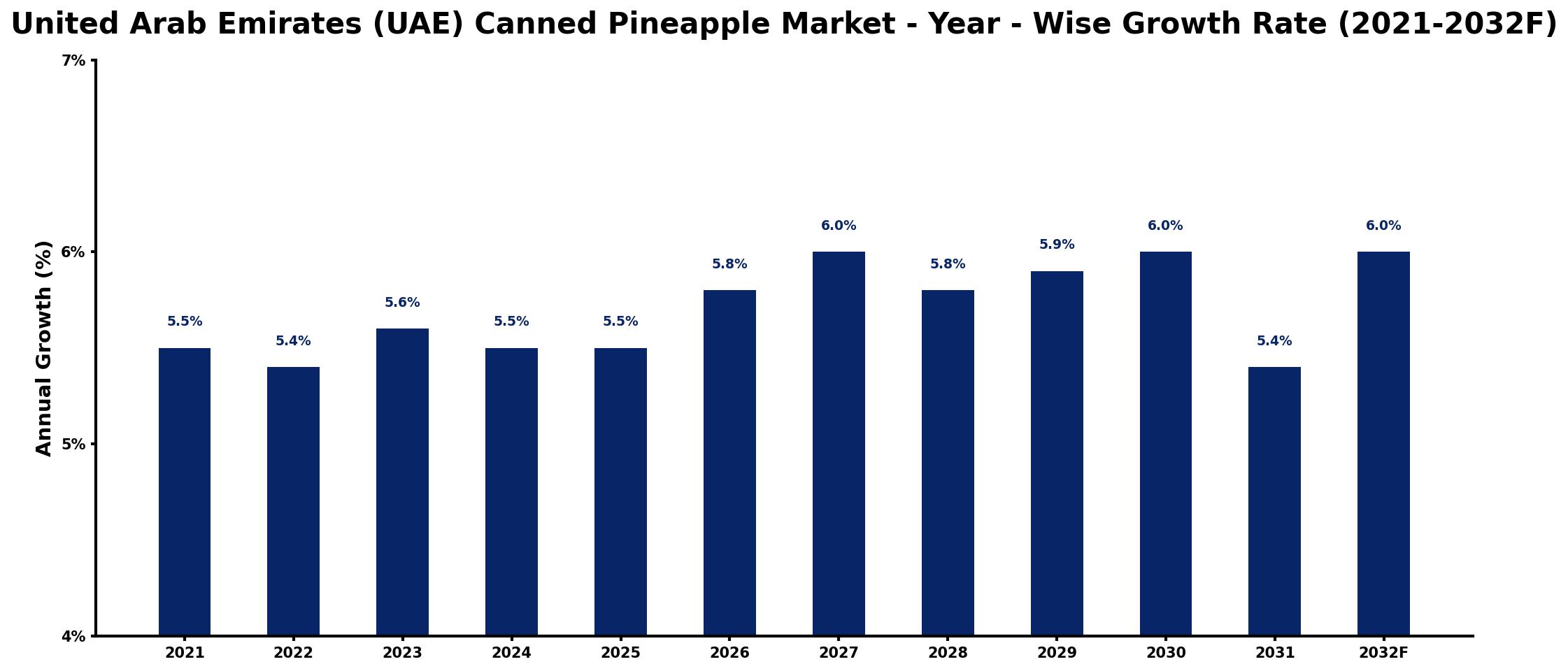
The table below presents the year‑wise growth rates along with the key drivers influencing the market
| Year | Growth Rate | Major Drivers |
| 2021 | 5.5% | increased health consciousness among consumers |
| 2022 | 5.4% | growing demand for convenient snacks |
| 2023 | 5.6% | expansion of retail distribution channels |
| 2024 | 5.5% | rising popularity of tropical flavors |
| 2025 | 5.5% | increased consumer interest in sustainability |
| 2026 | 5.8% | growth in food service partnerships |
| 2027 | 6.0% | emergence of new product innovations |
| 2028 | 5.8% | strengthening online shopping platforms |
| 2029 | 5.9% | increased marketing and brand awareness |
| 2030 | 6.0% | growing interest in international cuisines |
| 2031 | 5.4% | increased capital investment inflows |
| 2032 | 6.0% | rising demand for organic options |
Note: Market size estimations and growth projections presented in this report are based on 6Wresearch's proprietary forecasting methodology, utilizing the latest available industry data, government publications, and primary research inputs.
United Arab Emirates (UAE) Canned Pineapple Market Synopsis
In the UAE, the canned pineapple market has garnered significant consumer interest due to its versatility in various culinary applications. From sweet dishes to savory pairings, canned pineapple is embraced for its ease of use, making it a staple ingredient in many households. Furthermore, the region's preference for international cuisines has bolstered the demand for canned pineapple as an essential component in diverse recipes.
The market landscape features an array of products, including slices, chunks, and crushed varieties, catering to a wide range of consumer preferences. Companies are focusing on innovations in packaging, such as environmentally friendly options, to enhance product appeal. Additionally, the trend towards sustainability in sourcing practices is reshaping the market dynamics, responding to the increasing consumer awareness surrounding environmental impact.
United Arab Emirates (UAE) Canned Pineapple Market Key Takeaways
- The market is on a robust growth trajectory, driven by a rising preference for convenience in food consumption.
- Various forms of canned pineapple products cater to diverse culinary uses, making them popular among consumers.
- Sustainable sourcing and innovative packaging are becoming essential strategies for companies in this market.
- Consumer health trends are influencing the demand for low-sugar options and natural preservation methods.
- Year-round availability and ease of storage position canned pineapple as a pantry essential for UAE households.
Evaluation of Restraints in United Arab Emirates (UAE) Canned Pineapple Market
Despite the positive growth outlook, the UAE canned pineapple market encounters several restraints that could hinder its expansion. A notable shift toward healthier snacking options is prompting consumers to be more discerning about the sugar content and nutritional value of canned fruits. This trend potentially limits the appeal of traditional canned pineapple products that contain added sugars or preservatives. Supply chain challenges, particularly in the importation of raw pineapples, also pose risks for availability and cost stability. Lastly, stringent food safety regulations and evolving labeling requirements may further complicate market operations, necessitating adaptability from producers.
United Arab Emirates (UAE) Canned Pineapple Market Trends
Current trends indicate a strong consumer preference for health-conscious options, propelling interest in canned pineapples that emphasize natural sweetness without added sugars. Furthermore, the rise of e-commerce and online grocery shopping is reshaping distribution channels, allowing easier access to canned fruit products. Additionally, innovative marketing strategies that highlight the versatility of canned pineapple in a variety of dishes are gaining traction, enhancing consumer engagement. Sustainability in packaging, such as recyclable materials, is also increasingly vital as environmentally conscious purchasing decisions become more prevalent.
United Arab Emirates (UAE) Canned Pineapple Market Opportunities
There are substantial growth opportunities in the UAE canned pineapple market, particularly in the development of healthier product lines that cater to the modern consumer's preferences. Expanding into organic and low-sugar variants can attract health-conscious shoppers. Furthermore, tapping into the growing trend of online retail can enhance market reach and accessibility. Collaborative efforts with local chefs and food influencers to promote canned pineapple in diverse culinary creations can also stimulate demand and innovate usage ideas in households.
Government Initiatives in the United Arab Emirates (UAE) Canned Pineapple Market
The government of the UAE has implemented various initiatives aimed at bolstering food security and sustainability within the region. Policies encouraging local food production and quality standards are in place to enhance the overall safety and integrity of food products, including canned fruits. Public spending on agricultural technology and innovation is expected to support the supply chain, benefiting the canned pineapple sector by ensuring consistent quality and availability of raw materials.
Future Insights of the United Arab Emirates (UAE) Canned Pineapple Market
Looking ahead to the period from 2026 to 2032, the UAE canned pineapple market is poised for consistent growth as consumer habits evolve. The fusion of culinary innovation with health trends is likely to define product offerings, leading to a rise in demand for healthier, more natural variants. As e-commerce continues to grow, market players must adapt by enhancing their online presence and marketing strategies. Sustainability will remain a significant focus, with companies that prioritize eco-friendly practices likely to gain a competitive advantage.
United Arab Emirates (UAE) Canned Pineapple Market Latest Developments (2025 - 2026)
Recent developments in the UAE canned pineapple market indicate a growing emphasis on product diversification and sustainability. Companies are actively exploring innovative packaging solutions to reduce environmental impact, while simultaneously enhancing product shelf appeal. The shift towards healthier, low-sugar offerings is being met with new product launches aimed at health-conscious consumers. Additionally, local partnerships aimed at improving sourcing strategies and expanding distribution networks are gaining momentum, fostering a more resilient market landscape.
United Arab Emirates (UAE) Canned Pineapple Market - Key Attractiveness of the Report
- 10 Years of Market Numbers
- Historical Data Starting from 2022 to 2025
- Base Year: 2025
- Forecast Data until 2032
- Key Performance Indicators Impacting the Market
- Major Upcoming Developments and Projects
Key Highlights of the Report:
- United Arab Emirates (UAE) Canned Pineapple Market Outlook
- Market Size of United Arab Emirates (UAE) Canned Pineapple Market, 2025
- Forecast of United Arab Emirates (UAE) Canned Pineapple Market, 2032
- Historical Data and Forecast of United Arab Emirates (UAE) Canned Pineapple Revenues & Volume for the Period 2022-2032F
- United Arab Emirates (UAE) Canned Pineapple Market Trend Evolution
- United Arab Emirates (UAE) Canned Pineapple Market Drivers and Challenges
- United Arab Emirates (UAE) Canned Pineapple Price Trends
- United Arab Emirates (UAE) Canned Pineapple Porter's Five Forces
- United Arab Emirates (UAE) Canned Pineapple Industry Life Cycle
- Historical Data and Forecast of United Arab Emirates (UAE) Canned Pineapple Market Revenues & Volume By Products for the Period 2022-2032F
- Historical Data and Forecast of United Arab Emirates (UAE) Canned Pineapple Market Revenues & Volume By Pineapple Slices for the Period 2022-2032F
- Historical Data and Forecast of United Arab Emirates (UAE) Canned Pineapple Market Revenues & Volume By Pineapple Chunks for the Period 2022-2032F
- Historical Data and Forecast of United Arab Emirates (UAE) Canned Pineapple Market Revenues & Volume By Applications for the Period 2022-2032F
- Historical Data and Forecast of United Arab Emirates (UAE) Canned Pineapple Market Revenues & Volume By Beverages & Drinks for the Period 2022-2032F
- Historical Data and Forecast of United Arab Emirates (UAE) Canned Pineapple Market Revenues & Volume By Bakery & Snacks for the Period 2022-2032F
- Historical Data and Forecast of United Arab Emirates (UAE) Canned Pineapple Market Revenues & Volume By Others for the Period 2022-2032F
- United Arab Emirates (UAE) Canned Pineapple Import Export Trade Statistics
- Market Opportunity Assessment By Products
- Market Opportunity Assessment By Applications
- United Arab Emirates (UAE) Canned Pineapple Top Companies Market Share
- United Arab Emirates (UAE) Canned Pineapple Competitive Benchmarking By Technical and Operational Parameters
- United Arab Emirates (UAE) Canned Pineapple Company Profiles
- United Arab Emirates (UAE) Canned Pineapple Key Strategic Recommendations






































