United Arab Emirates (UAE) Canvas Market Size, Share & Growth Rate
The United Arab Emirates (UAE) Canvas Market was estimated at USD 266 Million in 2025 and is projected to reach USD 372 Million by 2032, growing at a CAGR of 4.9% from 2026 to 2032. This growth is primarily fueled by an expanding local art scene and increasing demand from interior design sectors, as consumers seek unique, personalized decor solutions. Additionally, the versatility of canvas applications—from traditional art to advertising—further propels this market's upward trajectory.
United Arab Emirates (UAE) Canvas Market Year-wise Growth Rate and Key Drivers
This graph highlights how the United Arab Emirates (UAE) Canvas Market has steadily grown over the years, supported by major growth factors.
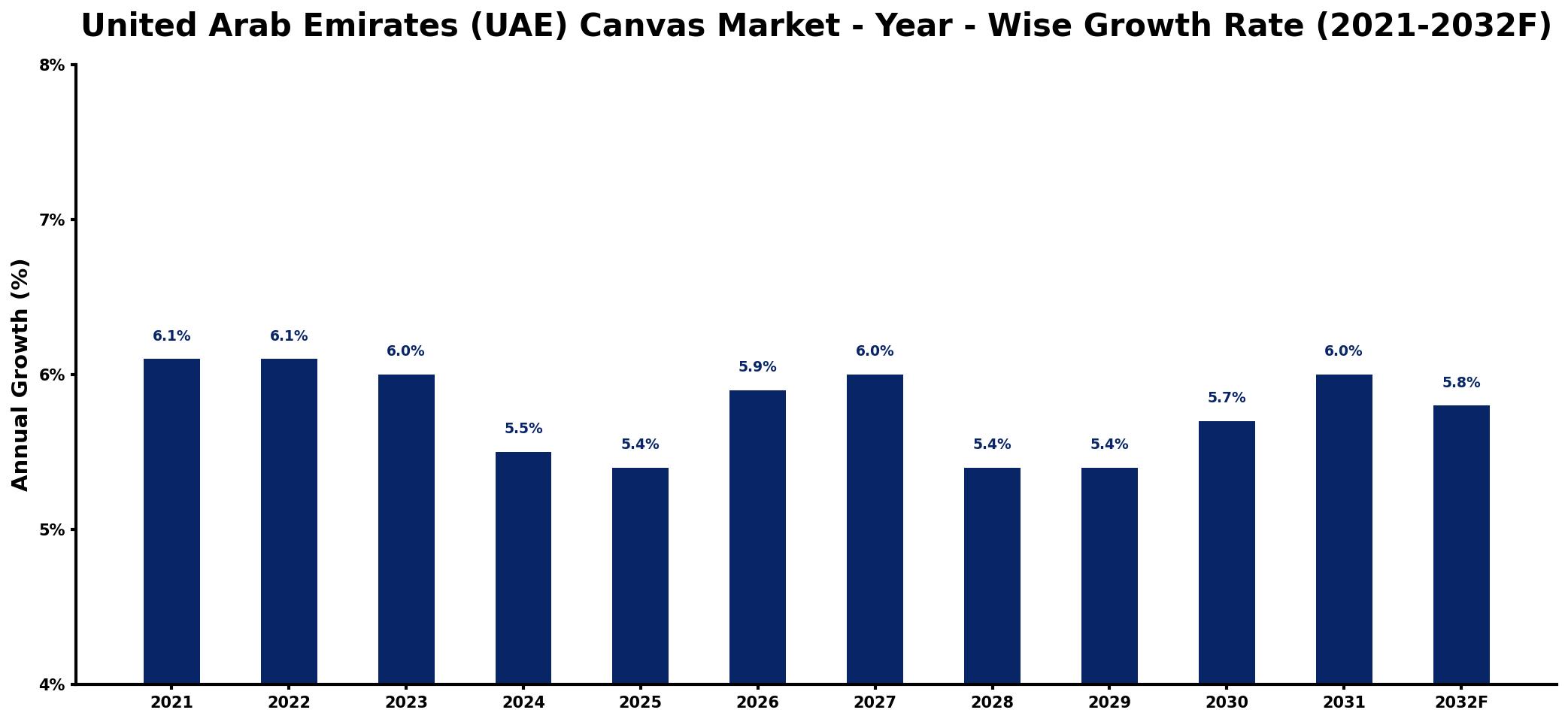
The table below presents the year‑wise growth rates along with the key drivers influencing the market
| Year | Growth Rate | Major Drivers |
| 2021 | 6.1% | Rising demand for custom art |
| 2022 | 6.1% | Increased investment in creative sectors |
| 2023 | 6.0% | Growth in online art sales |
| 2024 | 5.5% | Expansion of educational art programs |
| 2025 | 5.4% | Popularity of DIY home decor |
| 2026 | 5.9% | Emergence of eco-friendly materials |
| 2027 | 6.0% | Boost in cultural art events |
| 2028 | 5.4% | Demand for personalized gifts |
| 2029 | 5.4% | strengthening underlying market demand |
| 2030 | 5.7% | Interest in mixed media projects |
| 2031 | 6.0% | Rise of collaborative art spaces |
| 2032 | 5.8% | Increased focus on sustainable practices |
Note: Market size estimations and growth projections presented in this report are based on 6Wresearch's proprietary forecasting methodology, utilizing the latest available industry data, government publications, and primary research inputs.
United Arab Emirates (UAE) Canvas Market Synopsis
The strongest force shaping the UAE canvas market today is the burgeoning interest in local art and personalized decor. As artists and designers explore innovative uses of canvas, they are tapping into the cultural tapestry of the region, which is rich with history and artistic expression. This vibrant art scene has led to a higher demand for canvas products, driving sales across various consumer segments.
Furthermore, the canvas market caters to multiple industries, showcasing its flexibility beyond just artistic applications. From advertising materials to interior design, the demand for durable, high-quality canvas solutions continues to expand, bolstered by businesses seeking to create impactful visual narratives. This diverse applicability is vital for understanding the market's robust growth potential.
United Arab Emirates (UAE) Canvas Market Key Takeaways
- The canvas market is experiencing significant growth, driven by local art and design trends.
- Diverse applications, including advertising, are propelling demand for canvas solutions.
- Education and consumer awareness about canvas uses remain crucial for market expansion.
- Increased personalization in decor is a strong trend influencing market dynamics.
- Competition from digital alternatives challenges traditional canvas markets, requiring innovation.
Evaluation of Restraints in United Arab Emirates (UAE) Canvas Market
Despite the promising growth prospects, several restraints hinder the UAE canvas market's full potential. One of the most significant challenges is the competition posed by digital alternatives that offer lower costs and quicker production times. As businesses pivot toward digital solutions for advertising and décor, traditional canvas products may struggle to maintain their relevance. Additionally, there is a necessity to educate consumers about the broader applications of canvas, which remains an underutilized area. This lack of consumer awareness represents a substantial barrier to market expansion.
United Arab Emirates (UAE) Canvas Market Trends
The UAE canvas market is witnessing notable trends that are redefining its landscape. One of the most significant trends is the personalization of canvas products, where consumers are increasingly seeking customized artwork and decor to reflect their tastes. Concurrently, sustainability is gaining traction, with more businesses exploring eco-friendly canvas materials to appeal to environmentally conscious consumers. The rise of online platforms for art sales is also reshaping the way artists and businesses connect, facilitating greater market access and diversity.
United Arab Emirates (UAE) Canvas Market Opportunities
There are numerous avenues for growth within the UAE canvas market, particularly in expanding applications beyond traditional art and signage. Businesses that can educate consumers about the versatility of canvas—such as its use in fashion, event decor, and sustainable products—stand to benefit significantly. Furthermore, investment in technology and innovation for custom printing solutions can open new doors, meeting rising consumer demand for personalized offerings. Engaging in collaborations with local artists and designers can also enhance market presence and brand identity.
Government Initiatives in the United Arab Emirates (UAE) Canvas Market
Government initiatives aimed at fostering the arts and creative industries play a pivotal role in shaping the UAE canvas market. Various cultural programs and grants support local artists, encouraging artistic expression and innovation. Furthermore, public spending on cultural events and exhibitions promotes canvas applications, showcasing local talent and increasing consumer engagement in the art scene. Such initiatives not only boost market visibility but also cultivate a vibrant creative ecosystem within the UAE.
Future Insights of the United Arab Emirates (UAE) Canvas Market
Looking ahead to 2026-2032, the UAE canvas market is poised for continued growth, driven by evolving consumer preferences and technological advancements. As the local art scene flourishes and the demand for unique interior design solutions expands, businesses that adapt to these changes will thrive. Moreover, the integration of digital tools for custom canvas printing and art sales can enhance market reach and operational efficiency. Overall, the canvas market's adaptability will be key in navigating challenges and seizing new opportunities.
United Arab Emirates (UAE) Canvas Market Latest Developments (2025 - 2026)
In recent months, the UAE canvas market has seen a flurry of activity, with increased collaboration between artists and businesses to create bespoke canvas products. This trend has been particularly evident in interior design, where custom artwork is becoming a focal point. Additionally, local art fairs and exhibitions have gained momentum, providing a platform for artists to showcase their work, thus enhancing visibility for canvas products. The focus on sustainability has also led to experimentation with eco-friendly materials, reflecting a broader shift towards responsible consumption.
United Arab Emirates (UAE) Canvas Market - Key Attractiveness of the Report
- 10 Years of Market Numbers
- Historical Data Starting from 2022 to 2025
- Base Year: 2025
- Forecast Data until 2032
- Key Performance Indicators Impacting the Market
- Major Upcoming Developments and Projects
Key Highlights of the Report:
- United Arab Emirates (UAE) Canvas Market Outlook
- Market Size of United Arab Emirates (UAE) Canvas Market, 2025
- Forecast of United Arab Emirates (UAE) Canvas Market, 2032
- Historical Data and Forecast of United Arab Emirates (UAE) Canvas Revenues & Volume for the Period 2022-2032F
- United Arab Emirates (UAE) Canvas Market Trend Evolution
- United Arab Emirates (UAE) Canvas Market Drivers and Challenges
- United Arab Emirates (UAE) Canvas Price Trends
- United Arab Emirates (UAE) Canvas Porter's Five Forces
- United Arab Emirates (UAE) Canvas Industry Life Cycle
- Historical Data and Forecast of United Arab Emirates (UAE) Canvas Market Revenues & Volume By Types for the Period 2022-2032F
- Historical Data and Forecast of United Arab Emirates (UAE) Canvas Market Revenues & Volume By Plane Canvas for the Period 2022-2032F
- Historical Data and Forecast of United Arab Emirates (UAE) Canvas Market Revenues & Volume By Duck Canvas for the Period 2022-2032F
- Historical Data and Forecast of United Arab Emirates (UAE) Canvas Market Revenues & Volume By Application for the Period 2022-2032F
- Historical Data and Forecast of United Arab Emirates (UAE) Canvas Market Revenues & Volume By Tent for the Period 2022-2032F
- Historical Data and Forecast of United Arab Emirates (UAE) Canvas Market Revenues & Volume By Luggage Fabric for the Period 2022-2032F
- Historical Data and Forecast of United Arab Emirates (UAE) Canvas Market Revenues & Volume By Automotive Fabric for the Period 2022-2032F
- Historical Data and Forecast of United Arab Emirates (UAE) Canvas Market Revenues & Volume By Apparel for the Period 2022-2032F
- Historical Data and Forecast of United Arab Emirates (UAE) Canvas Market Revenues & Volume By Others for the Period 2022-2032F
- United Arab Emirates (UAE) Canvas Import Export Trade Statistics
- Market Opportunity Assessment By Types
- Market Opportunity Assessment By Application
- United Arab Emirates (UAE) Canvas Top Companies Market Share
- United Arab Emirates (UAE) Canvas Competitive Benchmarking By Technical and Operational Parameters
- United Arab Emirates (UAE) Canvas Company Profiles
- United Arab Emirates (UAE) Canvas Key Strategic Recommendations






































