United Arab Emirates (UAE) Cellulose Acetate Fiber Market Size, Share & Growth Rate
The United Arab Emirates (UAE) Cellulose Acetate Fiber Market was estimated at USD 750 Million in 2025 and is projected to reach USD 1087 Million by 2032, growing at a CAGR of 5.4% from 2026 to 2032. This growth trajectory is primarily fueled by the increasing demand for sustainable textiles amid growing consumer awareness surrounding environmental issues. Additionally, the versatile applications of cellulose acetate fibers in diverse industries, such as apparel and filtration, are enhancing market prospects.
United Arab Emirates (UAE) Cellulose Acetate Fiber Market Year-wise Growth Rate and Key Drivers
This graph highlights how the United Arab Emirates (UAE) Cellulose Acetate Fiber Market has steadily grown over the years, supported by major growth factors.
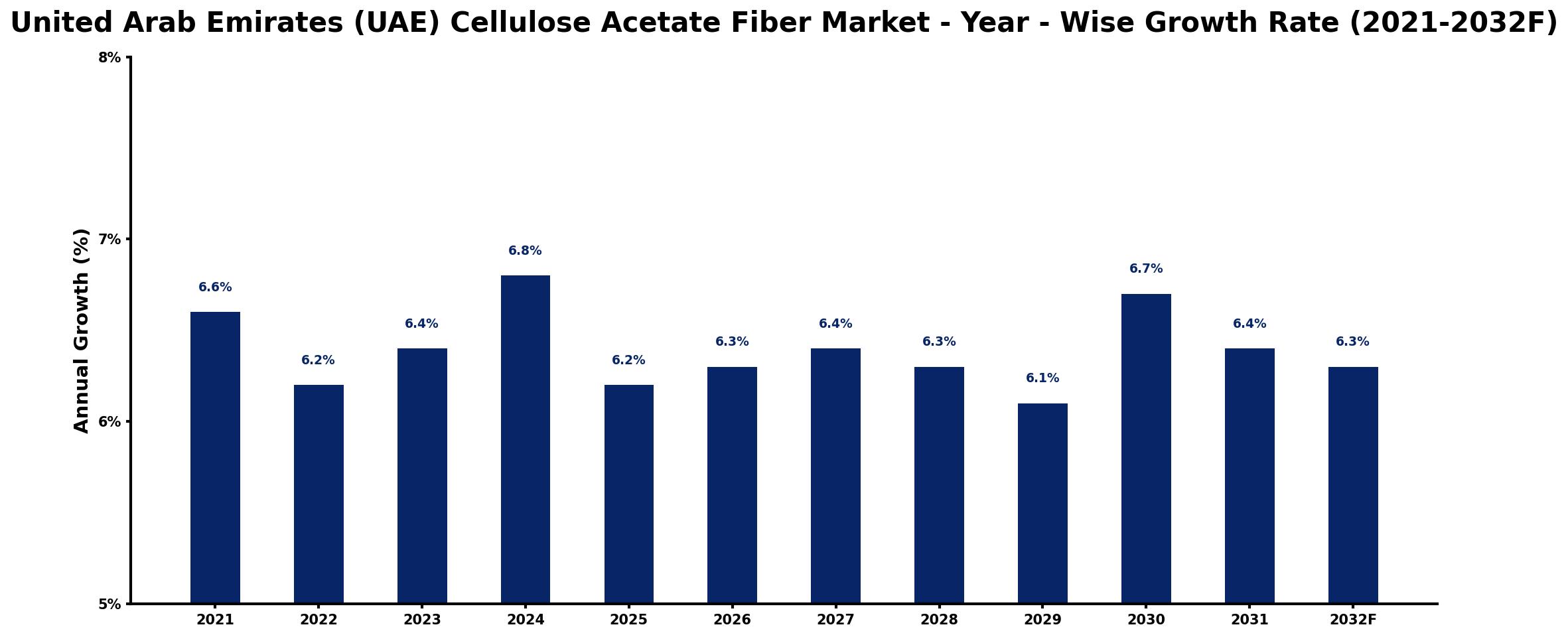
The table below presents the year‑wise growth rates along with the key drivers influencing the market
| Year | Growth Rate | Major Drivers |
| 2021 | 6.6% | Rising demand from textile industry |
| 2022 | 6.2% | Increased investments in manufacturing |
| 2023 | 6.4% | Growth in eco-friendly materials |
| 2024 | 6.8% | Expansion of fashion market trends |
| 2025 | 6.2% | Surge in consumer awareness initiatives |
| 2026 | 6.3% | Technological advancements in production |
| 2027 | 6.4% | Growing applications in automotive sector |
| 2028 | 6.3% | Increase in sustainable product offerings |
| 2029 | 6.1% | Rising popularity of biodegradable options |
| 2030 | 6.7% | Strengthening partnerships with retailers |
| 2031 | 6.4% | Growing demand for luxury textiles |
| 2032 | 6.3% | increased overall sector activity |
Note: Market size estimations and growth projections presented in this report are based on 6Wresearch's proprietary forecasting methodology, utilizing the latest available industry data, government publications, and primary research inputs.
United Arab Emirates (UAE) Cellulose Acetate Fiber Market Synopsis
The driving force behind the UAE Cellulose Acetate Fiber Market is the rising consumer preference for sustainable and eco-friendly materials in the textile industry. As awareness about environmental sustainability grows, cellulose acetate fibers, which are derived from natural resources, are gaining traction among environmentally-conscious consumers.
Furthermore, the unique properties of cellulose acetate fibers, such as breathability and moisture-wicking capabilities, are making them increasingly desirable in various applications. As the market evolves, the emphasis on comfort and sustainability remains paramount, positioning cellulose acetate fibers as a preferred choice across multiple sectors.
United Arab Emirates (UAE) Cellulose Acetate Fiber Market Key Takeaways
- The market is experiencing significant growth driven by demand for sustainable textile options.
- Cellulose acetate fibers are favored for their lightweight and breathable properties.
- The industry is adapting to post-pandemic consumer behavior changes favoring comfort and sustainability.
- Competition from synthetic fibers presents challenges that require innovative solutions.
- Government initiatives are likely to foster further market growth through sustainable practices.
Evaluation of Restraints in United Arab Emirates (UAE) Cellulose Acetate Fiber Market
The UAE Cellulose Acetate Fiber Market faces significant challenges stemming from fierce competition with synthetic alternatives, such as polyester and nylon. These synthetic fibers not only offer cost advantages but also possess comparable qualities that appeal to manufacturers and consumers alike. Moreover, sustainability concerns related to the production processes and disposal of cellulose acetate fibers may hinder broader acceptance. Thus, balancing cost-effectiveness with sustainable practices remains a crucial issue for companies within the market, requiring ongoing investment in eco-friendly technologies and practices.
United Arab Emirates (UAE) Cellulose Acetate Fiber Market Trends
Current trends in the UAE Cellulose Acetate Fiber Market include a rising focus on circular economy principles, where waste is minimized and materials are repurposed. Innovations in fiber technology are enabling more efficient production processes, enhancing the appeal of cellulose acetate fibers in the textile industry. Furthermore, the trend toward athleisure and comfortable clothing is boosting the demand for breathable and moisture-wicking materials. These trends are not only shaping consumer preferences but also guiding manufacturers toward more sustainable practices and products.
United Arab Emirates (UAE) Cellulose Acetate Fiber Market Opportunities
Opportunities for growth within the UAE Cellulose Acetate Fiber Market are abundant, particularly in the sectors of sustainable fashion and eco-friendly packaging. As brands prioritize sustainability in their supply chains, cellulose acetate fibers offer a viable alternative that aligns with these values. Additionally, the growing demand for performance fabrics in activewear presents an avenue for expansion. Investment in research and development to enhance fiber properties could further unlock new applications, making cellulose acetate fibers a competitive option against traditional synthetic materials.
Government Initiatives in the United Arab Emirates (UAE) Cellulose Acetate Fiber Market
The UAE government is increasingly emphasizing sustainability through various initiatives that support the cellulose acetate fiber market. Policies aimed at promoting eco-friendly manufacturing practices and reducing environmental footprints are encouraging companies to adopt more sustainable approaches. Moreover, public spending on green projects and incentives for research and development in sustainable materials contribute to a more favorable environment for market growth. These governmental efforts play a critical role in bolstering the cellulose acetate fiber industry's future viability.
Future Insights of the United Arab Emirates (UAE) Cellulose Acetate Fiber Market
Looking ahead to 2026-2032, the UAE Cellulose Acetate Fiber Market is anticipated to experience robust growth as consumers continue to prioritize sustainable options. The industry's adaptation to technological advancements in fiber production and its alignment with global sustainability trends will be pivotal in shaping market dynamics. As competition with synthetic fibers persists, ongoing innovation and emphasis on eco-friendliness will enhance cellulose acetate fibers' market positioning, likely leading to further adoption across diverse applications.
United Arab Emirates (UAE) Cellulose Acetate Fiber Market Latest Developments (2025 - 2026)
Recent developments in the UAE Cellulose Acetate Fiber Market indicate a shift towards enhancing sustainability practices. Companies are increasingly investing in advanced manufacturing techniques that minimize waste and promote recycling of cellulose acetate fibers. Additionally, collaborations between industry players and governmental bodies are fostering the development of standards for sustainable textiles. These efforts are expected to drive innovation and strengthen the market's commitment to environmental stewardship.
United Arab Emirates (UAE) Cellulose Acetate Fiber Market - Key Attractiveness of the Report
- 10 Years of Market Numbers
- Historical Data Starting from 2022 to 2025
- Base Year: 2025
- Forecast Data until 2032
- Key Performance Indicators Impacting the Market
- Major Upcoming Developments and Projects
Key Highlights of the Report:
- United Arab Emirates (UAE) Cellulose Acetate Fiber Market Outlook
- Market Size of United Arab Emirates (UAE) Cellulose Acetate Fiber Market, 2025
- Forecast of United Arab Emirates (UAE) Cellulose Acetate Fiber Market, 2032
- Historical Data and Forecast of United Arab Emirates (UAE) Cellulose Acetate Fiber Revenues & Volume for the Period 2022-2032F
- United Arab Emirates (UAE) Cellulose Acetate Fiber Market Trend Evolution
- United Arab Emirates (UAE) Cellulose Acetate Fiber Market Drivers and Challenges
- United Arab Emirates (UAE) Cellulose Acetate Fiber Price Trends
- United Arab Emirates (UAE) Cellulose Acetate Fiber Porter's Five Forces
- United Arab Emirates (UAE) Cellulose Acetate Fiber Industry Life Cycle
- Historical Data and Forecast of United Arab Emirates (UAE) Cellulose Acetate Fiber Market Revenues & Volume By Type for the Period 2022-2032F
- Historical Data and Forecast of United Arab Emirates (UAE) Cellulose Acetate Fiber Market Revenues & Volume By Plastic for the Period 2022-2032F
- Historical Data and Forecast of United Arab Emirates (UAE) Cellulose Acetate Fiber Market Revenues & Volume By Fiber for the Period 2022-2032F
- Historical Data and Forecast of United Arab Emirates (UAE) Cellulose Acetate Fiber Market Revenues & Volume By Application for the Period 2022-2032F
- Historical Data and Forecast of United Arab Emirates (UAE) Cellulose Acetate Fiber Market Revenues & Volume By Photographic Films for the Period 2022-2032F
- Historical Data and Forecast of United Arab Emirates (UAE) Cellulose Acetate Fiber Market Revenues & Volume By Cigarette Filters for the Period 2022-2032F
- Historical Data and Forecast of United Arab Emirates (UAE) Cellulose Acetate Fiber Market Revenues & Volume By Tapes & Labels for the Period 2022-2032F
- Historical Data and Forecast of United Arab Emirates (UAE) Cellulose Acetate Fiber Market Revenues & Volume By Textiles & Apparel for the Period 2022-2032F
- United Arab Emirates (UAE) Cellulose Acetate Fiber Import Export Trade Statistics
- Market Opportunity Assessment By Type
- Market Opportunity Assessment By Application
- United Arab Emirates (UAE) Cellulose Acetate Fiber Top Companies Market Share
- United Arab Emirates (UAE) Cellulose Acetate Fiber Competitive Benchmarking By Technical and Operational Parameters
- United Arab Emirates (UAE) Cellulose Acetate Fiber Company Profiles
- United Arab Emirates (UAE) Cellulose Acetate Fiber Key Strategic Recommendations






































