United Arab Emirates (UAE) Chlorofluorocarbon Market Size, Share & Growth Rate
The United Arab Emirates (UAE) Chlorofluorocarbon Market was estimated at USD 991 Million in 2025 and is projected to reach USD 1425 Million by 2032, growing at a CAGR of 5.3% from 2026 to 2032. This growth trajectory reflects a significant shift in the regulatory landscape as the UAE moves towards complying with international agreements aimed at phasing out ozone-depleting substances. The rising demand for air conditioning and refrigeration systems in the UAE, coupled with a proactive approach toward adopting eco-friendly alternatives, is driving this market forward.
United Arab Emirates (UAE) Chlorofluorocarbon Market Year-wise Growth Rate and Key Drivers
This graph highlights how the United Arab Emirates (UAE) Chlorofluorocarbon Market has steadily grown over the years, supported by major growth factors.
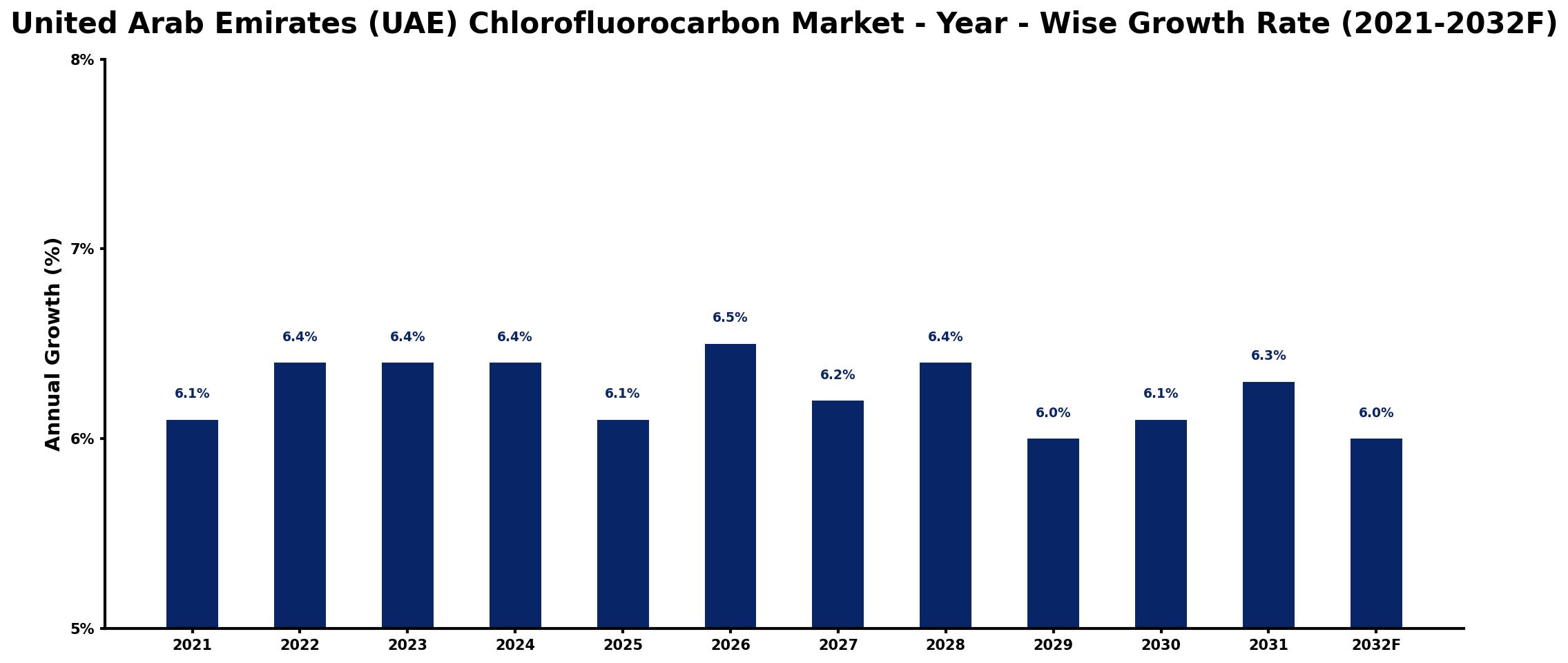
The table below presents the year‑wise growth rates along with the key drivers influencing the market
| Year | Growth Rate | Major Drivers |
| 2021 | 6.1% | Increased demand from refrigeration sector |
| 2022 | 6.4% | Growing investments in HVAC systems |
| 2023 | 6.4% | Expansion of construction industry projects |
| 2024 | 6.4% | Rising consumer electronics manufacturing |
| 2025 | 6.1% | Emerging markets boosting industrial output |
| 2026 | 6.5% | Technological advancements in cooling applications |
| 2027 | 6.2% | Strengthening regulations promoting efficiency |
| 2028 | 6.4% | Increased focus on sustainable practices |
| 2029 | 6.0% | Growth in automotive air conditioning |
| 2030 | 6.1% | Rising demand for commercial refrigeration |
| 2031 | 6.3% | Increasing awareness of energy efficiency |
| 2032 | 6.0% | rising end-use demand growth |
Note: Market size estimations and growth projections presented in this report are based on 6Wresearch's proprietary forecasting methodology, utilizing the latest available industry data, government publications, and primary research inputs.
United Arab Emirates (UAE) Chlorofluorocarbon Market Synopsis
The UAE Chlorofluorocarbon market is witnessing a pivotal transition as industries adapt to stringent environmental regulations. As a result, there is an increasing shift toward refrigerants and propellants that are less harmful to the ozone layer. This transition is particularly evident in the HVAC sector, where the adoption of alternative refrigerants is crucial to meet the growing demand for cooling solutions.
In this context, the market is redefining its supply chains and production techniques. The push for more sustainable practices is not only influencing product development but also shaping consumer preferences. Companies are now compelled to invest in research and development to innovate and offer safer alternatives, thereby aligning with global trends in environmental sustainability.
United Arab Emirates (UAE) Chlorofluorocarbon Market Key Takeaways
- The market is gradually transitioning from CFCs to environmentally-friendly alternatives.
- Increased demand for air conditioning and refrigeration drives the adoption of compliant refrigerants.
- Compliance with international agreements poses both a challenge and an opportunity for market players.
- Investment in R&D is crucial for companies seeking to thrive in this changing landscape.
- Logistical challenges remain regarding the management of existing CFC inventories.
Evaluation of Restraints in United Arab Emirates (UAE) Chlorofluorocarbon Market
Despite the market's growth potential, several restraints impede progress. Key among them is the stringent compliance with international agreements, compelling businesses to phase out CFCs while developing environmentally friendly alternatives. This shift necessitates substantial investments in R&D and the development of new infrastructure. Additionally, fluctuating global demand complicates the market dynamics as industries adapt to regulatory changes, further challenging operational stability.
United Arab Emirates (UAE) Chlorofluorocarbon Market Trends
Emerging trends in the UAE Chlorofluorocarbon market indicate a robust transition towards green technologies. The rapid advancement of refrigeration and air conditioning systems is paving the way for the adoption of next-generation refrigerants such as HFCs and HCFCs. Moreover, the commitment to sustainability is being mirrored in public policies that incentivize environmentally responsible practices across industries, shaping the future of the market.
United Arab Emirates (UAE) Chlorofluorocarbon Market Opportunities
The ongoing transition to sustainable alternatives offers numerous growth opportunities for stakeholders in the UAE Chlorofluorocarbon market. Companies that successfully innovate and develop eco-friendly refrigerants and propellants are well-positioned to capture a significant share of the market. Furthermore, government initiatives aimed at enhancing energy efficiency and sustainability could create investment avenues for businesses focused on R&D in this sector.
Government Initiatives in the United Arab Emirates (UAE) Chlorofluorocarbon Market
The UAE government is actively engaged in promoting sustainability, leading to the introduction of policies that encourage the reduction of ozone-depleting substances. Programs aimed at enhancing energy efficiency in residential and commercial buildings are gaining momentum. Moreover, the government is supporting initiatives that align with international environmental agreements, facilitating a smoother transition toward compliant refrigerants.
Future Insights of the United Arab Emirates (UAE) Chlorofluorocarbon Market
Looking ahead to 2026-2032, the UAE Chlorofluorocarbon market is expected to evolve significantly. The drive for sustainability will lead to increased adoption of innovative refrigerants and technologies. The regulatory framework will continue to shape market dynamics, compelling companies to innovate rapidly. Stakeholders who capitalize on these shifts will likely see substantial growth as the market realigns with environmental priorities.
United Arab Emirates (UAE) Chlorofluorocarbon Market Latest Developments (2025 - 2026)
Recent developments in the UAE Chlorofluorocarbon market indicate a clear focus on transitioning to more sustainable practices. Industry stakeholders are increasingly participating in forums and initiatives aimed at enhancing awareness and knowledge regarding eco-friendly refrigerants. Additionally, advancements in technology are fostering collaborations among companies seeking to develop compliant solutions that align with international standards.
United Arab Emirates (UAE) Chlorofluorocarbon Market - Key Attractiveness of the Report
- 10 Years of Market Numbers
- Historical Data Starting from 2022 to 2025
- Base Year: 2025
- Forecast Data until 2032
- Key Performance Indicators Impacting the Market
- Major Upcoming Developments and Projects
Key Highlights of the Report:
- United Arab Emirates (UAE) Chlorofluorocarbon Market Outlook
- Market Size of United Arab Emirates (UAE) Chlorofluorocarbon Market, 2025
- Forecast of United Arab Emirates (UAE) Chlorofluorocarbon Market, 2032
- Historical Data and Forecast of United Arab Emirates (UAE) Chlorofluorocarbon Revenues & Volume for the Period 2022-2032F
- United Arab Emirates (UAE) Chlorofluorocarbon Market Trend Evolution
- United Arab Emirates (UAE) Chlorofluorocarbon Market Drivers and Challenges
- United Arab Emirates (UAE) Chlorofluorocarbon Price Trends
- United Arab Emirates (UAE) Chlorofluorocarbon Porter's Five Forces
- United Arab Emirates (UAE) Chlorofluorocarbon Industry Life Cycle
- Historical Data and Forecast of United Arab Emirates (UAE) Chlorofluorocarbon Market Revenues & Volume By Type for the Period 2022-2032F
- Historical Data and Forecast of United Arab Emirates (UAE) Chlorofluorocarbon Market Revenues & Volume By CFC-11 for the Period 2022-2032F
- Historical Data and Forecast of United Arab Emirates (UAE) Chlorofluorocarbon Market Revenues & Volume By CFC-12 for the Period 2022-2032F
- Historical Data and Forecast of United Arab Emirates (UAE) Chlorofluorocarbon Market Revenues & Volume By CFC-113 for the Period 2022-2032F
- Historical Data and Forecast of United Arab Emirates (UAE) Chlorofluorocarbon Market Revenues & Volume By CFC-114 for the Period 2022-2032F
- Historical Data and Forecast of United Arab Emirates (UAE) Chlorofluorocarbon Market Revenues & Volume By CFC-115 for the Period 2022-2032F
- Historical Data and Forecast of United Arab Emirates (UAE) Chlorofluorocarbon Market Revenues & Volume By Others for the Period 2022-2032F
- Historical Data and Forecast of United Arab Emirates (UAE) Chlorofluorocarbon Market Revenues & Volume By Application for the Period 2022-2032F
- Historical Data and Forecast of United Arab Emirates (UAE) Chlorofluorocarbon Market Revenues & Volume By Aerosol Propellants for the Period 2022-2032F
- Historical Data and Forecast of United Arab Emirates (UAE) Chlorofluorocarbon Market Revenues & Volume By Blowing Agent for the Period 2022-2032F
- Historical Data and Forecast of United Arab Emirates (UAE) Chlorofluorocarbon Market Revenues & Volume By Refrigerants for the Period 2022-2032F
- Historical Data and Forecast of United Arab Emirates (UAE) Chlorofluorocarbon Market Revenues & Volume By Others for the Period 2022-2032F
- United Arab Emirates (UAE) Chlorofluorocarbon Import Export Trade Statistics
- Market Opportunity Assessment By Type
- Market Opportunity Assessment By Application
- United Arab Emirates (UAE) Chlorofluorocarbon Top Companies Market Share
- United Arab Emirates (UAE) Chlorofluorocarbon Competitive Benchmarking By Technical and Operational Parameters
- United Arab Emirates (UAE) Chlorofluorocarbon Company Profiles
- United Arab Emirates (UAE) Chlorofluorocarbon Key Strategic Recommendations






































