United Arab Emirates (UAE) Christmas Tree Market Size, Share & Growth Rate
The United Arab Emirates (UAE) Christmas Tree Market was estimated at USD 456 Million in 2025 and is projected to reach USD 597 Million by 2032, growing at a CAGR of 3.9% from 2026 to 2032. This growth trajectory is driven primarily by the increasing number of expatriates celebrating Christmas, alongside the rise in festive spending within the UAE's multicultural communities. The strong presence of retail and online platforms further fuels demand for both artificial and natural Christmas trees, enhancing the seasonal shopping experience.
United Arab Emirates (UAE) Christmas Tree Market Year-wise Growth Rate and Key Drivers
This graph highlights how the United Arab Emirates (UAE) Christmas Tree Market has steadily grown over the years, supported by major growth factors.
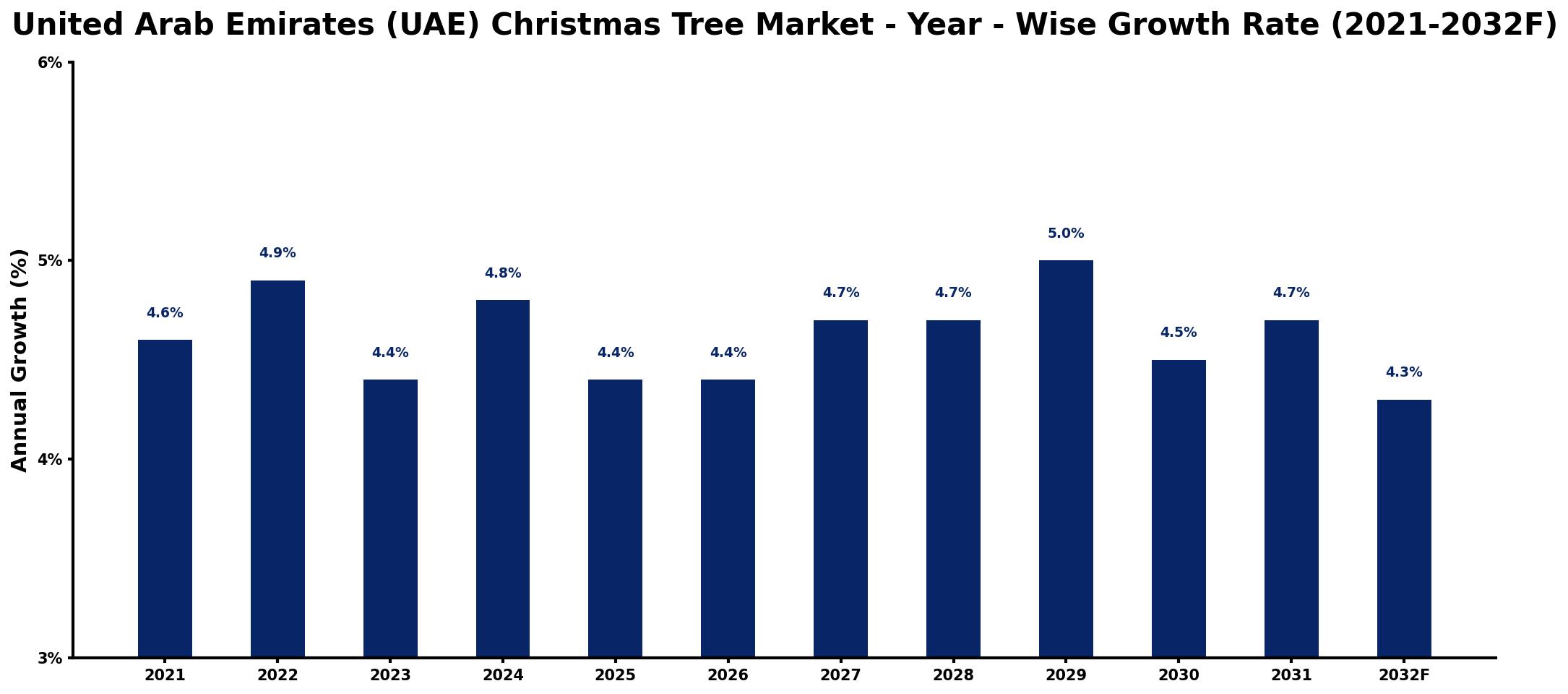
The table below presents the year‑wise growth rates along with the key drivers influencing the market
| Year | Growth Rate | Major Drivers |
| 2021 | 4.6% | Growing interest in festive decor |
| 2022 | 4.9% | Increase in holiday-themed events |
| 2023 | 4.4% | Rising disposable income levels |
| 2024 | 4.8% | Expansion of online retail platforms |
| 2025 | 4.4% | Surge in home decoration trends |
| 2026 | 4.4% | Increased consumer spending habits |
| 2027 | 4.7% | More festive tourism initiatives |
| 2028 | 4.7% | Growth in corporate gifting practices |
| 2029 | 5.0% | Popularity of eco-friendly options |
| 2030 | 4.5% | Enhanced marketing strategies deployed |
| 2031 | 4.7% | Diverse product offerings available |
| 2032 | 4.3% | Strengthened community celebration activities |
Note: Market size estimations and growth projections presented in this report are based on 6Wresearch's proprietary forecasting methodology, utilizing the latest available industry data, government publications, and primary research inputs.
United Arab Emirates (UAE) Christmas Tree Market Synopsis
The festive spirit in the UAE is exemplified by the growing demand for Christmas trees, particularly among the diverse expatriate population. Shopping malls, hotels, and restaurants actively participate in creating an enchanting holiday atmosphere, thereby boosting the market's visibility and reach.
Additionally, the popularity of artificial Christmas trees has surged due to their convenience and longevity. Retailers are increasingly recognizing the importance of festive offerings, adapting their stock to meet consumer preferences for quality decorations and accessories that align with the celebratory spirit of the season.
United Arab Emirates (UAE) Christmas Tree Market Key Takeaways
- The UAE Christmas Tree Market is largely driven by the countrys multicultural demographics and the celebration of Christmas among expatriates.
- There is a significant demand for both artificial and real Christmas trees, with artificial options becoming increasingly favored for their ease of use.
- Shopping centers and hospitality venues contribute significantly to the market by enhancing festive experiences through elaborate decorations.
- Online retail has seen a marked increase in importance, with many consumers opting for convenient online shopping for holiday decorations.
- Seasonal shifts in consumer behavior can significantly influence the sales landscape, especially following disruptions like the COVID-19 pandemic.
Evaluation of Restraints in United Arab Emirates (UAE) Christmas Tree Market
The UAE Christmas Tree Market faces several notable restraints. Firstly, the dominant Muslim demographic presents inherent cultural challenges, as Christmas is not a widely celebrated holiday. This limits the overall market potential. Logistical issues, particularly with the importation of real Christmas trees, raise concerns regarding sustainability and environmental impact, influencing consumer preferences. Additionally, competition from alternative festive decorations and the complexities involved in marketing Christmas-related products in a culturally diverse environment require careful navigation and targeted strategies.
United Arab Emirates (UAE) Christmas Tree Market Trends
Current trends in the UAE Christmas Tree Market reflect a growing preference for sustainable and eco-friendly products, particularly artificial trees made from recyclable materials. Additionally, personalized decorations and themed setups are on the rise, as consumers seek unique ways to express their festive spirit. The role of social media in showcasing holiday displays and decorations is increasingly influential, driving customer engagement and inspiring festive creativity.
United Arab Emirates (UAE) Christmas Tree Market Opportunities
There are ample opportunities for growth within the UAE Christmas Tree Market, particularly through enhanced e-commerce platforms and partnerships with local businesses. Creating bespoke Christmas experiences in shopping malls and public spaces presents another avenue for driving sales. Furthermore, targeting niche markets such as corporate gifts and decoration services offers exciting potential for expansion as consumer preferences continue to evolve.
Government Initiatives in the United Arab Emirates (UAE) Christmas Tree Market
The UAE government actively supports the multicultural tapestry of the nation through initiatives that promote inclusivity and celebration of various cultural festivals, including Christmas. Public spending on events and festive attractions often reflects a commitment to enhancing the holiday experience for residents and visitors alike. These initiatives encourage businesses to participate in seasonal marketing, fostering an environment conducive to market growth.
Future Insights of the United Arab Emirates (UAE) Christmas Tree Market
Looking ahead to 2026-2032, the UAE Christmas Tree Market is set for a period of rejuvenation as consumer confidence rebounds. The evolving landscape will likely see greater adoption of digital platforms for shopping and engagement, alongside a continued emphasis on sustainable practices. As the multicultural nature of the UAE persists, the market is expected to diversify, reflecting changing consumer preferences and expanded festive offerings.
United Arab Emirates (UAE) Christmas Tree Market Latest Developments (2025 - 2026)
In recent months, there has been a noticeable shift toward the use of locally sourced materials in Christmas decorations, with several retailers introducing lines that emphasize sustainability. Additionally, the market has witnessed a surge in interactive online experiences, allowing consumers to visualize holiday decorations in their own homes before purchasing. As holiday celebrations become increasingly prominent in public forums, the demand for innovative and immersive seasonal experiences continues to grow.
United Arab Emirates (UAE) Christmas Tree Market - Key Attractiveness of the Report
- 10 Years of Market Numbers
- Historical Data Starting from 2022 to 2025
- Base Year: 2025
- Forecast Data until 2032
- Key Performance Indicators Impacting the Market
- Major Upcoming Developments and Projects
Key Highlights of the Report:
- United Arab Emirates (UAE) Christmas Tree Market Outlook
- Market Size of United Arab Emirates (UAE) Christmas Tree Market, 2025
- Forecast of United Arab Emirates (UAE) Christmas Tree Market, 2032
- Historical Data and Forecast of United Arab Emirates (UAE) Christmas Tree Revenues & Volume for the Period 2022-2032F
- United Arab Emirates (UAE) Christmas Tree Market Trend Evolution
- United Arab Emirates (UAE) Christmas Tree Market Drivers and Challenges
- United Arab Emirates (UAE) Christmas Tree Price Trends
- United Arab Emirates (UAE) Christmas Tree Porter's Five Forces
- United Arab Emirates (UAE) Christmas Tree Industry Life Cycle
- Historical Data and Forecast of United Arab Emirates (UAE) Christmas Tree Market Revenues & Volume By Type for the Period 2022-2032F
- Historical Data and Forecast of United Arab Emirates (UAE) Christmas Tree Market Revenues & Volume By Horizontal Tree for the Period 2022-2032F
- Historical Data and Forecast of United Arab Emirates (UAE) Christmas Tree Market Revenues & Volume By Vertical Tree for the Period 2022-2032F
- Historical Data and Forecast of United Arab Emirates (UAE) Christmas Tree Market Revenues & Volume By Location of Deployment for the Period 2022-2032F
- Historical Data and Forecast of United Arab Emirates (UAE) Christmas Tree Market Revenues & Volume By Onshore for the Period 2022-2032F
- Historical Data and Forecast of United Arab Emirates (UAE) Christmas Tree Market Revenues & Volume By Offshore for the Period 2022-2032F
- United Arab Emirates (UAE) Christmas Tree Import Export Trade Statistics
- Market Opportunity Assessment By Type
- Market Opportunity Assessment By Location of Deployment
- United Arab Emirates (UAE) Christmas Tree Top Companies Market Share
- United Arab Emirates (UAE) Christmas Tree Competitive Benchmarking By Technical and Operational Parameters
- United Arab Emirates (UAE) Christmas Tree Company Profiles
- United Arab Emirates (UAE) Christmas Tree Key Strategic Recommendations






































