United Arab Emirates (UAE) Cloud Computing Market Size & Growth Rate (2026-2032)
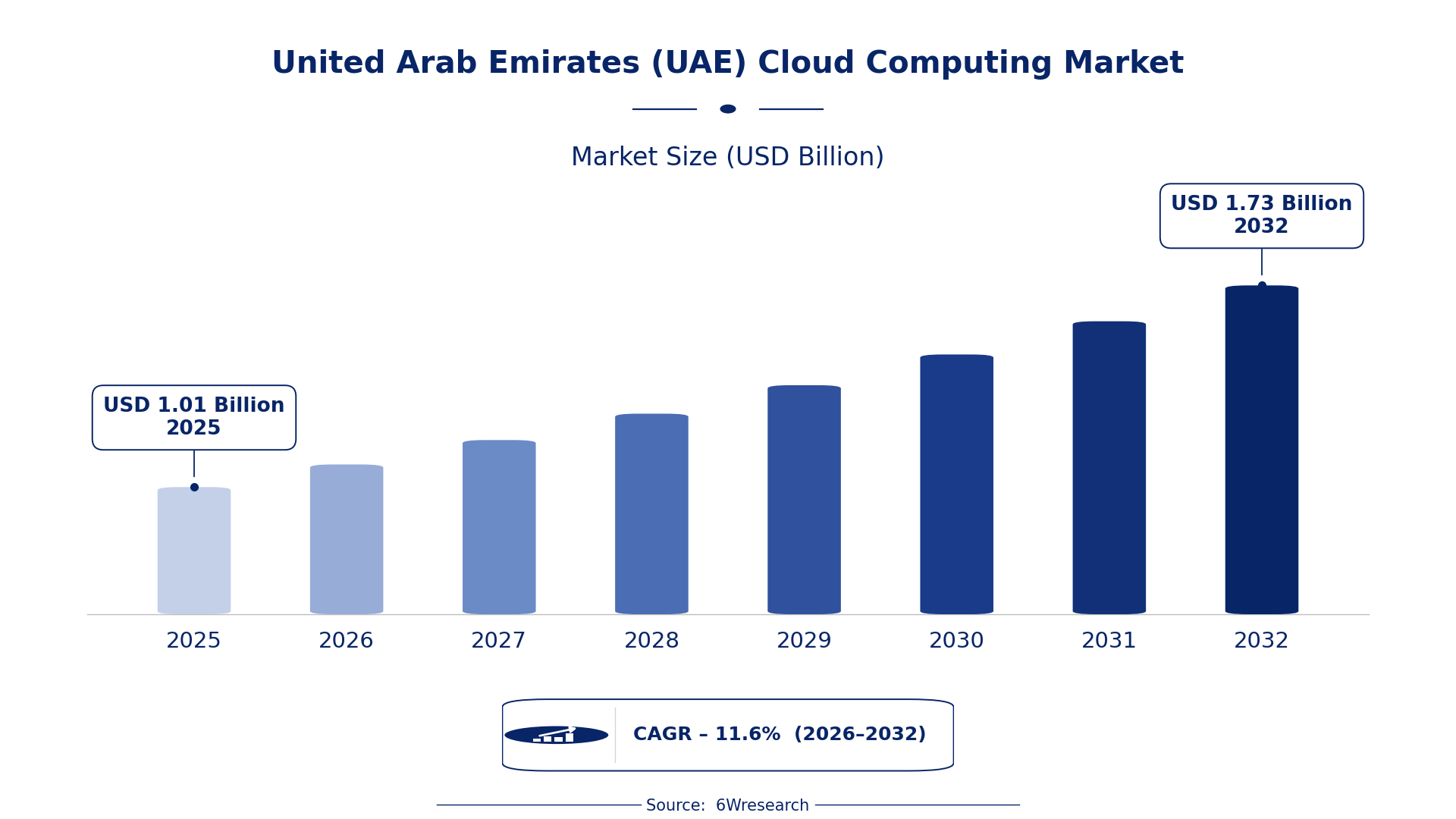
The United Arab Emirates (UAE) Cloud Computing Market was estimated at USD 1012 Million in 2025 and is projected to reach USD 1734 Million by 2032, growing at a CAGR of 11.6% from 2026 to 2032.
United Arab Emirates (UAE) Cloud Computing Market Synopsis
The cloud computing market in the UAE is experiencing a surge as organizations increasingly realize the benefits of cloud migration. What was once a slow transition is now accelerating, with both private and public sectors racing to leverage the cloud for enhanced operational efficiency.
Looking ahead, the market is set to maintain its upward trajectory, driven by the UAE's strategic vision to become a global technology leader. This ambition is supported by government initiatives that encourage digital transformation, setting the stage for sustained growth in cloud adoption.
United Arab Emirates (UAE) Cloud Computing Market Year-wise Growth Rate and Key Drivers
This graph illustrates the annual growth rates of the United Arab Emirates (UAE) Cloud Computing Market from 2021 to 2032, highlighting a steady upward trajectory and projected expansion over the forecast period.
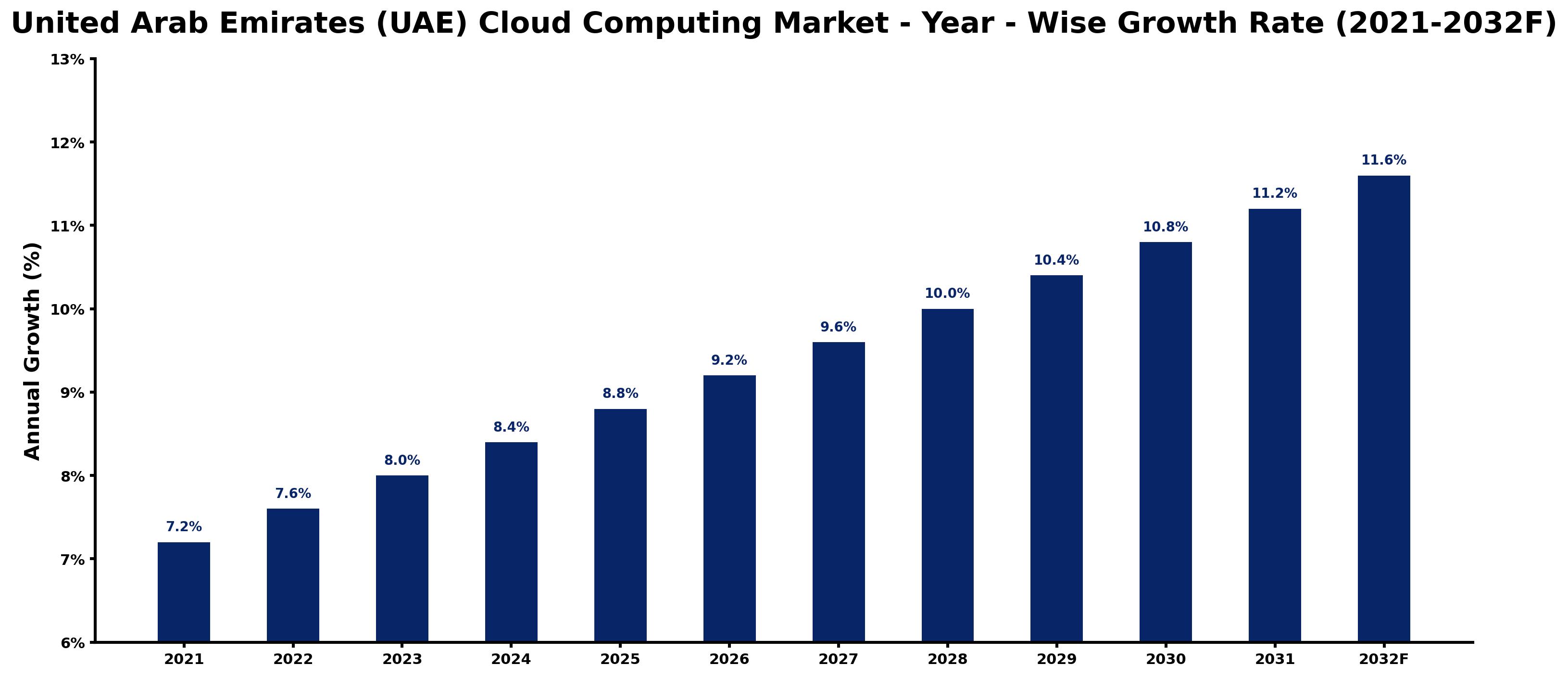
The table below presents the year‑wise growth rates along with the key drivers influencing the market
| Year | Growth Rate | Major Drivers |
| 2021 | 7.2% | UAE's Digital Government Strategy boosting cloud adoption. |
| 2022 | 7.6% | Dubai's push for smart city initiatives driving demand. |
| 2023 | 8.0% | Increased investment in data centers by local firms. |
| 2024 | 8.4% | UAE's 5G rollout enhancing cloud service accessibility. |
| 2025 | 8.8% | Government support for local tech startups intensifying competition. |
| 2026 | 9.2% | National AI Strategy increasing reliance on cloud solutions. |
| 2027 | 9.6% | Rising e-commerce popularity necessitating robust cloud infrastructure. |
| 2028 | 10.0% | Regional businesses migrating to cloud for scalability benefits. |
| 2029 | 10.4% | Enhanced cybersecurity regulations promoting cloud services uptake. |
| 2030 | 10.8% | UAE hosting global tech events elevating cloud visibility. |
| 2031 | 11.2% | Emergence of cloud-native applications driving customer demand. |
| 2032 | 11.6% | Sustainability goals encouraging green cloud solutions adoption. |
Note: Market size estimations and growth projections presented in this report are based on 6Wresearch's proprietary forecasting methodology, utilizing the latest available industry data, government publications, and primary research inputs.
United Arab Emirates (UAE) Cloud Computing Market Key Takeaways
Below are some of the specific key takeaways from the market, including:
- The UAE government's commitment to digital innovation is a primary driver of cloud adoption.
- Organizations are increasingly migrating to cloud solutions to enhance flexibility and scalability.
- The demand for data storage and processing capabilities is pushing the growth of cloud services.
- Remote work trends are significantly influencing the cloud service uptake across various sectors.
- Local and international providers are intensifying competition with diverse offerings in the market.
Evaluation of Restraints in United Arab Emirates (UAE) Cloud Computing Market
Despite the momentum, the UAE cloud computing market grapples with a notable skills gap. The rapid pace of technological advancements necessitates a skilled workforce proficient in cloud technologies. This talent shortage can hinder the adoption of cloud solutions and slow down innovation efforts, impacting the overall growth of the market.
United Arab Emirates (UAE) Cloud Computing Market Trends
Several trends are shaping the UAE cloud computing market. First, the increasing shift towards hybrid cloud environments reflects a growing preference for flexibility and data control. Additionally, industries are prioritizing cloud security as cyber threats become more sophisticated. The rise of artificial intelligence and machine learning capabilities is also encouraging organizations to adopt cloud solutions that can support these technologies.
United Arab Emirates (UAE) Cloud Computing Market Opportunities
There are substantial growth opportunities within the UAE cloud computing market. The government’s digital transformation initiatives create a favorable environment for investments in cloud infrastructure. Startups and SMEs are increasingly seeking scalable solutions to enhance their operations, opening avenues for service providers. on top of that, the rising demand for data analytics services presents an opportunity for cloud platforms to differentiate themselves through specialized offerings.
Government Initiatives in the United Arab Emirates (UAE) Cloud Computing Market
The UAE government actively supports the cloud computing market through various initiatives aimed at fostering digital transformation. With a clear vision to become a technological hub, public policies are designed to enhance cloud adoption across sectors. These initiatives not only focus on infrastructure but also on regulatory frameworks that facilitate innovation.
- A national digital infrastructure upgrade programme recently completed to enhance connectivity across the UAE.
- Current initiatives include the establishment of cloud service regulations that promote transparency and security for consumers.
- A planned public-private partnership is expected to expand cloud service accessibility to small businesses by 2027.
- The government is currently working on a digital skills development programme aimed at bridging the talent gap in cloud technologies.
- A forthcoming initiative set to launch in 2026 will introduce tax incentives for businesses investing in cloud solutions.
Future Insights of the United Arab Emirates (UAE) Cloud Computing Market
From 2026 to 2032, the UAE cloud computing market is expected to evolve significantly. Continuous government support and a growing appetite for advanced technological solutions will drive this growth. As businesses increasingly rely on data-driven insights, cloud services that integrate AI and machine learning capabilities will likely dominate the market. The overall trajectory points toward a more integrated digital ecosystem, where cloud solutions become foundational to operational strategies across sectors.
United Arab Emirates (UAE) Cloud Computing Market Latest Developments
In the past year, the UAE cloud computing market has seen a flurry of activity. Major players are enhancing their offerings to meet the rising demand for scalable and secure cloud solutions. Companies are also forming strategic partnerships to expand their service capabilities and reach.
- A leading regional operator announced the launch of a new cloud service platform designed for SMEs, initiated in Q1 2025.
- In mid-2025, a major technology vendor rolled out an advanced cybersecurity service tailored specifically for cloud environments.
- A recent partnership formed between two cloud service providers aims to enhance data analytics capabilities for enterprise clients, which began in early 2025 and is ongoing.
- By late 2025, an expansion project is expected to increase the cloud infrastructure capacity significantly, addressing the growing demand.
- Upcoming in mid-2026 is a new initiative focused on integrating blockchain technology into cloud services for improved transparency.
United Arab Emirates (UAE) Cloud Computing Market - Key Attractiveness of the Report
- 10 Years of Market Numbers
- Historical Data Starting from 2022 to 2025
- Base Year: 2025
- Forecast Data until 2032
- Key Performance Indicators Impacting the Market
- Major Upcoming Developments and Projects
Key Highlights of the Report:
- United Arab Emirates (UAE) Cloud Computing Market Outlook
- Market Size of United Arab Emirates (UAE) Cloud Computing Market, 2025
- Forecast of United Arab Emirates (UAE) Cloud Computing Market, 2032
- Historical Data and Forecast of United Arab Emirates (UAE) Cloud Computing Revenues & Volume for the Period 2022-2032F
- United Arab Emirates (UAE) Cloud Computing Market Trend Evolution
- United Arab Emirates (UAE) Cloud Computing Market Drivers and Challenges
- United Arab Emirates (UAE) Cloud Computing Price Trends
- United Arab Emirates (UAE) Cloud Computing Porter's Five Forces
- United Arab Emirates (UAE) Cloud Computing Industry Life Cycle
- Historical Data and Forecast of United Arab Emirates (UAE) Cloud Computing Market Revenues & Volume By Service Model for the Period 2022-2032F
- Historical Data and Forecast of United Arab Emirates (UAE) Cloud Computing Market Revenues & Volume By Infrastructure as a Service for the Period 2022-2032F
- Historical Data and Forecast of United Arab Emirates (UAE) Cloud Computing Market Revenues & Volume By Platform as a Service for the Period 2022-2032F
- Historical Data and Forecast of United Arab Emirates (UAE) Cloud Computing Market Revenues & Volume By Software as a Service for the Period 2022-2032F
- Historical Data and Forecast of United Arab Emirates (UAE) Cloud Computing Market Revenues & Volume By Infrastructure as a Service for the Period 2022-2032F
- Historical Data and Forecast of United Arab Emirates (UAE) Cloud Computing Market Revenues & Volume By Primary Storage for the Period 2022-2032F
- Historical Data and Forecast of United Arab Emirates (UAE) Cloud Computing Market Revenues & Volume By Disaster Recovery and Backup for the Period 2022-2032F
- Historical Data and Forecast of United Arab Emirates (UAE) Cloud Computing Market Revenues & Volume By Archiving for the Period 2022-2032F
- Historical Data and Forecast of United Arab Emirates (UAE) Cloud Computing Market Revenues & Volume By Computer for the Period 2022-2032F
- Historical Data and Forecast of United Arab Emirates (UAE) Cloud Computing Market Revenues & Volume By Platform as a Service for the Period 2022-2032F
- Historical Data and Forecast of United Arab Emirates (UAE) Cloud Computing Market Revenues & Volume By Application Development and Platforms for the Period 2022-2032F
- Historical Data and Forecast of United Arab Emirates (UAE) Cloud Computing Market Revenues & Volume By Application Testing and Quality for the Period 2022-2032F
- Historical Data and Forecast of United Arab Emirates (UAE) Cloud Computing Market Revenues & Volume By Analytics and Reporting for the Period 2022-2032F
- Historical Data and Forecast of United Arab Emirates (UAE) Cloud Computing Market Revenues & Volume By Integration and Orchestration for the Period 2022-2032F
- Historical Data and Forecast of United Arab Emirates (UAE) Cloud Computing Market Revenues & Volume By Data Management for the Period 2022-2032F
- Historical Data and Forecast of United Arab Emirates (UAE) Cloud Computing Market Revenues & Volume By Software as a Service for the Period 2022-2032F
- Historical Data and Forecast of United Arab Emirates (UAE) Cloud Computing Market Revenues & Volume By Customer Relationship Management for the Period 2022-2032F
- Historical Data and Forecast of United Arab Emirates (UAE) Cloud Computing Market Revenues & Volume By Enterprise Resource Management for the Period 2022-2032F
- Historical Data and Forecast of United Arab Emirates (UAE) Cloud Computing Market Revenues & Volume By Human Capital Management for the Period 2022-2032F
- Historical Data and Forecast of United Arab Emirates (UAE) Cloud Computing Market Revenues & Volume By Content Management for the Period 2022-2032F
- Historical Data and Forecast of United Arab Emirates (UAE) Cloud Computing Market Revenues & Volume By Collaboration and Productivity Suites for the Period 2022-2032F
- Historical Data and Forecast of United Arab Emirates (UAE) Cloud Computing Market Revenues & Volume By Supply Chain Management for the Period 2022-2032F
- Historical Data and Forecast of United Arab Emirates (UAE) Cloud Computing Market Revenues & Volume By Others for the Period 2022-2032F
- Historical Data and Forecast of United Arab Emirates (UAE) Cloud Computing Market Revenues & Volume By Organization Size for the Period 2022-2032F
- Historical Data and Forecast of United Arab Emirates (UAE) Cloud Computing Market Revenues & Volume By Large Enterprises for the Period 2022-2032F
- Historical Data and Forecast of United Arab Emirates (UAE) Cloud Computing Market Revenues & Volume By SMEs for the Period 2022-2032F
- Historical Data and Forecast of United Arab Emirates (UAE) Cloud Computing Market Revenues & Volume By Deployment Model for the Period 2022-2032F
- Historical Data and Forecast of United Arab Emirates (UAE) Cloud Computing Market Revenues & Volume By Public Cloud for the Period 2022-2032F
- Historical Data and Forecast of United Arab Emirates (UAE) Cloud Computing Market Revenues & Volume By Private Cloud for the Period 2022-2032F
- Historical Data and Forecast of United Arab Emirates (UAE) Cloud Computing Market Revenues & Volume By Verticals for the Period 2022-2032F
- Historical Data and Forecast of United Arab Emirates (UAE) Cloud Computing Market Revenues & Volume By BFSI for the Period 2022-2032F
- Historical Data and Forecast of United Arab Emirates (UAE) Cloud Computing Market Revenues & Volume By Telecommunication for the Period 2022-2032F
- Historical Data and Forecast of United Arab Emirates (UAE) Cloud Computing Market Revenues & Volume By IT & ITeS for the Period 2022-2032F
- Historical Data and Forecast of United Arab Emirates (UAE) Cloud Computing Market Revenues & Volume By Government & Public Sector for the Period 2022-2032F
- Historical Data and Forecast of United Arab Emirates (UAE) Cloud Computing Market Revenues & Volume By Retail & Consumer Goods for the Period 2022-2032F
- Historical Data and Forecast of United Arab Emirates (UAE) Cloud Computing Market Revenues & Volume By Manufacturing for the Period 2022-2032F
- Historical Data and Forecast of United Arab Emirates (UAE) Cloud Computing Market Revenues & Volume By Energy & Utility for the Period 2022-2032F
- Historical Data and Forecast of United Arab Emirates (UAE) Cloud Computing Market Revenues & Volume By Media & Entertainment for the Period 2022-2032F
- United Arab Emirates (UAE) Cloud Computing Import Export Trade Statistics
- Market Opportunity Assessment By Service Model
- Market Opportunity Assessment By Infrastructure as a Service
- Market Opportunity Assessment By Platform as a Service
- Market Opportunity Assessment By Software as a Service
- Market Opportunity Assessment By Organization Size
- Market Opportunity Assessment By Deployment Model
- Market Opportunity Assessment By Verticals
- United Arab Emirates (UAE) Cloud Computing Top Companies Market Share
- United Arab Emirates (UAE) Cloud Computing Competitive Benchmarking By Technical and Operational Parameters
- United Arab Emirates (UAE) Cloud Computing Company Profiles
- United Arab Emirates (UAE) Cloud Computing Key Strategic Recommendations






































