United Arab Emirates (UAE) Cloud Infrastructure Services Market Size & Growth Rate (2026-2032)
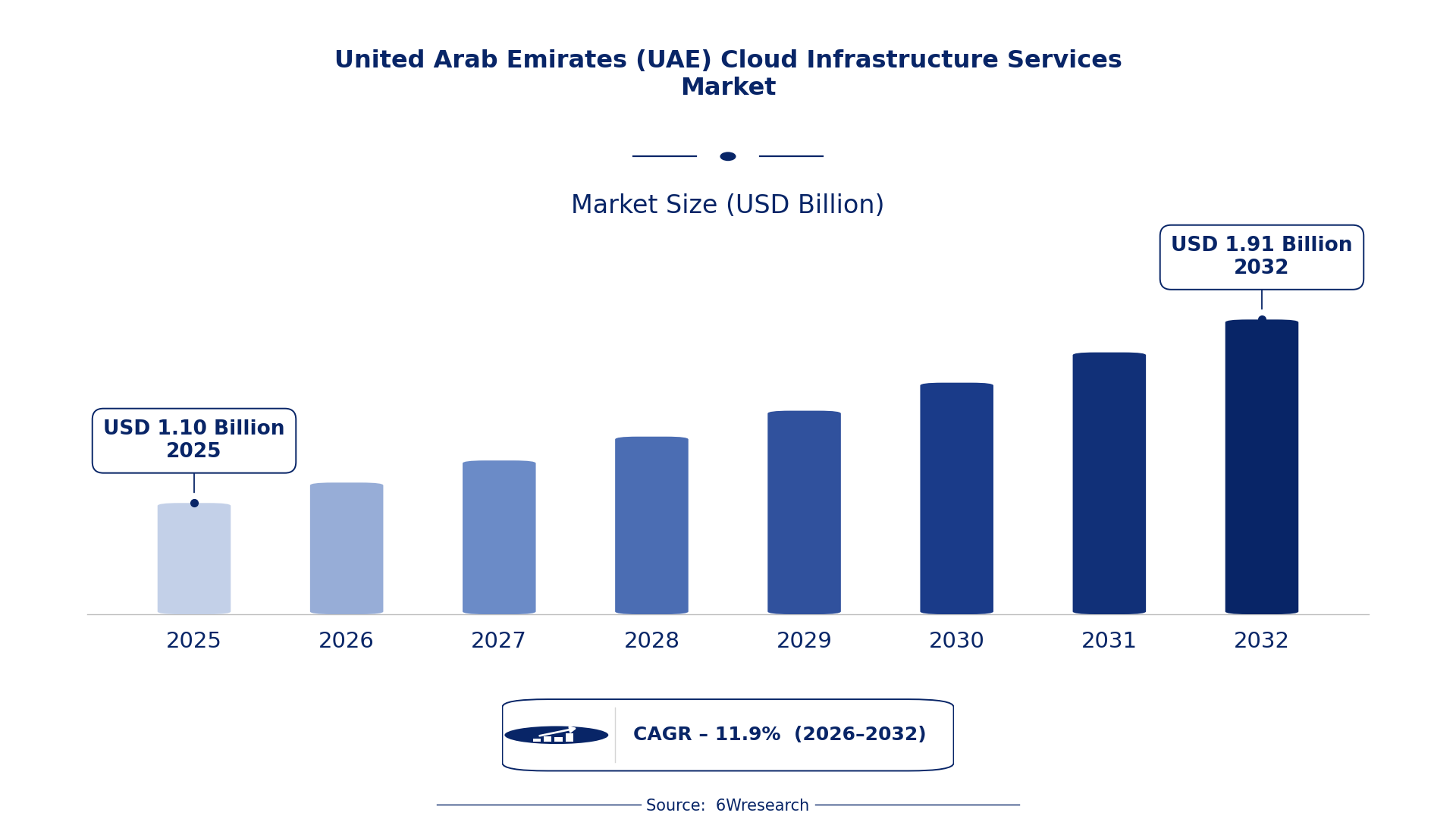
The United Arab Emirates (UAE) Cloud Infrastructure Services Market was estimated at USD 1097 Million in 2025 and is projected to reach USD 1911 Million by 2032, growing at a CAGR of 11.9% from 2026 to 2032.
United Arab Emirates (UAE) Cloud Infrastructure Services Market Synopsis
The demand for cloud infrastructure services in the UAE is soaring as organizations increasingly pivot towards digital-first operations. This shift is not merely a trend; it reflects a deep-seated need for flexible, scalable solutions that can adapt to the fast-paced business environment.
As local enterprises embark on their digital transformation journeys, they are discovering that cloud infrastructure not only enhances operational efficiency but also significantly reduces capital expenditures. The growing emphasis on data security and compliance further solidifies the case for adopting local cloud services.
United Arab Emirates (UAE) Cloud Infrastructure Services Market Year-wise Growth Rate and Key Drivers
This graph illustrates the annual growth rates of the United Arab Emirates (UAE) Cloud Infrastructure Services Market from 2021 to 2032, highlighting a steady upward trajectory and projected expansion over the forecast period.
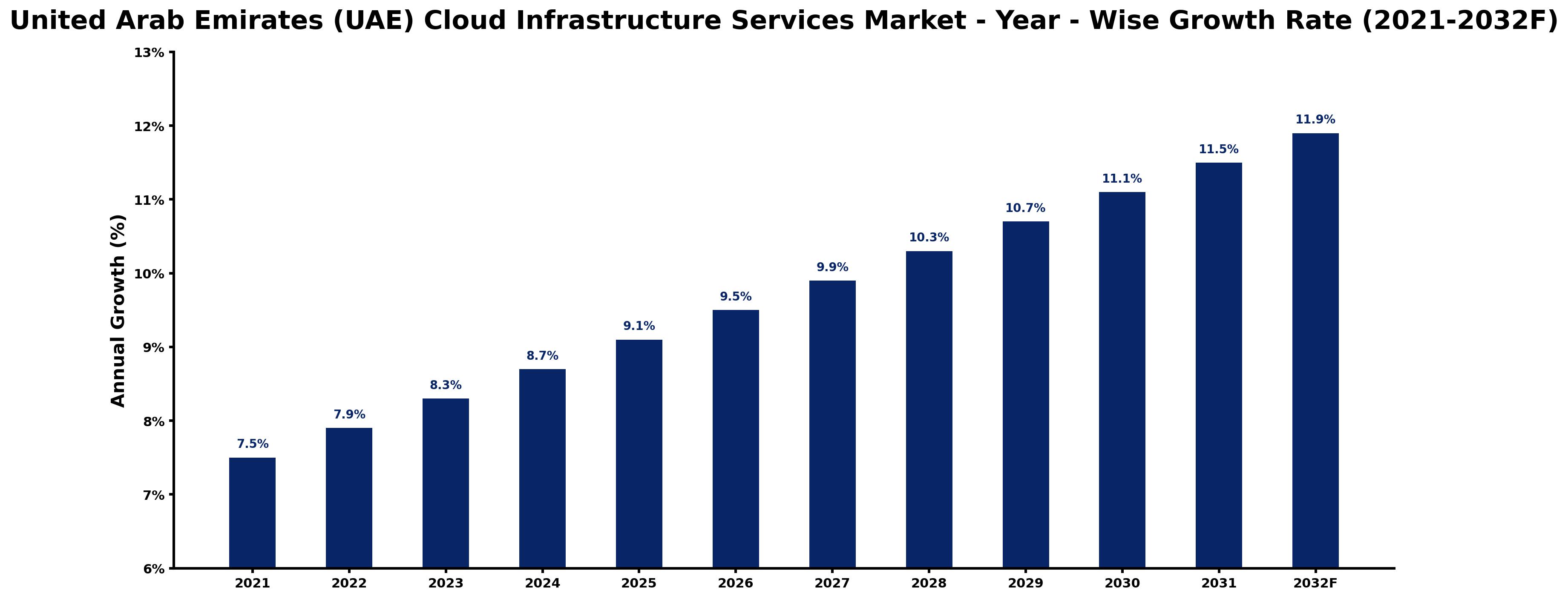
The table below presents the year‑wise growth rates along with the key drivers influencing the market
| Year | Growth Rate | Major Drivers |
| 2021 | 7.5% | ADDED Regulation promoting cloud adoption among local businesses. |
| 2022 | 7.9% | UAE AI strategy driving cloud-based solutions adoption. |
| 2023 | 8.3% | Rise in digital banking necessitating robust cloud solutions. |
| 2024 | 8.7% | 5G rollout pushing demand for cloud-enabled applications. |
| 2025 | 9.1% | Government initiatives boosting startup funding in tech sectors. |
| 2026 | 9.5% | Increased cybersecurity regulations driving secure cloud services. |
| 2027 | 9.9% | Growth of remote work requiring scalable cloud infrastructures. |
| 2028 | 10.3% | Healthcare digitalization demands advanced cloud storage solutions. |
| 2029 | 10.7% | Education sector's shift to online learning increasing cloud usage. |
| 2030 | 11.1% | Tourism recovery driving investments in cloud for hospitality. |
| 2031 | 11.5% | Sustainability goals encouraging green cloud technology adoption. |
| 2032 | 11.9% | Smart logistics expansion requiring efficient cloud management systems. |
Note: Market size estimations and growth projections presented in this report are based on 6Wresearch's proprietary forecasting methodology, utilizing the latest available industry data, government publications, and primary research inputs.
United Arab Emirates (UAE) Cloud Infrastructure Services Market Key Takeaways
Below are some of the specific key takeaways from the market, including:
- The UAE is witnessing increased adoption of cloud solutions across various sectors, driven by government initiatives and digital transformation strategies.
- Local providers are gaining traction as businesses seek to balance global standards with regional compliance and data sovereignty.
- The COVID-19 pandemic acted as a catalyst, accelerating the demand for remote work solutions and cloud-based infrastructure.
- Investment in cybersecurity is becoming paramount, as organizations prioritize the protection of sensitive data in cloud environments.
- Emerging technologies, such as AI and IoT, are increasingly integrated with cloud services, driving innovation and new service offerings.
Evaluation of Restraints in United Arab Emirates (UAE) Cloud Infrastructure Services Market
Despite the market's promising growth trajectory, several constraints hinder its full potential. A prevalent concern among organizations is the reliability of cloud services, particularly regarding downtime risks. Ensuring that service providers deliver high availability while minimizing disruptions is crucial for building trust. Additionally, the fast-paced nature of technological advancements often outstrips the capability of some local firms to keep pace, creating a gap in service offerings that could limit overall market growth.
United Arab Emirates (UAE) Cloud Infrastructure Services Market Trends
A notable trend in the UAE Cloud Infrastructure Services Market is the increasing integration of artificial intelligence (AI) and machine learning (ML) technologies. Businesses are leveraging these tools to optimize their cloud operations, enhance data analytics, and improve decision-making processes. Additionally, there is a growing focus on hybrid cloud solutions, allowing organizations to balance their on-premises infrastructure with cloud capabilities.
The commitment to sustainability is also shaping the market, with companies increasingly seeking energy-efficient cloud services that align with their corporate social responsibility goals. This trend not only addresses environmental concerns but also resonates with customers who prioritize sustainability in their business partnerships.
United Arab Emirates (UAE) Cloud Infrastructure Services Market Opportunities
Opportunities abound for businesses in the UAE Cloud Infrastructure Services Market. As the government continues to invest in digitalization initiatives, companies can position themselves as key players by offering tailored solutions that meet the evolving needs of both public and private sectors. The push for smart cities also presents avenues for cloud service providers to engage in partnerships that facilitate innovative solutions.
on top of that, the increasing importance of data sovereignty and security presents a unique chance for local providers to differentiate themselves from global competitors. Offering services that cater specifically to the regulatory and compliance needs of UAE organizations can yield significant competitive advantages.
Government Initiatives in the United Arab Emirates (UAE) Cloud Infrastructure Services Market
Government policy is a crucial driver of growth in the UAE Cloud Infrastructure Services Market. With a clear focus on digital transformation and smart city initiatives, the UAE government is actively fostering an environment that encourages cloud adoption. Regulatory frameworks are being established to ensure data protection and security, which are vital for building confidence in cloud solutions.
- A national digital infrastructure upgrade programme now in its rollout phase aims to enhance the connectivity and efficiency of cloud services across the country.
- Ongoing efforts to establish a regulatory framework focusing on data sovereignty are set to strengthen local cloud service providers.
- Plans for the launch of a public-private partnership expected to support the development of cloud computing capabilities for small and medium-sized enterprises by 2026.
- Recent initiatives have introduced standards for cloud security compliance to protect sensitive data in line with international regulations.
Future Insights of the United Arab Emirates (UAE) Cloud Infrastructure Services Market
The future of the UAE Cloud Infrastructure Services Market appears bright, driven by continuous advancements in technology and a supportive governmental framework. As organizations increasingly recognize the strategic importance of cloud solutions, we can expect heightened investments and innovations in the sector.
By 2032, the landscape will likely feature a more competitive environment with enhanced offerings from both local and international players. The integration of next-gen technologies, including AI, will further transform service delivery and client engagement, ensuring that the UAE remains at the forefront of cloud infrastructure developments.
United Arab Emirates (UAE) Cloud Infrastructure Services Market Latest Developments
Recent activities in the UAE Cloud Infrastructure Services Market indicate a surge in innovation and collaboration among industry players. Over the past year, the market has seen a flurry of new service offerings and partnerships aimed at enhancing cloud capabilities.
- A major technology vendor launched a new suite of cloud services designed specifically for the financial sector in late 2025, focusing on compliance and security features.
- In early 2026, a leading regional operator announced an expansion of its data center footprint to accommodate growing demand for cloud storage and processing.
- Currently ongoing is a collaborative initiative between several enterprises to develop a comprehensive cloud solution tailored for the healthcare industry.
- A rollout expected to begin in mid-2026 aims to enhance cloud service accessibility for educational institutions across the UAE.
United Arab Emirates (UAE) Cloud Infrastructure Services Market - Key Attractiveness of the Report
- 10 Years of Market Numbers
- Historical Data Starting from 2022 to 2025
- Base Year: 2025
- Forecast Data until 2032
- Key Performance Indicators Impacting the Market
- Major Upcoming Developments and Projects
Key Highlights of the Report:
- United Arab Emirates (UAE) Cloud Infrastructure Services Market Outlook
- Market Size of United Arab Emirates (UAE) Cloud Infrastructure Services Market, 2025
- Forecast of United Arab Emirates (UAE) Cloud Infrastructure Services Market, 2032
- Historical Data and Forecast of United Arab Emirates (UAE) Cloud Infrastructure Services Revenues & Volume for the Period 2022-2032F
- United Arab Emirates (UAE) Cloud Infrastructure Services Market Trend Evolution
- United Arab Emirates (UAE) Cloud Infrastructure Services Market Drivers and Challenges
- United Arab Emirates (UAE) Cloud Infrastructure Services Price Trends
- United Arab Emirates (UAE) Cloud Infrastructure Services Porter's Five Forces
- United Arab Emirates (UAE) Cloud Infrastructure Services Industry Life Cycle
- Historical Data and Forecast of United Arab Emirates (UAE) Cloud Infrastructure Services Market Revenues & Volume By Service Type for the Period 2022-2032F
- Historical Data and Forecast of United Arab Emirates (UAE) Cloud Infrastructure Services Market Revenues & Volume By Compute as a Service for the Period 2022-2032F
- Historical Data and Forecast of United Arab Emirates (UAE) Cloud Infrastructure Services Market Revenues & Volume By Storage as a Service for the Period 2022-2032F
- Historical Data and Forecast of United Arab Emirates (UAE) Cloud Infrastructure Services Market Revenues & Volume By Disaster Recovery and Backup as a Service for the Period 2022-2032F
- Historical Data and Forecast of United Arab Emirates (UAE) Cloud Infrastructure Services Market Revenues & Volume By Networking as a Service for the Period 2022-2032F
- Historical Data and Forecast of United Arab Emirates (UAE) Cloud Infrastructure Services Market Revenues & Volume By Desktop as a Service for the Period 2022-2032F
- Historical Data and Forecast of United Arab Emirates (UAE) Cloud Infrastructure Services Market Revenues & Volume By Managed Hosting for the Period 2022-2032F
- Historical Data and Forecast of United Arab Emirates (UAE) Cloud Infrastructure Services Market Revenues & Volume By Deployment Type for the Period 2022-2032F
- Historical Data and Forecast of United Arab Emirates (UAE) Cloud Infrastructure Services Market Revenues & Volume By On-premises for the Period 2022-2032F
- Historical Data and Forecast of United Arab Emirates (UAE) Cloud Infrastructure Services Market Revenues & Volume By Cloud for the Period 2022-2032F
- Historical Data and Forecast of United Arab Emirates (UAE) Cloud Infrastructure Services Market Revenues & Volume By Organization Size for the Period 2022-2032F
- Historical Data and Forecast of United Arab Emirates (UAE) Cloud Infrastructure Services Market Revenues & Volume By Small and Medium-sized Enterprises (SMEs) for the Period 2022-2032F
- Historical Data and Forecast of United Arab Emirates (UAE) Cloud Infrastructure Services Market Revenues & Volume By Large Enterprises for the Period 2022-2032F
- Historical Data and Forecast of United Arab Emirates (UAE) Cloud Infrastructure Services Market Revenues & Volume By Vertical for the Period 2022-2032F
- Historical Data and Forecast of United Arab Emirates (UAE) Cloud Infrastructure Services Market Revenues & Volume By Banking, Financial Services, and Insurance (BFSI) for the Period 2022-2032F
- Historical Data and Forecast of United Arab Emirates (UAE) Cloud Infrastructure Services Market Revenues & Volume By IT and Telecommunications for the Period 2022-2032F
- Historical Data and Forecast of United Arab Emirates (UAE) Cloud Infrastructure Services Market Revenues & Volume By Government and Public Sector for the Period 2022-2032F
- Historical Data and Forecast of United Arab Emirates (UAE) Cloud Infrastructure Services Market Revenues & Volume By Retail and Consumer Goods for the Period 2022-2032F
- Historical Data and Forecast of United Arab Emirates (UAE) Cloud Infrastructure Services Market Revenues & Volume By Manufacturing for the Period 2022-2032F
- Historical Data and Forecast of United Arab Emirates (UAE) Cloud Infrastructure Services Market Revenues & Volume By Energy and Utilities for the Period 2022-2032F
- Historical Data and Forecast of United Arab Emirates (UAE) Cloud Infrastructure Services Market Revenues & Volume By Media and Entertainment for the Period 2022-2032F
- Historical Data and Forecast of United Arab Emirates (UAE) Cloud Infrastructure Services Market Revenues & Volume By Healthcare and Life Sciences for the Period 2022-2032F
- United Arab Emirates (UAE) Cloud Infrastructure Services Import Export Trade Statistics
- Market Opportunity Assessment By Service Type
- Market Opportunity Assessment By Deployment Type
- Market Opportunity Assessment By Organization Size
- Market Opportunity Assessment By Vertical
- United Arab Emirates (UAE) Cloud Infrastructure Services Top Companies Market Share
- United Arab Emirates (UAE) Cloud Infrastructure Services Competitive Benchmarking By Technical and Operational Parameters
- United Arab Emirates (UAE) Cloud Infrastructure Services Company Profiles
- United Arab Emirates (UAE) Cloud Infrastructure Services Key Strategic Recommendations






































