United Arab Emirates (UAE) Computer Numerically Controlled Market Size, Share & Growth Rate
The United Arab Emirates (UAE) Computer Numerically Controlled Market was estimated at USD 788 Million in 2025 and is projected to reach USD 1151 Million by 2032, growing at a CAGR of 5.6% from 2026 to 2032. This upward trajectory is driven by the UAE's expanding manufacturing base, particularly in the aerospace and automotive sectors. Coupled with increasing investments in automation and advanced manufacturing technologies, this growth signals a robust demand for precision machinery across various industries.
United Arab Emirates (UAE) Computer Numerically Controlled Market Year-wise Growth Rate and Key Drivers
This graph highlights how the United Arab Emirates (UAE) Computer Numerically Controlled Market has steadily grown over the years, supported by major growth factors.
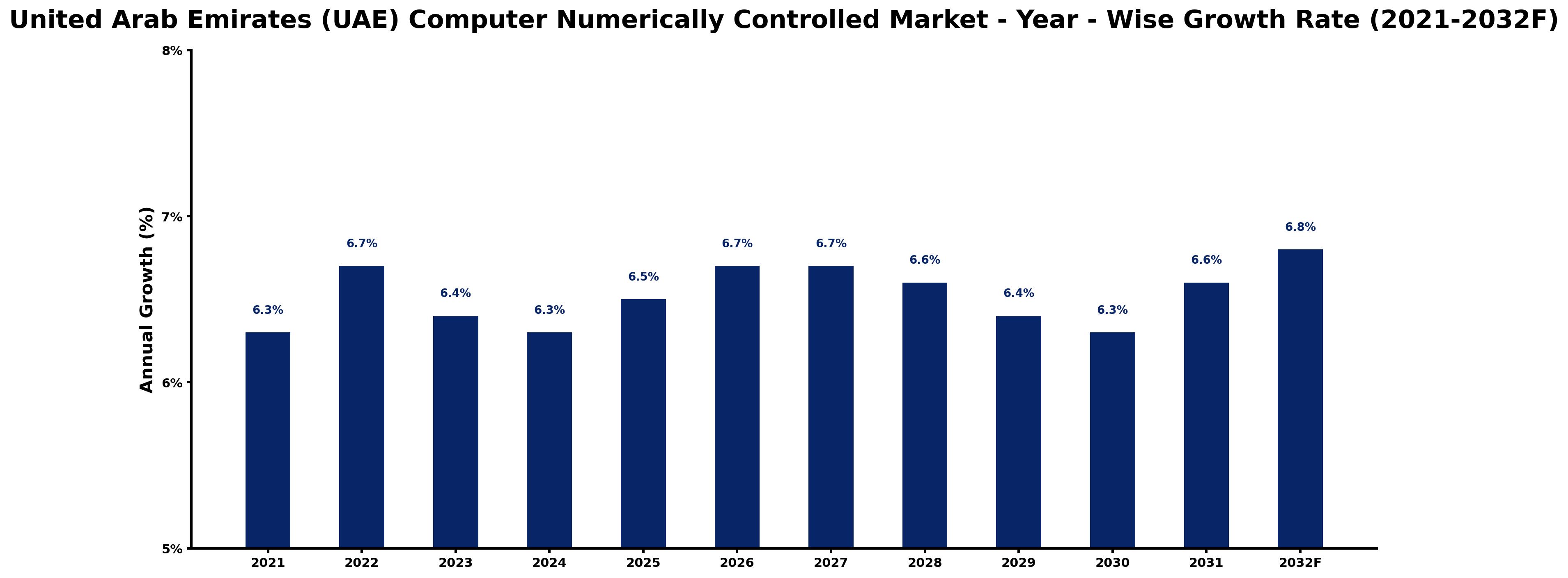
The table below presents the year‑wise growth rates along with the key drivers influencing the market
| Year | Growth Rate | Major Drivers |
| 2021 | 6.3% | Rapid growth in telecom and data center sectors |
| 2022 | 6.7% | Rising electricity demand across industries |
| 2023 | 6.4% | Increasing adoption of advanced technologies |
| 2024 | 6.3% | Government infrastructure modernization initiatives |
| 2025 | 6.5% | Growing renewable energy integration projects |
| 2026 | 6.7% | Rising electricity demand across industries |
| 2027 | 6.7% | Government infrastructure modernization initiatives |
| 2028 | 6.6% | Increasing industrial infrastructure investments |
| 2029 | 6.4% | Increasing industrial automation investments |
| 2030 | 6.3% | Expansion of commercial construction activities |
| 2031 | 6.6% | Increasing industrial automation investments |
| 2032 | 6.8% | Increasing adoption of advanced technologies |
Note - Market size estimations and growth projections presented in this report are based on 6Wresearch's advanced forecasting approach, validated with industry datasets as of June 2026.
United Arab Emirates (UAE) Computer Numerically Controlled Market Synopsis
The UAE CNC market has shown remarkable resilience in recent years, propelled by a combination of government initiatives and industrial investments. The focus on manufacturing automation and digitalization has created a fertile environment for CNC technologies, setting the stage for continued expansion. Looking ahead, the market is poised for growth as industries embrace modern manufacturing practices and the adoption of Industry 4.0 principles accelerates.
As companies in the UAE seek to enhance productivity and maintain competitive advantages, the demand for CNC machines is expected to rise. With a commitment to quality and innovation, the market is well-positioned to meet the evolving needs of various sectors, including aerospace, automotive, and electronics. This dynamism reflects broader trends in the manufacturing landscape, where precision and efficiency are paramount.
United Arab Emirates (UAE) Computer Numerically Controlled Market Key Takeaways
- The UAE CNC market is set to experience significant growth, driven by the expansion of manufacturing sectors.
- Government support for industrial automation is fostering greater adoption of CNC technologies.
- Industry 4.0 principles are increasingly influencing manufacturing strategies, pushing for advanced CNC solutions.
- As SMEs grow, there will be a rising demand for cost-effective and efficient CNC machine options.
- Market resilience post-COVID underscores the importance of automation in future-proofing manufacturing operations.
Evaluation of Restraints in United Arab Emirates (UAE) Computer Numerically Controlled Market
Despite the positive growth trajectory, the UAE CNC market faces several notable restraints. Intense competition from international manufacturers may limit the market share of local companies, compelling them to innovate continuously. Furthermore, the significant initial investment and ongoing maintenance costs associated with CNC machines can deter small and medium-sized enterprises from adopting these technologies. The supply chain disruptions experienced during the COVID-19 pandemic also highlighted vulnerabilities that could impact demand fluctuations in the future.
United Arab Emirates (UAE) Computer Numerically Controlled Market Trends
Several trends are shaping the UAE CNC market, primarily driven by technological advancements and industry requirements. One key trend is the integration of smart technologies within CNC systems, allowing for enhanced data connectivity and automation capabilities. Additionally, the increasing emphasis on sustainability and energy efficiency is prompting manufacturers to invest in eco-friendly CNC solutions. The shift towards custom and flexible manufacturing processes is also gaining traction, reflecting the need for machines that can adapt to a variety of production demands.
United Arab Emirates (UAE) Computer Numerically Controlled Market Opportunities
Opportunities for growth in the UAE CNC market are abundant, particularly in the realms of technological innovation and industry collaboration. The ongoing government initiatives aimed at fostering smart manufacturing present a prime avenue for investment. Additionally, sectors such as aerospace and automotive are primed for enhancements in production capabilities, driving demand for advanced CNC machines. Partnerships between local firms and international technology providers could also facilitate knowledge transfer and accelerate the adoption of cutting-edge solutions.
Government Initiatives in the United Arab Emirates (UAE) Computer Numerically Controlled Market
The UAE government has implemented various policies and programs aimed at bolstering the manufacturing sector, which directly influences the CNC market. Initiatives promoting industrial automation, digitalization, and smart manufacturing are central to the UAE's strategy for economic diversification. Investments in infrastructure, technology parks, and innovation hubs further demonstrate the government's commitment to creating a conducive environment for CNC adoption across industries. These efforts not only enhance productivity but also position the UAE as a competitive player in the global manufacturing landscape.
Future Insights of the United Arab Emirates (UAE) Computer Numerically Controlled Market
Looking ahead to 2026-2032, the UAE CNC market is expected to evolve significantly, reflecting broader shifts in manufacturing practices. The adoption of more sophisticated CNC systems, capable of integrating artificial intelligence and machine learning, will likely redefine operational efficiencies. As companies strive for higher levels of customization and flexibility, the demand for advanced CNC technologies will continue to rise. The interplay between governmental support and private sector innovation will be crucial in shaping the future landscape of the CNC market in the UAE.
United Arab Emirates (UAE) Computer Numerically Controlled Market Latest Developments (May 2025 - June 2026)
Recent developments in the UAE CNC market indicate a robust movement towards automation and enhanced production capabilities. Industries are increasingly adopting innovative technologies, with a significant focus on smart manufacturing solutions. Additionally, there has been a noticeable uptick in collaborations between local enterprises and global suppliers, aimed at leveraging advanced CNC technologies. These trends illustrate a proactive approach by the UAE to maintain its competitive edge in a rapidly evolving industrial landscape.
United Arab Emirates (UAE) Computer Numerically Controlled Market - Key Attractiveness of the Report
- 10 Years of Market Numbers
- Historical Data Starting from 2022 to 2025
- Base Year: 2025
- Forecast Data until 2032
- Key Performance Indicators Impacting the Market
- Major Upcoming Developments and Projects
Key Highlights of the Report:
- United Arab Emirates (UAE) Computer Numerically Controlled Market Outlook
- Market Size of United Arab Emirates (UAE) Computer Numerically Controlled Market, 2025
- Forecast of United Arab Emirates (UAE) Computer Numerically Controlled Market, 2032
- Historical Data and Forecast of United Arab Emirates (UAE) Computer Numerically Controlled Revenues & Volume for the Period 2022-2032F
- United Arab Emirates (UAE) Computer Numerically Controlled Market Trend Evolution
- United Arab Emirates (UAE) Computer Numerically Controlled Market Drivers and Challenges
- United Arab Emirates (UAE) Computer Numerically Controlled Price Trends
- United Arab Emirates (UAE) Computer Numerically Controlled Porter's Five Forces
- United Arab Emirates (UAE) Computer Numerically Controlled Industry Life Cycle
- Historical Data and Forecast of United Arab Emirates (UAE) Computer Numerically Controlled Market Revenues & Volume By Tool Type for the Period 2022-2032F
- Historical Data and Forecast of United Arab Emirates (UAE) Computer Numerically Controlled Market Revenues & Volume By Lathes for the Period 2022-2032F
- Historical Data and Forecast of United Arab Emirates (UAE) Computer Numerically Controlled Market Revenues & Volume By Mills for the Period 2022-2032F
- Historical Data and Forecast of United Arab Emirates (UAE) Computer Numerically Controlled Market Revenues & Volume By Routers for the Period 2022-2032F
- Historical Data and Forecast of United Arab Emirates (UAE) Computer Numerically Controlled Market Revenues & Volume By Grinders for the Period 2022-2032F
- Historical Data and Forecast of United Arab Emirates (UAE) Computer Numerically Controlled Market Revenues & Volume By Others for the Period 2022-2032F
- Historical Data and Forecast of United Arab Emirates (UAE) Computer Numerically Controlled Market Revenues & Volume By Industry Vertical for the Period 2022-2032F
- Historical Data and Forecast of United Arab Emirates (UAE) Computer Numerically Controlled Market Revenues & Volume By Aerospace & Defense for the Period 2022-2032F
- Historical Data and Forecast of United Arab Emirates (UAE) Computer Numerically Controlled Market Revenues & Volume By Automobile for the Period 2022-2032F
- Historical Data and Forecast of United Arab Emirates (UAE) Computer Numerically Controlled Market Revenues & Volume By Electronics for the Period 2022-2032F
- Historical Data and Forecast of United Arab Emirates (UAE) Computer Numerically Controlled Market Revenues & Volume By Healthcare for the Period 2022-2032F
- Historical Data and Forecast of United Arab Emirates (UAE) Computer Numerically Controlled Market Revenues & Volume By Industry Machinery for the Period 2022-2032F
- Historical Data and Forecast of United Arab Emirates (UAE) Computer Numerically Controlled Market Revenues & Volume By Others for the Period 2022-2032F
- United Arab Emirates (UAE) Computer Numerically Controlled Import Export Trade Statistics
- Market Opportunity Assessment By Tool Type
- Market Opportunity Assessment By Industry Vertical
- United Arab Emirates (UAE) Computer Numerically Controlled Top Companies Market Share
- United Arab Emirates (UAE) Computer Numerically Controlled Competitive Benchmarking By Technical and Operational Parameters
- United Arab Emirates (UAE) Computer Numerically Controlled Company Profiles
- United Arab Emirates (UAE) Computer Numerically Controlled Key Strategic Recommendations






































