United Arab Emirates (UAE) Conversational Systems Market Size & Growth Rate (2026-2032)
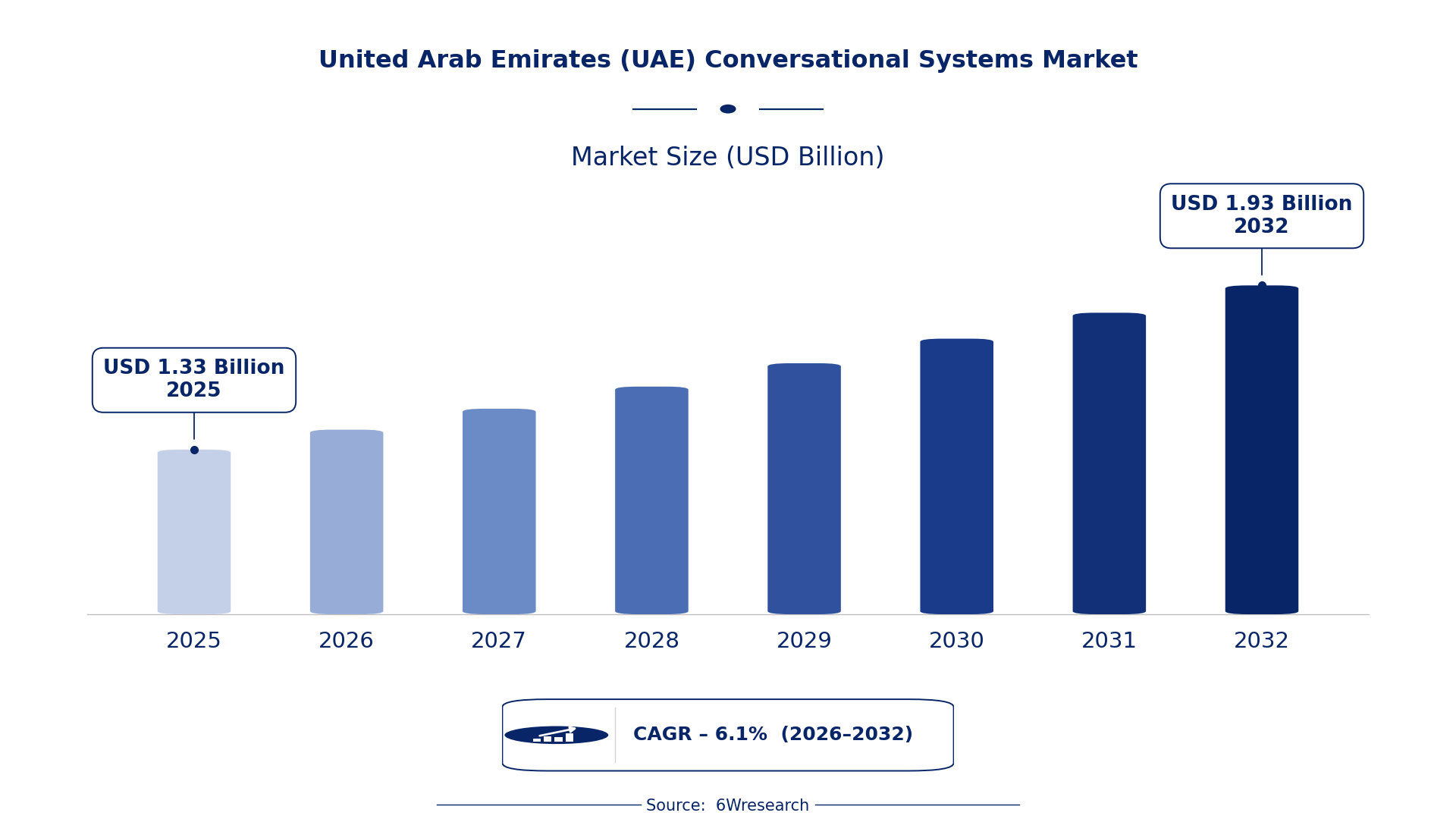
The United Arab Emirates (UAE) Conversational Systems Market was estimated at USD 1333 Million in 2025 and is projected to reach USD 1931 Million by 2032, growing at a CAGR of 6.1% from 2026 to 2032.
United Arab Emirates (UAE) Conversational Systems Market Synopsis
In the UAE, conversational systems are rapidly becoming essential tools for businesses aiming to enhance customer interactions. The increasing demand for chatbots and virtual assistants across various sectors, from finance to hospitality, highlights a shift towards automation and improved service delivery.
With a diverse economy, the UAE presents unique opportunities for conversational systems to thrive. Companies are leveraging these technologies not only to provide 24/7 customer support but also to streamline operations, thus driving efficiency in an increasingly digital marketplace.
United Arab Emirates (UAE) Conversational Systems Market Year-wise Growth Rate and Key Drivers
This graph illustrates the annual growth rates of the United Arab Emirates (UAE) Conversational Systems Market from 2021 to 2032, highlighting a steady upward trajectory and projected expansion over the forecast period.
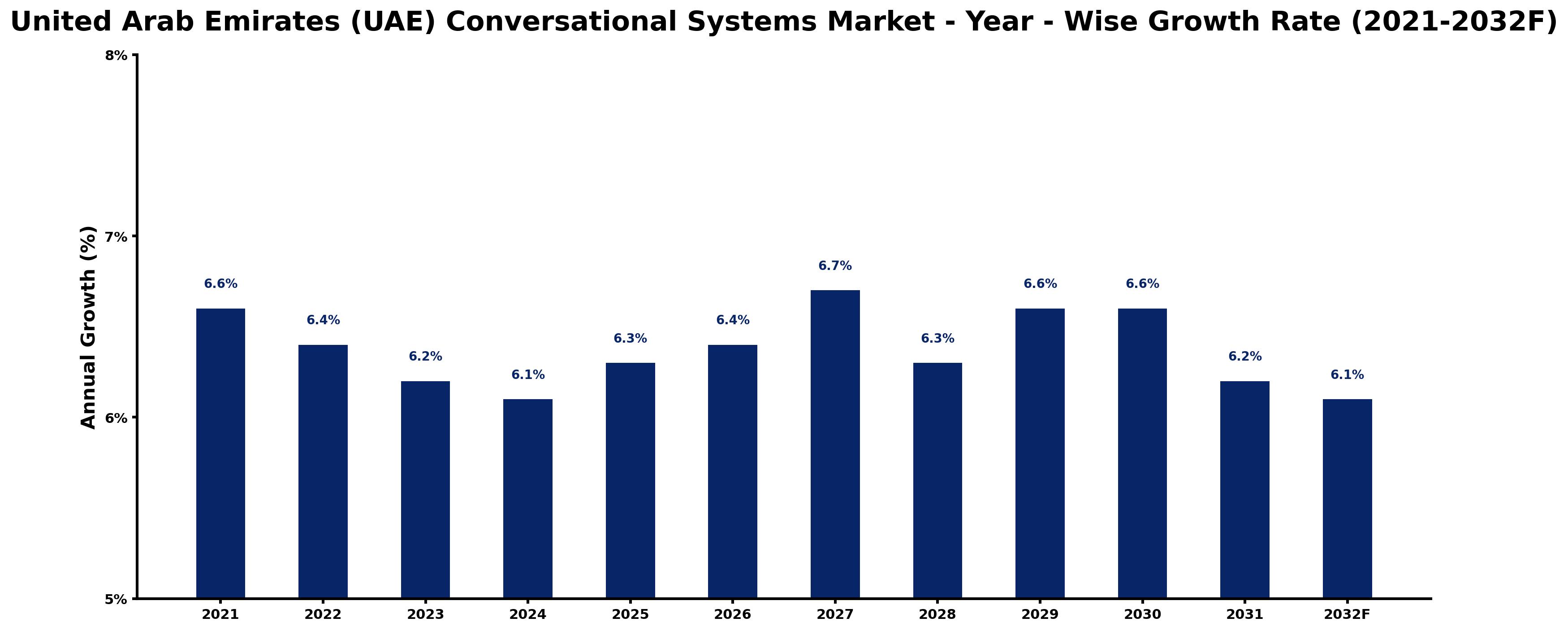
The table below presents the year‑wise growth rates along with the key drivers influencing the market
| Year | Growth Rate | Major Drivers |
| 2021 | 6.6% | Government AI strategy promotes conversational system integrations. |
| 2022 | 6.4% | Increased investment in smart city projects enhances user engagement. |
| 2023 | 6.2% | Growing tourism industry boosts demand for customer service automation. |
| 2024 | 6.1% | Local startups innovate with conversational AI solutions. |
| 2025 | 6.3% | Educational institutions adopt chatbots for student interaction. |
| 2026 | 6.4% | Telecom regulations encourage AI use in customer support. |
| 2027 | 6.7% | Rising adoption of mobile apps drives conversational interfaces. |
| 2028 | 6.3% | Corporate training programs implement conversational systems for efficiency. |
| 2029 | 6.6% | Healthcare sector embraces virtual assistants for patient interaction. |
| 2030 | 6.6% | Financial services integrate chatbots for enhanced client engagement. |
| 2031 | 6.2% | Retail sector utilizes conversational systems for personalized shopping. |
| 2032 | 6.1% | Cultural festivals incorporate conversational platforms for visitor interactions. |
Note: Market size estimations and growth projections presented in this report are based on 6Wresearch's proprietary forecasting methodology, utilizing the latest available industry data, government publications, and primary research inputs.
United Arab Emirates (UAE) Conversational Systems Market Key Takeaways
Below are some of the specific key takeaways from the market, including:
- Conversational systems are transforming customer engagement across various sectors in the UAE.
- The demand for these technologies is fueled by the growth of e-commerce and online services.
- Businesses are focusing on 24/7 support and automation to enhance operational efficiency.
- Challenges remain in natural language processing, especially given the UAE's multilingual environment.
- Digital transformation initiatives by the government are accelerating market growth.
Evaluation of Restraints in United Arab Emirates (UAE) Conversational Systems Market
Despite the promising growth trajectory, the UAE conversational systems market faces real constraints. A primary challenge is achieving effective natural language processing that caters to a culturally diverse audience. This is particularly pertinent in a region where multiple languages are spoken, and nuances in conversation can lead to misunderstandings. on top of that, integrating these systems into existing communication channels without diminishing user satisfaction presents a significant hurdle for businesses.
United Arab Emirates (UAE) Conversational Systems Market Trends
One trend shaping the UAE conversational systems market is the increasing reliance on artificial intelligence to enhance customer interactions. Companies are now investing in advanced analytics to better understand user behavior and preferences. Additionally, there is a notable rise in the use of omnichannel strategies, allowing businesses to engage with customers through various platforms seamlessly. This trend is expected to continue as companies seek to create more personalized experiences.
United Arab Emirates (UAE) Conversational Systems Market Opportunities
The UAE conversational systems market is ripe with growth opportunities. As digital transformation efforts continue, businesses that invest in conversational AI can significantly improve customer satisfaction. There is also potential for expanding conversational systems into new sectors, such as healthcare and education, where automation can streamline processes and enhance service delivery. Companies that capitalize on these trends are likely to gain a competitive edge.
Government Initiatives in the United Arab Emirates (UAE) Conversational Systems Market
Government policies play a crucial role in shaping the UAE conversational systems market. With a strong focus on digital transformation, the government is actively promoting initiatives that facilitate the adoption of advanced technologies. This regulatory support is essential for businesses looking to integrate conversational systems into their operations.
- A national digital infrastructure upgrade programme launched in 2023 aims to improve connectivity and accessibility for conversational systems.
- Currently ongoing efforts include a public-private partnership focused on developing AI-based solutions for customer service enhancement.
- A regulatory framework expected to be introduced by 2026 will provide guidelines for implementing conversational systems in various sectors.
- Plans are underway for a national initiative to promote the training and upskilling of professionals in AI and conversational technologies by 2027.
Future Insights of the United Arab Emirates (UAE) Conversational Systems Market
Looking ahead to 2026-2032, the UAE conversational systems market is set for substantial growth. As businesses increasingly recognize the value of automation in enhancing customer experiences, investments in these technologies will escalate. The combination of government support and a growing digital-savvy population will further drive market expansion. Companies that embrace innovation and adapt to evolving consumer demands will thrive in this dynamic environment.
United Arab Emirates (UAE) Conversational Systems Market Latest Developments
Recent months have seen a flurry of activity in the UAE conversational systems market, reflecting a strong commitment to adopting AI-driven solutions. Companies are rapidly advancing their capabilities to meet the growing demand for improved customer interaction tools.
- A major technology vendor rolled out a new virtual assistant platform in early 2025, enhancing customer engagement for several large retailers.
- In mid-2025, an initiative aimed at integrating AI chatbots within government services was launched, aiming to streamline public inquiries.
- By late 2025, a collaborative project between various sectors was announced, focusing on developing multilingual conversational capabilities.
- A rollout of enhanced analytics tools for conversational systems is expected to begin in the second half of 2026, aimed at improving service efficiency.
United Arab Emirates (UAE) Conversational Systems Market - Key Attractiveness of the Report
- 10 Years of Market Numbers
- Historical Data Starting from 2022 to 2025
- Base Year: 2025
- Forecast Data until 2032
- Key Performance Indicators Impacting the Market
- Major Upcoming Developments and Projects
Key Highlights of the Report:
- United Arab Emirates (UAE) Conversational Systems Market Outlook
- Market Size of United Arab Emirates (UAE) Conversational Systems Market, 2025
- Forecast of United Arab Emirates (UAE) Conversational Systems Market, 2032
- Historical Data and Forecast of United Arab Emirates (UAE) Conversational Systems Revenues & Volume for the Period 2022-2032F
- United Arab Emirates (UAE) Conversational Systems Market Trend Evolution
- United Arab Emirates (UAE) Conversational Systems Market Drivers and Challenges
- United Arab Emirates (UAE) Conversational Systems Price Trends
- United Arab Emirates (UAE) Conversational Systems Porter's Five Forces
- United Arab Emirates (UAE) Conversational Systems Industry Life Cycle
- Historical Data and Forecast of United Arab Emirates (UAE) Conversational Systems Market Revenues & Volume By Component for the Period 2022-2032F
- Historical Data and Forecast of United Arab Emirates (UAE) Conversational Systems Market Revenues & Volume By Compute Platforms for the Period 2022-2032F
- Historical Data and Forecast of United Arab Emirates (UAE) Conversational Systems Market Revenues & Volume By Solutions for the Period 2022-2032F
- Historical Data and Forecast of United Arab Emirates (UAE) Conversational Systems Market Revenues & Volume By Services for the Period 2022-2032F
- Historical Data and Forecast of United Arab Emirates (UAE) Conversational Systems Market Revenues & Volume By Application for the Period 2022-2032F
- Historical Data and Forecast of United Arab Emirates (UAE) Conversational Systems Market Revenues & Volume By Customer Support and Personal Assistant for the Period 2022-2032F
- Historical Data and Forecast of United Arab Emirates (UAE) Conversational Systems Market Revenues & Volume By Branding and Advertisement for the Period 2022-2032F
- Historical Data and Forecast of United Arab Emirates (UAE) Conversational Systems Market Revenues & Volume By Data Privacy and Compliance for the Period 2022-2032F
- Historical Data and Forecast of United Arab Emirates (UAE) Conversational Systems Market Revenues & Volume By Others for the Period 2022-2032F
- Historical Data and Forecast of United Arab Emirates (UAE) Conversational Systems Market Revenues & Volume By Type for the Period 2022-2032F
- Historical Data and Forecast of United Arab Emirates (UAE) Conversational Systems Market Revenues & Volume By Voice Assisted for the Period 2022-2032F
- Historical Data and Forecast of United Arab Emirates (UAE) Conversational Systems Market Revenues & Volume By Text Assistant for the Period 2022-2032F
- Historical Data and Forecast of United Arab Emirates (UAE) Conversational Systems Market Revenues & Volume By Others for the Period 2022-2032F
- Historical Data and Forecast of United Arab Emirates (UAE) Conversational Systems Market Revenues & Volume By Vertical for the Period 2022-2032F
- Historical Data and Forecast of United Arab Emirates (UAE) Conversational Systems Market Revenues & Volume By BFSI for the Period 2022-2032F
- Historical Data and Forecast of United Arab Emirates (UAE) Conversational Systems Market Revenues & Volume By Media and Entertainment for the Period 2022-2032F
- Historical Data and Forecast of United Arab Emirates (UAE) Conversational Systems Market Revenues & Volume By Retail and eCommerce for the Period 2022-2032F
- Historical Data and Forecast of United Arab Emirates (UAE) Conversational Systems Market Revenues & Volume By Travel and Hospitality for the Period 2022-2032F
- Historical Data and Forecast of United Arab Emirates (UAE) Conversational Systems Market Revenues & Volume By Telecom for the Period 2022-2032F
- Historical Data and Forecast of United Arab Emirates (UAE) Conversational Systems Market Revenues & Volume By Healthcare and Life Sciences for the Period 2022-2032F
- Historical Data and Forecast of United Arab Emirates (UAE) Conversational Systems Market Revenues & Volume By Others for the Period 2022-2032F
- United Arab Emirates (UAE) Conversational Systems Import Export Trade Statistics
- Market Opportunity Assessment By Component
- Market Opportunity Assessment By Application
- Market Opportunity Assessment By Type
- Market Opportunity Assessment By Vertical
- United Arab Emirates (UAE) Conversational Systems Top Companies Market Share
- United Arab Emirates (UAE) Conversational Systems Competitive Benchmarking By Technical and Operational Parameters
- United Arab Emirates (UAE) Conversational Systems Company Profiles
- United Arab Emirates (UAE) Conversational Systems Key Strategic Recommendations






































