United Arab Emirates (UAE) Cultivator and Tiller Machinery Market Size, Share & Growth Rate
The United Arab Emirates (UAE) Cultivator and Tiller Machinery Market was estimated at USD 1258 Million in 2025 and is projected to reach USD 1820 Million by 2032, growing at a CAGR of 5.4% from 2026 to 2032. This growth trajectory is largely driven by the country's urgent push towards food security and the adoption of advanced agricultural technologies. Farmers are increasingly recognizing the value of mechanization in improving productivity and efficiency, further propelling demand for innovative cultivators and tillers.
United Arab Emirates (UAE) Cultivator and Tiller Machinery Market Year-wise Growth Rate and Key Drivers
This graph highlights how the United Arab Emirates (UAE) Cultivator and Tiller Machinery Market has steadily grown over the years, supported by major growth factors.
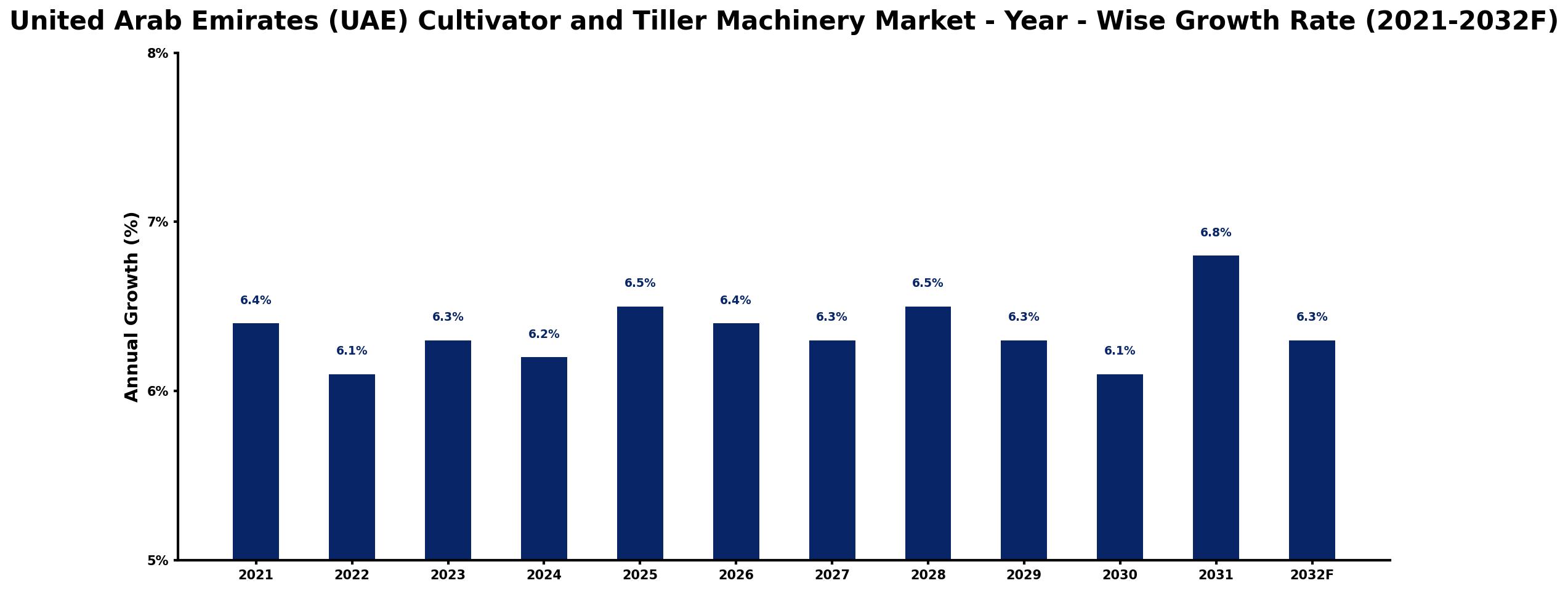
The table below presents the year‑wise growth rates along with the key drivers influencing the market
| Year | Growth Rate | Major Drivers |
| 2021 | 6.4% | increased agricultural investments nationwide |
| 2022 | 6.1% | growing demand for sustainable farming |
| 2023 | 6.3% | rising population driving food production |
| 2024 | 6.2% | expansion of smart farming technologies |
| 2025 | 6.5% | enhanced irrigation infrastructure development |
| 2026 | 6.4% | increased focus on food security |
| 2027 | 6.3% | growing interest in organic farming |
| 2028 | 6.5% | government initiatives supporting agriculture |
| 2029 | 6.3% | advancements in precision agriculture techniques |
| 2030 | 6.1% | increased availability of financing options |
| 2031 | 6.8% | improved raw material availability |
| 2032 | 6.3% | growing commercial sector adoption |
Note: Market size estimations and growth projections presented in this report are based on 6Wresearch's proprietary forecasting methodology, utilizing the latest available industry data, government publications, and primary research inputs.
United Arab Emirates (UAE) Cultivator and Tiller Machinery Market Synopsis
The UAE is undergoing a significant transformation in its agricultural sector, emphasizing the importance of cultivator and tiller machinery in both traditional and modern farming practices. These machines are essential for effective soil preparation, directly impacting crop yields and overall agricultural productivity.
With increasing governmental focus on sustainable farming methods, local farmers are investing in advanced machinery that not only enhances operational efficiency but also aligns with eco-friendly practices. As mechanization continues to expand, the market is set for substantial growth in the coming years.
United Arab Emirates (UAE) Cultivator and Tiller Machinery Market Key Takeaways
- The market is experiencing robust growth due to a rise in mechanized agricultural practices.
- Innovative technologies are increasingly integrated into farming machinery to enhance efficiency.
- Government initiatives promoting sustainable agriculture are driving demand for modern equipment.
- Water scarcity and soil quality challenges are influencing machinery design and functionality.
- Post-pandemic recovery is stimulating renewed interest in advanced cultivator and tiller machinery.
Evaluation of Restraints in United Arab Emirates (UAE) Cultivator and Tiller Machinery Market
Despite the promising growth, the UAE cultivator and tiller machinery market faces notable restraints. Water scarcity remains a significant challenge, necessitating machinery that optimally utilizes irrigation resources. Additionally, local manufacturers are contending with competitive pressure from imports, which can affect market pricing and availability. Environmental regulations and a shift towards eco-friendly machinery designs also impose limitations, as manufacturers must innovate while adhering to stringent standards. These factors require a strategic focus on adaptability and sustainability to navigate the evolving landscape.
United Arab Emirates (UAE) Cultivator and Tiller Machinery Market Trends
Several trends are currently shaping the UAE cultivator and tiller machinery market. Firstly, the integration of precision agriculture technologies is gaining traction, allowing for targeted soil management and efficient resource allocation. Secondly, smart farming solutions, including automation and IoT devices, are becoming increasingly commonplace, enhancing productivity and operational efficiency. Moreover, there is a marked shift towards sustainable practices, with an emphasis on machinery that supports eco-friendly cultivation methods and reduces environmental impact.
United Arab Emirates (UAE) Cultivator and Tiller Machinery Market Opportunities
The opportunities within the UAE cultivator and tiller machinery market are abundant. The government's commitment to enhancing food security paves the way for investment in modern agricultural equipment. Furthermore, the rising trend of vertical farming and urban agriculture presents a niche for specialized machinery tailored to these innovative farming methods. Additionally, local manufacturers can capitalize on the growing demand for eco-friendly machinery, aligning product development with sustainability goals to meet consumer expectations.
Government Initiatives in the United Arab Emirates (UAE) Cultivator and Tiller Machinery Market
The UAE government is actively promoting agricultural modernization through various initiatives and policies aimed at enhancing food security and sustainability. Programs that incentivize the adoption of advanced farming techniques and mechanized equipment are being implemented. Additionally, public spending on agricultural research and technology development is increasing, aimed at improving crop yields and resource efficiency. These initiatives are essential in supporting the transition towards a more resilient agricultural sector, ultimately benefiting the cultivator and tiller machinery market.
Future Insights of the United Arab Emirates (UAE) Cultivator and Tiller Machinery Market
Looking ahead to the 2026-2032 period, the UAE cultivator and tiller machinery market is expected to experience significant advancements in technology and design. As the agriculture sector continues to evolve, we anticipate greater integration of automated solutions and smart farming technologies. Additionally, as environmental concerns become more prominent, manufacturers will likely focus on producing more sustainable and efficient machinery. The ongoing push for food security will further solidify the market's growth potential, making it an attractive landscape for investment.
United Arab Emirates (UAE) Cultivator and Tiller Machinery Market Latest Developments (2025 - 2026)
In the latest developments within the UAE cultivator and tiller machinery market, there has been a notable shift towards the adoption of smart farming technologies. The integration of precision agriculture tools is gaining momentum, with local farmers seeking to enhance productivity through data-driven decisions. Furthermore, recent government initiatives aimed at promoting sustainable agriculture are encouraging investments in eco-friendly machinery. As the market continues to recover post-pandemic, industry stakeholders are optimistic about upcoming innovations and partnerships that will further enhance operational efficiency.
United Arab Emirates (UAE) Cultivator and Tiller Machinery Market - Key Attractiveness of the Report
- 10 Years of Market Numbers
- Historical Data Starting from 2022 to 2025
- Base Year: 2025
- Forecast Data until 2032
- Key Performance Indicators Impacting the Market
- Major Upcoming Developments and Projects
Key Highlights of the Report:
- United Arab Emirates (UAE) Cultivator and Tiller Machinery Market Outlook
- Market Size of United Arab Emirates (UAE) Cultivator and Tiller Machinery Market, 2025
- Forecast of United Arab Emirates (UAE) Cultivator and Tiller Machinery Market, 2032
- Historical Data and Forecast of United Arab Emirates (UAE) Cultivator and Tiller Machinery Revenues & Volume for the Period 2022-2032F
- United Arab Emirates (UAE) Cultivator and Tiller Machinery Market Trend Evolution
- United Arab Emirates (UAE) Cultivator and Tiller Machinery Market Drivers and Challenges
- United Arab Emirates (UAE) Cultivator and Tiller Machinery Price Trends
- United Arab Emirates (UAE) Cultivator and Tiller Machinery Porter's Five Forces
- United Arab Emirates (UAE) Cultivator and Tiller Machinery Industry Life Cycle
- Historical Data and Forecast of United Arab Emirates (UAE) Cultivator and Tiller Machinery Market Revenues & Volume By Product Type for the Period 2022-2032F
- Historical Data and Forecast of United Arab Emirates (UAE) Cultivator and Tiller Machinery Market Revenues & Volume By Cultivators for the Period 2022-2032F
- Historical Data and Forecast of United Arab Emirates (UAE) Cultivator and Tiller Machinery Market Revenues & Volume By Tillers for the Period 2022-2032F
- Historical Data and Forecast of United Arab Emirates (UAE) Cultivator and Tiller Machinery Market Revenues & Volume By for the Period 2022-2032F
- Historical Data and Forecast of United Arab Emirates (UAE) Cultivator and Tiller Machinery Market Revenues & Volume By Application for the Period 2022-2032F
- Historical Data and Forecast of United Arab Emirates (UAE) Cultivator and Tiller Machinery Market Revenues & Volume By Agriculture for the Period 2022-2032F
- Historical Data and Forecast of United Arab Emirates (UAE) Cultivator and Tiller Machinery Market Revenues & Volume By Garden for the Period 2022-2032F
- United Arab Emirates (UAE) Cultivator and Tiller Machinery Import Export Trade Statistics
- Market Opportunity Assessment By Product Type
- Market Opportunity Assessment By Application
- United Arab Emirates (UAE) Cultivator and Tiller Machinery Top Companies Market Share
- United Arab Emirates (UAE) Cultivator and Tiller Machinery Competitive Benchmarking By Technical and Operational Parameters
- United Arab Emirates (UAE) Cultivator and Tiller Machinery Company Profiles
- United Arab Emirates (UAE) Cultivator and Tiller Machinery Key Strategic Recommendations






































