United Arab Emirates (UAE) Cultured Meat Market Size, Share & Growth Rate
The United Arab Emirates (UAE) Cultured Meat Market was estimated at USD 490 Million in 2025 and is projected to reach USD 670 Million by 2032, growing at a CAGR of 4.6% from 2026 to 2032. This upward trajectory is largely driven by increasing consumer awareness surrounding sustainability and ethical eating, alongside significant government backing aimed at promoting food security and innovation in food technologies. Additionally, with a strong push towards diversifying protein sources, the UAE is uniquely positioned to leverage cultured meat as a viable solution to its culinary landscape.
United Arab Emirates (UAE) Cultured Meat Market Year-wise Growth Rate and Key Drivers
This graph highlights how the United Arab Emirates (UAE) Cultured Meat Market has steadily grown over the years, supported by major growth factors.
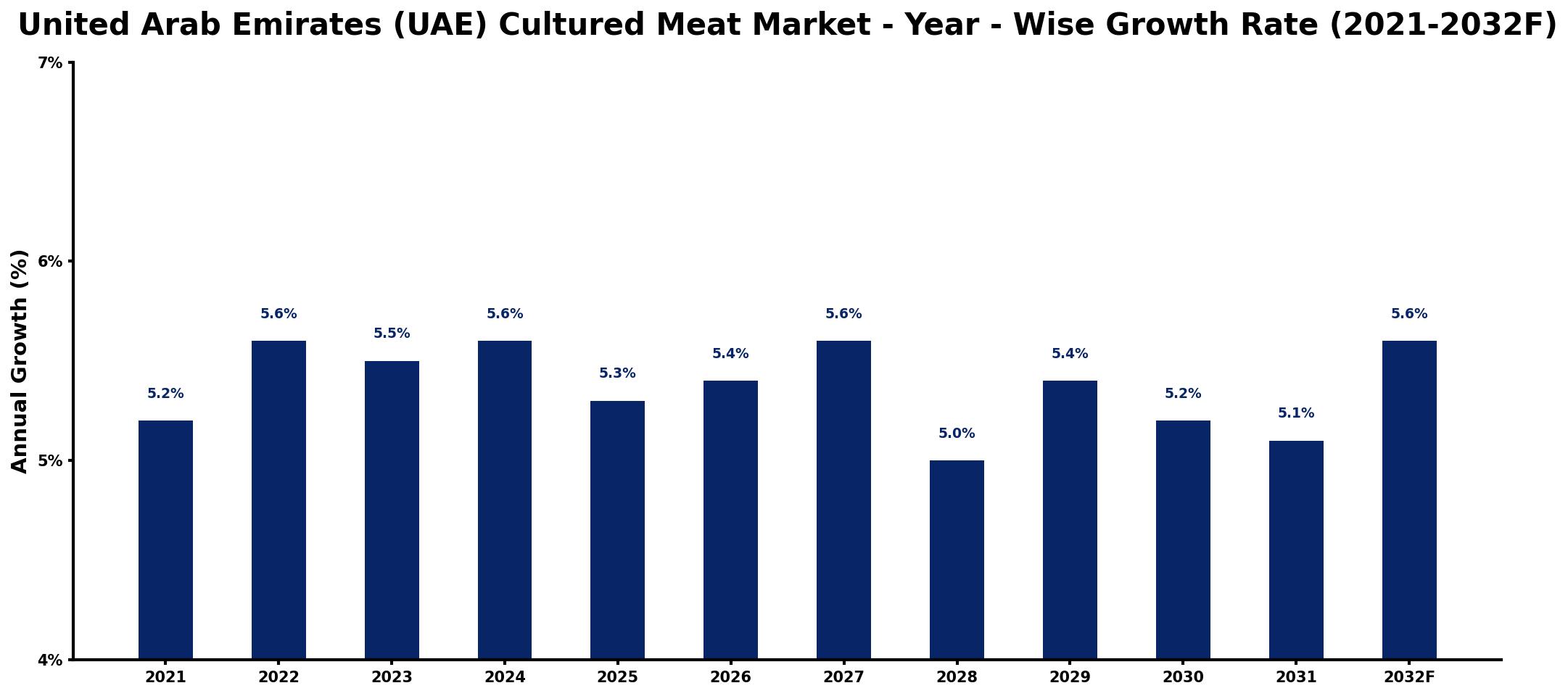
The table below presents the year‑wise growth rates along with the key drivers influencing the market
| Year | Growth Rate | Major Drivers |
| 2021 | 5.2% | Rising consumer health consciousness |
| 2022 | 5.6% | Increased investment in technology |
| 2023 | 5.5% | Growing demand for sustainable options |
| 2024 | 5.6% | Expansion of distribution networks |
| 2025 | 5.3% | Heightened focus on food security |
| 2026 | 5.4% | Innovations in production methods |
| 2027 | 5.6% | Increased regulatory support initiatives |
| 2028 | 5.0% | Growing interest in alternative proteins |
| 2029 | 5.4% | Enhancements in consumer education programs |
| 2030 | 5.2% | Rising interest in ethical sourcing |
| 2031 | 5.1% | Strengthened partnerships with retailers |
| 2032 | 5.6% | Emerging trends in culinary applications |
Note: Market size estimations and growth projections presented in this report are based on 6Wresearch's proprietary forecasting methodology, utilizing the latest available industry data, government publications, and primary research inputs.
United Arab Emirates (UAE) Cultured Meat Market Synopsis
The UAE is witnessing a marked shift toward cultured meat, reflecting a broader regional trend toward sustainable food production. As urban populations grow and environmental concerns mount, the nation is turning to cellular agriculture as a method to provide protein without the ecological footprint associated with traditional farming.
With a blend of innovation and tradition, cultured meat production in the UAE is gaining traction, with startups experimenting in various protein types, from conventional beef and chicken to more culturally significant options like camel meat. This advancement not only aligns with local tastes but also reinforces the UAEs commitment to food security and sustainability.
United Arab Emirates (UAE) Cultured Meat Market Key Takeaways
- The UAE's commitment to sustainability is a key driver of the cultured meat market.
- Innovative startups are at the forefront, exploring diverse meat alternatives.
- Consumer education and acceptance remain crucial for market growth.
- High production costs present a challenge, necessitating ongoing investment in technology.
- Government support provides a favorable environment for research and development in cultured meat.
Evaluation of Restraints in United Arab Emirates (UAE) Cultured Meat Market
Despite its promise, the UAE cultured meat market grapples with significant challenges. The high costs associated with the sophisticated technology needed for cellular agriculture limit production scalability. Additionally, as the market is still emerging, consumer familiarity with cultured meat remains limited. This necessitates comprehensive outreach efforts to educate potential customers and foster acceptance. Furthermore, evolving regulatory frameworks create uncertainty for investors and producers, complicating market entry and expansion strategies.
United Arab Emirates (UAE) Cultured Meat Market Trends
Several key trends are shaping the UAE cultured meat market. A growing appetite for sustainable and cruelty-free food options is driving interest from both consumers and investors. Additionally, advancements in cellular agriculture technology are making production more viable, while collaborations between academic institutions and startups are fostering innovation. The rise of health-conscious consumers has led to increased interest in high-quality, nutrient-dense protein sources, further propelling demand for cultured meat products.
United Arab Emirates (UAE) Cultured Meat Market Opportunities
Investment opportunities within the UAE cultured meat market are on the rise. As awareness of ethical consumption continues to grow, businesses can capitalize on the demand for diverse meat products that cater to both local and international tastes. Additionally, collaboration with research institutions to further refine production processes could enhance product quality and reduce costs. The potential to export cultured meat products to neighboring regions further underscores the market's growth potential.
Government Initiatives in the United Arab Emirates (UAE) Cultured Meat Market
The UAE government has taken proactive steps to foster the growth of the cultured meat market. By investing in research and development initiatives, the government encourages innovation in sustainable food technologies. Additionally, supportive regulatory frameworks are being crafted to create a conducive environment for cultured meat production, facilitating faster market entry for new players. Public awareness campaigns are also aimed at educating consumers about the benefits of cultured meat, further aligning with national sustainability goals.
Future Insights of the United Arab Emirates (UAE) Cultured Meat Market
Looking ahead to 2026-2032, the UAE cultured meat market is poised for substantial evolution. As production technologies advance and costs decline, the market is expected to expand significantly. Increasing consumer acceptance, propelled by education and awareness initiatives, will likely drive demand. The alignment of cultured meat production with national objectives for sustainability and food security will further bolster the market's growth, creating a landscape rich in innovation and opportunity.
United Arab Emirates (UAE) Cultured Meat Market Latest Developments (2025 - 2026)
Recent developments in the UAE's cultured meat sector illustrate a clear momentum towards innovation and market readiness. New partnerships have emerged between technology firms and food producers aimed at accelerating research and production capabilities. Additionally, pilot projects are testing consumer reactions and market viability, indicating a robust pipeline of cultured meat products set to enter the market in the near future. Overall, industry sentiment remains optimistic as the market gears up for a transformative phase.
United Arab Emirates (UAE) Cultured Meat Market - Key Attractiveness of the Report
- 10 Years of Market Numbers
- Historical Data Starting from 2022 to 2025
- Base Year: 2025
- Forecast Data until 2032
- Key Performance Indicators Impacting the Market
- Major Upcoming Developments and Projects
Key Highlights of the Report:
- United Arab Emirates (UAE) Cultured Meat Market Outlook
- Market Size of United Arab Emirates (UAE) Cultured Meat Market, 2025
- Forecast of United Arab Emirates (UAE) Cultured Meat Market, 2032
- Historical Data and Forecast of United Arab Emirates (UAE) Cultured Meat Revenues & Volume for the Period 2022-2032F
- United Arab Emirates (UAE) Cultured Meat Market Trend Evolution
- United Arab Emirates (UAE) Cultured Meat Market Drivers and Challenges
- United Arab Emirates (UAE) Cultured Meat Price Trends
- United Arab Emirates (UAE) Cultured Meat Porter's Five Forces
- United Arab Emirates (UAE) Cultured Meat Industry Life Cycle
- Historical Data and Forecast of United Arab Emirates (UAE) Cultured Meat Market Revenues & Volume By Product Type for the Period 2022-2032F
- Historical Data and Forecast of United Arab Emirates (UAE) Cultured Meat Market Revenues & Volume By Poultry for the Period 2022-2032F
- Historical Data and Forecast of United Arab Emirates (UAE) Cultured Meat Market Revenues & Volume By Beef for the Period 2022-2032F
- Historical Data and Forecast of United Arab Emirates (UAE) Cultured Meat Market Revenues & Volume By Seafood for the Period 2022-2032F
- Historical Data and Forecast of United Arab Emirates (UAE) Cultured Meat Market Revenues & Volume By Pork for the Period 2022-2032F
- Historical Data and Forecast of United Arab Emirates (UAE) Cultured Meat Market Revenues & Volume By Duck for the Period 2022-2032F
- Historical Data and Forecast of United Arab Emirates (UAE) Cultured Meat Market Revenues & Volume By End-Use for the Period 2022-2032F
- Historical Data and Forecast of United Arab Emirates (UAE) Cultured Meat Market Revenues & Volume By Nuggets for the Period 2022-2032F
- Historical Data and Forecast of United Arab Emirates (UAE) Cultured Meat Market Revenues & Volume By Burgers for the Period 2022-2032F
- Historical Data and Forecast of United Arab Emirates (UAE) Cultured Meat Market Revenues & Volume By Meatballs for the Period 2022-2032F
- Historical Data and Forecast of United Arab Emirates (UAE) Cultured Meat Market Revenues & Volume By Sausage for the Period 2022-2032F
- Historical Data and Forecast of United Arab Emirates (UAE) Cultured Meat Market Revenues & Volume By Hot dogs for the Period 2022-2032F
- Historical Data and Forecast of United Arab Emirates (UAE) Cultured Meat Market Revenues & Volume By Others for the Period 2022-2032F
- United Arab Emirates (UAE) Cultured Meat Import Export Trade Statistics
- Market Opportunity Assessment By Product Type
- Market Opportunity Assessment By End-Use
- United Arab Emirates (UAE) Cultured Meat Top Companies Market Share
- United Arab Emirates (UAE) Cultured Meat Competitive Benchmarking By Technical and Operational Parameters
- United Arab Emirates (UAE) Cultured Meat Company Profiles
- United Arab Emirates (UAE) Cultured Meat Key Strategic Recommendations






































