United Arab Emirates (UAE) Cutting Equipment Market Size, Share & Growth Rate
The United Arab Emirates (UAE) Cutting Equipment Market was estimated at USD 435 Million in 2025 and is projected to reach USD 568 Million by 2032, growing at a CAGR of 3.9% from 2026 to 2032. This upward trajectory is largely attributed to the robust expansion of the manufacturing and construction sectors within the region. The increasing adoption of advanced technologies, including automation and digital solutions, is further driving demand for high-precision cutting tools and machinery.
United Arab Emirates (UAE) Cutting Equipment Market Year-wise Growth Rate and Key Drivers
This graph highlights how the United Arab Emirates (UAE) Cutting Equipment Market has steadily grown over the years, supported by major growth factors.
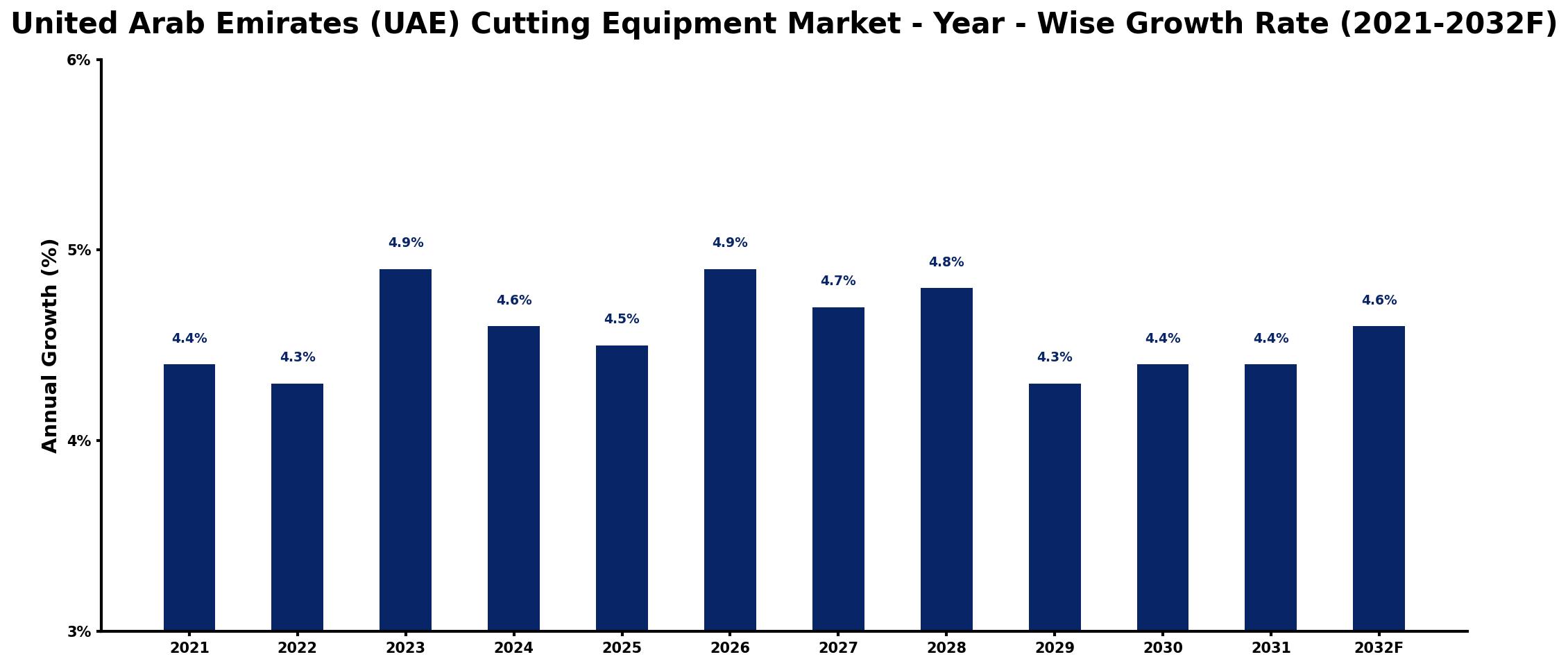
The table below presents the year‑wise growth rates along with the key drivers influencing the market
| Year | Growth Rate | Major Drivers |
| 2021 | 4.4% | Increased construction sector investments |
| 2022 | 4.3% | Growing manufacturing sector demand |
| 2023 | 4.9% | Rise in infrastructure projects |
| 2024 | 4.6% | Expansion of renewable energy initiatives |
| 2025 | 4.5% | Boost in automotive industry production |
| 2026 | 4.9% | Surge in technological advancements |
| 2027 | 4.7% | Growth in logistics and transportation |
| 2028 | 4.8% | Increased focus on sustainability practices |
| 2029 | 4.3% | growing regional consumption patterns |
| 2030 | 4.4% | Growing demand for precision tools |
| 2031 | 4.4% | growing downstream application demand |
| 2032 | 4.6% | Increased automation in industries |
Note: Market size estimations and growth projections presented in this report are based on 6Wresearch's proprietary forecasting methodology, utilizing the latest available industry data, government publications, and primary research inputs.
United Arab Emirates (UAE) Cutting Equipment Market Synopsis
The strongest force currently shaping the UAE Cutting Equipment Market is the rapid development in the manufacturing and construction industries. These sectors have become the backbone of the UAE's economy, demanding increasingly sophisticated cutting solutions to enhance productivity and operational efficiency.
Moreover, technological advancements, particularly in laser cutting and waterjet technology, are redefining industry standards. As companies strive for precision and quality in their products, the demand for innovative cutting equipment is on the rise, positioning the UAE market for sustained growth.
United Arab Emirates (UAE) Cutting Equipment Market Key Takeaways
- The market is fueled by the burgeoning manufacturing and construction sectors.
- Technological innovation is key, with automation enhancing cutting efficiency.
- High-quality cutting solutions are increasingly sought after across various industries.
- The market is adapting post-COVID, focusing on safety and precision enhancements.
- Competitive pressures necessitate constant innovation and regulatory compliance.
Evaluation of Restraints in United Arab Emirates (UAE) Cutting Equipment Market
Despite its robust growth, the UAE Cutting Equipment Market faces several notable restraints. The need for precision and versatility in cutting equipment demands continuous innovation, which can be resource-intensive for manufacturers. Additionally, compliance with stringent safety standards and regulations complicates product development and can lead to increased costs. Moreover, intense competition from global manufacturers pressures local companies to stay technologically relevant while also managing cost-effectiveness. Fluctuations in economic conditions and demand across sectors can further impact sales and profitability, creating a challenging landscape for market players.
United Arab Emirates (UAE) Cutting Equipment Market Trends
Key trends in the UAE Cutting Equipment Market include a shift towards automation and the integration of digital technologies. Manufacturers are increasingly investing in smart cutting systems that enhance operational efficiency and reduce waste. Furthermore, the growing focus on sustainable practices is propelling demand for cutting equipment that minimizes energy consumption and supports recycling initiatives. The rise of Industry 4.0 is also influencing the market, as more companies seek interconnected solutions that offer real-time data analytics to improve productivity and reduce downtime.
United Arab Emirates (UAE) Cutting Equipment Market Opportunities
Significant growth opportunities exist in the UAE Cutting Equipment Market, particularly in expanding sectors like renewable energy and automotive manufacturing. Investment in high-tech infrastructure and the push towards smart manufacturing solutions provide fertile ground for innovative cutting equipment. Additionally, with the ongoing initiatives in construction and urban development, companies can capitalize on the demand for advanced cutting technologies that meet evolving industry standards. As local manufacturers enhance their capabilities, there is potential for export opportunities in neighboring regions, further driving market expansion.
Government Initiatives in the United Arab Emirates (UAE) Cutting Equipment Market
The UAE government plays a pivotal role in fostering growth in the cutting equipment market through various initiatives and policies aimed at bolstering industrial sectors. Public investment in infrastructure and manufacturing capabilities, combined with incentives for adopting advanced technologies, supports industry players. Furthermore, the government's commitment to economic diversification through initiatives like the UAE Vision 2021 promotes innovation and competitiveness, creating a conducive environment for cutting equipment manufacturers to thrive.
Future Insights of the United Arab Emirates (UAE) Cutting Equipment Market
Looking ahead to 2026-2032, the UAE Cutting Equipment Market is anticipated to witness robust growth driven by technological advancements and heightened industry demand. As sectors like aerospace and automotive embrace cutting-edge solutions, companies must stay ahead of the curve by investing in R&D. The ongoing transition towards smart manufacturing and increased focus on sustainability will shape product development. Additionally, greater collaboration between government bodies and industry stakeholders is expected to further enhance innovation and boost market dynamics.
United Arab Emirates (UAE) Cutting Equipment Market Latest Developments (2025 - 2026)
In recent months, the UAE Cutting Equipment Market has seen a shift towards more sustainable and automated solutions, reflecting a broader industry trend. Manufacturers are increasingly prioritizing advanced safety features in their equipment, catering to the growing demand for high-precision tools. Additionally, collaborations among industry players and technology providers are emerging to enhance product offerings and expand market reach, enabling a more competitive landscape. The emphasis on digitalization continues to grow, with companies integrating smart technologies to streamline operations and improve efficiency.
United Arab Emirates (UAE) Cutting Equipment Market - Key Attractiveness of the Report
- 10 Years of Market Numbers
- Historical Data Starting from 2022 to 2025
- Base Year: 2025
- Forecast Data until 2032
- Key Performance Indicators Impacting the Market
- Major Upcoming Developments and Projects
Key Highlights of the Report:
- United Arab Emirates (UAE) Cutting Equipment Market Outlook
- Market Size of United Arab Emirates (UAE) Cutting Equipment Market, 2025
- Forecast of United Arab Emirates (UAE) Cutting Equipment Market, 2032
- Historical Data and Forecast of United Arab Emirates (UAE) Cutting Equipment Revenues & Volume for the Period 2022-2032F
- United Arab Emirates (UAE) Cutting Equipment Market Trend Evolution
- United Arab Emirates (UAE) Cutting Equipment Market Drivers and Challenges
- United Arab Emirates (UAE) Cutting Equipment Price Trends
- United Arab Emirates (UAE) Cutting Equipment Porter's Five Forces
- United Arab Emirates (UAE) Cutting Equipment Industry Life Cycle
- Historical Data and Forecast of United Arab Emirates (UAE) Cutting Equipment Market Revenues & Volume By Equipment Type for the Period 2022-2032F
- Historical Data and Forecast of United Arab Emirates (UAE) Cutting Equipment Market Revenues & Volume By Manual for the Period 2022-2032F
- Historical Data and Forecast of United Arab Emirates (UAE) Cutting Equipment Market Revenues & Volume By Mechanized for the Period 2022-2032F
- Historical Data and Forecast of United Arab Emirates (UAE) Cutting Equipment Market Revenues & Volume By Cutting Technology for the Period 2022-2032F
- Historical Data and Forecast of United Arab Emirates (UAE) Cutting Equipment Market Revenues & Volume By Plasma cutting for the Period 2022-2032F
- Historical Data and Forecast of United Arab Emirates (UAE) Cutting Equipment Market Revenues & Volume By Oxy-fuel cutting for the Period 2022-2032F
- Historical Data and Forecast of United Arab Emirates (UAE) Cutting Equipment Market Revenues & Volume By Laser cutting for the Period 2022-2032F
- Historical Data and Forecast of United Arab Emirates (UAE) Cutting Equipment Market Revenues & Volume By Waterjet cutting for the Period 2022-2032F
- Historical Data and Forecast of United Arab Emirates (UAE) Cutting Equipment Market Revenues & Volume By Carbon arc cutting for the Period 2022-2032F
- Historical Data and Forecast of United Arab Emirates (UAE) Cutting Equipment Market Revenues & Volume By End Use Industry for the Period 2022-2032F
- Historical Data and Forecast of United Arab Emirates (UAE) Cutting Equipment Market Revenues & Volume By Construction for the Period 2022-2032F
- Historical Data and Forecast of United Arab Emirates (UAE) Cutting Equipment Market Revenues & Volume By Heavy metal fabrication for the Period 2022-2032F
- Historical Data and Forecast of United Arab Emirates (UAE) Cutting Equipment Market Revenues & Volume By Shipbuilding & offshore for the Period 2022-2032F
- Historical Data and Forecast of United Arab Emirates (UAE) Cutting Equipment Market Revenues & Volume By Automotive for the Period 2022-2032F
- Historical Data and Forecast of United Arab Emirates (UAE) Cutting Equipment Market Revenues & Volume By Others for the Period 2022-2032F
- Historical Data and Forecast of United Arab Emirates (UAE) Cutting Equipment Market Revenues & Volume By Type for the Period 2022-2032F
- Historical Data and Forecast of United Arab Emirates (UAE) Cutting Equipment Market Revenues & Volume By Equipment for the Period 2022-2032F
- Historical Data and Forecast of United Arab Emirates (UAE) Cutting Equipment Market Revenues & Volume By Consumables/Accessories for the Period 2022-2032F
- United Arab Emirates (UAE) Cutting Equipment Import Export Trade Statistics
- Market Opportunity Assessment By Equipment Type
- Market Opportunity Assessment By Cutting Technology
- Market Opportunity Assessment By End Use Industry
- Market Opportunity Assessment By Type
- United Arab Emirates (UAE) Cutting Equipment Top Companies Market Share
- United Arab Emirates (UAE) Cutting Equipment Competitive Benchmarking By Technical and Operational Parameters
- United Arab Emirates (UAE) Cutting Equipment Company Profiles
- United Arab Emirates (UAE) Cutting Equipment Key Strategic Recommendations






































