United Arab Emirates (UAE) Data Integration Market Size & Growth Rate (2026-2032)
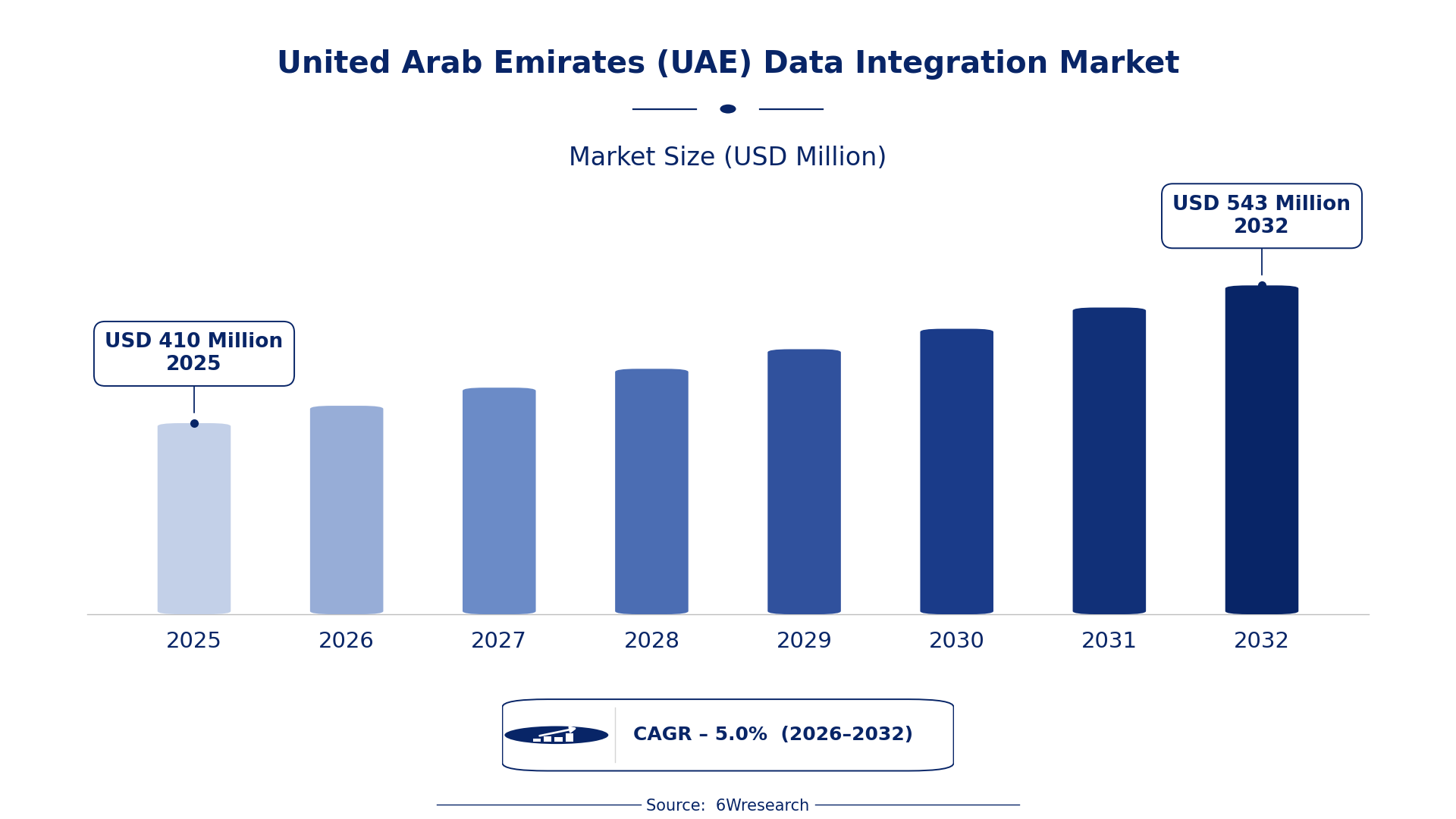
The United Arab Emirates (UAE) Data Integration Market was estimated at USD 410 Million in 2025 and is projected to reach USD 543 Million by 2032, growing at a CAGR of 5.0% from 2026 to 2032.
United Arab Emirates (UAE) Data Integration Market Synopsis
As the UAE advances its ambitions toward a knowledge-based economy, the demand for data integration solutions has surged. Organizations are increasingly tasked with consolidating data from various sources to enhance decision-making, drive operational efficiency, and maintain competitive advantage.
This drive is catalyzed by the complexities of data environments across sectors, including finance, healthcare, and public services. Businesses are actively seeking ways to dismantle data silos, thereby creating a unified data architecture that supports comprehensive analytics and insights.
United Arab Emirates (UAE) Data Integration Market Year-wise Growth Rate and Key Drivers
This graph illustrates the annual growth rates of the United Arab Emirates (UAE) Data Integration Market from 2021 to 2032, highlighting a steady upward trajectory and projected expansion over the forecast period.
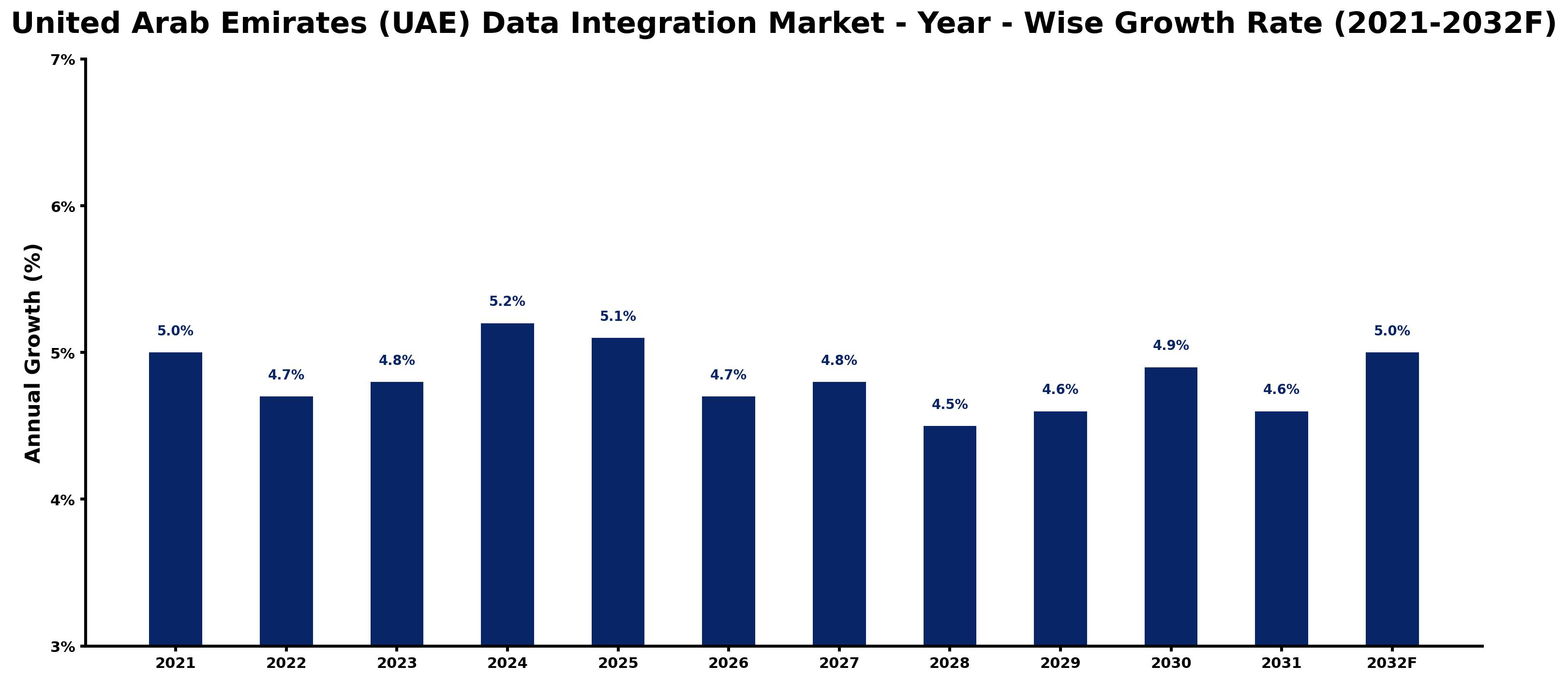
The table below presents the year‑wise growth rates along with the key drivers influencing the market
| Year | Growth Rate | Major Drivers |
| 2021 | 5.0% | UAE's National Data Management Framework launch drives integration. |
| 2022 | 4.7% | Growing fintech sector requires streamlined data processing solutions. |
| 2023 | 4.8% | Smart Dubai initiative accelerates demand for data interoperability. |
| 2024 | 5.2% | Unified Digital Payment Strategy enhances data integration needs. |
| 2025 | 5.1% | Increasing regulations on data privacy spur integration investments. |
| 2026 | 4.7% | Tech-savvy population urges data solutions for businesses. |
| 2027 | 4.8% | Regional growth in AI applications boosts data integration demand. |
| 2028 | 4.5% | Investment in healthcare digitalization drives data connectivity. |
| 2029 | 4.6% | Government initiatives in smart logistics require data synchronization. |
| 2030 | 4.9% | Sustainability initiatives lead to enhanced data reporting standards. |
| 2031 | 4.6% | Rise of remote work creates need for integrated data platforms. |
| 2032 | 5.0% | UAE's focus on cybersecurity mandates robust data integration solutions. |
Note: Market size estimations and growth projections presented in this report are based on 6Wresearch's proprietary forecasting methodology, utilizing the latest available industry data, government publications, and primary research inputs.
United Arab Emirates (UAE) Data Integration Market Key Takeaways
Below are some of the specific key takeaways from the market, including:
- The market is driven by the rising need for data-driven decision-making across sectors.
- Organizations are focusing on integrating disparate data sources to improve operational efficiency.
- Government initiatives are fostering a data-centric approach in public and private sectors.
- The ongoing digital transformation is a key factor propelling market growth.
- Technology advancements are enhancing the capabilities of data integration solutions.
Evaluation of Restraints in United Arab Emirates (UAE) Data Integration Market
Despite the growth potential, the UAE Data Integration market faces notable restraints. Organizations often contend with the challenge of integrating data from a myriad of platforms and applications. This complexity can lead to inaccuracies, inefficiencies, and delays in data processing. The lack of standardized protocols further complicates integration efforts, resulting in fragmented data environments that hinder effective decision-making.
United Arab Emirates (UAE) Data Integration Market Trends
Several trends are emerging in the UAE Data Integration market. First, the adoption of cloud-based integration solutions is gaining traction, driven by the need for flexibility and scalability. Companies are increasingly leveraging APIs for real-time data exchange, enhancing collaboration and responsiveness.
Additionally, the integration of AI and machine learning in data management processes is becoming common, enabling organizations to automate data handling and derive predictive insights. As businesses aim for digital transformation, the demand for enhanced data integration capabilities will continue to grow.
United Arab Emirates (UAE) Data Integration Market Opportunities
The UAE Data Integration market presents considerable growth opportunities. Organizations are increasingly investing in advanced analytics and BI tools that require robust data integration. The ongoing development of smart cities and digital government initiatives is also creating demand for integrated data solutions that can support smart applications and enhance citizen services.
on top of that, the expansion of IoT devices across various industries is driving the need for effective data integration solutions to manage and analyze large volumes of data generated. Companies that can offer innovative, scalable, and secure integration solutions stand to benefit significantly in this evolving market.
Government Initiatives in the United Arab Emirates (UAE) Data Integration Market
The UAE government is actively shaping the Data Integration market through various initiatives aimed at enhancing data connectivity and transparency. With a strong emphasis on data-driven governance and smart city developments, public policy is aligning closely with technological advancements to foster a vibrant data ecosystem.
- A national data strategy implemented in 2023 focuses on creating a unified data framework across public sectors.
- Current initiatives include the rollout of a digital infrastructure upgrade programme aimed at improving data sharing capabilities among government entities.
- Recently, a public-private partnership was launched to enhance data integration solutions for small and medium-sized enterprises (SMEs).
- Future plans involve the establishment of a regulatory body dedicated to overseeing data integration practices, expected to be operational by 2026.
- The government is also promoting incentives for organizations investing in data integration technologies, with a focus on fostering innovation.
Future Insights of the United Arab Emirates (UAE) Data Integration Market
Looking ahead to 2026-2032, the UAE Data Integration market is expected to experience steady growth. As organizations increasingly recognize the importance of integrated data environments, investment in data integration solutions will likely rise. The government's commitment to smart initiatives and data-driven governance will continue to drive demand.
Technological advancements, particularly in AI and machine learning, will further enhance data integration capabilities, allowing organizations to extract valuable insights from their data. As the market matures, companies that adapt and innovate will find ample opportunities to thrive.
United Arab Emirates (UAE) Data Integration Market Latest Developments
In the last 12-14 months, the UAE Data Integration market has witnessed significant developments, reflecting the increasing focus on data interoperability and management. Organizations are actively seeking solutions to meet their growing data integration needs, leading to a surge in new offerings and partnerships.
- A major technology vendor announced a new data integration platform designed to streamline data workflows, launched in early 2025 and now gaining traction among enterprises.
- In mid-2025, a consortium of regional companies began collaborating on an initiative to create standardized APIs for seamless data exchange across sectors.
- Upcoming in late 2026 is a planned rollout of a government-backed project focused on enhancing data integration capabilities for healthcare providers.
- Recently, a prominent analytics firm introduced an upgraded version of its integration tool that incorporates AI capabilities, currently being piloted by select organizations.
- By the second half of 2025, a leading regional operator is expected to expand its data integration services to include IoT data management solutions.
United Arab Emirates (UAE) Data Integration Market - Key Attractiveness of the Report
- 10 Years of Market Numbers
- Historical Data Starting from 2022 to 2025
- Base Year: 2025
- Forecast Data until 2032
- Key Performance Indicators Impacting the Market
- Major Upcoming Developments and Projects
Key Highlights of the Report:
- United Arab Emirates (UAE) Data Integration Market Outlook
- Market Size of United Arab Emirates (UAE) Data Integration Market, 2025
- Forecast of United Arab Emirates (UAE) Data Integration Market, 2032
- Historical Data and Forecast of United Arab Emirates (UAE) Data Integration Revenues & Volume for the Period 2022-2032F
- United Arab Emirates (UAE) Data Integration Market Trend Evolution
- United Arab Emirates (UAE) Data Integration Market Drivers and Challenges
- United Arab Emirates (UAE) Data Integration Price Trends
- United Arab Emirates (UAE) Data Integration Porter's Five Forces
- United Arab Emirates (UAE) Data Integration Industry Life Cycle
- Historical Data and Forecast of United Arab Emirates (UAE) Data Integration Market Revenues & Volume By Deployment Mode for the Period 2022-2032F
- Historical Data and Forecast of United Arab Emirates (UAE) Data Integration Market Revenues & Volume By Cloud for the Period 2022-2032F
- Historical Data and Forecast of United Arab Emirates (UAE) Data Integration Market Revenues & Volume By On-premises for the Period 2022-2032F
- Historical Data and Forecast of United Arab Emirates (UAE) Data Integration Market Revenues & Volume By Organization Size for the Period 2022-2032F
- Historical Data and Forecast of United Arab Emirates (UAE) Data Integration Market Revenues & Volume By Large enterprises for the Period 2022-2032F
- Historical Data and Forecast of United Arab Emirates (UAE) Data Integration Market Revenues & Volume By SMEs for the Period 2022-2032F
- Historical Data and Forecast of United Arab Emirates (UAE) Data Integration Market Revenues & Volume By Business Application for the Period 2022-2032F
- Historical Data and Forecast of United Arab Emirates (UAE) Data Integration Market Revenues & Volume By Marketing for the Period 2022-2032F
- Historical Data and Forecast of United Arab Emirates (UAE) Data Integration Market Revenues & Volume By Sales for the Period 2022-2032F
- Historical Data and Forecast of United Arab Emirates (UAE) Data Integration Market Revenues & Volume By Operations for the Period 2022-2032F
- Historical Data and Forecast of United Arab Emirates (UAE) Data Integration Market Revenues & Volume By Finance for the Period 2022-2032F
- Historical Data and Forecast of United Arab Emirates (UAE) Data Integration Market Revenues & Volume By HR for the Period 2022-2032F
- Historical Data and Forecast of United Arab Emirates (UAE) Data Integration Market Revenues & Volume By Component for the Period 2022-2032F
- Historical Data and Forecast of United Arab Emirates (UAE) Data Integration Market Revenues & Volume By Tools for the Period 2022-2032F
- Historical Data and Forecast of United Arab Emirates (UAE) Data Integration Market Revenues & Volume By Services for the Period 2022-2032F
- Historical Data and Forecast of United Arab Emirates (UAE) Data Integration Market Revenues & Volume By Professional Services for the Period 2022-2032F
- Historical Data and Forecast of United Arab Emirates (UAE) Data Integration Market Revenues & Volume By Managed Services for the Period 2022-2032F
- Historical Data and Forecast of United Arab Emirates (UAE) Data Integration Market Revenues & Volume By Industry Vertical for the Period 2022-2032F
- Historical Data and Forecast of United Arab Emirates (UAE) Data Integration Market Revenues & Volume By BFSI for the Period 2022-2032F
- Historical Data and Forecast of United Arab Emirates (UAE) Data Integration Market Revenues & Volume By Retail and Consumer Goods for the Period 2022-2032F
- Historical Data and Forecast of United Arab Emirates (UAE) Data Integration Market Revenues & Volume By Media and Entertainment for the Period 2022-2032F
- Historical Data and Forecast of United Arab Emirates (UAE) Data Integration Market Revenues & Volume By Manufacturing for the Period 2022-2032F
- Historical Data and Forecast of United Arab Emirates (UAE) Data Integration Market Revenues & Volume By Energy and Utilities for the Period 2022-2032F
- Historical Data and Forecast of United Arab Emirates (UAE) Data Integration Market Revenues & Volume By Telecom and IT for the Period 2022-2032F
- Historical Data and Forecast of United Arab Emirates (UAE) Data Integration Market Revenues & Volume By Healthcare and Life Sciences for the Period 2022-2032F
- Historical Data and Forecast of United Arab Emirates (UAE) Data Integration Market Revenues & Volume By Government and Defense for the Period 2022-2032F
- United Arab Emirates (UAE) Data Integration Import Export Trade Statistics
- Market Opportunity Assessment By Deployment Mode
- Market Opportunity Assessment By Organization Size
- Market Opportunity Assessment By Business Application
- Market Opportunity Assessment By Component
- Market Opportunity Assessment By Industry Vertical
- United Arab Emirates (UAE) Data Integration Top Companies Market Share
- United Arab Emirates (UAE) Data Integration Competitive Benchmarking By Technical and Operational Parameters
- United Arab Emirates (UAE) Data Integration Company Profiles
- United Arab Emirates (UAE) Data Integration Key Strategic Recommendations






































