United Arab Emirates (UAE) Deli Meat Market Size, Share & Growth Rate
The United Arab Emirates (UAE) Deli Meat Market was estimated at USD 484 Million in 2025 and is projected to reach USD 636 Million by 2032, growing at a CAGR of 4.0% from 2026 to 2032. This trajectory is driven by the country's diverse culinary landscape and a growing appetite for premium deli offerings. As more consumers prioritize convenience alongside quality, the demand for artisanal and specialty deli meats is expected to continue rising.
United Arab Emirates (UAE) Deli Meat Market Year-wise Growth Rate and Key Drivers
This graph highlights how the United Arab Emirates (UAE) Deli Meat Market has steadily grown over the years, supported by major growth factors.
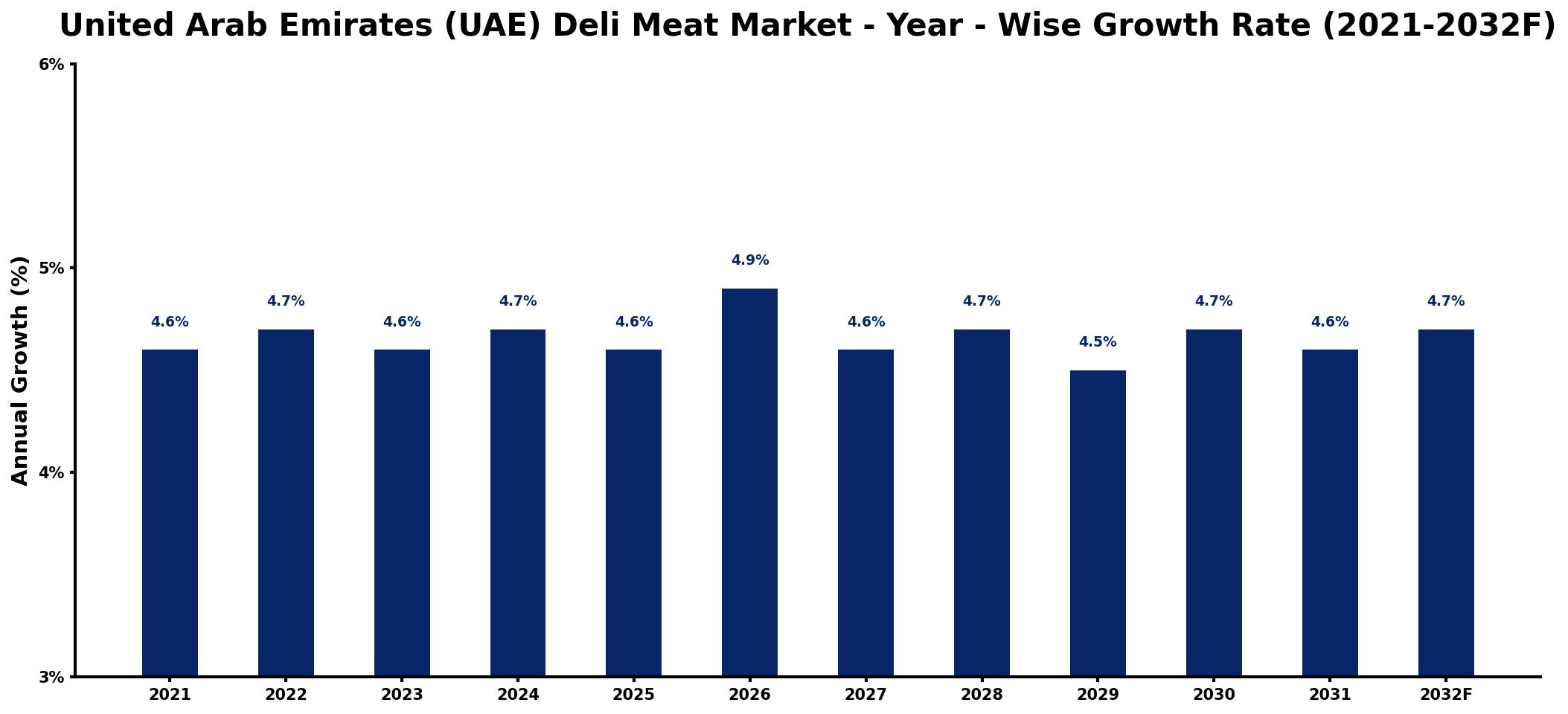
The table below presents the year‑wise growth rates along with the key drivers influencing the market
| Year | Growth Rate | Major Drivers |
| 2021 | 4.6% | Rising consumer demand for convenience |
| 2022 | 4.7% | Increased investment in processing technology |
| 2023 | 4.6% | Expansion of retail distribution channels |
| 2024 | 4.7% | Growing popularity of gourmet options |
| 2025 | 4.6% | Surge in health-conscious consumer trends |
| 2026 | 4.9% | Emergence of innovative flavor profiles |
| 2027 | 4.6% | Strengthening online shopping platforms |
| 2028 | 4.7% | Increased focus on sustainability practices |
| 2029 | 4.5% | Growth in foodservice sector offerings |
| 2030 | 4.7% | Rising popularity of international cuisines |
| 2031 | 4.6% | Enhancements in supply chain efficiency |
| 2032 | 4.7% | Development of premium product lines |
Note: Market size estimations and growth projections presented in this report are based on 6Wresearch's proprietary forecasting methodology, utilizing the latest available industry data, government publications, and primary research inputs.
United Arab Emirates (UAE) Deli Meat Market Synopsis
The UAE deli meat market thrives on the multicultural fabric of the population, which fosters a rich demand for varied meat options that cater to global culinary preferences. As consumers increasingly seek out unique flavor profiles, specialty deli meats have gained traction, prompting producers to emphasize product differentiation and quality assurance.
Additionally, the rapid expansion of delis and sandwich shops within urban areas fuels convenience-based consumption. Busy lifestyles are leading consumers to opt for ready-to-eat options, making deli meats a popular choice for meals and snacks, further solidifying this segment's market position.
United Arab Emirates (UAE) Deli Meat Market Key Takeaways
- The demand for specialty and artisanal deli meats is increasing, driven by diverse consumer preferences.
- Health-conscious choices are shaping product offerings, with a focus on natural ingredients and reduced sodium levels.
- Urbanization and the convenience trend are leading to a rise in deli and sandwich shop establishments.
- The shift towards online grocery shopping post-COVID-19 is reshaping distribution channels for deli meats.
- Supply chain logistics remain crucial for maintaining product quality in a hot climate.
Evaluation of Restraints in United Arab Emirates (UAE) Deli Meat Market
Despite the promising growth trajectory, the UAE deli meat market faces significant constraints that could hinder its expansion. One notable issue is the changing consumer preference towards healthier alternatives; many consumers are increasingly concerned about the health implications of processed meats, including high sodium and saturated fat content. This shift places pressure on manufacturers to innovate while ensuring that flavor and shelf life are not compromised.
Moreover, supply chain challenges, particularly in maintaining the freshness of perishable goods, pose logistical difficulties in the UAE's hot climate. These operational hurdles require a robust infrastructure and meticulous planning to ensure quality delivery to retail and foodservice channels.
United Arab Emirates (UAE) Deli Meat Market Trends
Current trends highlight a shift towards premium and healthier deli meat options as consumers demand transparency regarding product ingredients. Rising popularity for clean-label products is influencing manufacturers to eliminate artificial additives, which resonates particularly well with the health-conscious demographic. Additionally, the growth of plant-based alternatives in the market reflects a broader trend toward sustainable eating practices.
E-commerce is increasingly becoming a critical component of the distribution strategy, with many consumers opting to purchase deli meats online for convenience. This shift presents both a challenge and an opportunity for manufacturers to adapt their marketing and sales approaches to cater to changing consumer behavior.
United Arab Emirates (UAE) Deli Meat Market Opportunities
The UAE deli meat market is rife with opportunities for growth and innovation. One significant area lies in the development of health-oriented products, including low-sodium and preservative-free options, to meet the evolving dietary preferences of consumers. Brands that can successfully balance health without sacrificing taste stand to capture a loyal customer base.
Moreover, exploring partnerships with local delis and cafés can amplify market reach while enhancing brand visibility. Engaging in community-focused marketing initiatives can also help in creating a local presence that resonates with consumers. As e-commerce continues to grow, investing in digital platforms and enhancing online customer experience will also open new revenue streams.
Government Initiatives in the United Arab Emirates (UAE) Deli Meat Market
The UAE government has shown a commitment to enhancing food safety and quality standards within the deli meat sector. Ongoing initiatives aimed at promoting local food production and sustainable practices highlight the importance of supporting local businesses while ensuring the health and safety of consumers. Additionally, the regulatory environment is evolving to accommodate trends towards healthier eating, providing a supportive framework for innovative product development in the deli meat market.
Future Insights of the United Arab Emirates (UAE) Deli Meat Market
Looking forward to the period from 2026 to 2032, the UAE deli meat market is anticipated to experience robust growth fueled by evolving consumer preferences for quality and convenience. The trend towards healthier alternatives is expected to shape product lines, encouraging manufacturers to innovate in the realm of clean-label products. As the online shopping channel solidifies its foothold, companies will need to invest significantly in digital marketing strategies to capture and retain consumer attention.
In addition, fostering local partnerships will likely be a pivotal strategy as brands seek to build trust with consumers by emphasizing community and sustainability. Overall, the market's resilience, characterized by its ability to adapt to consumer demands, positions it well for future growth.
United Arab Emirates (UAE) Deli Meat Market Latest Developments (2025 - 2026)
Recent developments within the UAE deli meat market indicate a significant shift towards incorporating more natural and organic ingredients in product lines. Several manufacturers are responding to rising consumer demand for transparency and healthier options by reformulating their products. Additionally, there is an increasing focus on enhancing online sales channels, with companies prioritizing digital strategies to improve customer engagement and streamline the purchasing process.
United Arab Emirates (UAE) Deli Meat Market - Key Attractiveness of the Report
- 10 Years of Market Numbers
- Historical Data Starting from 2022 to 2025
- Base Year: 2025
- Forecast Data until 2032
- Key Performance Indicators Impacting the Market
- Major Upcoming Developments and Projects
Key Highlights of the Report:
- United Arab Emirates (UAE) Deli Meat Market Outlook
- Market Size of United Arab Emirates (UAE) Deli Meat Market, 2025
- Forecast of United Arab Emirates (UAE) Deli Meat Market, 2032
- Historical Data and Forecast of United Arab Emirates (UAE) Deli Meat Revenues & Volume for the Period 2022-2032F
- United Arab Emirates (UAE) Deli Meat Market Trend Evolution
- United Arab Emirates (UAE) Deli Meat Market Drivers and Challenges
- United Arab Emirates (UAE) Deli Meat Price Trends
- United Arab Emirates (UAE) Deli Meat Porter's Five Forces
- United Arab Emirates (UAE) Deli Meat Industry Life Cycle
- Historical Data and Forecast of United Arab Emirates (UAE) Deli Meat Market Revenues & Volume By Source for the Period 2022-2032F
- Historical Data and Forecast of United Arab Emirates (UAE) Deli Meat Market Revenues & Volume By Beef for the Period 2022-2032F
- Historical Data and Forecast of United Arab Emirates (UAE) Deli Meat Market Revenues & Volume By Pork for the Period 2022-2032F
- Historical Data and Forecast of United Arab Emirates (UAE) Deli Meat Market Revenues & Volume By Chicken for the Period 2022-2032F
- Historical Data and Forecast of United Arab Emirates (UAE) Deli Meat Market Revenues & Volume By Others for the Period 2022-2032F
- Historical Data and Forecast of United Arab Emirates (UAE) Deli Meat Market Revenues & Volume By Product Type for the Period 2022-2032F
- Historical Data and Forecast of United Arab Emirates (UAE) Deli Meat Market Revenues & Volume By Cured Meat for the Period 2022-2032F
- Historical Data and Forecast of United Arab Emirates (UAE) Deli Meat Market Revenues & Volume By Uncured Meat for the Period 2022-2032F
- Historical Data and Forecast of United Arab Emirates (UAE) Deli Meat Market Revenues & Volume By Sales Channel for the Period 2022-2032F
- Historical Data and Forecast of United Arab Emirates (UAE) Deli Meat Market Revenues & Volume By Hypermarkets/Supermarkets for the Period 2022-2032F
- Historical Data and Forecast of United Arab Emirates (UAE) Deli Meat Market Revenues & Volume By Specialty Stores for the Period 2022-2032F
- Historical Data and Forecast of United Arab Emirates (UAE) Deli Meat Market Revenues & Volume By Convenience Stores for the Period 2022-2032F
- Historical Data and Forecast of United Arab Emirates (UAE) Deli Meat Market Revenues & Volume By Online Channels for the Period 2022-2032F
- Historical Data and Forecast of United Arab Emirates (UAE) Deli Meat Market Revenues & Volume By Others for the Period 2022-2032F
- United Arab Emirates (UAE) Deli Meat Import Export Trade Statistics
- Market Opportunity Assessment By Source
- Market Opportunity Assessment By Product Type
- Market Opportunity Assessment By Sales Channel
- United Arab Emirates (UAE) Deli Meat Top Companies Market Share
- United Arab Emirates (UAE) Deli Meat Competitive Benchmarking By Technical and Operational Parameters
- United Arab Emirates (UAE) Deli Meat Company Profiles
- United Arab Emirates (UAE) Deli Meat Key Strategic Recommendations






































