United Arab Emirates (UAE) DevOps Market Size & Growth Rate (2026-2032)
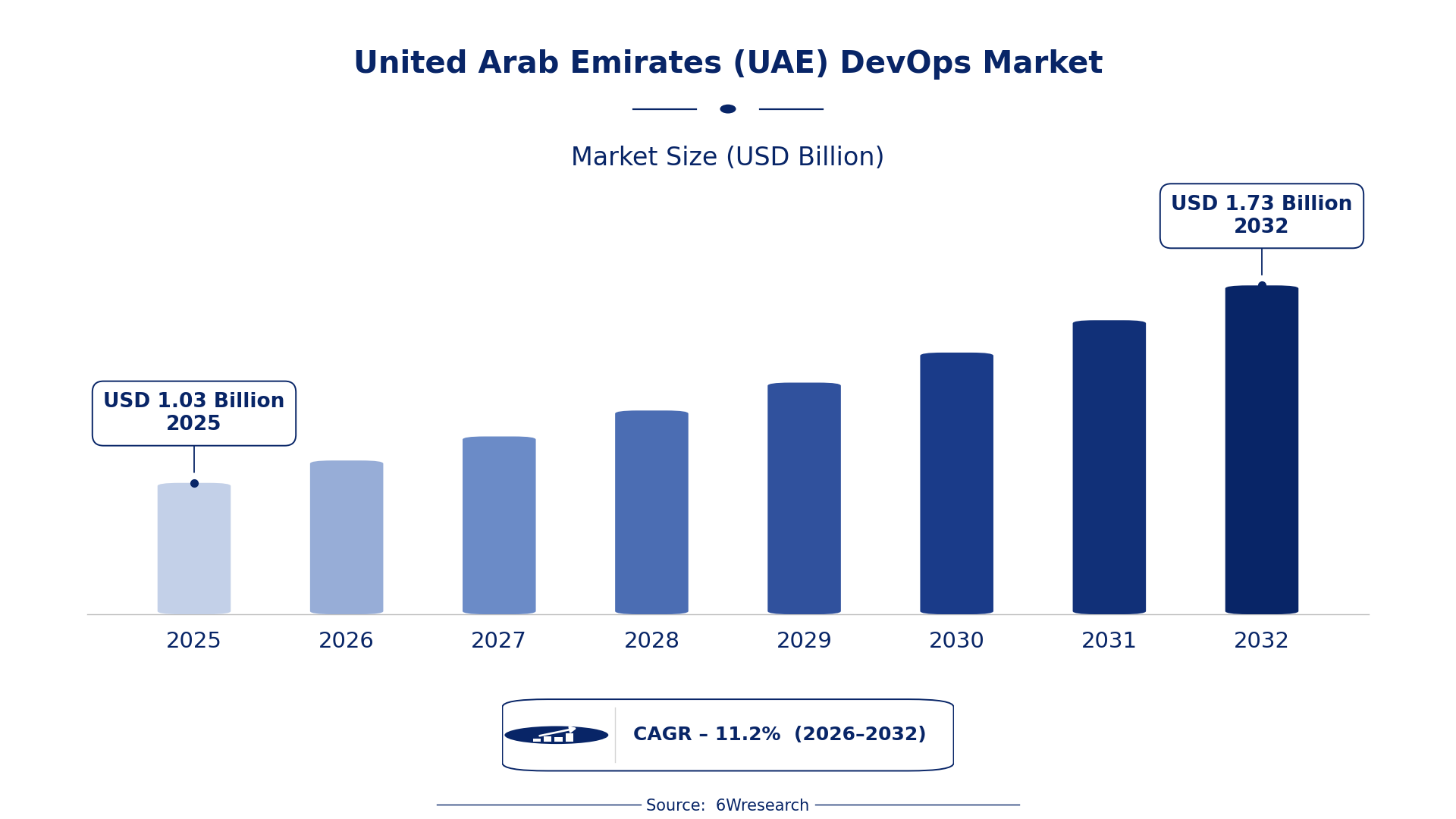
The United Arab Emirates (UAE) DevOps Market was estimated at USD 1032 Million in 2025 and is projected to reach USD 1730 Million by 2032, growing at a CAGR of 11.2% from 2026 to 2032.
United Arab Emirates (UAE) DevOps Market Synopsis
The DevOps market in the UAE is gaining momentum as organizations seek to enhance their software development and deployment capabilities. With a strong focus on integrating development and IT operations, companies are adopting DevOps to achieve faster, more reliable software delivery that aligns with the region's technological ambitions.
This surge is fueled by a governmental push towards digital transformation, urging businesses to innovate and optimize their processes. As organizations strive for agility and competitiveness, the demand for DevOps solutions is set to expand significantly, making it a cornerstone of the UAE’s evolving technology framework.
United Arab Emirates (UAE) DevOps Market Year-wise Growth Rate and Key Drivers
This graph illustrates the annual growth rates of the United Arab Emirates (UAE) DevOps Market from 2021 to 2032, highlighting a steady upward trajectory and projected expansion over the forecast period.
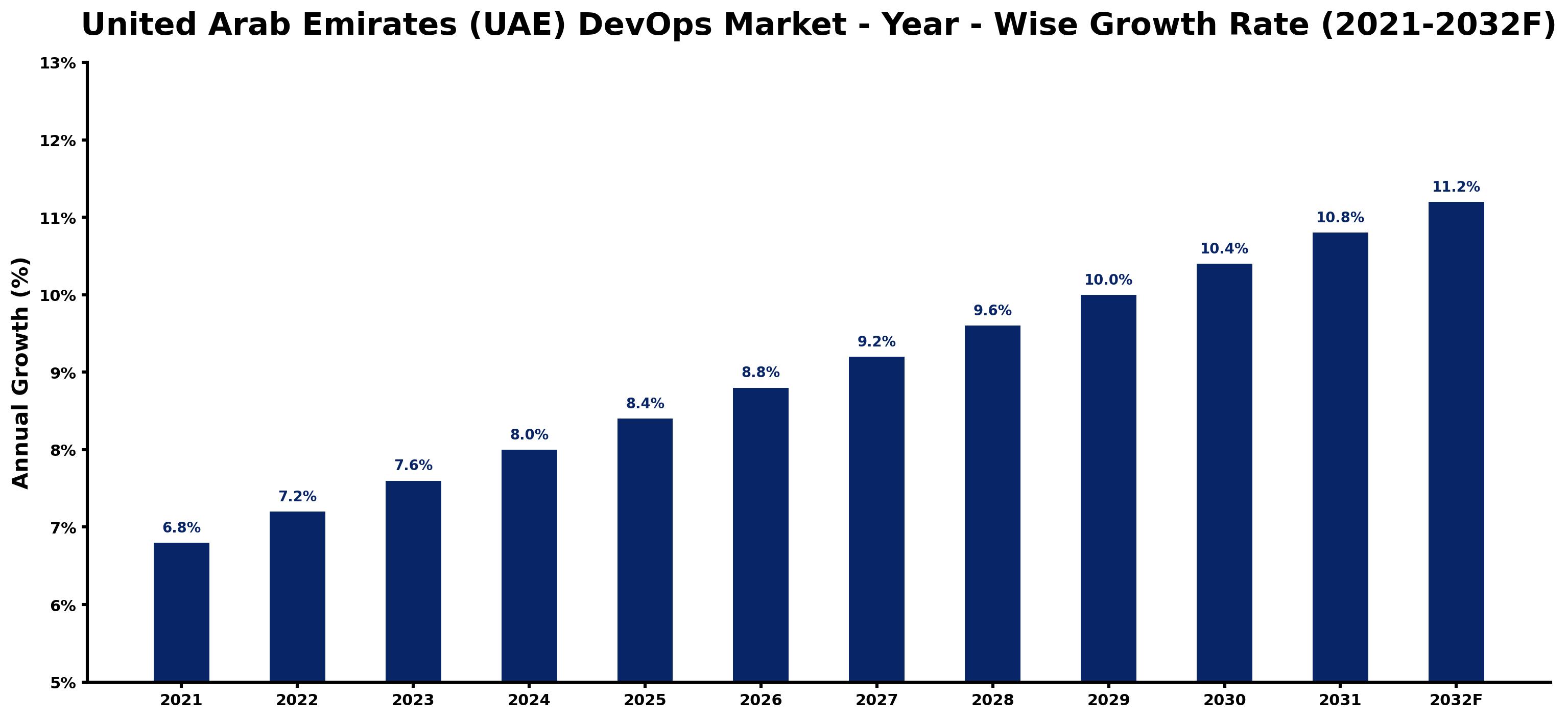
The table below presents the year‑wise growth rates along with the key drivers influencing the market
| Year | Growth Rate | Major Drivers |
| 2021 | 6.8% | UAE Cloud Computing strategy enhances DevOps adoption. |
| 2022 | 7.2% | Strong demand for agile development in fintech sector. |
| 2023 | 7.6% | Increased cybersecurity regulations push DevOps implementations. |
| 2024 | 8.0% | Government initiatives incentivize digital transformation in businesses. |
| 2025 | 8.4% | Rise of AI projects fuels demand for DevOps tools. |
| 2026 | 8.8% | UAE tech hubs support innovation in software development. |
| 2027 | 9.2% | Remote work policies accelerate need for efficient DevOps. |
| 2028 | 9.6% | Growth in e-commerce drives requirements for DevOps efficiencies. |
| 2029 | 10.0% | Investment in smart city projects boosts software development needs. |
| 2030 | 10.4% | UAE's Vision 2031 promotes digital infrastructure advancements. |
| 2031 | 10.8% | Increased collaboration in startups enhances DevOps practices. |
| 2032 | 11.2% | Sustained investment in digital services drives DevOps growth. |
Note: Market size estimations and growth projections presented in this report are based on 6Wresearch's proprietary forecasting methodology, utilizing the latest available industry data, government publications, and primary research inputs.
United Arab Emirates (UAE) DevOps Market Key Takeaways
Below are some of the specific key takeaways from the market, including:
- The UAE government’s commitment to digital transformation is accelerating the adoption of DevOps practices.
- Organizations are increasingly prioritizing faster time-to-market and automation in software development.
- Integration challenges among various tools and technologies remain a significant hurdle for many companies.
- Continuous learning and upskilling are critical for fostering a collaborative DevOps culture within organizations.
- The pandemic has catalyzed the interest in DevOps solutions as firms seek more efficient development processes.
Evaluation of Restraints in United Arab Emirates (UAE) DevOps Market
The journey toward effective DevOps implementation in the UAE is not without its obstacles. A major restraint is the cultural shift required within organizations; many companies grapple with resistance to change from traditional methodologies. This resistance can stall progress and affect the seamless integration of DevOps practices. Additionally, organizations often face challenges with aligning diverse toolsets and technologies. Achieving interoperability requires a strategic approach to standardization and cohesive communication across teams, which can be resource-intensive. These challenges highlight the need for a focused effort on cultural transformation and skill development.
United Arab Emirates (UAE) DevOps Market Trends
Several trends are currently influencing the DevOps market in the UAE. A growing emphasis on automation is driving organizations to adopt tools that facilitate continuous integration and continuous delivery (CI/CD). The rise of cloud-native technologies is also shaping how businesses deploy applications, with a shift towards microservices architecture enhancing flexibility and scalability. on top of that, as security becomes a priority, the integration of DevSecOps practices is becoming increasingly popular, ensuring security measures are embedded throughout the development lifecycle.
United Arab Emirates (UAE) DevOps Market Opportunities
The UAE DevOps market is rife with opportunities for growth and innovation. Companies that invest in training and upskilling their workforce can better harness the potential of DevOps practices. Additionally, the increasing demand for customized DevOps solutions tailored to specific industries presents a lucrative avenue for service providers. As more organizations recognize the importance of agility, there is a significant opportunity for firms that can deliver effective integration of DevOps tools and practices.
Government Initiatives in the United Arab Emirates (UAE) DevOps Market
The UAE government is actively shaping the DevOps market through various initiatives aimed at fostering digital innovation and technology adoption. This supportive regulatory environment is crucial as it encourages businesses to embrace DevOps methodologies. By prioritizing public-sector digital transformation, the government sets a precedent that benefits the broader technology ecosystem.
- A recently completed national digital infrastructure upgrade program aimed to enhance connectivity and support for cloud services.
- Currently underway is a public-private partnership initiative focusing on developing a skilled workforce in advanced technologies, including DevOps.
- A planned regulatory framework expected to launch in 2026 will mandate the integration of DevOps practices in public-sector software projects.
- The government is promoting innovation hubs that foster collaboration among tech companies and startups to facilitate the adoption of agile methodologies.
Future Insights of the United Arab Emirates (UAE) DevOps Market
Looking ahead to 2026-2032, the UAE DevOps market is set to witness substantial growth. As the digital transformation agenda continues to gain traction, organizations will increasingly prioritize agility and efficiency in their operations. The integration of AI and machine learning into DevOps processes will enhance predictive capabilities, enabling companies to better respond to market demands. on top of that, as more organizations recognize the value of continuous delivery, the adoption of DevOps will become a standard practice rather than an exception. This evolution will position the UAE as a leader in innovative software development practices.
United Arab Emirates (UAE) DevOps Market Latest Developments
Recent developments in the UAE's DevOps market reflect a dynamic environment where innovation is key. Over the past year, companies have been increasingly focused on enhancing their DevOps capabilities to remain competitive. This has led to a surge in partnerships and technology rollouts that aim to improve efficiency and collaboration.
- A major technology vendor launched a new DevOps platform in early 2025, designed to streamline workflows and enhance team collaboration.
- An initiative that began in mid-2025 is currently underway, focusing on the integration of security practices into the DevOps lifecycle.
- A rollout expected to begin in late 2025 will introduce advanced analytics tools aimed at optimizing DevOps processes.
- Recent partnerships between local tech companies and global firms are enhancing the availability of training programs for DevOps methodologies.
United Arab Emirates (UAE) DevOps Market - Key Attractiveness of the Report
- 10 Years of Market Numbers
- Historical Data Starting from 2022 to 2025
- Base Year: 2025
- Forecast Data until 2032
- Key Performance Indicators Impacting the Market
- Major Upcoming Developments and Projects
Key Highlights of the Report:
- United Arab Emirates (UAE) DevOps Market Outlook
- Market Size of United Arab Emirates (UAE) DevOps Market, 2025
- Forecast of United Arab Emirates (UAE) DevOps Market, 2032
- Historical Data and Forecast of United Arab Emirates (UAE) DevOps Revenues & Volume for the Period 2022-2032F
- United Arab Emirates (UAE) DevOps Market Trend Evolution
- United Arab Emirates (UAE) DevOps Market Drivers and Challenges
- United Arab Emirates (UAE) DevOps Price Trends
- United Arab Emirates (UAE) DevOps Porter's Five Forces
- United Arab Emirates (UAE) DevOps Industry Life Cycle
- Historical Data and Forecast of United Arab Emirates (UAE) DevOps Market Revenues & Volume By Type for the Period 2022-2032F
- Historical Data and Forecast of United Arab Emirates (UAE) DevOps Market Revenues & Volume By Solutions for the Period 2022-2032F
- Historical Data and Forecast of United Arab Emirates (UAE) DevOps Market Revenues & Volume By Services for the Period 2022-2032F
- Historical Data and Forecast of United Arab Emirates (UAE) DevOps Market Revenues & Volume By Vertical for the Period 2022-2032F
- Historical Data and Forecast of United Arab Emirates (UAE) DevOps Market Revenues & Volume By Telecommunications for the Period 2022-2032F
- Historical Data and Forecast of United Arab Emirates (UAE) DevOps Market Revenues & Volume By IT and ITeS for the Period 2022-2032F
- Historical Data and Forecast of United Arab Emirates (UAE) DevOps Market Revenues & Volume By Retail and Consumer Goods for the Period 2022-2032F
- Historical Data and Forecast of United Arab Emirates (UAE) DevOps Market Revenues & Volume By Media and Entertainment for the Period 2022-2032F
- Historical Data and Forecast of United Arab Emirates (UAE) DevOps Market Revenues & Volume By Government and Public Sector for the Period 2022-2032F
- Historical Data and Forecast of United Arab Emirates (UAE) DevOps Market Revenues & Volume By Manufacturing for the Period 2022-2032F
- Historical Data and Forecast of United Arab Emirates (UAE) DevOps Market Revenues & Volume By Healthcare and Life Sciences for the Period 2022-2032F
- Historical Data and Forecast of United Arab Emirates (UAE) DevOps Market Revenues & Volume By Education for the Period 2022-2032F
- Historical Data and Forecast of United Arab Emirates (UAE) DevOps Market Revenues & Volume By Deployment Model for the Period 2022-2032F
- Historical Data and Forecast of United Arab Emirates (UAE) DevOps Market Revenues & Volume By Public for the Period 2022-2032F
- Historical Data and Forecast of United Arab Emirates (UAE) DevOps Market Revenues & Volume By Private for the Period 2022-2032F
- Historical Data and Forecast of United Arab Emirates (UAE) DevOps Market Revenues & Volume By Organization Size for the Period 2022-2032F
- Historical Data and Forecast of United Arab Emirates (UAE) DevOps Market Revenues & Volume By SMEs for the Period 2022-2032F
- Historical Data and Forecast of United Arab Emirates (UAE) DevOps Market Revenues & Volume By Large enterprises for the Period 2022-2032F
- United Arab Emirates (UAE) DevOps Import Export Trade Statistics
- Market Opportunity Assessment By Type
- Market Opportunity Assessment By Vertical
- Market Opportunity Assessment By Deployment Model
- Market Opportunity Assessment By Organization Size
- United Arab Emirates (UAE) DevOps Top Companies Market Share
- United Arab Emirates (UAE) DevOps Competitive Benchmarking By Technical and Operational Parameters
- United Arab Emirates (UAE) DevOps Company Profiles
- United Arab Emirates (UAE) DevOps Key Strategic Recommendations






































