United Arab Emirates (UAE) Distributed Cloud Market Size & Growth Rate (2026-2032)
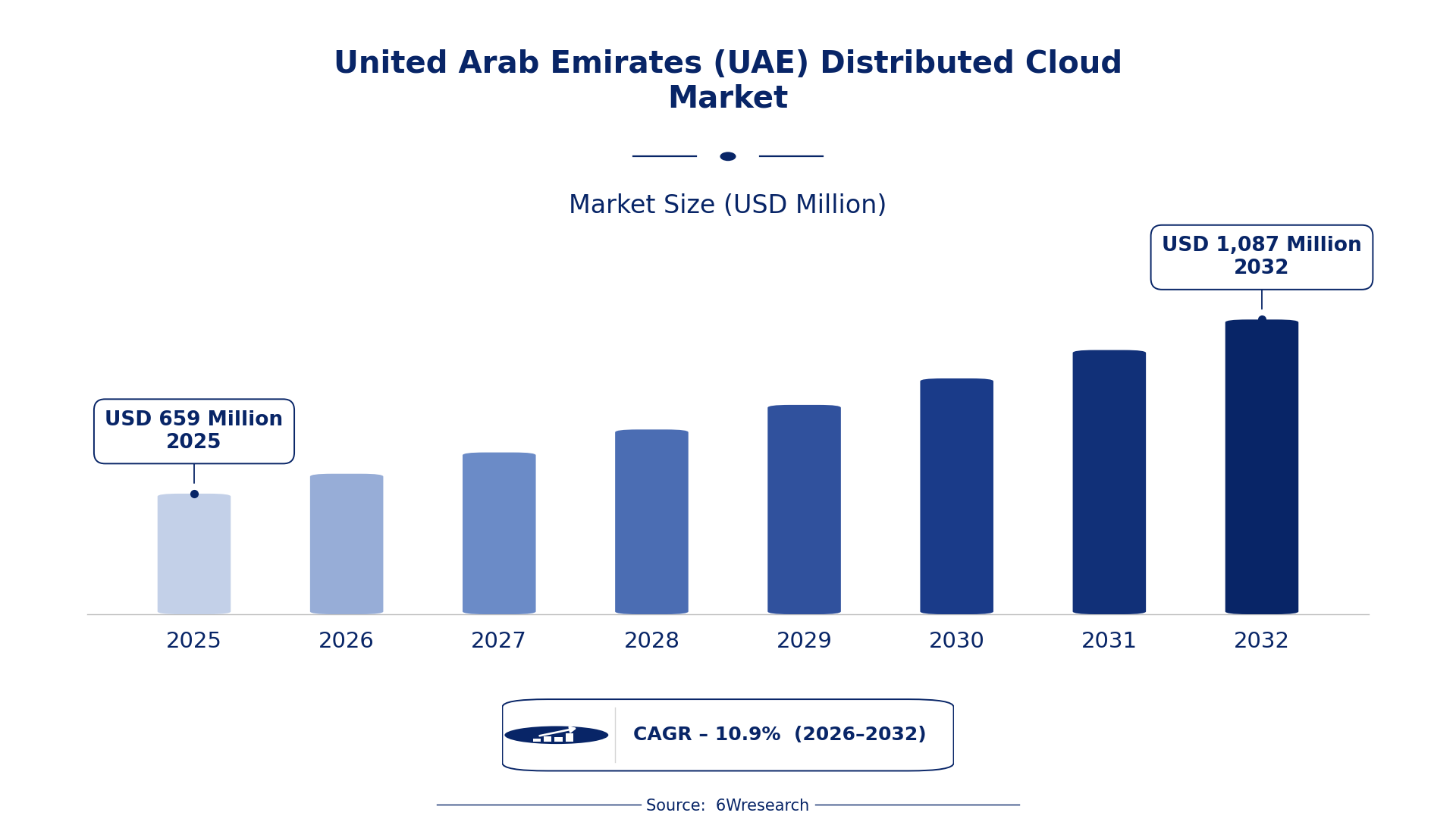
The United Arab Emirates (UAE) Distributed Cloud Market was estimated at USD 659 Million in 2025 and is projected to reach USD 1087 Million by 2032, growing at a CAGR of 10.9% from 2026 to 2032.
United Arab Emirates (UAE) Distributed Cloud Market Synopsis
The Distributed Cloud market in the UAE is witnessing a surge as businesses increasingly prioritize localized cloud solutions. Companies are recognizing that decentralizing cloud resources can significantly enhance data processing speeds and improve user experience, particularly for data-intensive applications.
This shift aligns perfectly with the UAE's strategic vision to enhance digital transformation across various sectors. By bringing cloud services closer to end-users, distributed cloud technologies are set to redefine how organizations operate and interact with their customers.
United Arab Emirates (UAE) Distributed Cloud Market Year-wise Growth Rate and Key Drivers
This graph illustrates the annual growth rates of the United Arab Emirates (UAE) Distributed Cloud Market from 2021 to 2032, highlighting a steady upward trajectory and projected expansion over the forecast period.
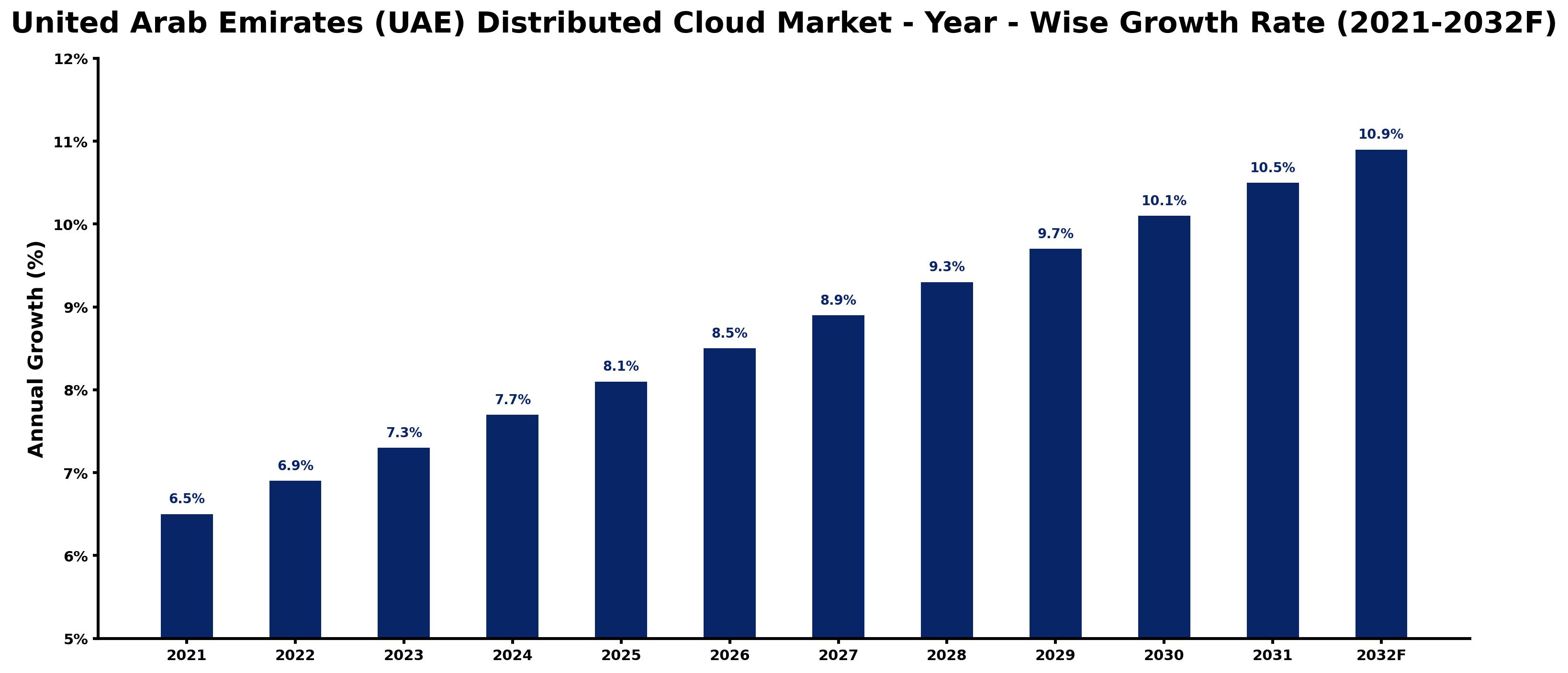
The table below presents the year‑wise growth rates along with the key drivers influencing the market
| Year | Growth Rate | Major Drivers |
| 2021 | 6.5% | UAE Vision 2021 promotes digital infrastructure advancements. |
| 2022 | 6.9% | Dubai's Expo 2020 accelerated cloud technology adoption. |
| 2023 | 7.3% | RAK's new smart city initiative leverages distributed cloud solutions. |
| 2024 | 7.7% | Increased demand for data sovereignty drives local cloud installations. |
| 2025 | 8.1% | FEDERAL law encourages increased local data storage requirements. |
| 2026 | 8.5% | UAE's investment in AI boosts distributed computing needs. |
| 2027 | 8.9% | Growing fintech sector demands secure, scalable cloud platforms. |
| 2028 | 9.3% | 5G rollout enhances distributed cloud service capabilities. |
| 2029 | 9.7% | Local enterprises shifting to hybrid cloud models post-COVID. |
| 2030 | 10.1% | Government-backed cybersecurity strategies necessitate distributed solutions. |
| 2031 | 10.5% | Public-private partnerships enhance cloud service offerings. |
| 2032 | 10.9% | Rising e-commerce trends fuel cloud infrastructure investment. |
Note: Market size estimations and growth projections presented in this report are based on 6Wresearch's proprietary forecasting methodology, utilizing the latest available industry data, government publications, and primary research inputs.
United Arab Emirates (UAE) Distributed Cloud Market Key Takeaways
Below are some of the specific key takeaways from the market, including:
- Demand for localized cloud resources is driving the growth of the distributed cloud market.
- Businesses are focusing on reducing latency and enhancing data privacy through decentralized solutions.
- The UAE's commitment to digital transformation is a significant catalyst for market expansion.
- Challenges related to data synchronization and architecture management must be addressed for successful implementation.
- Increased investment in distributed cloud technology is expected in response to remote work trends.
Evaluation of Restraints in United Arab Emirates (UAE) Distributed Cloud Market
Despite its promising outlook, the Distributed Cloud Market in the UAE faces several barriers. The technical complexity of implementing a distributed architecture can deter organizations, as they must grapple with issues related to data consistency and synchronization across multiple nodes. Many businesses may lack the necessary expertise and resources to manage these challenges effectively, which could slow down adoption rates. on top of that, regulatory compliance and data sovereignty concerns add another layer of complexity that organizations must navigate when deploying distributed cloud solutions.
United Arab Emirates (UAE) Distributed Cloud Market Trends
Several trends are shaping the future of the distributed cloud market in the UAE. A growing emphasis on edge computing is emerging as businesses recognize its potential for reducing latency and enhancing real-time data processing capabilities. Additionally, the rise of 5G technology is expected to further bolster demand for distributed cloud services, enabling faster and more reliable connections.
on top of that, organizations are increasingly prioritizing data privacy, pushing for cloud solutions that meet stringent regulatory standards while delivering localized services. This trend highlights the balancing act businesses must perform between leveraging cloud capabilities and adhering to compliance requirements.
United Arab Emirates (UAE) Distributed Cloud Market Opportunities
The distributed cloud market presents numerous growth opportunities in the UAE. As organizations continue to invest in digital transformation, the demand for tailored cloud solutions that address specific business needs will rise. Companies focusing on developing edge computing solutions can capitalize on this trend, particularly in sectors like healthcare, finance, and telecommunications.
on top of that, partnerships between technology vendors and local businesses can accelerate the adoption of distributed cloud solutions, fostering innovation and creating new revenue streams. The government's ongoing commitment to enhancing the digital ecosystem will also play a crucial role in driving market growth.
Government Initiatives in the United Arab Emirates (UAE) Distributed Cloud Market
Government policies in the UAE are crucial in shaping the distributed cloud market. The focus on creating a conducive environment for digital transformation underscores the importance of robust regulatory frameworks and infrastructure development. With public-sector priorities aligning with technological advancements, businesses are encouraged to adopt distributed cloud solutions that meet compliance requirements and enhance operational efficiency.
- A national digital infrastructure upgrade programme launched in early 2025 aims to enhance connectivity and support cloud services across various sectors.
- Currently underway is a regulatory framework designed to facilitate data privacy and security standards for cloud providers, ensuring compliance with local laws.
- A planned public-private initiative is set to expand access to high-speed internet, particularly in underserved areas, expected to roll out by 2028.
- The government has introduced incentives for businesses investing in cloud technologies, encouraging local organizations to transition to distributed models.
- Recent policy revisions in 2025 are promoting collaboration between public institutions and technology vendors to accelerate the adoption of advanced cloud solutions.
Future Insights of the United Arab Emirates (UAE) Distributed Cloud Market
Looking ahead to 2026-2032, the distributed cloud market in the UAE is likely to experience significant growth as organizations continue to prioritize data localization and reduced latency. The emergence of advanced technologies, such as AI and machine learning, will further enhance the capabilities of distributed cloud solutions, enabling businesses to harness data in innovative ways.
As the market matures, we can expect to see increased competition among cloud service providers, driving innovation and leading to more tailored solutions for specific industries. The ongoing support from the government will also play a vital role in fostering a thriving ecosystem for distributed cloud technologies.
United Arab Emirates (UAE) Distributed Cloud Market Latest Developments
Over the last 12-14 months, the United Arab Emirates Distributed Cloud Market has seen a flurry of activity as businesses adapt to new operational demands. The focus has shifted towards solutions that offer enhanced speed, security, and compliance, reflecting the growing importance of distributed cloud architectures.
- A leading regional operator announced the launch of its distributed cloud services in early 2025, aimed at improving service delivery and reducing latency for local businesses.
- In mid-2025, a major technology vendor initiated a partnership with local enterprises to develop customized distributed cloud solutions tailored for the healthcare sector.
- A rollout expected to begin in Q3 2026 will expand the availability of edge computing resources across metropolitan areas, enhancing connectivity for businesses.
- Currently underway is an initiative focused on integrating AI capabilities into distributed cloud services, with plans to pilot the program by late 2025.
- A recently completed upgrade of a national data center infrastructure aims to support increased demand for distributed cloud applications, finalized by early 2025.
United Arab Emirates (UAE) Distributed Cloud Market - Key Attractiveness of the Report
- 10 Years of Market Numbers
- Historical Data Starting from 2022 to 2025
- Base Year: 2025
- Forecast Data until 2032
- Key Performance Indicators Impacting the Market
- Major Upcoming Developments and Projects
Key Highlights of the Report:
- United Arab Emirates (UAE) Distributed Cloud Market Outlook
- Market Size of United Arab Emirates (UAE) Distributed Cloud Market, 2025
- Forecast of United Arab Emirates (UAE) Distributed Cloud Market, 2032
- Historical Data and Forecast of United Arab Emirates (UAE) Distributed Cloud Revenues & Volume for the Period 2022-2032F
- United Arab Emirates (UAE) Distributed Cloud Market Trend Evolution
- United Arab Emirates (UAE) Distributed Cloud Market Drivers and Challenges
- United Arab Emirates (UAE) Distributed Cloud Price Trends
- United Arab Emirates (UAE) Distributed Cloud Porter's Five Forces
- United Arab Emirates (UAE) Distributed Cloud Industry Life Cycle
- Historical Data and Forecast of United Arab Emirates (UAE) Distributed Cloud Market Revenues & Volume By Service Type for the Period 2022-2032F
- Historical Data and Forecast of United Arab Emirates (UAE) Distributed Cloud Market Revenues & Volume By Data Security for the Period 2022-2032F
- Historical Data and Forecast of United Arab Emirates (UAE) Distributed Cloud Market Revenues & Volume By Data Storage for the Period 2022-2032F
- Historical Data and Forecast of United Arab Emirates (UAE) Distributed Cloud Market Revenues & Volume By Networking for the Period 2022-2032F
- Historical Data and Forecast of United Arab Emirates (UAE) Distributed Cloud Market Revenues & Volume By Vertical for the Period 2022-2032F
- Historical Data and Forecast of United Arab Emirates (UAE) Distributed Cloud Market Revenues & Volume By BFSI for the Period 2022-2032F
- Historical Data and Forecast of United Arab Emirates (UAE) Distributed Cloud Market Revenues & Volume By IT & Telecom for the Period 2022-2032F
- Historical Data and Forecast of United Arab Emirates (UAE) Distributed Cloud Market Revenues & Volume By Government for the Period 2022-2032F
- Historical Data and Forecast of United Arab Emirates (UAE) Distributed Cloud Market Revenues & Volume By Healthcare & Life Sciences for the Period 2022-2032F
- Historical Data and Forecast of United Arab Emirates (UAE) Distributed Cloud Market Revenues & Volume By Retail & Consumer Goods for the Period 2022-2032F
- Historical Data and Forecast of United Arab Emirates (UAE) Distributed Cloud Market Revenues & Volume By Media & Entertainment for the Period 2022-2032F
- Historical Data and Forecast of United Arab Emirates (UAE) Distributed Cloud Market Revenues & Volume By Energy & Utilities for the Period 2022-2032F
- Historical Data and Forecast of United Arab Emirates (UAE) Distributed Cloud Market Revenues & Volume By Application for the Period 2022-2032F
- Historical Data and Forecast of United Arab Emirates (UAE) Distributed Cloud Market Revenues & Volume By Edge Computing for the Period 2022-2032F
- Historical Data and Forecast of United Arab Emirates (UAE) Distributed Cloud Market Revenues & Volume By Content Delivery for the Period 2022-2032F
- Historical Data and Forecast of United Arab Emirates (UAE) Distributed Cloud Market Revenues & Volume By Internet of Things for the Period 2022-2032F
- Historical Data and Forecast of United Arab Emirates (UAE) Distributed Cloud Market Revenues & Volume By Other Applications for the Period 2022-2032F
- Historical Data and Forecast of United Arab Emirates (UAE) Distributed Cloud Market Revenues & Volume By Organization Size for the Period 2022-2032F
- Historical Data and Forecast of United Arab Emirates (UAE) Distributed Cloud Market Revenues & Volume By Large Enterprises for the Period 2022-2032F
- Historical Data and Forecast of United Arab Emirates (UAE) Distributed Cloud Market Revenues & Volume By Small and Medium Size Enterprises for the Period 2022-2032F
- United Arab Emirates (UAE) Distributed Cloud Import Export Trade Statistics
- Market Opportunity Assessment By Service Type
- Market Opportunity Assessment By Vertical
- Market Opportunity Assessment By Application
- Market Opportunity Assessment By Organization Size
- United Arab Emirates (UAE) Distributed Cloud Top Companies Market Share
- United Arab Emirates (UAE) Distributed Cloud Competitive Benchmarking By Technical and Operational Parameters
- United Arab Emirates (UAE) Distributed Cloud Company Profiles
- United Arab Emirates (UAE) Distributed Cloud Key Strategic Recommendations






































