United Arab Emirates (UAE) Dyeing Machine Market Size, Share & Growth Rate
The United Arab Emirates (UAE) Dyeing Machine Market was estimated at USD 376 Million in 2025 and is projected to reach USD 527 Million by 2032, growing at a CAGR of 4.9% from 2026 to 2032. This growth trajectory is primarily propelled by the burgeoning textile and garment sector, which demands advanced dyeing technologies that are energy-efficient and sustainable. Furthermore, the increasing regulatory pressures to mitigate environmental impacts are pushing manufacturers to upgrade their dyeing machinery, thus amplifying the market's expansion.
United Arab Emirates (UAE) Dyeing Machine Market Year-wise Growth Rate and Key Drivers
This graph highlights how the United Arab Emirates (UAE) Dyeing Machine Market has steadily grown over the years, supported by major growth factors.
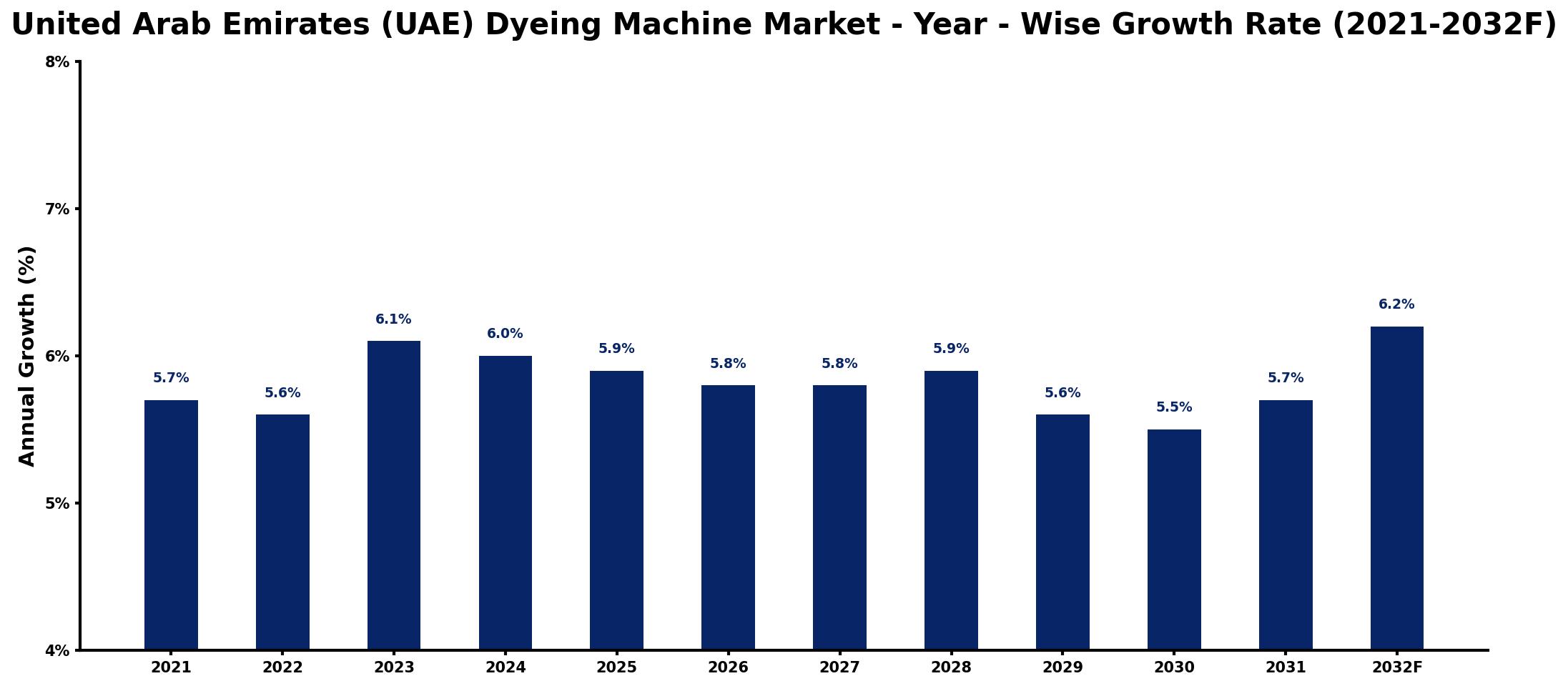
The table below presents the year‑wise growth rates along with the key drivers influencing the market
| Year | Growth Rate | Major Drivers |
| 2021 | 5.7% | Rising textile production capacity |
| 2022 | 5.6% | Growing fashion industry investments |
| 2023 | 6.1% | Increased demand for sustainability |
| 2024 | 6.0% | Expansion of export markets |
| 2025 | 5.9% | Technological advancements in production |
| 2026 | 5.8% | Diversification of product offerings |
| 2027 | 5.8% | Strengthening domestic supply chains |
| 2028 | 5.9% | Higher consumer spending trends |
| 2029 | 5.6% | Emergence of eco-friendly practices |
| 2030 | 5.5% | Boost in regional trade agreements |
| 2031 | 5.7% | Surge in online retail platforms |
| 2032 | 6.2% | Innovations in production methods |
Note: Market size estimations and growth projections presented in this report are based on 6Wresearch's proprietary forecasting methodology, utilizing the latest available industry data, government publications, and primary research inputs.
United Arab Emirates (UAE) Dyeing Machine Market Synopsis
The UAE's dyeing machine market is characterized by its rapid technological advancements, catering to a textile industry that is both vibrant and competitive. The local manufacturers are increasingly developing cutting-edge, eco-friendly dyeing solutions that align with the UAE's strategic vision of sustainability and innovation.
An ongoing shift towards high-quality dyed fabrics reflects the market's adaptability to international trends, alongside a rising consumer preference for sustainable products. This demand has attracted significant investments, thereby fostering an environment ripe for innovation and growth.
United Arab Emirates (UAE) Dyeing Machine Market Key Takeaways
- The market is driven by the increasing demand for advanced, energy-efficient dyeing technologies.
- Manufacturers face regulatory pressures to adopt sustainable practices, influencing investment decisions.
- Competition between local and international players is intensifying, affecting market dynamics.
- The impact of COVID-19 has prompted companies to pivot towards energy-efficient and sustainable solutions.
- Technological advancements are essential for maintaining competitive edges in this rapidly evolving market.
Evaluation of Restraints in United Arab Emirates (UAE) Dyeing Machine Market
Despite its growth potential, the UAE Dyeing Machine Market encounters various restraints that can hinder its progress. One of the most pressing challenges is the stringent environmental regulations regarding wastewater management and chemical usage in dyeing processes. These regulations can impose substantial operational costs, compelling companies to reassess their production methods.
Additionally, rapid advancements in technology create a risk of obsolescence, pushing manufacturers to continuously innovate and upgrade their equipment. The market's saturation level can lead to fierce competition and subsequent pricing pressures, further complicating profitability in an already volatile market influenced by fluctuations in global textile demand.
United Arab Emirates (UAE) Dyeing Machine Market Trends
Current trends in the UAE Dyeing Machine Market are heavily influenced by a movement toward sustainability and efficiency. Innovations such as waterless dyeing technologies and biodegradable dyes are gaining traction, driven by both consumer preferences and regulatory frameworks. There is also an increasing focus on automation within dyeing processes, allowing for greater precision, reduced waste, and enhanced productivity.
Moreover, digital technologies, including IoT and AI, are being integrated into dyeing machines to facilitate real-time monitoring and data analysis, which enhances operational efficiency. These trends not only address sustainability but also help in aligning manufacturing practices with global standards.
United Arab Emirates (UAE) Dyeing Machine Market Opportunities
The UAE Dyeing Machine Market holds numerous opportunities for growth, particularly in the realm of sustainable technologies. As the region continues to prioritize eco-friendly practices, businesses that invest in innovative, sustainable dyeing solutions stand to gain a competitive edge. Additionally, the ongoing expansion of the textile sector presents opportunities for manufacturers to introduce advanced machinery tailored to specific fabric types and dyeing methods.
Furthermore, exploring untapped markets, particularly in emerging economies within the region, offers potential for increased sales and market penetration. Collaborations and partnerships with local textile producers can further enhance market presence and innovation.
Government Initiatives in the United Arab Emirates (UAE) Dyeing Machine Market
The UAE government is actively promoting initiatives aimed at boosting the textile and dyeing industries through public spending and supportive policies. Programs focused on sustainability encourage manufacturers to invest in eco-friendly technologies, aligning with national goals for environmental conservation. Additionally, various incentives are available for companies that adopt innovative practices, helping to drive technological advancements in the dyeing machine market.
Future Insights of the United Arab Emirates (UAE) Dyeing Machine Market
Looking ahead, the UAE Dyeing Machine Market is poised for continued growth, propelled by a confluence of technological innovation, regulatory support, and a burgeoning textile industry. By 2032, the push for advanced, sustainable dyeing solutions will likely dominate the competitive landscape. Manufacturers that prioritize energy efficiency and environmental compliance will emerge as leaders, while those slow to adapt may face challenges in a rapidly evolving market.
United Arab Emirates (UAE) Dyeing Machine Market Latest Developments (2025 - 2026)
Recent industry developments have highlighted a growing focus on automation and digital transformation in dyeing processes. Companies are increasingly investing in technologies that allow for remote monitoring and smart manufacturing, which improves operational efficiency and reduces waste. Moreover, partnerships between local firms and technology providers are enhancing the availability of innovative solutions, thereby meeting the evolving demands of the textile market.
United Arab Emirates (UAE) Dyeing Machine Market - Key Attractiveness of the Report
- 10 Years of Market Numbers
- Historical Data Starting from 2022 to 2025
- Base Year: 2025
- Forecast Data until 2032
- Key Performance Indicators Impacting the Market
- Major Upcoming Developments and Projects
Key Highlights of the Report:
- United Arab Emirates (UAE) Dyeing Machine Market Outlook
- Market Size of United Arab Emirates (UAE) Dyeing Machine Market, 2025
- Forecast of United Arab Emirates (UAE) Dyeing Machine Market, 2032
- Historical Data and Forecast of United Arab Emirates (UAE) Dyeing Machine Revenues & Volume for the Period 2022-2032F
- United Arab Emirates (UAE) Dyeing Machine Market Trend Evolution
- United Arab Emirates (UAE) Dyeing Machine Market Drivers and Challenges
- United Arab Emirates (UAE) Dyeing Machine Price Trends
- United Arab Emirates (UAE) Dyeing Machine Porter's Five Forces
- United Arab Emirates (UAE) Dyeing Machine Industry Life Cycle
- Historical Data and Forecast of United Arab Emirates (UAE) Dyeing Machine Market Revenues & Volume By Product Type for the Period 2022-2032F
- Historical Data and Forecast of United Arab Emirates (UAE) Dyeing Machine Market Revenues & Volume By Fabric Dyeing Machine for the Period 2022-2032F
- Historical Data and Forecast of United Arab Emirates (UAE) Dyeing Machine Market Revenues & Volume By Yarn Dyeing Machine for the Period 2022-2032F
- Historical Data and Forecast of United Arab Emirates (UAE) Dyeing Machine Market Revenues & Volume By Knit Dyeing Machine for the Period 2022-2032F
- Historical Data and Forecast of United Arab Emirates (UAE) Dyeing Machine Market Revenues & Volume By Woven Dyeing Machine for the Period 2022-2032F
- Historical Data and Forecast of United Arab Emirates (UAE) Dyeing Machine Market Revenues & Volume By Dyeing Procedure for the Period 2022-2032F
- Historical Data and Forecast of United Arab Emirates (UAE) Dyeing Machine Market Revenues & Volume By Open Dyeing Machine for the Period 2022-2032F
- Historical Data and Forecast of United Arab Emirates (UAE) Dyeing Machine Market Revenues & Volume By Enclosed Dyeing Machine for the Period 2022-2032F
- United Arab Emirates (UAE) Dyeing Machine Import Export Trade Statistics
- Market Opportunity Assessment By Product Type
- Market Opportunity Assessment By Dyeing Procedure
- United Arab Emirates (UAE) Dyeing Machine Top Companies Market Share
- United Arab Emirates (UAE) Dyeing Machine Competitive Benchmarking By Technical and Operational Parameters
- United Arab Emirates (UAE) Dyeing Machine Company Profiles
- United Arab Emirates (UAE) Dyeing Machine Key Strategic Recommendations






































