United Arab Emirates (UAE) Edge Data Center Market Size & Growth Rate (2026-2032)
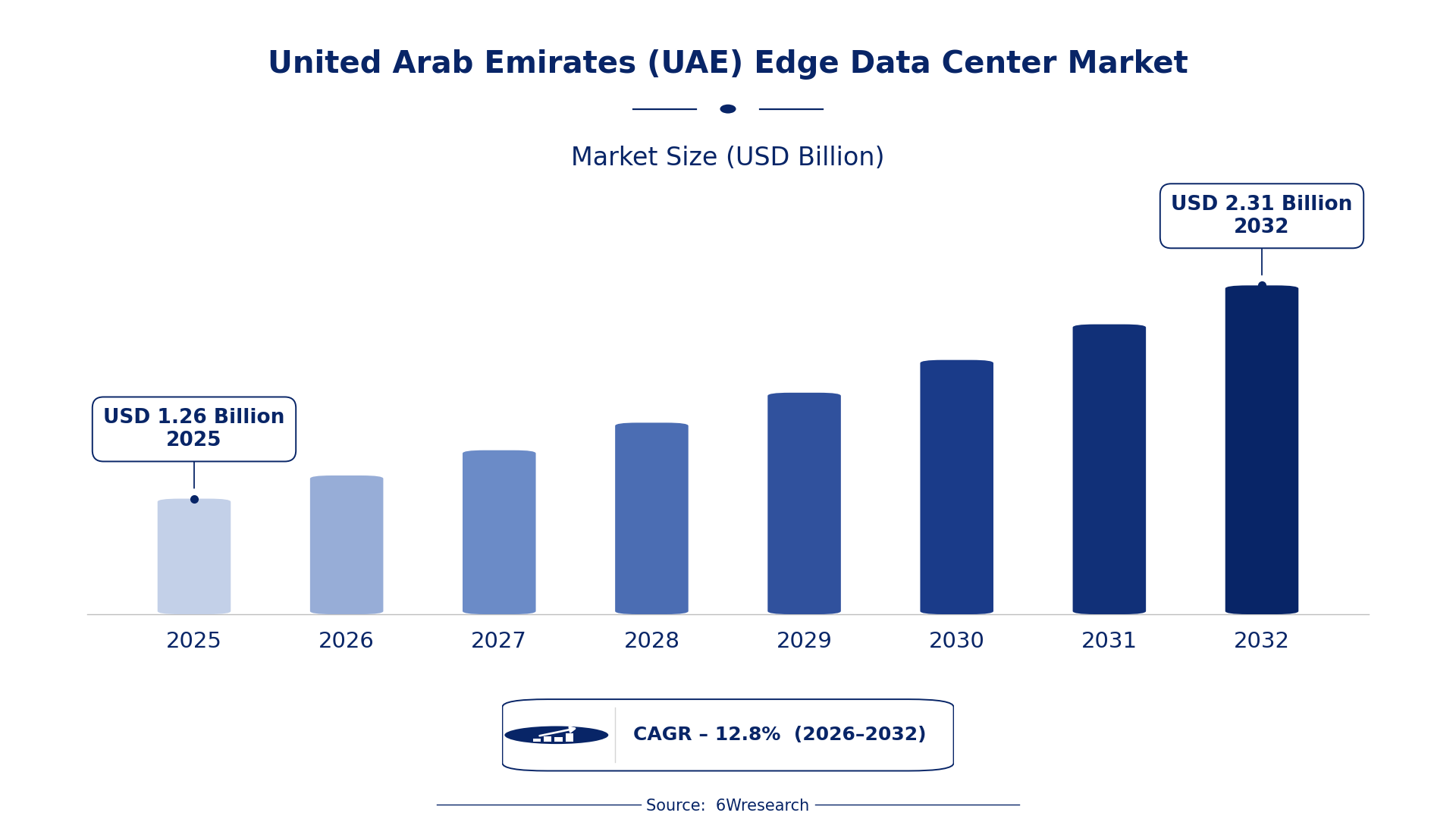
The United Arab Emirates (UAE) Edge Data Center Market was estimated at USD 1260 Million in 2025 and is projected to reach USD 2306 Million by 2032, growing at a CAGR of 12.8% from 2026 to 2032.
United Arab Emirates (UAE) Edge Data Center Market Synopsis
The rapid expansion of IoT and 5G networks has created an urgent need for low-latency data processing in the UAE. Edge data centers are becoming essential as businesses seek to enhance user experiences by minimizing delays in data transmission and processing.
Organizations across various sectors in the UAE are increasingly relying on edge computing solutions to support real-time applications. This demand is a direct response to the growing volume of data generated at the edge, necessitating localized processing capabilities for efficiency and security.
United Arab Emirates (UAE) Edge Data Center Market Year-wise Growth Rate and Key Drivers
This graph illustrates the annual growth rates of the United Arab Emirates (UAE) Edge Data Center Market from 2021 to 2032, highlighting a steady upward trajectory and projected expansion over the forecast period.
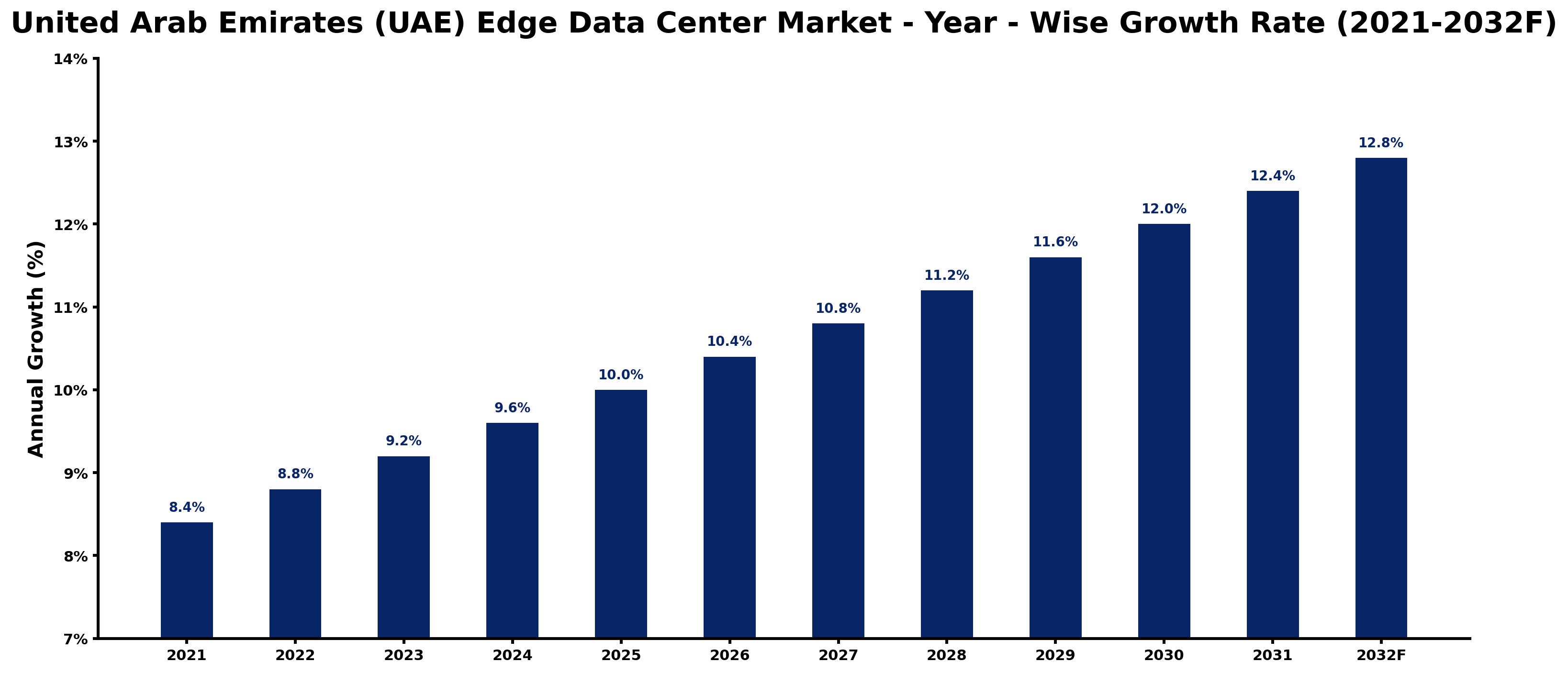
The table below presents the year‑wise growth rates along with the key drivers influencing the market
| Year | Growth Rate | Major Drivers |
| 2021 | 8.4% | UAE data protection regulations boosting edge data center demand |
| 2022 | 8.8% | Smart Dubai initiative promoting local data processing solutions |
| 2023 | 9.2% | Rising 5G adoption enhancing edge data service utilization |
| 2024 | 9.6% | Increased remote work driving demand for local data centers |
| 2025 | 10.0% | Sustainability goals supporting energy-efficient edge innovations |
| 2026 | 10.4% | Growing regional digital economy necessitating low-latency services |
| 2027 | 10.8% | National Artificial Intelligence Strategy fueling local edge investments |
| 2028 | 11.2% | Emergence of IoT applications driving localized data processing |
| 2029 | 11.6% | Supportive government incentives for tech infrastructure development |
| 2030 | 12.0% | Rising tourism data management needs for immediate processing |
| 2031 | 12.4% | Increased cybersecurity mandates requiring localized data storage |
| 2032 | 12.8% | Growing urban population driving demand for edge computing services |
Note: Market size estimations and growth projections presented in this report are based on 6Wresearch's proprietary forecasting methodology, utilizing the latest available industry data, government publications, and primary research inputs.
United Arab Emirates (UAE) Edge Data Center Market Key Takeaways
Below are some of the specific key takeaways from the market, including:
- The market is driven by the increasing demand for real-time data processing in sectors like healthcare and autonomous vehicles.
- Edge data centers are critical for reducing latency and improving overall network efficiency.
- Emerging technologies, including AI and machine learning, are further fueling the need for localized computing resources.
- Challenges related to data security and infrastructure scalability remain key concerns for market participants.
- Strong government support and initiatives are paving the way for market growth and innovation.
Evaluation of Restraints in United Arab Emirates (UAE) Edge Data Center Market
The UAE edge data center market faces several restraints that could hinder its growth trajectory. One major concern is the escalating volume of data generated at the edge, which complicates management and processing. Organizations must balance centralized control with the need for localized data handling, a challenge that can lead to inefficiencies if not addressed properly. on top of that, ensuring robust security at edge facilities is critical, given the increasing cyber threats. Infrastructure requirements also pose a challenge, as existing setups may require significant upgrades to meet the demands of edge computing.
United Arab Emirates (UAE) Edge Data Center Market Trends
Several trends are shaping the UAE edge data center market. The rise of 5G technology is one of the most impactful, enabling faster data transfer rates that necessitate the deployment of edge solutions. Additionally, the surge in IoT devices is pushing businesses to rethink their data strategies, further increasing the demand for localized computing. Companies are also exploring hybrid solutions that combine traditional data centers with edge capabilities to enhance flexibility and scalability.
United Arab Emirates (UAE) Edge Data Center Market Opportunities
The market presents numerous opportunities, particularly for those willing to invest in infrastructure development and technological innovation. Sectors such as healthcare and smart cities are ripe for edge computing solutions that can process data in real time, significantly improving service delivery. on top of that, partnerships between private and public sectors to enhance digital infrastructure could catalyze growth, while advancements in AI will drive demand for more efficient data processing capabilities.
Government Initiatives in the United Arab Emirates (UAE) Edge Data Center Market
The UAE government is actively promoting the development of edge data centers through various initiatives aimed at enhancing digital infrastructure. These efforts are crucial in supporting the nation's vision for a smart and connected future. Policies are being put in place to encourage investments in technology and ensure that the UAE remains a leader in digital innovation.
- A national digital infrastructure upgrade programme now in its rollout phase aims to enhance connectivity and data processing capabilities across the UAE.
- A regulatory framework introduced in 2025 mandating billing transparency for data services is currently underway to build trust and accountability in the sector.
- A planned public-private initiative expected to expand telecom infrastructure access by 2028 seeks to bolster edge data center capabilities.
- Recently completed policies focused on improving cybersecurity measures are enhancing the safety of edge data processing facilities.
- Ongoing discussions regarding tax incentives for businesses investing in edge computing technologies are set to attract further investments.
Future Insights of the United Arab Emirates (UAE) Edge Data Center Market
Looking ahead to 2026-2032, the UAE edge data center market is expected to witness significant growth fueled by increasing demand for localized computing. As IoT and 5G adoption accelerates, the need for efficient data processing solutions will only intensify. Organizations that proactively adapt to these changes by investing in edge technologies will position themselves favorably in the competitive landscape. on top of that, the ongoing government initiatives will likely create a supportive environment for innovation and expansion, reinforcing the UAE's role as a regional hub for edge computing.
United Arab Emirates (UAE) Edge Data Center Market Latest Developments
In the past 12-14 months, the UAE edge data center market has seen a surge in activity, reflecting a growing recognition of the importance of localized data processing. Key players are ramping up efforts to enhance their edge infrastructure in response to increasing demand from various sectors.
- A major technology vendor launched a new edge data center solution aimed at improving data processing speeds in mid-2025, which has already garnered significant interest from local businesses.
- Initiatives to upgrade existing data centers with edge capabilities began in early 2025 and remain underway, focusing on enhancing performance and scalability.
- A partnership between two leading regional operators was announced in Q2 2025, aimed at co-developing edge computing solutions tailored for the healthcare sector.
- A rollout expected to begin in the second half of 2026 will introduce a series of edge data centers designed for smart city applications, supporting the UAE’s urbanization goals.
United Arab Emirates (UAE) Edge Data Center Market - Key Attractiveness of the Report
- 10 Years of Market Numbers
- Historical Data Starting from 2022 to 2025
- Base Year: 2025
- Forecast Data until 2032
- Key Performance Indicators Impacting the Market
- Major Upcoming Developments and Projects
Key Highlights of the Report:
- United Arab Emirates (UAE) Edge Data Center Market Outlook
- Market Size of United Arab Emirates (UAE) Edge Data Center Market, 2025
- Forecast of United Arab Emirates (UAE) Edge Data Center Market, 2032
- Historical Data and Forecast of United Arab Emirates (UAE) Edge Data Center Revenues & Volume for the Period 2022-2032F
- United Arab Emirates (UAE) Edge Data Center Market Trend Evolution
- United Arab Emirates (UAE) Edge Data Center Market Drivers and Challenges
- United Arab Emirates (UAE) Edge Data Center Price Trends
- United Arab Emirates (UAE) Edge Data Center Porter's Five Forces
- United Arab Emirates (UAE) Edge Data Center Industry Life Cycle
- Historical Data and Forecast of United Arab Emirates (UAE) Edge Data Center Market Revenues & Volume By Component for the Period 2022-2032F
- Historical Data and Forecast of United Arab Emirates (UAE) Edge Data Center Market Revenues & Volume By Solutions for the Period 2022-2032F
- Historical Data and Forecast of United Arab Emirates (UAE) Edge Data Center Market Revenues & Volume By Services for the Period 2022-2032F
- Historical Data and Forecast of United Arab Emirates (UAE) Edge Data Center Market Revenues & Volume By for the Period 2022-2032F
- Historical Data and Forecast of United Arab Emirates (UAE) Edge Data Center Market Revenues & Volume By APAC for the Period 2022-2032F
- Historical Data and Forecast of United Arab Emirates (UAE) Edge Data Center Market Revenues & Volume By Facility Size for the Period 2022-2032F
- Historical Data and Forecast of United Arab Emirates (UAE) Edge Data Center Market Revenues & Volume By Small for the Period 2022-2032F
- Historical Data and Forecast of United Arab Emirates (UAE) Edge Data Center Market Revenues & Volume By Medium Facilities for the Period 2022-2032F
- Historical Data and Forecast of United Arab Emirates (UAE) Edge Data Center Market Revenues & Volume By Large Facility for the Period 2022-2032F
- Historical Data and Forecast of United Arab Emirates (UAE) Edge Data Center Market Revenues & Volume By Vertical for the Period 2022-2032F
- Historical Data and Forecast of United Arab Emirates (UAE) Edge Data Center Market Revenues & Volume By IT and Telecom for the Period 2022-2032F
- Historical Data and Forecast of United Arab Emirates (UAE) Edge Data Center Market Revenues & Volume By BFSI for the Period 2022-2032F
- Historical Data and Forecast of United Arab Emirates (UAE) Edge Data Center Market Revenues & Volume By Healthcare and Lifesciences for the Period 2022-2032F
- Historical Data and Forecast of United Arab Emirates (UAE) Edge Data Center Market Revenues & Volume By Manufacturing for the Period 2022-2032F
- Historical Data and Forecast of United Arab Emirates (UAE) Edge Data Center Market Revenues & Volume By Government for the Period 2022-2032F
- Historical Data and Forecast of United Arab Emirates (UAE) Edge Data Center Market Revenues & Volume By Automotive for the Period 2022-2032F
- Historical Data and Forecast of United Arab Emirates (UAE) Edge Data Center Market Revenues & Volume By Gaming and Entertainment for the Period 2022-2032F
- Historical Data and Forecast of United Arab Emirates (UAE) Edge Data Center Market Revenues & Volume By Retail and E-commerce for the Period 2022-2032F
- United Arab Emirates (UAE) Edge Data Center Import Export Trade Statistics
- Market Opportunity Assessment By Component
- Market Opportunity Assessment By
- Market Opportunity Assessment By Facility Size
- Market Opportunity Assessment By Vertical
- United Arab Emirates (UAE) Edge Data Center Top Companies Market Share
- United Arab Emirates (UAE) Edge Data Center Competitive Benchmarking By Technical and Operational Parameters
- United Arab Emirates (UAE) Edge Data Center Company Profiles
- United Arab Emirates (UAE) Edge Data Center Key Strategic Recommendations






































