United Arab Emirates (UAE) Electrical Equipment Market Summary
The united arab emirates (uae) electrical equipment market was estimated at USD 706 Million in 2025 and is projected to reach USD 1031 Million by 2032, growing at a CAGR of 6.6% from 2026 to 2032.
United Arab Emirates (UAE) Electrical Equipment Market Year-wise Growth Rate and Key Drivers
This graph highlights how the United Arab Emirates (UAE) Electrical Equipment Market has steadily grown over the past five years, supported by major growth factors.
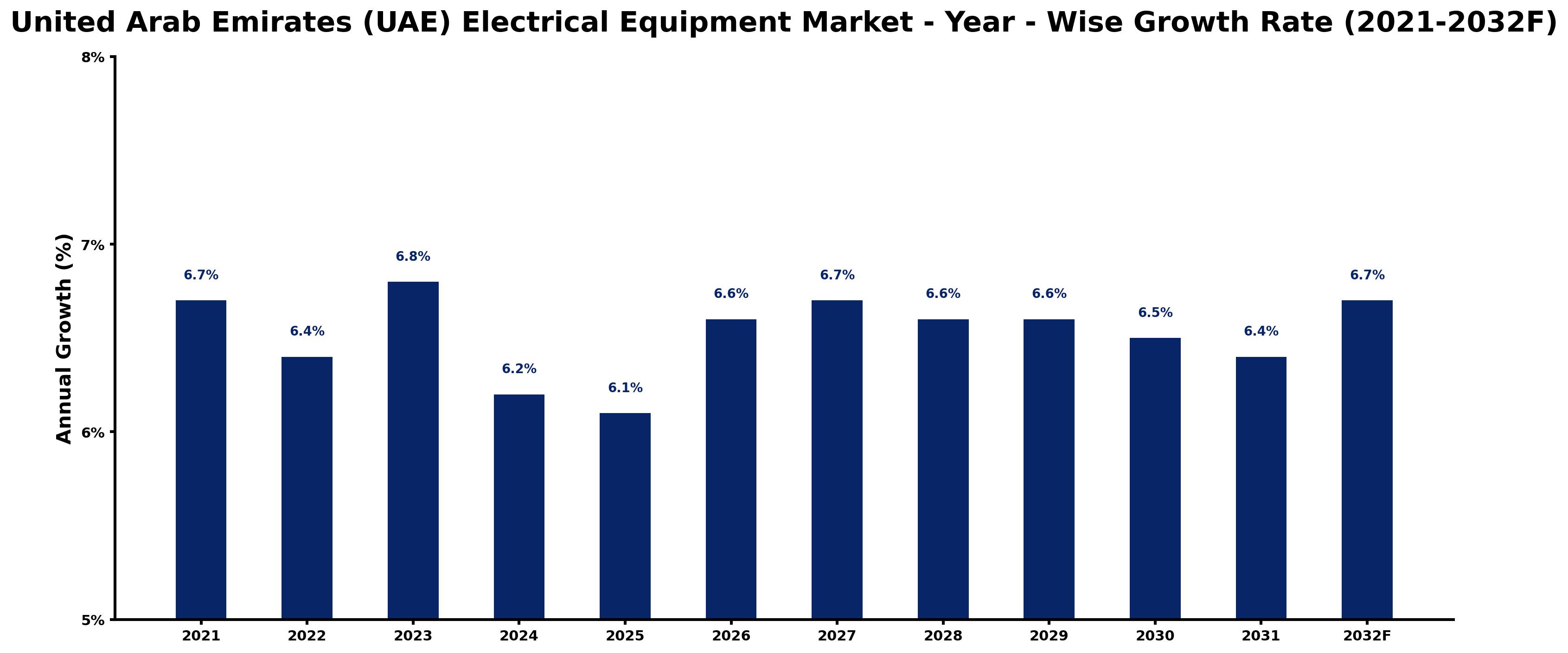
The table below presents the year wise growth rates along with the key drivers influencing the market
| Year | Growth Rate | Major Drivers |
| 2021 | 6.7% | Post-pandemic recovery saw significant investments in infrastructure and electrical upgrades. |
| 2022 | 6.4% | Localization efforts gained momentum, enhancing regional manufacturing capabilities for electrical components. |
| 2023 | 6.8% | Construction projects in Dubai and Abu Dhabi created substantial demand for electrical equipment. |
| 2024 | 6.2% | Rising population figures necessitated upgrades in residential and commercial electrical systems. |
| 2025 | 6.1% | Smart city initiatives in UAE focused on integrating advanced electrical solutions and technologies. |
| 2026 | 6.6% | Legacy copper grid failures prompted rapid modernization of electrical infrastructure across the region. |
| 2027 | 6.7% | Increased participation of private sectors in renewable energy projects spurred equipment innovations. |
| 2028 | 6.6% | Corporate budgets prioritizing sustainability led to higher investments in energy-efficient electrical devices. |
| 2029 | 6.6% | The emergence of electric vehicles drove significant demand for charging infrastructure and related equipment. |
| 2030 | 6.5% | GCC economic diversification plans emphasized enhancing the electrical components supply chain. |
| 2031 | 6.4% | Technological advancements in energy management systems transformed electrical usage efficiency across sectors. |
| 2032 | 6.7% | Sectoral shifts towards automation and AI integration increased the need for sophisticated electrical solutions. |
Note - Market size estimations and growth projections presented in this report are based on 6Wresearch's advanced forecasting approach, validated with industry datasets as of June 2026.
United Arab Emirates (UAE) Electrical Equipment Market Synopsis
The United Arab Emirates (UAE) Electrical Equipment Market is projected to reach 6.6% and witness significant growth during the forecast period (2026-2032). This market plays a crucial role in supporting the infrastructure and industrial development of the UAE, encompassing various electrical products such as distribution systems, power generation equipment, motors, switches, and wiring devices. The increasing population, rapid urbanization, and a strong focus on sustainable development are key factors positively influencing the demand for electrical equipment across diverse sectors, including construction, manufacturing, utilities, and transportation.
United Arab Emirates (UAE) Electrical Equipment Market Growth Drivers
The growth trajectory of the United Arab Emirates (UAE) Electrical Equipment Market is propelled by several pivotal factors:
- Government-backed infrastructure development initiatives, including the construction of airports, ports, and smart cities, are driving substantial demand for electrical equipment necessary to support these mega-projects.
- An increasing emphasis on renewable energy integration is prompting the adoption of advanced electrical systems, including energy-efficient equipment that meets modern sustainability standards.
- The expansion of the manufacturing sector within the UAE has created a growing need for robust electrical solutions that can power diverse industrial applications.
- Impressive growth within the transportation sector is leading to rising requirements for electrical equipment, particularly in smart transport systems and electric vehicle infrastructure.
- The UAE's strategic geographical positioning as a hub for trade in the Middle East enhances its attractiveness for multinational investments in the electrical equipment landscape.
United Arab Emirates (UAE) Electrical Equipment Market Challenges and Restraints
Despite the promising outlook, the United Arab Emirates (UAE) Electrical Equipment Market is confronted with several challenges:
- Intense competition from imported electrical products poses a significant challenge, as international manufacturers often provide lower-cost alternatives, impacting local producers.
- Fluctuations in raw material prices can affect production costs, making it difficult for manufacturers to maintain competitive pricing without eroding profit margins.
- Currency exchange rate volatility can influence the affordability of imported components and equipment, complicating financial planning for local companies.
- Although the market is recovering from the Covid-19 pandemic, disruptions in supply chains can still pose risks, affecting the timely availability of essential electrical products.
- Regulatory compliance regarding safety and environmental standards requires continuous investment in quality assurance, which can be a burden for smaller manufacturers.
United Arab Emirates (UAE) Electrical Equipment Market Government Investment and Initiatives
The United Arab Emirates government recognizes the importance of the electrical equipment sector in achieving its long-term development goals. Significant investments in infrastructure development are prioritized, with public spending directed towards ambitious projects aimed at enhancing the country's energy efficiency and sustainability. Initiatives under the UAE Vision 2021 and the National Energy Strategy 2050 encourage the adoption of renewable energy sources and the development of smart energy solutions. These policies not only support the growth of the electrical equipment market but also align with global sustainability trends, aiming to position the UAE as a leader in clean energy technologies.
United Arab Emirates (UAE) Electrical Equipment Market Latest Developments (May 2025 - June 2026)
In the period from May 2025 to June 2026, the United Arab Emirates (UAE) Electrical Equipment Market has witnessed several noteworthy developments that indicate a positive direction for industry stakeholders. Significant advancements in building smart infrastructures have gained momentum, notably in the realms of IoT and automation, which are driving a need for more sophisticated electrical solutions. Additionally, regulatory changes aimed at enhancing energy efficiency have prompted manufacturers to innovate and introduce new products that align with updated standards. Furthermore, partnerships between the government and private sectors have been emphasized, aimed at fostering collaborative efforts in developing renewable energy projects that demand cutting-edge electrical equipment. The overall sentiment in the market remains optimistic as economic recovery continues to unfold post-pandemic, paving the way for more investments in electrical technologies.
United Arab Emirates (UAE) Electrical Equipment Market - Key Attractiveness of the Report
- 10 Years of Market Numbers
- Historical Data Starting from 2022 to 2025
- Base Year: 2025
- Forecast Data until 2032
- Key Performance Indicators Impacting the Market
- Major Upcoming Developments and Projects
Key Highlights of the Report:
- United Arab Emirates (UAE) Electrical Equipment Market Outlook
- Market Size of United Arab Emirates (UAE) Electrical Equipment Market, 2025
- Forecast of United Arab Emirates (UAE) Electrical Equipment Market, 2032
- Historical Data and Forecast of United Arab Emirates (UAE) Electrical Equipment Revenues & Volume for the Period 2022-2032F
- United Arab Emirates (UAE) Electrical Equipment Market Trend Evolution
- United Arab Emirates (UAE) Electrical Equipment Market Drivers and Challenges
- United Arab Emirates (UAE) Electrical Equipment Price Trends
- United Arab Emirates (UAE) Electrical Equipment Porter's Five Forces
- United Arab Emirates (UAE) Electrical Equipment Industry Life Cycle
- Historical Data and Forecast of United Arab Emirates (UAE) Electrical Equipment Market Revenues & Volume By Types for the Period 2022-2032F
- Historical Data and Forecast of United Arab Emirates (UAE) Electrical Equipment Market Revenues & Volume By Electronic and electrical wires and cables for the Period 2022-2032F
- Historical Data and Forecast of United Arab Emirates (UAE) Electrical Equipment Market Revenues & Volume By Batteries and accumulators for the Period 2022-2032F
- Historical Data and Forecast of United Arab Emirates (UAE) Electrical Equipment Market Revenues & Volume By Wiring devices for the Period 2022-2032F
- Historical Data and Forecast of United Arab Emirates (UAE) Electrical Equipment Market Revenues & Volume By Electric lighting equipment for the Period 2022-2032F
- Historical Data and Forecast of United Arab Emirates (UAE) Electrical Equipment Market Revenues & Volume By Others for the Period 2022-2032F
- Historical Data and Forecast of United Arab Emirates (UAE) Electrical Equipment Market Revenues & Volume By Applications for the Period 2022-2032F
- Historical Data and Forecast of United Arab Emirates (UAE) Electrical Equipment Market Revenues & Volume By Residential end-users for the Period 2022-2032F
- Historical Data and Forecast of United Arab Emirates (UAE) Electrical Equipment Market Revenues & Volume By Non-residential end-users for the Period 2022-2032F
- United Arab Emirates (UAE) Electrical Equipment Import Export Trade Statistics
- Market Opportunity Assessment By Types
- Market Opportunity Assessment By Applications
- United Arab Emirates (UAE) Electrical Equipment Top Companies Market Share
- United Arab Emirates (UAE) Electrical Equipment Competitive Benchmarking By Technical and Operational Parameters
- United Arab Emirates (UAE) Electrical Equipment Company Profiles
- United Arab Emirates (UAE) Electrical Equipment Key Strategic Recommendations






































