United Arab Emirates (UAE) Electrical Testing Equipment Market Size, Share & Growth Rate
The United Arab Emirates (UAE) Electrical Testing Equipment Market was estimated at USD 204 Million in 2025 and is projected to reach USD 279 Million by 2032, growing at a CAGR of 4.6% from 2026 to 2032. This growth trajectory is predominantly fueled by the UAE's ongoing investments in infrastructure, driven by both urbanization and the need for renewable energy solutions. The push towards modernization and adherence to international safety standards further enhances the demand for high-quality testing equipment essential for maintaining the integrity of electrical systems.
United Arab Emirates (UAE) Electrical Testing Equipment Market Year-wise Growth Rate and Key Drivers
This graph highlights how the United Arab Emirates (UAE) Electrical Testing Equipment Market has steadily grown over the years, supported by major growth factors.
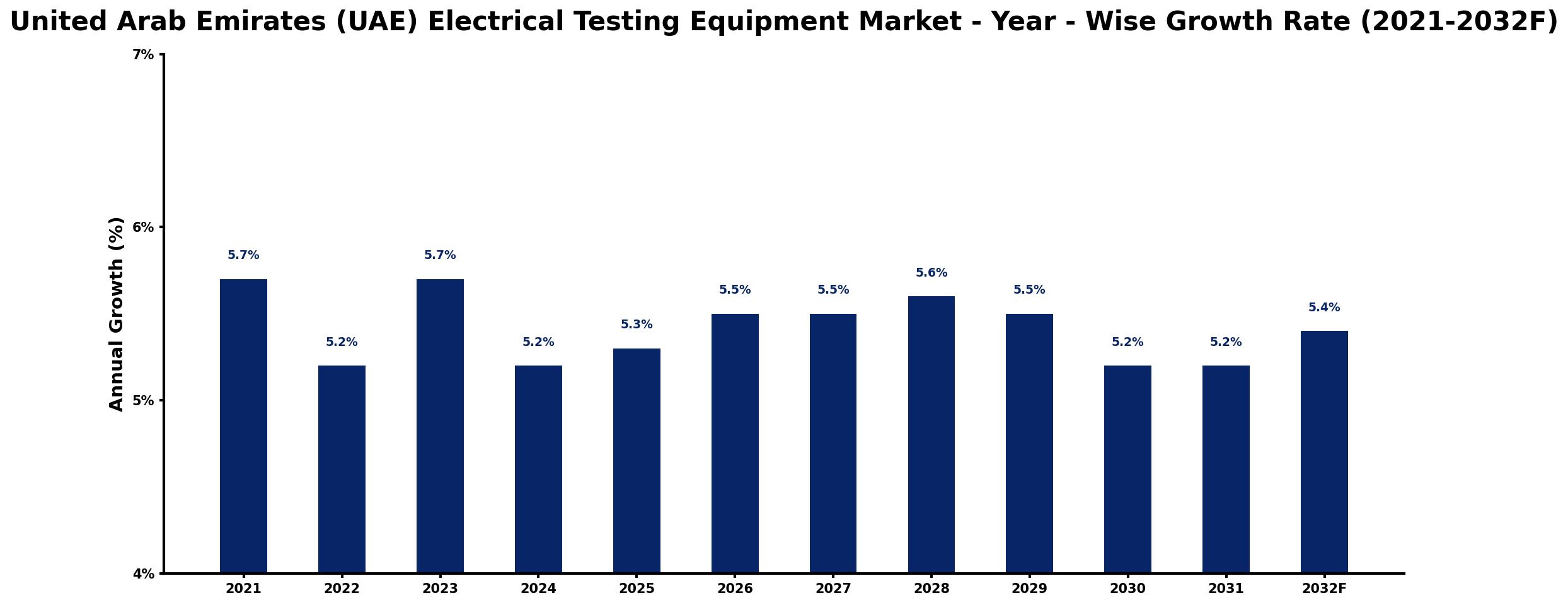
The table below presents the year‑wise growth rates along with the key drivers influencing the market
| Year | Growth Rate | Major Drivers |
| 2021 | 5.7% | Rising investment in infrastructure projects |
| 2022 | 5.2% | Increased focus on renewable energy |
| 2023 | 5.7% | Growing industrial automation needs |
| 2024 | 5.2% | Expansion of smart city initiatives |
| 2025 | 5.3% | Surge in construction activities |
| 2026 | 5.5% | Boost in maintenance service demand |
| 2027 | 5.5% | Development of energy efficiency standards |
| 2028 | 5.6% | Heightened safety regulation enforcement |
| 2029 | 5.5% | Emergence of new technology applications |
| 2030 | 5.2% | Growing urbanization and population density |
| 2031 | 5.2% | Increased demand for energy reliability |
| 2032 | 5.4% | strengthening underlying market demand |
Note: Market size estimations and growth projections presented in this report are based on 6Wresearch's proprietary forecasting methodology, utilizing the latest available industry data, government publications, and primary research inputs.
United Arab Emirates (UAE) Electrical Testing Equipment Market Synopsis
A major force propelling the UAE electrical testing equipment market is the urgent necessity to ensure safety and reliability in electrical installations across industries. As the country's industrial sector expands, the importance of effective electrical testing has become increasingly prominent, especially given the heavy reliance on consistent electrical power.
Additionally, the burgeoning renewable energy sector plays a pivotal role in shaping this market. With significant investments allocated to sustainable energy projects, the demand for specialized electrical testing equipment that supports these initiatives is on the rise, further solidifying the market's growth potential.
United Arab Emirates (UAE) Electrical Testing Equipment Market Key Takeaways
- The market is experiencing robust growth driven by infrastructure development and modernization efforts.
- Renewable energy investments are significantly contributing to the demand for electrical testing equipment.
- Ensuring safety compliance and regulatory adherence remains a critical focus for stakeholders.
- Technological advancements necessitate ongoing innovation in electrical testing solutions.
- COVID-19 disruptions are receding, allowing for gradual market recovery and expansion.
Evaluation of Restraints in United Arab Emirates (UAE) Electrical Testing Equipment Market
While the UAE electrical testing equipment market is poised for growth, several constraints persist. The stringent safety standards and regulatory requirements demand continuous enhancements in testing equipment. This challenge is compounded by the rapid evolution of electrical technologies, requiring manufacturers to innovate consistently to meet new expectations. The complexities of compliance may deter smaller firms from entering the market, thereby limiting competition and the potential for rapid advancements.
United Arab Emirates (UAE) Electrical Testing Equipment Market Trends
Current trends indicate a clear shift towards automation and digitalization within the electrical testing equipment landscape. The integration of IoT technology is making testing processes more efficient, allowing for real-time monitoring and data analysis. Furthermore, there is a growing demand for portable testing solutions, enabling professionals to conduct assessments on-site, enhancing convenience and operational efficiency.
United Arab Emirates (UAE) Electrical Testing Equipment Market Opportunities
The ongoing transition towards renewable energy sources presents significant growth opportunities within the UAE electrical testing equipment market. As the government prioritizes sustainable energy initiatives, suppliers of electrical testing solutions that cater to solar, wind, and other alternative energies will likely find a receptive market. Moreover, advancements in smart grid technologies also provide avenues for innovation and investment in testing equipment specifically tailored for these evolving infrastructures.
Government Initiatives in the United Arab Emirates (UAE) Electrical Testing Equipment Market
The UAE government has launched several initiatives aimed at modernizing the nation's electrical infrastructure. Public spending on infrastructure development remains high, particularly concerning renewable energy projects, which are aligned with the UAE Vision 2021 strategy. Programs promoting safety and regulatory compliance in electrical installations are also driving demand for high-quality testing equipment, thus positively impacting market dynamics.
Future Insights of the United Arab Emirates (UAE) Electrical Testing Equipment Market
Looking ahead to the period from 2026 to 2032, the UAE electrical testing equipment market is anticipated to continue its upward momentum. The confluence of urban development, a strong regulatory framework, and a shift towards renewable energy solutions will be pivotal. Companies in this space will need to invest in R&D to innovate and adapt to the demands of a changing technological landscape. The market is poised to benefit from both public and private sector investments, ensuring a steady demand for advanced electrical testing solutions.
United Arab Emirates (UAE) Electrical Testing Equipment Market Latest Developments (2025 - 2026)
Recent developments in the UAE electrical testing equipment market reflect a strong focus on integrating advanced technologies. Companies are increasingly investing in the development of automated testing solutions that enhance the accuracy and speed of assessments. Furthermore, there is a growing emphasis on sustainability, with initiatives aimed at reducing the environmental impact of testing processes gaining traction. Collaborative efforts among stakeholders are fostering innovation and the introduction of cutting-edge products.
United Arab Emirates (UAE) Electrical Testing Equipment Market - Key Attractiveness of the Report
- 10 Years of Market Numbers
- Historical Data Starting from 2022 to 2025
- Base Year: 2025
- Forecast Data until 2032
- Key Performance Indicators Impacting the Market
- Major Upcoming Developments and Projects
Key Highlights of the Report:
- United Arab Emirates (UAE) Electrical Testing Equipment Market Outlook
- Market Size of United Arab Emirates (UAE) Electrical Testing Equipment Market, 2025
- Forecast of United Arab Emirates (UAE) Electrical Testing Equipment Market, 2032
- Historical Data and Forecast of United Arab Emirates (UAE) Electrical Testing Equipment Revenues & Volume for the Period 2022-2032F
- United Arab Emirates (UAE) Electrical Testing Equipment Market Trend Evolution
- United Arab Emirates (UAE) Electrical Testing Equipment Market Drivers and Challenges
- United Arab Emirates (UAE) Electrical Testing Equipment Price Trends
- United Arab Emirates (UAE) Electrical Testing Equipment Porter's Five Forces
- United Arab Emirates (UAE) Electrical Testing Equipment Industry Life Cycle
- Historical Data and Forecast of United Arab Emirates (UAE) Electrical Testing Equipment Market Revenues & Volume By Service Type for the Period 2022-2032F
- Historical Data and Forecast of United Arab Emirates (UAE) Electrical Testing Equipment Market Revenues & Volume By Electrical Testing Equipment Calibration Services for the Period 2022-2032F
- Historical Data and Forecast of United Arab Emirates (UAE) Electrical Testing Equipment Market Revenues & Volume By Electrical Testing Equipment Repair Services or After Sales Services for the Period 2022-2032F
- Historical Data and Forecast of United Arab Emirates (UAE) Electrical Testing Equipment Market Revenues & Volume By Product Type for the Period 2022-2032F
- Historical Data and Forecast of United Arab Emirates (UAE) Electrical Testing Equipment Market Revenues & Volume By General Purpose Electrical Testing Equipment for the Period 2022-2032F
- Historical Data and Forecast of United Arab Emirates (UAE) Electrical Testing Equipment Market Revenues & Volume By Mechanical Electrical Test Equipment for the Period 2022-2032F
- Historical Data and Forecast of United Arab Emirates (UAE) Electrical Testing Equipment Market Revenues & Volume By End User for the Period 2022-2032F
- Historical Data and Forecast of United Arab Emirates (UAE) Electrical Testing Equipment Market Revenues & Volume By Aerospace and Defense for the Period 2022-2032F
- Historical Data and Forecast of United Arab Emirates (UAE) Electrical Testing Equipment Market Revenues & Volume By Telecommunications for the Period 2022-2032F
- Historical Data and Forecast of United Arab Emirates (UAE) Electrical Testing Equipment Market Revenues & Volume By Semiconductor and Electronics for the Period 2022-2032F
- United Arab Emirates (UAE) Electrical Testing Equipment Import Export Trade Statistics
- Market Opportunity Assessment By Service Type
- Market Opportunity Assessment By Product Type
- Market Opportunity Assessment By End User
- United Arab Emirates (UAE) Electrical Testing Equipment Top Companies Market Share
- United Arab Emirates (UAE) Electrical Testing Equipment Competitive Benchmarking By Technical and Operational Parameters
- United Arab Emirates (UAE) Electrical Testing Equipment Company Profiles
- United Arab Emirates (UAE) Electrical Testing Equipment Key Strategic Recommendations






































