United Arab Emirates (UAE) Facility Management Market Size & Growth Rate (2026-2032)
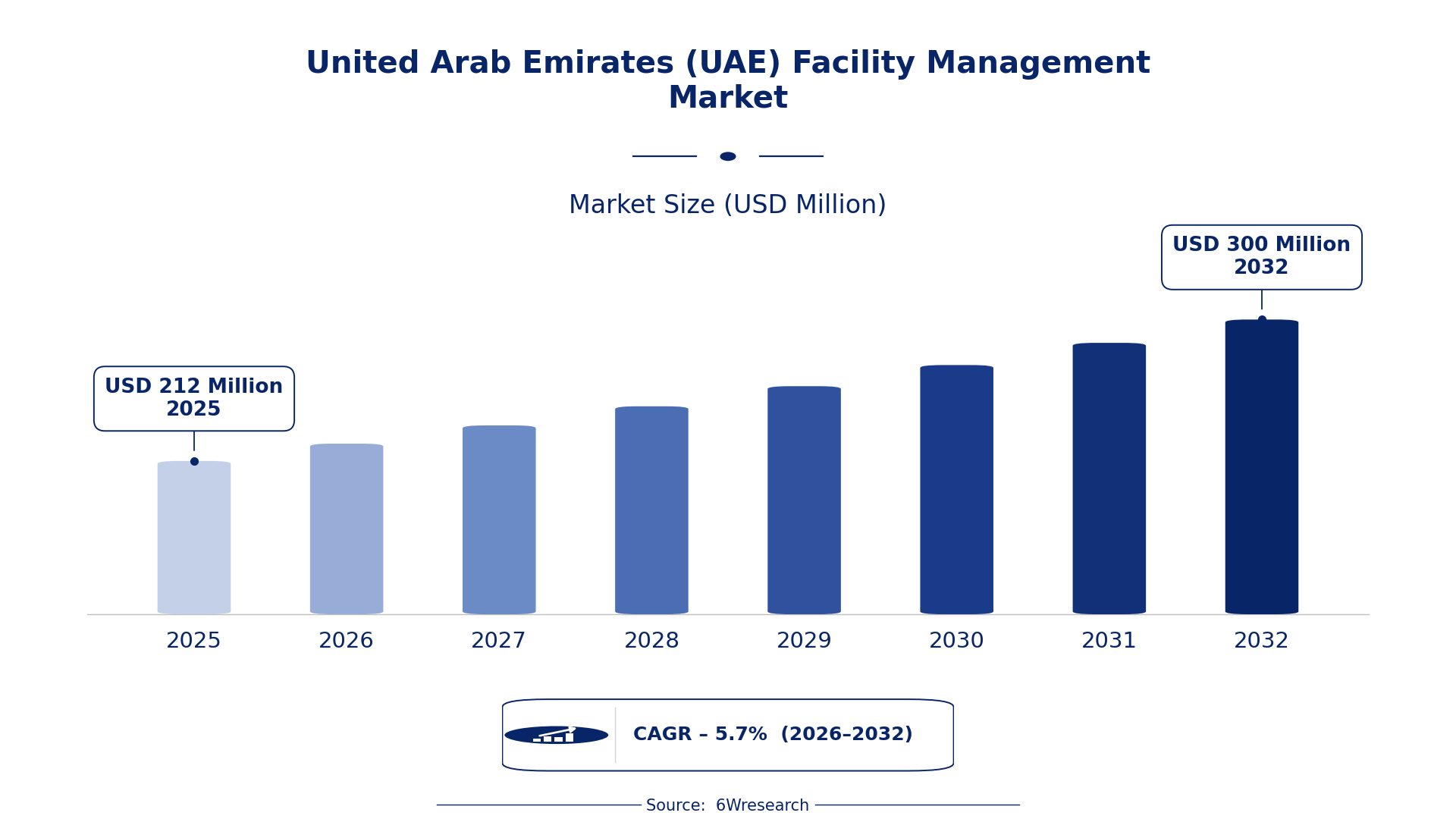
The United Arab Emirates (UAE) Facility Management Market was estimated at USD 212 Million in 2025 and is projected to reach USD 300 Million by 2032, growing at a CAGR of 5.7% from 2026 to 2032.
United Arab Emirates (UAE) Facility Management Market Synopsis
The rapid urbanization in the UAE is the strongest force currently shaping the Facility Management Market. With a surge in commercial and residential developments, the demand for streamlined facility management services has skyrocketed, reflecting the country's ambitious infrastructure goals.
Sustainability initiatives are also gaining traction, pushing businesses to adopt energy-efficient practices. As organizations increasingly prioritize customer experience and operational efficiency, facility management services are critical in optimizing building functionalities and ensuring safety and cost-effectiveness.
United Arab Emirates (UAE) Facility Management Market Year-wise Growth Rate and Key Drivers
This graph illustrates the annual growth rates of the United Arab Emirates (UAE) Facility Management Market from 2021 to 2032, highlighting a steady upward trajectory and projected expansion over the forecast period.
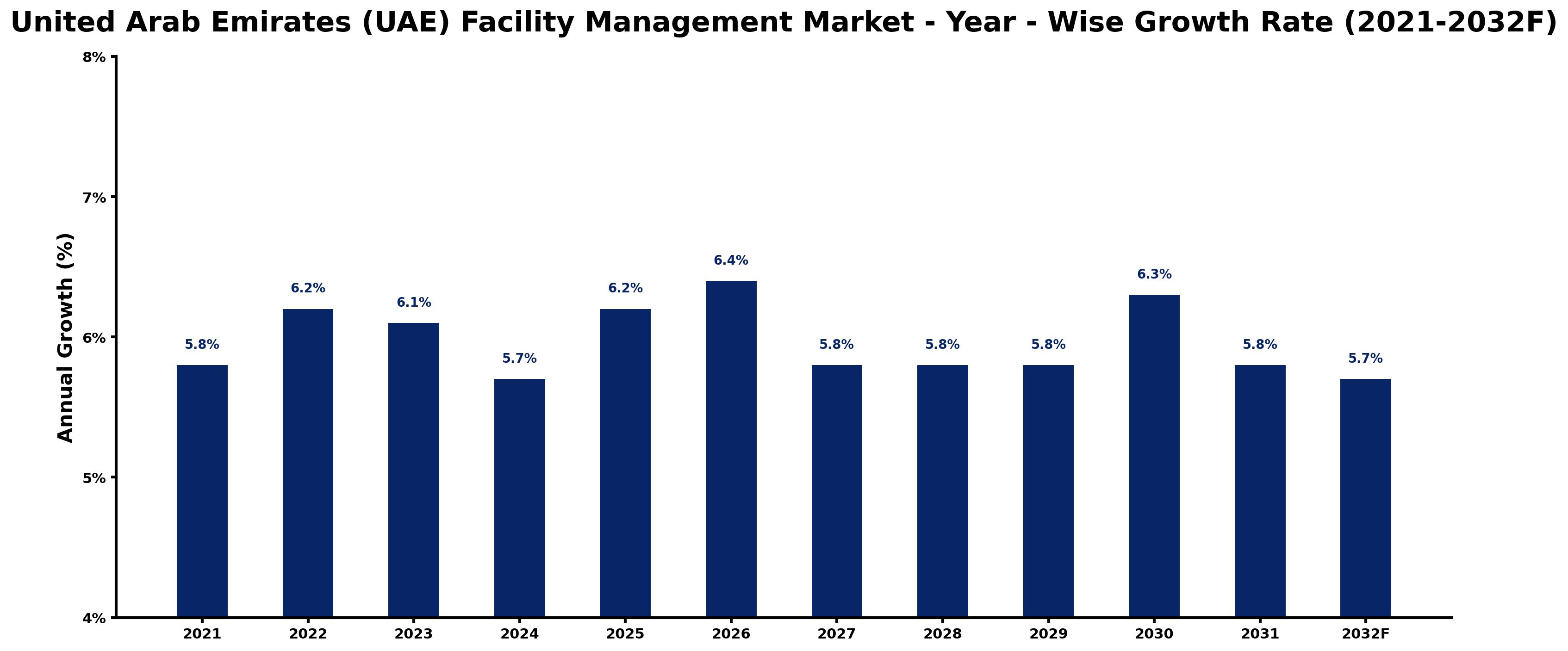
The table below presents the year‑wise growth rates along with the key drivers influencing the market
| Year | Growth Rate | Major Drivers |
| 2021 | 5.8% | Dubai's green building regulations boosting sustainability efforts |
| 2022 | 6.2% | Increased investment in tourism facilities post-expo 2020 |
| 2023 | 6.1% | Government initiatives for smart city infrastructure development |
| 2024 | 5.7% | Rising population driving demand for residential FM services |
| 2025 | 6.2% | Focus on maintaining high standards for luxury properties |
| 2026 | 6.4% | Investment in technology-driven FM solutions in Abu Dhabi |
| 2027 | 5.8% | Growing expatriate population increases facility maintenance needs |
| 2028 | 5.8% | Development of new commercial skyscrapers requiring FM integration |
| 2029 | 5.8% | Government regulations enhancing building maintenance standards |
| 2030 | 6.3% | Sustainability mandates supporting eco-friendly facility management |
| 2031 | 5.8% | Popularity of co-working spaces driving flexible FM services |
| 2032 | 5.7% | Enhancements in public facility maintenance standards by municipalities |
Note: Market size estimations and growth projections presented in this report are based on 6Wresearch's proprietary forecasting methodology, utilizing the latest available industry data, government publications, and primary research inputs.
United Arab Emirates (UAE) Facility Management Market Key Takeaways
Below are some of the specific key takeaways from the market, including:
- The market is being driven by the urgent need for sustainable and efficient building management solutions.
- Urbanization continues to create substantial demand for both residential and commercial facility management services.
- Technological advancements are crucial, with IoT and AI expected to reshape operational strategies.
- Government initiatives are increasingly focused on regulatory frameworks that support sustainable practices.
- The impact of the COVID-19 pandemic has elevated the importance of hygiene and safety standards in facility management.
Evaluation of Restraints in United Arab Emirates (UAE) Facility Management Market
Despite the market's impressive growth trajectory, several restraints hinder its full potential. The challenge of integrating sustainable practices with cost-efficiency remains paramount. Many firms grapple with high initial investments required for advanced technologies like IoT and AI, which are essential for predictive maintenance. Additionally, a shortage of skilled workforce in this sector poses a barrier to effectively implementing these innovations.
United Arab Emirates (UAE) Facility Management Market Trends
A noticeable trend is the shift toward adopting smart technologies that enhance operational efficiencies. Companies are increasingly integrating IoT systems for real-time data collection and analysis, facilitating proactive maintenance. on top of that, there's a growing emphasis on sustainability, driving firms to implement energy management solutions that not only reduce costs but also align with government regulations on environmental impact.
United Arab Emirates (UAE) Facility Management Market Opportunities
Significant opportunities lie in the expansion of smart building technologies and the increasing demand for green certifications. As businesses seek to enhance their sustainability credentials, facility management services that focus on energy efficiency and waste reduction are likely to see heightened interest. on top of that, the integration of advanced software solutions for facility management can streamline operations and reduce costs, presenting lucrative avenues for investment.
Government Initiatives in the United Arab Emirates (UAE) Facility Management Market
The UAE government is actively shaping the Facility Management Market through various initiatives aimed at promoting sustainability and efficiency. With a strong focus on maintaining world-class infrastructure, public policies are increasingly designed to encourage private-sector involvement in facility management. These initiatives are essential for ensuring that facilities operate at optimal standards while complying with evolving regulations.
- A recently completed regulatory framework introduced in 2023 mandates energy efficiency standards for all new commercial buildings.
- Currently ongoing is a national program aimed at upgrading public facilities to meet advanced sustainability benchmarks.
- A planned initiative scheduled for 2026 seeks to incentivize the adoption of smart technologies in facility management practices.
- In 2024, the government launched a campaign to promote best practices in hygiene and safety across all sectors, impacting facility management operations.
- A public-private partnership is expected to be established by 2025 to fund research into innovative facility management solutions.
Future Insights of the United Arab Emirates (UAE) Facility Management Market
Looking ahead to 2026-2032, the Facility Management Market in the UAE is set to experience substantial growth driven by technological advancements and sustainable practices. As urbanization continues unabated, the demand for innovative facility management solutions will only increase. Companies that adapt swiftly to these changes and invest in smart technologies will be well-positioned to thrive in this evolving market.
United Arab Emirates (UAE) Facility Management Market Latest Developments
In the past year, the UAE Facility Management Market has seen a flurry of activity, particularly in technological integration and sustainable practices. Companies are actively pursuing partnerships and innovations that align with government mandates on efficiency and sustainability. This heightened focus is indicative of the market's responsiveness to both consumer demands and regulatory pressures.
- A major technology vendor began an ongoing rollout of an AI-driven facility management platform in Q2 2025, aimed at enhancing operational efficiency.
- An initiative launched in early 2025 focuses on training the existing workforce in smart building technologies, addressing skill gaps in the sector.
- A leading regional operator is planning to expand its service offerings in mid-2026 to include comprehensive energy management solutions.
- A new partnership between technology firms was formed in late 2025 to develop IoT-enabled smart facility management systems.
- A regional conference on sustainability in facility management is scheduled for late 2026, expected to draw significant industry attention.
United Arab Emirates (UAE) Facility Management Market - Key Attractiveness of the Report
- 10 Years of Market Numbers
- Historical Data Starting from 2022 to 2025
- Base Year: 2025
- Forecast Data until 2032
- Key Performance Indicators Impacting the Market
- Major Upcoming Developments and Projects
Key Highlights of the Report:
- United Arab Emirates (UAE) Facility Management Market Outlook
- Market Size of United Arab Emirates (UAE) Facility Management Market, 2025
- Forecast of United Arab Emirates (UAE) Facility Management Market, 2032
- Historical Data and Forecast of United Arab Emirates (UAE) Facility Management Revenues & Volume for the Period 2022-2032F
- United Arab Emirates (UAE) Facility Management Market Trend Evolution
- United Arab Emirates (UAE) Facility Management Market Drivers and Challenges
- United Arab Emirates (UAE) Facility Management Price Trends
- United Arab Emirates (UAE) Facility Management Porter's Five Forces
- United Arab Emirates (UAE) Facility Management Industry Life Cycle
- Historical Data and Forecast of United Arab Emirates (UAE) Facility Management Market Revenues & Volume By Component for the Period 2022-2032F
- Historical Data and Forecast of United Arab Emirates (UAE) Facility Management Market Revenues & Volume By Solutions for the Period 2022-2032F
- Historical Data and Forecast of United Arab Emirates (UAE) Facility Management Market Revenues & Volume By Services for the Period 2022-2032F
- Historical Data and Forecast of United Arab Emirates (UAE) Facility Management Market Revenues & Volume By Deployment Mode for the Period 2022-2032F
- Historical Data and Forecast of United Arab Emirates (UAE) Facility Management Market Revenues & Volume By Cloud for the Period 2022-2032F
- Historical Data and Forecast of United Arab Emirates (UAE) Facility Management Market Revenues & Volume By On-premises for the Period 2022-2032F
- Historical Data and Forecast of United Arab Emirates (UAE) Facility Management Market Revenues & Volume By Organization Size for the Period 2022-2032F
- Historical Data and Forecast of United Arab Emirates (UAE) Facility Management Market Revenues & Volume By Large enterprises for the Period 2022-2032F
- Historical Data and Forecast of United Arab Emirates (UAE) Facility Management Market Revenues & Volume By Small and medium-sized enterprises (SMEs) for the Period 2022-2032F
- Historical Data and Forecast of United Arab Emirates (UAE) Facility Management Market Revenues & Volume By Vertical for the Period 2022-2032F
- Historical Data and Forecast of United Arab Emirates (UAE) Facility Management Market Revenues & Volume By BFSI for the Period 2022-2032F
- Historical Data and Forecast of United Arab Emirates (UAE) Facility Management Market Revenues & Volume By IT and Telecom for the Period 2022-2032F
- Historical Data and Forecast of United Arab Emirates (UAE) Facility Management Market Revenues & Volume By Government and Public Administration for the Period 2022-2032F
- Historical Data and Forecast of United Arab Emirates (UAE) Facility Management Market Revenues & Volume By Healthcare for the Period 2022-2032F
- Historical Data and Forecast of United Arab Emirates (UAE) Facility Management Market Revenues & Volume By Education for the Period 2022-2032F
- Historical Data and Forecast of United Arab Emirates (UAE) Facility Management Market Revenues & Volume By Retail for the Period 2022-2032F
- Historical Data and Forecast of United Arab Emirates (UAE) Facility Management Market Revenues & Volume By Energy and Utilities for the Period 2022-2032F
- Historical Data and Forecast of United Arab Emirates (UAE) Facility Management Market Revenues & Volume By Manufacturing for the Period 2022-2032F
- United Arab Emirates (UAE) Facility Management Import Export Trade Statistics
- Market Opportunity Assessment By Component
- Market Opportunity Assessment By Deployment Mode
- Market Opportunity Assessment By Organization Size
- Market Opportunity Assessment By Vertical
- United Arab Emirates (UAE) Facility Management Top Companies Market Share
- United Arab Emirates (UAE) Facility Management Competitive Benchmarking By Technical and Operational Parameters
- United Arab Emirates (UAE) Facility Management Company Profiles
- United Arab Emirates (UAE) Facility Management Key Strategic Recommendations






































