United Arab Emirates (UAE) Food Processing & Handling Equipment Market Summary
The united arab emirates (uae) food processing & handling equipment market was estimated at USD 839 Million in 2025 and is projected to reach USD 1231 Million by 2032, growing at a CAGR of 6.6% from 2026 to 2032.
United Arab Emirates (UAE) Food Processing & Handling Equipment Market Year-wise Growth Rate and Key Drivers
This graph highlights how the United Arab Emirates (UAE) Food Processing & Handling Equipment Market has steadily grown over the past five years, supported by major growth factors.
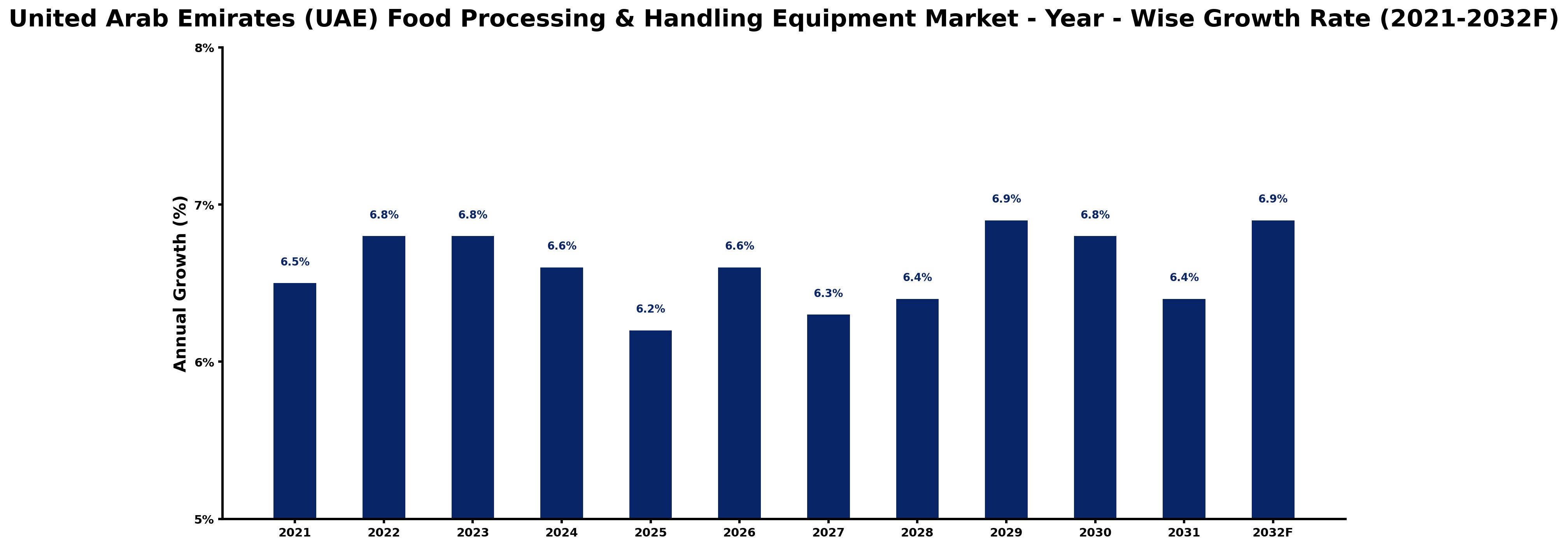
The table below presents the year wise growth rates along with the key drivers influencing the market
| Year | Growth Rate | Major Drivers |
| 2021 | 6.5% | Post-lockdown retail projects accelerate investment in food processing infrastructure. |
| 2022 | 6.8% | Rising consumer preference for convenience foods boosts processing equipment demand. |
| 2023 | 6.8% | Food safety regulations compel manufacturers to upgrade handling technologies significantly. |
| 2024 | 6.6% | Local food production initiatives enhance the necessity for advanced processing solutions. |
| 2025 | 6.2% | E-commerce expansion influences packaging innovations in the food sector. |
| 2026 | 6.6% | Sustainability practices drive companies to adopt eco-friendly processing equipment. |
| 2027 | 6.3% | Tourism recovery stimulates the hospitality sector's demand for efficient food handling. |
| 2028 | 6.4% | Technological integrations with IoT optimize operational efficiency in food processing. |
| 2029 | 6.9% | Expanding population necessitates robust food supply chain solutions in the UAE. |
| 2030 | 6.8% | Investment in food tech startups diversifies the processing equipment landscape creatively. |
| 2031 | 6.4% | Cross-border trade agreements enhance market access for innovative equipment suppliers. |
| 2032 | 6.9% | International events in UAE promote state-of-the-art food processing showcases. |
Note - Market size estimations and growth projections presented in this report are based on 6Wresearch's advanced forecasting approach, validated with industry datasets as of June 2026.
United Arab Emirates (UAE) Food Processing & Handling Equipment Market Synopsis
The United Arab Emirates (UAE) Food Processing Handling Equipment Market is projected to reach 6.6% and witness significant growth during the forecast period (2026-2032). This market encompasses the manufacturing, distribution, and installation of a wide array of equipment utilized in the food processing and handling sector, which includes machinery for processing, packaging, and storage. The expansion of this market is primarily driven by the robust food and beverage sector in the UAE, alongside the increasing consumer demand for processed and packaged food products, and the growing need for efficient and hygienic food processing practices.
United Arab Emirates (UAE) Food Processing & Handling Equipment Market Growth Drivers
The growth of the United Arab Emirates (UAE) Food Processing & Handling Equipment Market can be attributed to several key factors:
- The burgeoning food and beverage industry in the UAE continues to expand, driven by a diverse and growing population along with an increasing influx of tourists, leading to a heightened demand for a wide variety of food products.
- As consumer preferences shift toward convenience and quality, there is a notable increase in the demand for advanced food processing equipment that enhances productivity and ensures food safety.
- The need for compliance with stringent hygiene standards and food safety regulations is prompting manufacturers to adopt innovative processing solutions that meet regulatory requirements.
- A greater focus on sustainable practices within food production and processing is driving the adoption of energy-efficient and environmentally friendly equipment.
- The rise of e-commerce and online food delivery services is leading to increased investment in packaging and handling equipment that can accommodate the unique needs of this distribution model.
United Arab Emirates (UAE) Food Processing & Handling Equipment Market Challenges and Restraints
Despite the optimistic outlook for the United Arab Emirates (UAE) Food Processing & Handling Equipment Market, several challenges may impede growth:
- The ever-evolving landscape of food safety regulations requires manufacturers to stay updated and ensure their equipment meets all necessary compliance standards.
- Supply chain disruptions, as experienced during the Covid-19 pandemic, may continue to affect the timely delivery and installation of equipment.
- High costs associated with the acquisition of advanced food processing technology can be a barrier for smaller businesses looking to upgrade their equipment.
- Competition from established global players in the food processing equipment sector may pose challenges for local manufacturers in terms of pricing and technology.
- Rapid changes in consumer preferences and trends necessitate ongoing innovation and adaptation by equipment manufacturers, which can strain resources.
United Arab Emirates (UAE) Food Processing & Handling Equipment Market Government Investment and Initiatives
The United Arab Emirates government is actively investing in the food processing and handling sector to bolster food security and enhance the overall efficiency of the food supply chain. Various initiatives aim to promote innovation and sustainability within the industry. Significant public spending on infrastructure improvements, food safety research, and technology development is anticipated to spur growth. The government is also providing incentives for businesses to adopt advanced processing technologies, thereby encouraging compliance with international food safety standards and boosting local production capabilities. Overall, these initiatives are designed to create a robust and resilient food processing ecosystem in the UAE.
United Arab Emirates (UAE) Food Processing & Handling Equipment Market Latest Developments (May 2025 - June 2026)
Recent developments in the United Arab Emirates (UAE) Food Processing & Handling Equipment Market have highlighted several trends and directions: the emphasis on automation and contactless processing solutions has intensified, particularly in response to ongoing health concerns. Manufacturers are increasingly focusing on developing innovative equipment that aligns with health, safety, and hygiene protocols. Investment in smart technology, including IoT-enabled systems, is gaining traction, enhancing operational efficiency and product traceability. As the market continues to evolve, the integration of sustainable practices in equipment design is becoming a focal point, reflecting a broader commitment to minimizing environmental impacts while meeting consumer demands for higher quality food products.
United Arab Emirates (UAE) Food Processing & Handling Equipment Market - Key Attractiveness of the Report
- 10 Years of Market Numbers
- Historical Data Starting from 2022 to 2025
- Base Year: 2025
- Forecast Data until 2032
- Key Performance Indicators Impacting the Market
- Major Upcoming Developments and Projects
Key Highlights of the Report:
- United Arab Emirates (UAE) Food Processing & Handling Equipment Market Outlook
- Market Size of United Arab Emirates (UAE) Food Processing & Handling Equipment Market, 2025
- Forecast of United Arab Emirates (UAE) Food Processing & Handling Equipment Market, 2032
- Historical Data and Forecast of United Arab Emirates (UAE) Food Processing & Handling Equipment Revenues & Volume for the Period 2022-2032F
- United Arab Emirates (UAE) Food Processing & Handling Equipment Market Trend Evolution
- United Arab Emirates (UAE) Food Processing & Handling Equipment Market Drivers and Challenges
- United Arab Emirates (UAE) Food Processing & Handling Equipment Price Trends
- United Arab Emirates (UAE) Food Processing & Handling Equipment Porter's Five Forces
- United Arab Emirates (UAE) Food Processing & Handling Equipment Industry Life Cycle
- Historical Data and Forecast of United Arab Emirates (UAE) Food Processing & Handling Equipment Market Revenues & Volume By Equipment Type for the Period 2022-2032F
- Historical Data and Forecast of United Arab Emirates (UAE) Food Processing & Handling Equipment Market Revenues & Volume By Food Processing equipment for the Period 2022-2032F
- Historical Data and Forecast of United Arab Emirates (UAE) Food Processing & Handling Equipment Market Revenues & Volume By Foodservice equipment for the Period 2022-2032F
- Historical Data and Forecast of United Arab Emirates (UAE) Food Processing & Handling Equipment Market Revenues & Volume By Food Packaging equipment for the Period 2022-2032F
- Historical Data and Forecast of United Arab Emirates (UAE) Food Processing & Handling Equipment Market Revenues & Volume By Application for the Period 2022-2032F
- Historical Data and Forecast of United Arab Emirates (UAE) Food Processing & Handling Equipment Market Revenues & Volume By Bakery & confectionery products for the Period 2022-2032F
- Historical Data and Forecast of United Arab Emirates (UAE) Food Processing & Handling Equipment Market Revenues & Volume By Meat & poultry products for the Period 2022-2032F
- Historical Data and Forecast of United Arab Emirates (UAE) Food Processing & Handling Equipment Market Revenues & Volume By Dairy products for the Period 2022-2032F
- Historical Data and Forecast of United Arab Emirates (UAE) Food Processing & Handling Equipment Market Revenues & Volume By Alcoholic beverages for the Period 2022-2032F
- Historical Data and Forecast of United Arab Emirates (UAE) Food Processing & Handling Equipment Market Revenues & Volume By Non-alcoholic beverages for the Period 2022-2032F
- Historical Data and Forecast of United Arab Emirates (UAE) Food Processing & Handling Equipment Market Revenues & Volume By Fish & seafood products for the Period 2022-2032F
- Historical Data and Forecast of United Arab Emirates (UAE) Food Processing & Handling Equipment Market Revenues & Volume By Others? for the Period 2022-2032F
- Historical Data and Forecast of United Arab Emirates (UAE) Food Processing & Handling Equipment Market Revenues & Volume By Form for the Period 2022-2032F
- Historical Data and Forecast of United Arab Emirates (UAE) Food Processing & Handling Equipment Market Revenues & Volume By Solid for the Period 2022-2032F
- Historical Data and Forecast of United Arab Emirates (UAE) Food Processing & Handling Equipment Market Revenues & Volume By Liquid for the Period 2022-2032F
- Historical Data and Forecast of United Arab Emirates (UAE) Food Processing & Handling Equipment Market Revenues & Volume By Semi-solid for the Period 2022-2032F
- United Arab Emirates (UAE) Food Processing & Handling Equipment Import Export Trade Statistics
- Market Opportunity Assessment By Equipment Type
- Market Opportunity Assessment By Application
- Market Opportunity Assessment By Form
- United Arab Emirates (UAE) Food Processing & Handling Equipment Top Companies Market Share
- United Arab Emirates (UAE) Food Processing & Handling Equipment Competitive Benchmarking By Technical and Operational Parameters
- United Arab Emirates (UAE) Food Processing & Handling Equipment Company Profiles
- United Arab Emirates (UAE) Food Processing & Handling Equipment Key Strategic Recommendations






































