United Arab Emirates (UAE) Footwear Manufacturing Machinery Market Size, Share & Growth Rate
The United Arab Emirates (UAE) Footwear Manufacturing Machinery Market was estimated at USD 333 Million in 2025 and is projected to reach USD 456 Million by 2032, growing at a CAGR of 4.6% from 2026 to 2032. This growth trajectory is primarily driven by the rising demand for high-quality footwear driven by the fashion-conscious consumer base in the UAE. As luxury brands expand their presence in the region, manufacturers are investing in advanced machinery to enhance production efficiency and respond quickly to market trends.
United Arab Emirates (UAE) Footwear Manufacturing Machinery Market Year-wise Growth Rate and Key Drivers
This graph highlights how the United Arab Emirates (UAE) Footwear Manufacturing Machinery Market has steadily grown over the years, supported by major growth factors.
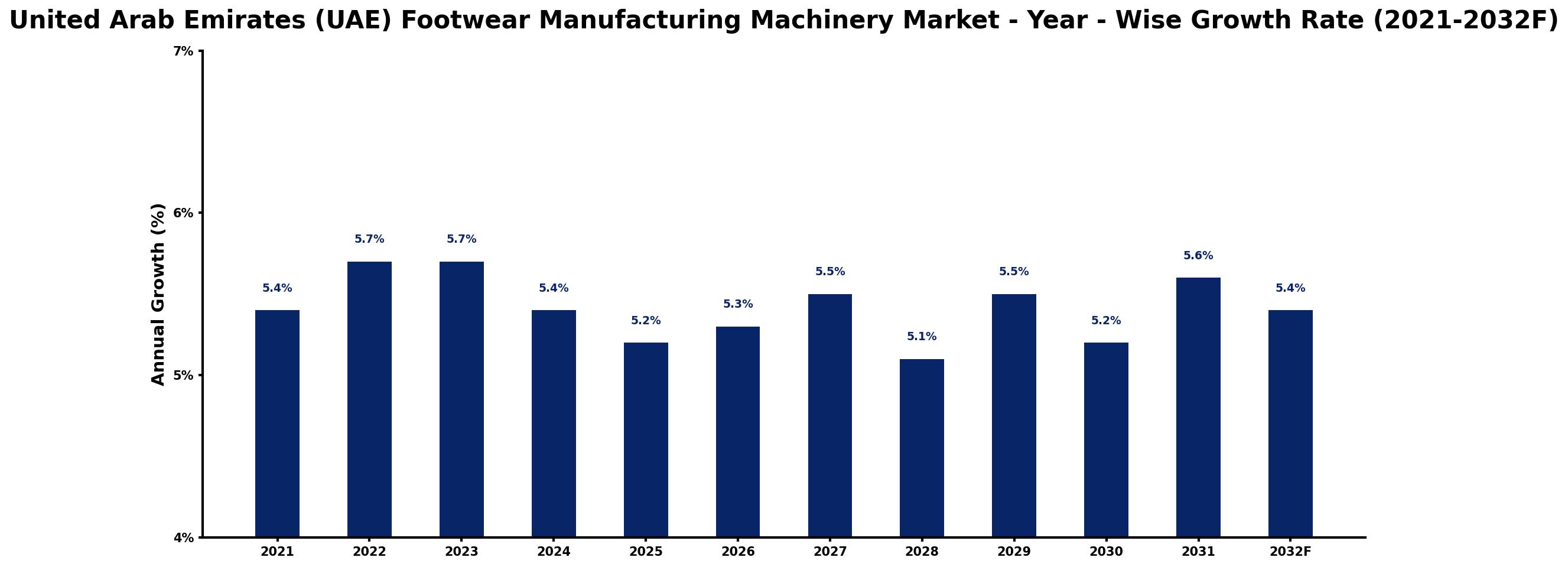
The table below presents the year‑wise growth rates along with the key drivers influencing the market
| Year | Growth Rate | Major Drivers |
| 2021 | 5.4% | Rising demand in retail sector |
| 2022 | 5.7% | Increased investment in technology |
| 2023 | 5.7% | Growth in e-commerce platforms |
| 2024 | 5.4% | Expansion of logistics networks |
| 2025 | 5.2% | Strengthening regional trade agreements |
| 2026 | 5.3% | Surge in consumer spending habits |
| 2027 | 5.5% | Innovations in sustainable practices |
| 2028 | 5.1% | Emergence of new market players |
| 2029 | 5.5% | Focus on customization services |
| 2030 | 5.2% | Development of online marketplaces |
| 2031 | 5.6% | Increased export opportunities abroad |
| 2032 | 5.4% | Enhancements in supply chain efficiency |
Note: Market size estimations and growth projections presented in this report are based on 6Wresearch's proprietary forecasting methodology, utilizing the latest available industry data, government publications, and primary research inputs.
United Arab Emirates (UAE) Footwear Manufacturing Machinery Market Synopsis
The UAE's vibrant fashion landscape significantly influences its footwear manufacturing machinery market. With a continuous influx of new designs and innovative materials, manufacturers require state-of-the-art machinery capable of adapting to these changes while ensuring high productivity. This demand is further bolstered by the shift towards local production, as brands seek to reduce reliance on global supply chains.
In addition, the market is witnessing an increased adoption of sustainable manufacturing practices. As environmental concerns rise, machinery that supports eco-friendly production methods is becoming a priority. This shift not only enhances brand reputation but also meets the regulatory standards set by local authorities, pushing manufacturers to invest in the latest technologies.
United Arab Emirates (UAE) Footwear Manufacturing Machinery Market Key Takeaways
- The market is witnessing substantial growth, with expectations to reach USD 456 Million by 2032.
- Technological advancements and the increasing demand for luxury footwear drive the market forward.
- There is a growing trend towards sustainable manufacturing practices within the industry.
- Local production initiatives are reshaping the competitive landscape and supply chain dynamics.
- Adapting to innovative designs and materials presents both challenges and opportunities for manufacturers.
Evaluation of Restraints in United Arab Emirates (UAE) Footwear Manufacturing Machinery Market
Despite its growth prospects, the UAE Footwear Manufacturing Machinery Market faces certain constraints. A primary challenge is the balance between automation and skilled labor retention, as companies must invest in advanced machinery while ensuring they maintain a workforce capable of operating and troubleshooting complex systems. Furthermore, the rapid evolution of footwear design necessitates continuous research and development, which can strain resources for smaller manufacturers. The market must also navigate fluctuating economic conditions influenced by global events, which can impact consumer spending and production rates.
United Arab Emirates (UAE) Footwear Manufacturing Machinery Market Trends
Current trends indicate a surge in the integration of digital technologies within manufacturing processes. This includes the use of automation and robotics to streamline operations, improve precision, and enhance productivity. Additionally, the demand for personalized footwear solutions is influencing manufacturers to adopt machinery that offers customization capabilities. As sustainability becomes increasingly vital, eco-friendly manufacturing techniques and machinery that reduces waste and energy consumption are also gaining traction.
United Arab Emirates (UAE) Footwear Manufacturing Machinery Market Opportunities
Opportunities within the UAE Footwear Manufacturing Machinery Market are abundant, particularly as domestic production gains momentum. Manufacturers that focus on innovative, sustainable solutions are likely to attract investment and partnerships. Additionally, the growing interest in e-commerce and direct-to-consumer models is creating demand for machinery that can quickly adapt to changing designs and production volumes. With the right investments in technology, manufacturers can position themselves as leaders in a rapidly evolving market.
Government Initiatives in the United Arab Emirates (UAE) Footwear Manufacturing Machinery Market
The UAE government has been proactive in fostering the growth of its manufacturing sectors, including footwear. Various initiatives aim to enhance local production capabilities, reduce import dependencies, and promote technological innovation. Public spending on infrastructure and manufacturing facilities is expected to create a conducive environment for the footwear machinery market. Furthermore, incentives for adopting sustainable practices are likely to encourage manufacturers to invest in more efficient and environmentally friendly technologies.
Future Insights of the United Arab Emirates (UAE) Footwear Manufacturing Machinery Market
Looking ahead to 2026-2032, the UAE Footwear Manufacturing Machinery Market is poised for transformative growth. As manufacturers adapt to both consumer trends and technological advancements, the focus will likely shift towards increased automation, sustainability, and customization. With a strong emphasis on innovation, the market can expect to see new entrants leveraging advanced technologies to gain competitive advantages, further invigorating this dynamic sector.
United Arab Emirates (UAE) Footwear Manufacturing Machinery Market Latest Developments (2025 - 2026)
Recent developments in the UAE Footwear Manufacturing Machinery Market suggest a shift toward greater digitalization and automation. Industry players are increasingly investing in smart machinery that integrates IoT technology for real-time monitoring and data analytics. Additionally, there is a noticeable increase in partnerships aimed at promoting research and development of sustainable manufacturing practices. These trends indicate that the market is evolving to meet not only local demand but also international standards.
United Arab Emirates (UAE) Footwear Manufacturing Machinery Market - Key Attractiveness of the Report
- 10 Years of Market Numbers
- Historical Data Starting from 2022 to 2025
- Base Year: 2025
- Forecast Data until 2032
- Key Performance Indicators Impacting the Market
- Major Upcoming Developments and Projects
Key Highlights of the Report:
- United Arab Emirates (UAE) Footwear Manufacturing Machinery Market Outlook
- Market Size of United Arab Emirates (UAE) Footwear Manufacturing Machinery Market, 2025
- Forecast of United Arab Emirates (UAE) Footwear Manufacturing Machinery Market, 2032
- Historical Data and Forecast of United Arab Emirates (UAE) Footwear Manufacturing Machinery Revenues & Volume for the Period 2022-2032F
- United Arab Emirates (UAE) Footwear Manufacturing Machinery Market Trend Evolution
- United Arab Emirates (UAE) Footwear Manufacturing Machinery Market Drivers and Challenges
- United Arab Emirates (UAE) Footwear Manufacturing Machinery Price Trends
- United Arab Emirates (UAE) Footwear Manufacturing Machinery Porter's Five Forces
- United Arab Emirates (UAE) Footwear Manufacturing Machinery Industry Life Cycle
- Historical Data and Forecast of United Arab Emirates (UAE) Footwear Manufacturing Machinery Market Revenues & Volume By Type for the Period 2022-2032F
- Historical Data and Forecast of United Arab Emirates (UAE) Footwear Manufacturing Machinery Market Revenues & Volume By Pattern-making for the Period 2022-2032F
- Historical Data and Forecast of United Arab Emirates (UAE) Footwear Manufacturing Machinery Market Revenues & Volume By Cutting for the Period 2022-2032F
- Historical Data and Forecast of United Arab Emirates (UAE) Footwear Manufacturing Machinery Market Revenues & Volume By Finishing for the Period 2022-2032F
- Historical Data and Forecast of United Arab Emirates (UAE) Footwear Manufacturing Machinery Market Revenues & Volume By Molds for the Period 2022-2032F
- Historical Data and Forecast of United Arab Emirates (UAE) Footwear Manufacturing Machinery Market Revenues & Volume By Repair for the Period 2022-2032F
- Historical Data and Forecast of United Arab Emirates (UAE) Footwear Manufacturing Machinery Market Revenues & Volume By Component Preparation for the Period 2022-2032F
- Historical Data and Forecast of United Arab Emirates (UAE) Footwear Manufacturing Machinery Market Revenues & Volume By Stitching Machinery for the Period 2022-2032F
- Historical Data and Forecast of United Arab Emirates (UAE) Pattern-making Footwear Manufacturing Machinery Market Revenues & Volume By Others for the Period 2022-2032F
- Historical Data and Forecast of United Arab Emirates (UAE) Footwear Manufacturing Machinery Market Revenues & Volume By Technology for the Period 2022-2032F
- Historical Data and Forecast of United Arab Emirates (UAE) Footwear Manufacturing Machinery Market Revenues & Volume By Manual for the Period 2022-2032F
- Historical Data and Forecast of United Arab Emirates (UAE) Footwear Manufacturing Machinery Market Revenues & Volume By Semi-Automatic for the Period 2022-2032F
- Historical Data and Forecast of United Arab Emirates (UAE) Footwear Manufacturing Machinery Market Revenues & Volume By Fully-Automatic for the Period 2022-2032F
- Historical Data and Forecast of United Arab Emirates (UAE) Footwear Manufacturing Machinery Market Revenues & Volume By Application for the Period 2022-2032F
- Historical Data and Forecast of United Arab Emirates (UAE) Footwear Manufacturing Machinery Market Revenues & Volume By Athletic for the Period 2022-2032F
- Historical Data and Forecast of United Arab Emirates (UAE) Footwear Manufacturing Machinery Market Revenues & Volume By Casual for the Period 2022-2032F
- Historical Data and Forecast of United Arab Emirates (UAE) Footwear Manufacturing Machinery Market Revenues & Volume By Military for the Period 2022-2032F
- Historical Data and Forecast of United Arab Emirates (UAE) Footwear Manufacturing Machinery Market Revenues & Volume By Others for the Period 2022-2032F
- United Arab Emirates (UAE) Footwear Manufacturing Machinery Import Export Trade Statistics
- Market Opportunity Assessment By Type
- Market Opportunity Assessment By Technology
- United Arab Emirates (UAE) Footwear Manufacturing Machinery Top Companies Market Share
- United Arab Emirates (UAE) Footwear Manufacturing Machinery Competitive Benchmarking By Technical and Operational Parameters
- United Arab Emirates (UAE) Footwear Manufacturing Machinery Company Profiles
- United Arab Emirates (UAE) Footwear Manufacturing Machinery Key Strategic Recommendations






































