United Arab Emirates (UAE) Fragrance-free Skin Care Products Market Size, Share & Growth Rate
The United Arab Emirates (UAE) Fragrance-free Skin Care Products Market was estimated at USD 405 Million in 2025 and is projected to reach USD 545 Million by 2032, growing at a CAGR of 4.3% from 2026 to 2032. This growth trajectory is largely attributed to a heightened awareness surrounding skin health and sensitivities, with consumers increasingly opting for products that minimize irritants. The market's expansion is further driven by educational initiatives on the adverse effects of fragrances in skincare, propelling a shift toward gentler, hypoallergenic options.
United Arab Emirates (UAE) Fragrance-free Skin Care Products Market Year-wise Growth Rate and Key Drivers
This graph highlights how the United Arab Emirates (UAE) Fragrance-free Skin Care Products Market has steadily grown over the years, supported by major growth factors.
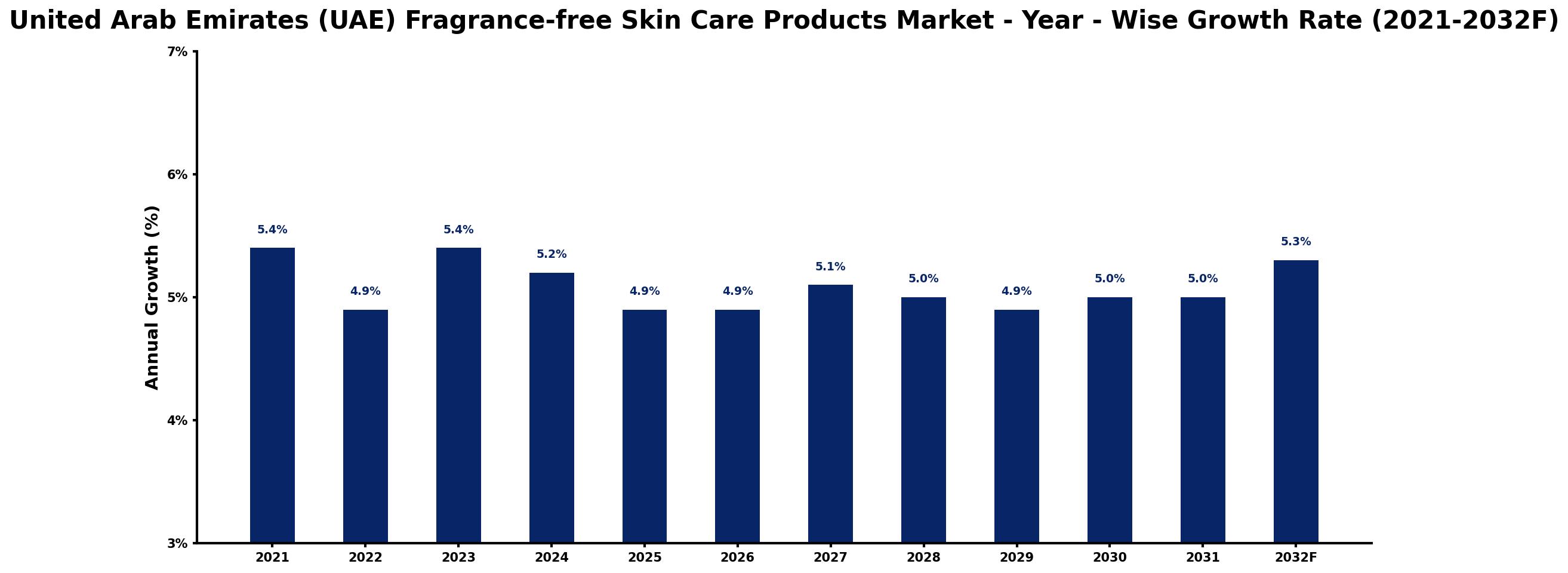
The table below presents the year‑wise growth rates along with the key drivers influencing the market
| Year | Growth Rate | Major Drivers |
| 2021 | 5.4% | Rising consumer health consciousness |
| 2022 | 4.9% | Increased demand for natural ingredients |
| 2023 | 5.4% | Growing online retail expansion |
| 2024 | 5.2% | Shift towards minimalistic routines |
| 2025 | 4.9% | Surge in eco-friendly packaging |
| 2026 | 4.9% | Expansion of local manufacturers |
| 2027 | 5.1% | Increased focus on sustainability |
| 2028 | 5.0% | Higher disposable income levels |
| 2029 | 4.9% | Emergence of innovative formulations |
| 2030 | 5.0% | Growing awareness of allergies |
| 2031 | 5.0% | Investment in research and development |
| 2032 | 5.3% | Increase in consumer education initiatives |
Note: Market size estimations and growth projections presented in this report are based on 6Wresearch's proprietary forecasting methodology, utilizing the latest available industry data, government publications, and primary research inputs.
United Arab Emirates (UAE) Fragrance-free Skin Care Products Market Synopsis
The UAE fragrance-free skin care products market has witnessed notable momentum in recent years, propelled by consumer demand for safer and more effective skincare options. With an increasing number of consumers facing skin allergies, the market is evolving to meet the need for products that cater to sensitive skin types.
Looking ahead, the demand for fragrance-free skincare is anticipated to intensify as consumers become more discerning about product ingredients. This shifting mindset presents a plethora of opportunities for brands that prioritize transparency and efficacy in their formulations, ultimately fostering a loyal customer base.
United Arab Emirates (UAE) Fragrance-free Skin Care Products Market Key Takeaways
- The market is expected to grow from USD 405 Million in 2025 to USD 545 Million by 2032.
- Increased awareness of skin allergies is driving demand for fragrance-free products.
- Education on the impact of irritants is influencing consumer purchasing decisions.
- Brands that emphasize product transparency are likely to capture market share.
- Consumers are increasingly favoring hypoallergenic options in their skincare regimens.
Evaluation of Restraints in United Arab Emirates (UAE) Fragrance-free Skin Care Products Market
One of the significant challenges within the UAE fragrance-free skin care products market is the need for brands to establish trust with consumers. Given the sensitivity of the target demographic, ensuring that products are genuinely fragrance-free and effective is crucial. Additionally, with an influx of options available, standing out in a crowded marketplace necessitates a robust branding and marketing strategy to effectively communicate product benefits. Meeting the precise requirements of consumers while maintaining high efficacy presents ongoing challenges for brands operating in this segment.
United Arab Emirates (UAE) Fragrance-free Skin Care Products Market Trends
Current trends indicate a significant rise in the demand for natural and organic ingredients as consumers seek safer alternatives to conventional skincare products. Additionally, there is an increasing popularity of multi-functional products that cater to both sensitive skin and offer additional benefits, such as sun protection and hydration. The focus on clean beauty is reshaping product formulations, compelling brands to innovate and adapt to consumer preferences. As the market matures, consumer education and product transparency are becoming pivotal in shaping purchasing decisions.
United Arab Emirates (UAE) Fragrance-free Skin Care Products Market Opportunities
The expanding consumer base seeking fragrance-free options presents significant growth opportunities for both established and emerging brands. Companies that can effectively highlight their commitment to transparency in ingredient sourcing and product efficacy are likely to see enhanced brand loyalty and market penetration. Additionally, collaborations with dermatologists and skincare professionals can elevate brand credibility, opening doors for product endorsements that appeal to the health-conscious consumer.
Government Initiatives in the United Arab Emirates (UAE) Fragrance-free Skin Care Products Market
The UAE government has been proactive in promoting public health initiatives that encompass consumer safety in skincare products. This includes establishing stricter regulations on product formulations and encouraging brands to disclose ingredient transparency. Public awareness campaigns designed to educate consumers about skin health are also being implemented, aligning with the market's growth trajectory. The government's support for innovative healthcare solutions further strengthens the market landscape.
Future Insights of the United Arab Emirates (UAE) Fragrance-free Skin Care Products Market
Between 2026 and 2032, the UAE fragrance-free skin care products market is projected to experience notable advancements. Consumer preferences will increasingly gravitate towards products that are not only free of fragrances but also rich in natural and organic ingredients. As brands continue to innovate and align with consumer values regarding health and wellness, the market is set to see a significant transformation. Moreover, increased access to e-commerce platforms will enhance consumer reach, allowing brands to connect more directly with their target audiences.
United Arab Emirates (UAE) Fragrance-free Skin Care Products Market Latest Developments (2025 - 2026)
Recent developments indicate that brands are launching new fragrance-free lines specifically designed for sensitive skin. Companies are increasingly leveraging digital marketing strategies to inform consumers about the benefits of their products. In addition, collaborations with skincare specialists to offer expert-backed recommendations are becoming more common, positioning brands as trusted authorities in the fragrance-free segment. These trends highlight the dynamic nature of the market as it adapts to evolving consumer needs.
United Arab Emirates (UAE) Fragrance-free Skin Care Products Market - Key Attractiveness of the Report
- 10 Years of Market Numbers
- Historical Data Starting from 2022 to 2025
- Base Year: 2025
- Forecast Data until 2032
- Key Performance Indicators Impacting the Market
- Major Upcoming Developments and Projects
Key Highlights of the Report:
- United Arab Emirates (UAE) Fragrance-free Skin Care Products Market Outlook
- Market Size of United Arab Emirates (UAE) Fragrance-free Skin Care Products Market, 2025
- Forecast of United Arab Emirates (UAE) Fragrance-free Skin Care Products Market, 2032
- Historical Data and Forecast of United Arab Emirates (UAE) Fragrance-free Skin Care Products Revenues & Volume for the Period 2022-2032F
- United Arab Emirates (UAE) Fragrance-free Skin Care Products Market Trend Evolution
- United Arab Emirates (UAE) Fragrance-free Skin Care Products Market Drivers and Challenges
- United Arab Emirates (UAE) Fragrance-free Skin Care Products Price Trends
- United Arab Emirates (UAE) Fragrance-free Skin Care Products Porter's Five Forces
- United Arab Emirates (UAE) Fragrance-free Skin Care Products Industry Life Cycle
- Historical Data and Forecast of United Arab Emirates (UAE) Fragrance-free Skin Care Products Market Revenues & Volume By Type for the Period 2022-2032F
- Historical Data and Forecast of United Arab Emirates (UAE) Fragrance-free Skin Care Products Market Revenues & Volume By Moisturizer for the Period 2022-2032F
- Historical Data and Forecast of United Arab Emirates (UAE) Fragrance-free Skin Care Products Market Revenues & Volume By Serum for the Period 2022-2032F
- Historical Data and Forecast of United Arab Emirates (UAE) Fragrance-free Skin Care Products Market Revenues & Volume By Cream for the Period 2022-2032F
- Historical Data and Forecast of United Arab Emirates (UAE) Fragrance-free Skin Care Products Market Revenues & Volume By Lotion for the Period 2022-2032F
- Historical Data and Forecast of United Arab Emirates (UAE) Fragrance-free Skin Care Products Market Revenues & Volume By Others for the Period 2022-2032F
- Historical Data and Forecast of United Arab Emirates (UAE) Fragrance-free Skin Care Products Market Revenues & Volume By Skin Type for the Period 2022-2032F
- Historical Data and Forecast of United Arab Emirates (UAE) Fragrance-free Skin Care Products Market Revenues & Volume By Oily Skin for the Period 2022-2032F
- Historical Data and Forecast of United Arab Emirates (UAE) Fragrance-free Skin Care Products Market Revenues & Volume By Combination Skin for the Period 2022-2032F
- Historical Data and Forecast of United Arab Emirates (UAE) Fragrance-free Skin Care Products Market Revenues & Volume By Dry Skin for the Period 2022-2032F
- Historical Data and Forecast of United Arab Emirates (UAE) Fragrance-free Skin Care Products Market Revenues & Volume By Others for the Period 2022-2032F
- Historical Data and Forecast of United Arab Emirates (UAE) Fragrance-free Skin Care Products Market Revenues & Volume By Price for the Period 2022-2032F
- Historical Data and Forecast of United Arab Emirates (UAE) Fragrance-free Skin Care Products Market Revenues & Volume By Low for the Period 2022-2032F
- Historical Data and Forecast of United Arab Emirates (UAE) Fragrance-free Skin Care Products Market Revenues & Volume By Medium for the Period 2022-2032F
- Historical Data and Forecast of United Arab Emirates (UAE) Fragrance-free Skin Care Products Market Revenues & Volume By High for the Period 2022-2032F
- Historical Data and Forecast of United Arab Emirates (UAE) Fragrance-free Skin Care Products Market Revenues & Volume By Distribution Channel for the Period 2022-2032F
- Historical Data and Forecast of United Arab Emirates (UAE) Fragrance-free Skin Care Products Market Revenues & Volume By Online for the Period 2022-2032F
- Historical Data and Forecast of United Arab Emirates (UAE) Fragrance-free Skin Care Products Market Revenues & Volume By Offline for the Period 2022-2032F
- United Arab Emirates (UAE) Fragrance-free Skin Care Products Import Export Trade Statistics
- Market Opportunity Assessment By Type
- Market Opportunity Assessment By Skin Type
- Market Opportunity Assessment By Price
- Market Opportunity Assessment By Distribution Channel
- United Arab Emirates (UAE) Fragrance-free Skin Care Products Top Companies Market Share
- United Arab Emirates (UAE) Fragrance-free Skin Care Products Competitive Benchmarking By Technical and Operational Parameters
- United Arab Emirates (UAE) Fragrance-free Skin Care Products Company Profiles
- United Arab Emirates (UAE) Fragrance-free Skin Care Products Key Strategic Recommendations






































