United Arab Emirates (UAE) Glass Beads Market Size, Share & Growth Rate
The United Arab Emirates (UAE) Glass Beads Market was estimated at USD 496 Million in 2025 and is projected to reach USD 706 Million by 2032, growing at a CAGR of 5.2% from 2026 to 2032. This growth trajectory is primarily driven by the UAE's ongoing infrastructure development, which heavily utilizes glass beads for road markings and safety signage. Moreover, the increasing demand for reflective materials, combined with the rising popularity of decorative glass beads in the construction and crafts sectors, further fuels this market expansion.
United Arab Emirates (UAE) Glass Beads Market Year-wise Growth Rate and Key Drivers
This graph highlights how the United Arab Emirates (UAE) Glass Beads Market has steadily grown over the years, supported by major growth factors.
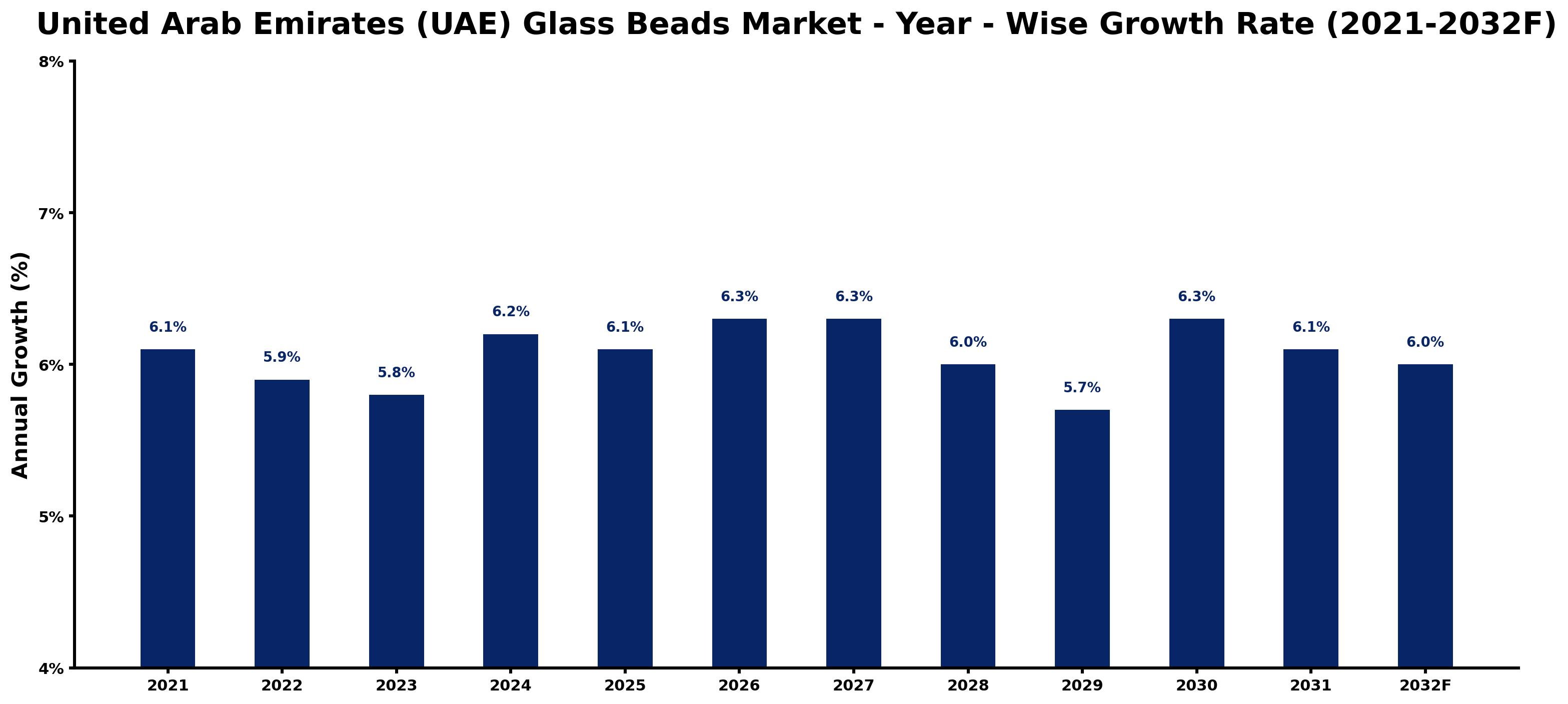
The table below presents the year‑wise growth rates along with the key drivers influencing the market
| Year | Growth Rate | Major Drivers |
| 2021 | 6.1% | Growing renewable energy integration projects |
| 2022 | 5.9% | Increasing smart city development projects |
| 2023 | 5.8% | Rapid growth in telecom and data center sectors |
| 2024 | 6.2% | Expansion of transportation and logistics networks |
| 2025 | 6.1% | Expansion of manufacturing activities |
| 2026 | 6.3% | Expansion of manufacturing activities |
| 2027 | 6.3% | Growing renewable energy integration projects |
| 2028 | 6.0% | Expansion of commercial construction activities |
| 2029 | 5.7% | Rapid growth in telecom and data center sectors |
| 2030 | 6.3% | Expansion of transportation and logistics networks |
| 2031 | 6.1% | Growing urbanization and commercial development |
| 2032 | 6.0% | Expansion of transportation and logistics networks |
Note - Market size estimations and growth projections presented in this report are based on 6Wresearch’s advanced forecasting approach, validated with industry datasets as of June 2026.
United Arab Emirates (UAE) Glass Beads Market Synopsis
The UAE glass beads market is characterized by its diverse applications, ranging from essential road safety features to decorative elements in construction and craft projects. The rising focus on enhancing public safety through improved road visibility significantly contributes to the demand for high-quality glass beads.
As the nation invests in ambitious infrastructure projects, including highways and urban development, the market for glass beads is poised for growth. The increasing consumer interest in jewelry and artisanal crafts has also led to a notable surge in the demand for decorative glass beads, providing additional momentum to the market.
United Arab Emirates (UAE) Glass Beads Market Key Takeaways
- The market is significantly driven by infrastructure projects focused on enhancing road safety.
- Decorative applications in construction and jewelry are becoming increasingly popular.
- Glass beads offer durability and superior reflective performance compared to alternative materials.
- Market growth is rebounding following disruptions caused by the Covid-19 pandemic.
- Growing public awareness regarding safety and visibility is boosting demand for glass beads.
Evaluation of Restraints in United Arab Emirates (UAE) Glass Beads Market
Despite a positive outlook, the UAE glass beads market encounters certain constraints that could limit its full potential. A notable challenge lies in the competition posed by alternative reflective materials, such as microprismatic films and specialized paints, which can match or surpass the reflective capabilities of glass beads. This competition necessitates that manufacturers and suppliers highlight the unique benefits of glass beads, including their longevity and effectiveness in various applications. Additionally, volatility in raw material prices and strict environmental regulations can lead to fluctuations in production costs, further impacting market stability.
United Arab Emirates (UAE) Glass Beads Market Trends
Several trends are influencing the UAE glass beads market. The emphasis on sustainability is prompting manufacturers to explore eco-friendly production methods and materials. Additionally, the rise of smart city initiatives is expected to drive further demand for advanced reflective materials for safety purposes. Technological advancements are enhancing the manufacturing processes of glass beads, resulting in improved quality and performance. Furthermore, consumer interest in DIY crafts is increasing the popularity of glass beads in artistic applications.
United Arab Emirates (UAE) Glass Beads Market Opportunities
The UAE glass beads market presents several promising opportunities for growth and investment. With a focus on enhancing road safety, there is a considerable opportunity for suppliers to engage in partnerships with governmental agencies and private contractors involved in infrastructure projects. Furthermore, the burgeoning construction industry presents a significant market for decorative glass beads, particularly in high-end residential and commercial developments. Additionally, tapping into the DIY and artisan markets can lead to increased demand and innovative product offerings that align with consumer preferences.
Government Initiatives in the United Arab Emirates (UAE) Glass Beads Market
The UAE government has been proactive in implementing policies aimed at improving road safety and infrastructure development, which directly impact the glass beads market. Public investments in road maintenance and enhancement projects prioritize the use of materials that ensure better visibility and safety, thereby fostering an environment conducive to the growth of the glass beads market. Additionally, there are various programs and incentives focused on promoting sustainability and environmentally-friendly materials in construction, further supporting market expansion.
Future Insights of the United Arab Emirates (UAE) Glass Beads Market
Looking ahead to the 2026-2032 period, the UAE glass beads market is expected to continue on its growth trajectory, fueled by sustained investment in infrastructure and the ongoing urbanization of the region. The growing awareness of safety and visibility in public spaces will keep the demand for glass beads robust, particularly in road marking and safety applications. Moreover, the increasing emphasis on decorative uses will diversify market opportunities. As technology advances, manufacturers are likely to introduce more innovative products, thereby broadening their competitive edge.
United Arab Emirates (UAE) Glass Beads Market Latest Developments (May 2025 - June 2026)
Recent developments in the UAE glass beads market reflect a shift towards more sustainable manufacturing practices as companies seek to meet both regulatory demands and consumer preferences. Furthermore, new infrastructure projects, particularly in urban areas, are increasingly incorporating glass beads for safety and visibility. Market participants are also exploring collaborations that enhance product offerings and ensure adherence to the highest quality standards.
United Arab Emirates (UAE) Glass Beads Market - Key Attractiveness of the Report
- 10 Years of Market Numbers
- Historical Data Starting from 2022 to 2025
- Base Year: 2025
- Forecast Data until 2032
- Key Performance Indicators Impacting the Market
- Major Upcoming Developments and Projects
Key Highlights of the Report:
- United Arab Emirates (UAE) Glass Beads? Market Outlook
- Market Size of United Arab Emirates (UAE) Glass Beads? Market, 2025
- Forecast of United Arab Emirates (UAE) Glass Beads? Market, 2032
- Historical Data and Forecast of United Arab Emirates (UAE) Glass Beads? Revenues & Volume for the Period 2022-2032F
- United Arab Emirates (UAE) Glass Beads? Market Trend Evolution
- United Arab Emirates (UAE) Glass Beads? Market Drivers and Challenges
- United Arab Emirates (UAE) Glass Beads? Price Trends
- United Arab Emirates (UAE) Glass Beads? Porter's Five Forces
- United Arab Emirates (UAE) Glass Beads? Industry Life Cycle
- Historical Data and Forecast of United Arab Emirates (UAE) Glass Beads? Market Revenues & Volume By Type for the Period 2022-2032F
- Historical Data and Forecast of United Arab Emirates (UAE) Glass Beads? Market Revenues & Volume By Soild for the Period 2022-2032F
- Historical Data and Forecast of United Arab Emirates (UAE) Glass Beads? Market Revenues & Volume By Hollow for the Period 2022-2032F
- Historical Data and Forecast of United Arab Emirates (UAE) Glass Beads? Market Revenues & Volume By Other for the Period 2022-2032F
- Historical Data and Forecast of United Arab Emirates (UAE) Glass Beads? Market Revenues & Volume By Application for the Period 2022-2032F
- Historical Data and Forecast of United Arab Emirates (UAE) Glass Beads? Market Revenues & Volume By Reflective meterial for the Period 2022-2032F
- Historical Data and Forecast of United Arab Emirates (UAE) Glass Beads? Market Revenues & Volume By Industry polishing& meterial for the Period 2022-2032F
- Historical Data and Forecast of United Arab Emirates (UAE) Glass Beads? Market Revenues & Volume By Thermal insulating meterial for the Period 2022-2032F
- Historical Data and Forecast of United Arab Emirates (UAE) Glass Beads? Market Revenues & Volume By Other for the Period 2022-2032F
- United Arab Emirates (UAE) Glass Beads? Import Export Trade Statistics
- Market Opportunity Assessment By Type
- Market Opportunity Assessment By Application
- United Arab Emirates (UAE) Glass Beads? Top Companies Market Share
- United Arab Emirates (UAE) Glass Beads? Competitive Benchmarking By Technical and Operational Parameters
- United Arab Emirates (UAE) Glass Beads? Company Profiles
- United Arab Emirates (UAE) Glass Beads? Key Strategic Recommendations






































