United Arab Emirates (UAE) Glass Fiber Reinforced Concrete Market Summary
The united arab emirates (uae) glass fiber reinforced concrete market was estimated at USD 759 Million in 2025 and is projected to reach USD 1091 Million by 2032, growing at a CAGR of 6.0% from 2026 to 2032.
United Arab Emirates (UAE) Glass Fiber Reinforced Concrete Market Year-wise Growth Rate and Key Drivers
This graph highlights how the United Arab Emirates (UAE) Glass Fiber Reinforced Concrete Market has steadily grown over the past five years, supported by major growth factors.
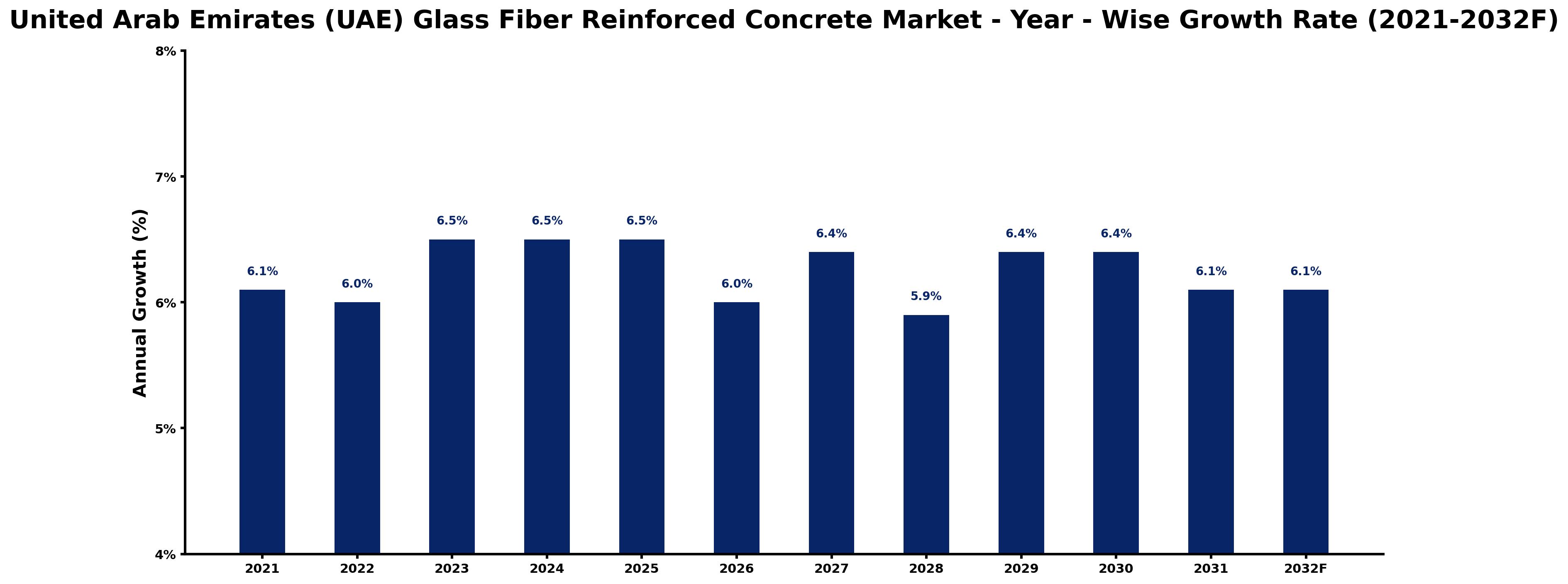
The table below presents the year wise growth rates along with the key drivers influencing the market
| Year | Growth Rate | Major Drivers |
| 2021 | 6.1% | Construction activity resumed post-COVID, boosting demand for durable building materials. |
| 2022 | 6.0% | Increased investments in infrastructure projects highlighted the need for advanced concrete solutions. |
| 2023 | 6.5% | Local manufacturers began focusing on sustainable materials to meet environmental standards. |
| 2024 | 6.5% | Major urban developments in Abu Dhabi and Dubai drove the glass fiber market. |
| 2025 | 6.5% | Technological innovations in concrete additives improved product quality and performance. |
| 2026 | 6.0% | Collaboration between local and international firms enhanced market competitiveness and offerings. |
| 2027 | 6.4% | Growing emphasis on resilience against extreme weather conditions influenced material selection. |
| 2028 | 5.9% | Expansion of luxury residential projects increased the demand for architectural concrete products. |
| 2029 | 6.4% | Emerging smart city projects incorporated advanced materials for modern construction standards. |
| 2030 | 6.4% | Supply chain improvements reduced costs, making glass fiber reinforced concrete more accessible. |
| 2031 | 6.1% | Global trends toward sustainable construction influenced local market preferences and practices. |
| 2032 | 6.1% | Economic diversification initiatives created opportunities for innovative construction techniques and materials. |
Note - Market size estimations and growth projections presented in this report are based on 6Wresearch's advanced forecasting approach, validated with industry datasets as of June 2026.
United Arab Emirates (UAE) Glass Fiber Reinforced Concrete Market Synopsis
The United Arab Emirates (UAE) Glass Fiber Reinforced Concrete Market is projected to reach 6.0% and witness significant growth during the forecast period (2026-2032). The increasing integration of sustainability and innovation within the construction industry has fueled the demand for advanced building materials like Glass Fiber Reinforced Concrete (GFRC). This composite material, characterized by its composition of cement, sand, water, and glass fibers, offers notable enhancements in strength and durability, thereby positioning it as a preferred choice in modern architectural applications.
United Arab Emirates (UAE) Glass Fiber Reinforced Concrete Market Growth Drivers
Several factors have contributed to the growth of the UAE Glass Fiber Reinforced Concrete Market. Firstly, the robust expansion of the UAE's construction and real estate sectors is a significant driver. The ongoing development of residential and commercial properties has escalated the demand for innovative building materials, with GFRC standing out due to its performance attributes. Secondly, the lightweight nature of GFRC, combined with its high tensile strength, has made it an ideal choice for a variety of architectural elements, enhancing both functionality and design appeal.
Moreover, the increasing emphasis on sustainable construction practices has further encouraged the adoption of GFRC. Its low environmental impact aligns well with contemporary architectural trends that prioritize eco-friendly solutions.
- Growth in the construction sector driven by mega-projects and real estate developments, necessitating advanced materials.
- Properties of GFRC, such as resistance to cracking and moisture, suitable for the UAE's climatic conditions.
- Popularity of GFRC in aesthetic applications, including facades and decorative elements.
- Innovations in GFRC manufacturing processes, enhancing availability and reducing costs over time.
- Support from the architectural community promoting the use of lightweight and durable materials for modern construction.
United Arab Emirates (UAE) Glass Fiber Reinforced Concrete Market Challenges and Restraints
Despite its numerous advantages, the UAE Glass Fiber Reinforced Concrete Market faces specific challenges. One significant restraint is the higher upfront cost associated with GFRC compared to traditional materials. This financial consideration can deter some project stakeholders from opting for GFRC despite its long-term benefits.
Furthermore, the technical expertise required for the correct installation and application of GFRC can pose challenges for contractors and builders. Ensuring that the material is properly utilized necessitates skilled labor and training, which may not always be readily available. Additionally, the disruption of supply chains and construction activities due to the Covid-19 pandemic has temporarily impacted the demand for GFRC, highlighting vulnerabilities in the market.
- Initial investment barriers affecting project budgets and planning decisions.
- Limited access to skilled labor for specialized GFRC installation techniques.
- Potential supply chain disruptions impacting timely project completion.
- Market uncertainty stemming from global economic fluctuations influencing construction projects.
- Regulatory challenges related to building codes and standards that may affect GFRC usage.
United Arab Emirates (UAE) Glass Fiber Reinforced Concrete Market Government Investment and Initiatives
The UAE government has made significant strides in promoting sustainable construction materials, including Glass Fiber Reinforced Concrete, through various initiatives and investments. With the Vision 2021 strategy focused on creating a sustainable and diversified economy, public spending on infrastructure projects has been robust. This long-term vision supports the construction of environmentally friendly buildings and encourages innovative material usage.
Government initiatives aimed at enhancing construction standards and sustainability have also played a pivotal role in advancing the GFRC market. Incentives for green building certifications and compliance with environmental regulations promote the use of materials like GFRC that align with sustainability goals.
- Public infrastructure spending targeting sustainable and energy-efficient building approaches.
- Regulatory frameworks encouraging the usage of eco-friendly materials in construction.
- Government-led research and development initiatives to promote innovative construction technologies.
- Collaborative programs between government and private sectors focusing on sustainability in architecture.
- Financial incentives for projects that meet specified environmental and energy standards.
United Arab Emirates (UAE) Glass Fiber Reinforced Concrete Market Latest Developments (May 2025 - June 2026)
The period from May 2025 to June 2026 has seen a notable evolution in the UAE Glass Fiber Reinforced Concrete Market. A surge in construction activities, driven by economic recovery post-pandemic, has shifted focus back to innovative building materials, including GFRC. This recovery phase has rekindled interest in unique architectural designs where GFRC's aesthetic versatility and functional properties come to the fore.
Furthermore, several industry stakeholders have placed a greater emphasis on research and development efforts to enhance the performance characteristics of GFRC, particularly in terms of durability and environmental resistance. Environmental considerations continue to shape market dynamics, as architects and builders seek materials that align with sustainability goals.
- Increased engagement in international construction expos promoting sustainable solutions.
- Emerging partnerships focusing on the development of new GFRC formulations.
- Growing awareness of the environmental benefits of GFRC among stakeholders.
- Enhanced product offerings catering to specific architectural and performance needs.
- Resumption of mega-projects showcasing GFRC capabilities in large-scale applications.
United Arab Emirates (UAE) Glass Fiber Reinforced Concrete Market - Key Attractiveness of the Report
- 10 Years of Market Numbers
- Historical Data Starting from 2022 to 2025
- Base Year: 2025
- Forecast Data until 2032
- Key Performance Indicators Impacting the Market
- Major Upcoming Developments and Projects
Key Highlights of the Report:
- United Arab Emirates (UAE) Glass Fiber Reinforced Concrete Market Outlook
- Market Size of United Arab Emirates (UAE) Glass Fiber Reinforced Concrete Market, 2025
- Forecast of United Arab Emirates (UAE) Glass Fiber Reinforced Concrete Market, 2032
- Historical Data and Forecast of United Arab Emirates (UAE) Glass Fiber Reinforced Concrete Revenues & Volume for the Period 2022-2032F
- United Arab Emirates (UAE) Glass Fiber Reinforced Concrete Market Trend Evolution
- United Arab Emirates (UAE) Glass Fiber Reinforced Concrete Market Drivers and Challenges
- United Arab Emirates (UAE) Glass Fiber Reinforced Concrete Price Trends
- United Arab Emirates (UAE) Glass Fiber Reinforced Concrete Porter's Five Forces
- United Arab Emirates (UAE) Glass Fiber Reinforced Concrete Industry Life Cycle
- Historical Data and Forecast of United Arab Emirates (UAE) Glass Fiber Reinforced Concrete Market Revenues & Volume By Process for the Period 2022-2032F
- Historical Data and Forecast of United Arab Emirates (UAE) Glass Fiber Reinforced Concrete Market Revenues & Volume By Spray for the Period 2022-2032F
- Historical Data and Forecast of United Arab Emirates (UAE) Glass Fiber Reinforced Concrete Market Revenues & Volume By Premix for the Period 2022-2032F
- Historical Data and Forecast of United Arab Emirates (UAE) Glass Fiber Reinforced Concrete Market Revenues & Volume By Hybrid for the Period 2022-2032F
- Historical Data and Forecast of United Arab Emirates (UAE) Glass Fiber Reinforced Concrete Market Revenues & Volume By Applications for the Period 2022-2032F
- Historical Data and Forecast of United Arab Emirates (UAE) Glass Fiber Reinforced Concrete Market Revenues & Volume By Architecture for the Period 2022-2032F
- Historical Data and Forecast of United Arab Emirates (UAE) Glass Fiber Reinforced Concrete Market Revenues & Volume By Civil Construction for the Period 2022-2032F
- Historical Data and Forecast of United Arab Emirates (UAE) Glass Fiber Reinforced Concrete Market Revenues & Volume By Engineering for the Period 2022-2032F
- Historical Data and Forecast of United Arab Emirates (UAE) Glass Fiber Reinforced Concrete Market Revenues & Volume By Commercial for the Period 2022-2032F
- Historical Data and Forecast of United Arab Emirates (UAE) Glass Fiber Reinforced Concrete Market Revenues & Volume By Residential for the Period 2022-2032F
- Historical Data and Forecast of United Arab Emirates (UAE) Glass Fiber Reinforced Concrete Market Revenues & Volume By Building for the Period 2022-2032F
- Historical Data and Forecast of United Arab Emirates (UAE) Glass Fiber Reinforced Concrete Market Revenues & Volume By Defense for the Period 2022-2032F
- Historical Data and Forecast of United Arab Emirates (UAE) Glass Fiber Reinforced Concrete Market Revenues & Volume By Others for the Period 2022-2032F
- United Arab Emirates (UAE) Glass Fiber Reinforced Concrete Import Export Trade Statistics
- Market Opportunity Assessment By Process
- Market Opportunity Assessment By Applications
- United Arab Emirates (UAE) Glass Fiber Reinforced Concrete Top Companies Market Share
- United Arab Emirates (UAE) Glass Fiber Reinforced Concrete Competitive Benchmarking By Technical and Operational Parameters
- United Arab Emirates (UAE) Glass Fiber Reinforced Concrete Company Profiles
- United Arab Emirates (UAE) Glass Fiber Reinforced Concrete Key Strategic Recommendations






































