United Arab Emirates (UAE) Grape Juice Market Size, Share & Growth Rate
The United Arab Emirates (UAE) Grape Juice Market was estimated at USD 174 Million in 2025 and is projected to reach USD 242 Million by 2032, growing at a CAGR of 4.8% from 2026 to 2032. This growth trajectory is primarily fueled by a rising consumer inclination towards healthier, non-alcoholic beverage options, particularly as awareness about health benefits grows. Moreover, the ongoing trend towards premium and organic products further accelerates market expansion, as consumers look for authenticity and quality in their food and drink choices.
United Arab Emirates (UAE) Grape Juice Market Year-wise Growth Rate and Key Drivers
This graph highlights how the United Arab Emirates (UAE) Grape Juice Market has steadily grown over the years, supported by major growth factors.
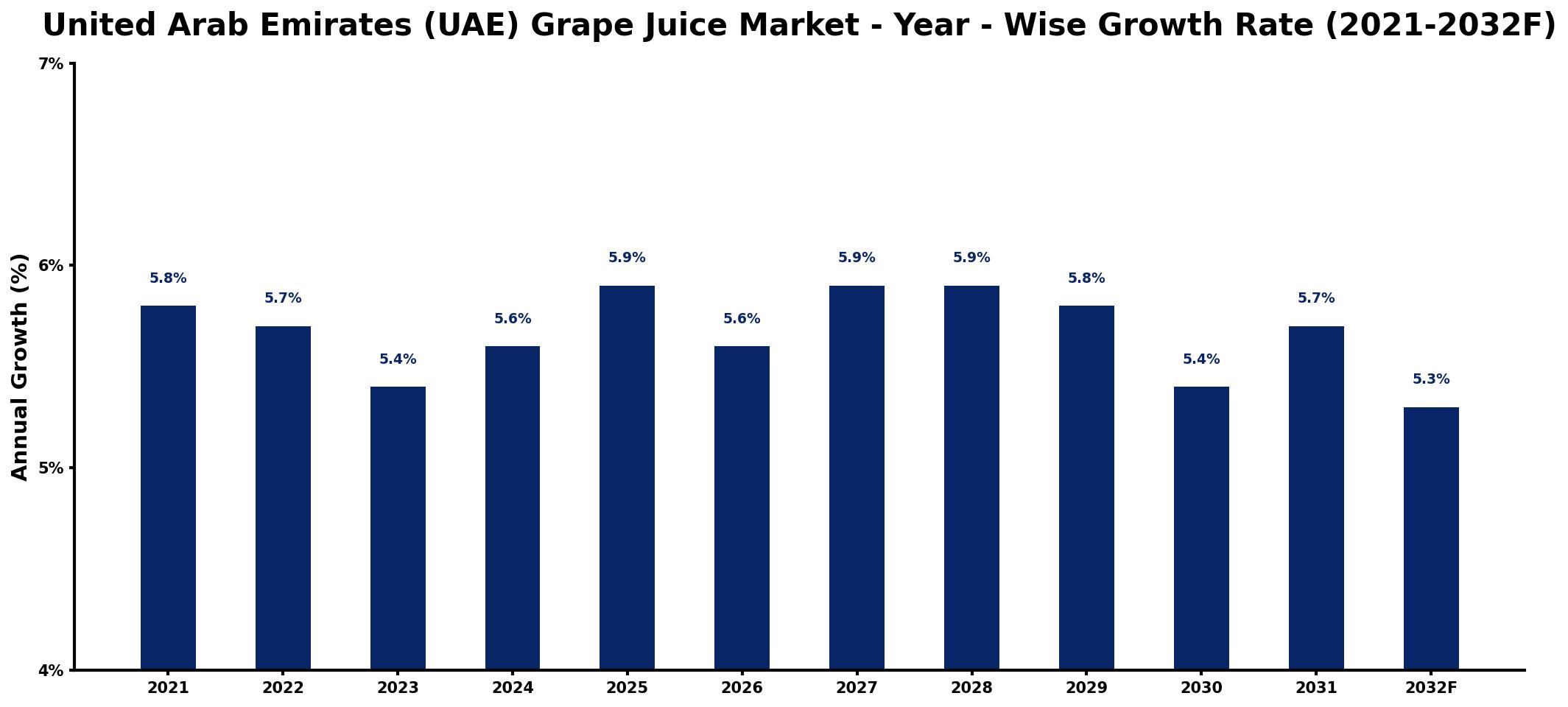
The table below presents the year‑wise growth rates along with the key drivers influencing the market
| Year | Growth Rate | Major Drivers |
| 2021 | 5.8% | Rising health consciousness among consumers |
| 2022 | 5.7% | Increased investment in beverage sector |
| 2023 | 5.4% | Growing popularity of natural products |
| 2024 | 5.6% | Expansion of retail distribution channels |
| 2025 | 5.9% | increased domestic production output |
| 2026 | 5.6% | Innovative marketing strategies adopted |
| 2027 | 5.9% | Emergence of new consumer segments |
| 2028 | 5.9% | Strengthening tourism boosting consumption |
| 2029 | 5.8% | Higher disposable income levels observed |
| 2030 | 5.4% | Increased focus on sustainability practices |
| 2031 | 5.7% | Growing awareness of nutritional benefits |
| 2032 | 5.3% | expanding industrial usage applications |
Note: Market size estimations and growth projections presented in this report are based on 6Wresearch's proprietary forecasting methodology, utilizing the latest available industry data, government publications, and primary research inputs.
United Arab Emirates (UAE) Grape Juice Market Synopsis
The most significant force currently shaping the UAE grape juice market is the increasing consumer demand for natural beverages. As individuals become more health-conscious, they are turning away from sugary sodas and artificial drinks, gravitating instead toward grape juice, renowned for its antioxidant properties and nutritious benefits. This transition is not just a fleeting trend; it represents a fundamental shift in consumer preferences, which is poised to sustain growth in the coming years.
In addition to health considerations, the UAE's favorable climate for grape cultivation plays a pivotal role in supporting the local grape juice industry. The availability of fresh, high-quality grapes allows producers to tap into the burgeoning interest in local sourcing. This enhances the markets overall appeal, especially among environmentally conscious consumers eager to support sustainable practices and enjoy locally produced goods.
United Arab Emirates (UAE) Grape Juice Market Key Takeaways
- The market is experiencing robust growth driven by health-conscious consumers.
- There is a notable rise in demand for organic and premium grape juice products.
- Local grape cultivation supports the market, ensuring a steady supply of high-quality ingredients.
- Competition from alternative beverages remains a significant factor influencing market dynamics.
- Consumer concerns over added sugars and preservatives are prompting producers to innovate their offerings.
Evaluation of Restraints in United Arab Emirates (UAE) Grape Juice Market
Despite the favorable growth outlook, the UAE grape juice market faces several key restraints. Securing a consistent supply of high-quality grapes is crucial, as fluctuations in crop yield can impact production. Seasonal variations complicate the supply chain, necessitating careful management by producers. Additionally, the growing consumer scrutiny regarding added sugars and preservatives puts pressure on manufacturers to adapt their formulations while maintaining taste and quality. These challenges underscore the need for innovative approaches to production and marketing strategies.
United Arab Emirates (UAE) Grape Juice Market Trends
A few trends are shaping the UAE grape juice market landscape. The demand for organic variants is on the rise, driven by a consumer preference for clean labels and healthier options. Innovations in product formulations, such as low-sugar and no-preservative options, are becoming increasingly popular. Additionally, brand storytelling focused on local sourcing and sustainability resonates with the UAE's environmentally aware consumers, further driving market engagement. These trends illustrate a shift towards a more informed and health-centric consumer base.
United Arab Emirates (UAE) Grape Juice Market Opportunities
Significant opportunities lie ahead for stakeholders in the UAE grape juice market. The increasing emphasis on health and wellness suggests potential for product diversification, including fortified juices and blends that cater to specific dietary needs. Furthermore, the growing tourism sector in the UAE presents an avenue for grape juice brands to expand their market reach. By aligning with international health trends and tapping into the local culture, businesses can seize opportunities for growth and enhance consumer loyalty.
Government Initiatives in the United Arab Emirates (UAE) Grape Juice Market
The UAE government has implemented various initiatives aimed at boosting local agriculture and food production, which indirectly benefits the grape juice market. Through support for sustainable farming practices and investments in research and development, the government fosters an environment conducive to innovation in food production. Programs focusing on food security and public awareness campaigns about health benefits of natural beverages further encourage consumer interest in grape juice.
Future Insights of the United Arab Emirates (UAE) Grape Juice Market
Looking ahead to 2026-2032, the UAE grape juice market is well-positioned for continued growth. As consumers increasingly prioritize health and wellness, the demand for natural, high-quality beverages will likely rise. Innovations in product offerings, combined with effective marketing strategies that emphasize local sourcing and health benefits, will be crucial. The ongoing trend toward premiumization will also shape the competitive landscape, encouraging brands to enhance their value propositions. Overall, with the right strategies in place, the market is set to flourish.
United Arab Emirates (UAE) Grape Juice Market Latest Developments (2025 - 2026)
Recent developments in the UAE grape juice market indicate a stronger focus on product differentiation. Producers are increasingly launching innovative flavors and formulations that cater to health-conscious consumers. Additionally, sustainability has become a focal point for many brands, leading to initiatives that enhance the environmental footprint of grape juice production. As health trends continue to evolve, businesses are actively exploring opportunities for collaboration and partnerships to expand market presence.
United Arab Emirates (UAE) Grape Juice Market - Key Attractiveness of the Report
- 10 Years of Market Numbers
- Historical Data Starting from 2022 to 2025
- Base Year: 2025
- Forecast Data until 2032
- Key Performance Indicators Impacting the Market
- Major Upcoming Developments and Projects
Key Highlights of the Report:
- United Arab Emirates (UAE) Grape Juice Market Outlook
- Market Size of United Arab Emirates (UAE) Grape Juice Market, 2025
- Forecast of United Arab Emirates (UAE) Grape Juice Market, 2032
- Historical Data and Forecast of United Arab Emirates (UAE) Grape Juice Revenues & Volume for the Period 2022-2032F
- United Arab Emirates (UAE) Grape Juice Market Trend Evolution
- United Arab Emirates (UAE) Grape Juice Market Drivers and Challenges
- United Arab Emirates (UAE) Grape Juice Price Trends
- United Arab Emirates (UAE) Grape Juice Porter's Five Forces
- United Arab Emirates (UAE) Grape Juice Industry Life Cycle
- Historical Data and Forecast of United Arab Emirates (UAE) Grape Juice Market Revenues & Volume By Type for the Period 2022-2032F
- Historical Data and Forecast of United Arab Emirates (UAE) Grape Juice Market Revenues & Volume By Pure Juice for the Period 2022-2032F
- Historical Data and Forecast of United Arab Emirates (UAE) Grape Juice Market Revenues & Volume By Mixed Juice for the Period 2022-2032F
- Historical Data and Forecast of United Arab Emirates (UAE) Grape Juice Market Revenues & Volume By Application for the Period 2022-2032F
- Historical Data and Forecast of United Arab Emirates (UAE) Grape Juice Market Revenues & Volume By 0-14 yrs for the Period 2022-2032F
- Historical Data and Forecast of United Arab Emirates (UAE) Grape Juice Market Revenues & Volume By 15-34 yrs for the Period 2022-2032F
- Historical Data and Forecast of United Arab Emirates (UAE) Grape Juice Market Revenues & Volume By 35-54 yrs for the Period 2022-2032F
- Historical Data and Forecast of United Arab Emirates (UAE) Grape Juice Market Revenues & Volume By 55 yrs up for the Period 2022-2032F
- United Arab Emirates (UAE) Grape Juice Import Export Trade Statistics
- Market Opportunity Assessment By Type
- Market Opportunity Assessment By Application
- United Arab Emirates (UAE) Grape Juice Top Companies Market Share
- United Arab Emirates (UAE) Grape Juice Competitive Benchmarking By Technical and Operational Parameters
- United Arab Emirates (UAE) Grape Juice Company Profiles
- United Arab Emirates (UAE) Grape Juice Key Strategic Recommendations






































