United Arab Emirates (UAE) Grape Wine Market Summary
The united arab emirates (uae) grape wine market was estimated at USD 206 Million in 2025 and is projected to reach USD 272 Million by 2032, growing at a CAGR of 4.6% from 2026 to 2032.
United Arab Emirates (UAE) Grape Wine Market Year-wise Growth Rate and Key Drivers
This graph highlights how the United Arab Emirates (UAE) Grape Wine Market has steadily grown over the past five years, supported by major growth factors.
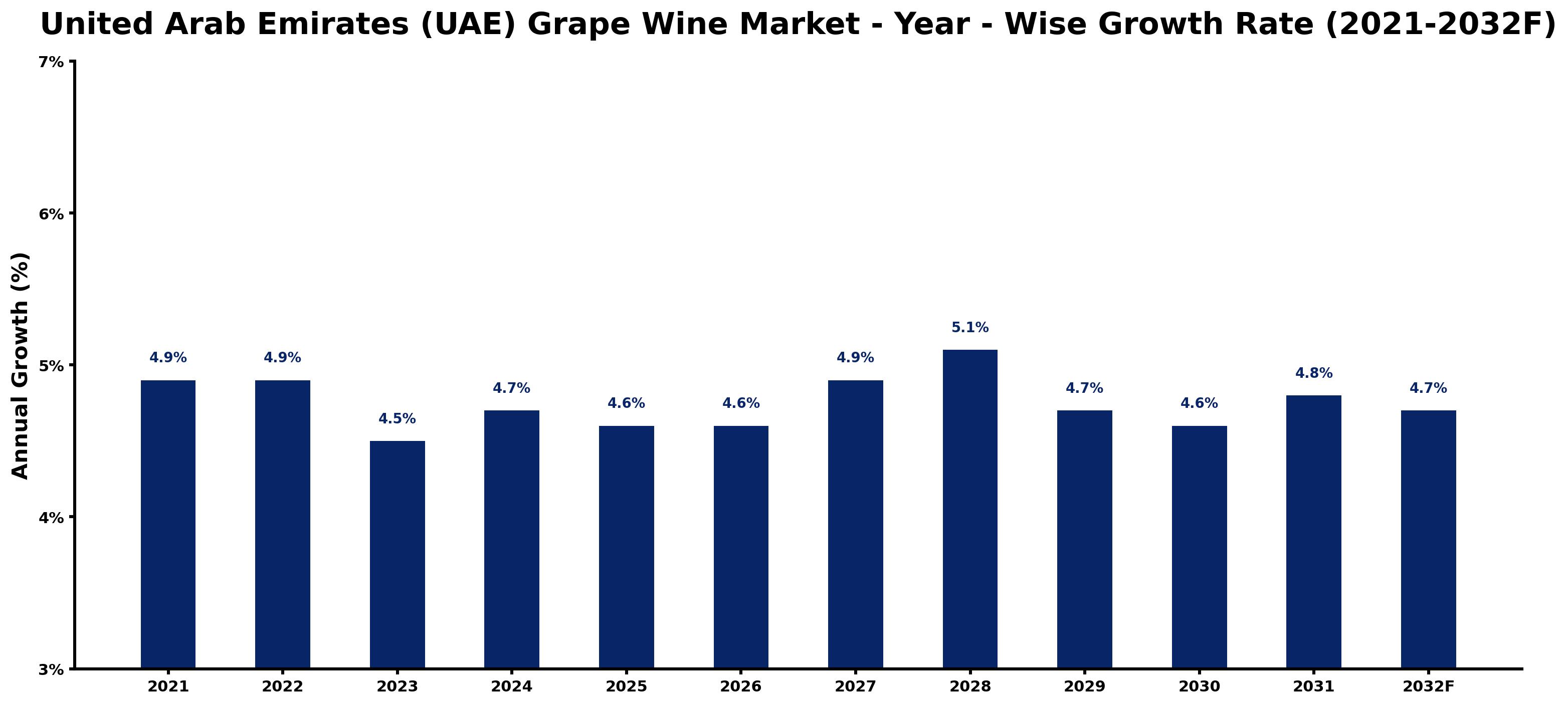
The table below presents the year wise growth rates along with the key drivers influencing the market
| Year | Growth Rate | Major Drivers |
| 2021 | 4.9% | International travel restrictions led to increased local wine consumption in the UAE. |
| 2022 | 4.9% | Wine tourism initiatives spurred interest in local vineyards and wine experiences. |
| 2023 | 4.5% | Cultural acceptance of wine is shifting, reflected in restaurant and event offerings. |
| 2024 | 4.7% | Local production capacities improve, enhancing wine quality and variety available. |
| 2025 | 4.6% | Social events and celebrations increasingly feature wine, expanding market reach. |
| 2026 | 4.6% | Luxury dining establishments begin to curate extensive wine lists, attracting connoisseurs. |
| 2027 | 4.9% | Collaborations between local and international wineries foster innovation in wine styles. |
| 2028 | 5.1% | E-commerce platforms develop specialized wine sections, enhancing consumer access significantly. |
| 2029 | 4.7% | Wine education programs and tastings cultivate a knowledgeable consumer base. |
| 2030 | 4.6% | Sustainability trends push wineries to adopt eco-friendly practices, appealing to consumers. |
| 2031 | 4.8% | Cross-border trade expansions enable a broader selection of international wines. |
| 2032 | 4.7% | Culinary events increasingly showcase wine pairings, enhancing cultural appreciation and consumption. |
Note - Market size estimations and growth projections presented in this report are based on 6Wresearch's advanced forecasting approach, validated with industry datasets as of June 2026.
United Arab Emirates (UAE) Grape Wine Market Synopsis
The United Arab Emirates (UAE) Grape Wine Market is projected to reach 4.6% and witness significant growth during the forecast period (2026-2032). This market has experienced a gradual increase in demand, propelled by a combination of cultural shifts, a rising expatriate population, and heightened interest in wine as a social beverage. As the UAE evolves into a melting pot of cultures, its grape wine market has adapted to cater to a diverse and expanding consumer base.
United Arab Emirates (UAE) Grape Wine Market Growth Drivers
Several factors are driving the growth of the grape wine market in the UAE. First and foremost, the thriving hospitality and tourism sectors in the region play a pivotal role in expanding market reach.
- The influx of tourists has led to the proliferation of restaurants, hotels, and bars that offer a diverse selection of grape wines, enhancing consumer access and experience.
- Changing consumer lifestyles, influenced by Western cultures, have fostered a greater acceptance and appreciation for wine, positioning it as a favored social beverage.
- The government's strategic initiatives aimed at diversifying the economy have encouraged investments in the food and beverage sector, thereby supporting the growth of the wine market.
- Increased exposure to international wine cultures through events and festivals has played a significant role in educating consumers and driving demand.
- The rising number of expatriates, particularly those from wine-favorable cultures, has resulted in an augmented demand for high-quality grape wines, further stimulating market growth.
United Arab Emirates (UAE) Grape Wine Market Challenges and Restraints
Despite its growth prospects, the UAE grape wine market faces certain challenges that may hinder its expansion. One of the most significant obstacles is the stringent regulations surrounding alcohol consumption.
- Alcohol is subject to strict licensing and distribution laws, which can limit accessibility and availability to consumers, particularly in conservative areas.
- High taxation on alcoholic beverages creates pricing challenges, particularly affecting premium and imported wines, which may deter some consumers.
- Market players must navigate a complex regulatory environment, which can complicate distribution and marketing strategies within the country.
- Cultural sensitivities surrounding alcohol consumption might deter certain demographic segments from engaging with the grape wine market.
- The fluctuations in global economy and supply chain issues could impact the importation of wines, thereby affecting market stability.
United Arab Emirates (UAE) Grape Wine Market Government Investment and Initiatives
The government of the UAE has recognized the potential of the grape wine market and is beginning to implement policies aimed at fostering its development. These initiatives include numerous efforts to promote the country as a premier global tourist destination, where wine culture plays an integral role.
- Initiatives to enhance tourism infrastructure, such as wine-centric festivals and events, are being organized to attract international visitors and wine enthusiasts.
- Public spending on hospitality sectors has increased, creating a conducive environment for wine businesses to flourish.
- The UAE government is also encouraging local production of grape wines through incentives aimed at boosting domestic agriculture and winemaking capabilities.
- Educational programs and partnerships with international wine institutions are being pursued to enhance local knowledge and expertise within the industry.
- In efforts to expand market accessibility, there is a focus on reviewing and potentially relaxing some regulatory constraints associated with wine distribution.
United Arab Emirates (UAE) Grape Wine Market Latest Developments (May 2025 - June 2026)
Recent developments within the UAE grape wine market from May 2025 to June 2026 indicate a notable evolution in market dynamics. The period has witnessed a rise in the establishment of wine-focused retail outlets, enhancing consumer access to a variety of grape wines.
- E-commerce platforms specializing in wine sales have gained traction, offering consumers convenient options for purchasing grape wines from the comfort of their homes.
- Wine festivals and tasting events have become more frequent, helping to educate consumers while promoting the wine culture within the UAE.
- Collaborations between local producers and international brands have emerged, allowing for the introduction of new products and varietals to the market.
- Marketing strategies increasingly utilize digital platforms, reaching a broader audience and engaging consumers through targeted campaigns.
- The adaptation of wine menus in restaurants and bars has reflected an increasing consumer interest in unique and premium grape wine offerings.
United Arab Emirates (UAE) Grape Wine Market - Key Attractiveness of the Report
- 10 Years of Market Numbers
- Historical Data Starting from 2022 to 2025
- Base Year: 2025
- Forecast Data until 2032
- Key Performance Indicators Impacting the Market
- Major Upcoming Developments and Projects
Key Highlights of the Report:
- United Arab Emirates (UAE) Grape Wine Market Outlook
- Market Size of United Arab Emirates (UAE) Grape Wine Market, 2025
- Forecast of United Arab Emirates (UAE) Grape Wine Market, 2032
- Historical Data and Forecast of United Arab Emirates (UAE) Grape Wine Revenues & Volume for the Period 2022-2032F
- United Arab Emirates (UAE) Grape Wine Market Trend Evolution
- United Arab Emirates (UAE) Grape Wine Market Drivers and Challenges
- United Arab Emirates (UAE) Grape Wine Price Trends
- United Arab Emirates (UAE) Grape Wine Porter's Five Forces
- United Arab Emirates (UAE) Grape Wine Industry Life Cycle
- Historical Data and Forecast of United Arab Emirates (UAE) Grape Wine Market Revenues & Volume By Type for the Period 2022-2032F
- Historical Data and Forecast of United Arab Emirates (UAE) Grape Wine Market Revenues & Volume By Red Wine for the Period 2022-2032F
- Historical Data and Forecast of United Arab Emirates (UAE) Grape Wine Market Revenues & Volume By White Wine for the Period 2022-2032F
- Historical Data and Forecast of United Arab Emirates (UAE) Grape Wine Market Revenues & Volume By Rose Wine for the Period 2022-2032F
- Historical Data and Forecast of United Arab Emirates (UAE) Grape Wine Market Revenues & Volume By Other for the Period 2022-2032F
- Historical Data and Forecast of United Arab Emirates (UAE) Grape Wine Market Revenues & Volume By Applications for the Period 2022-2032F
- Historical Data and Forecast of United Arab Emirates (UAE) Grape Wine Market Revenues & Volume By Commercial Consumption for the Period 2022-2032F
- Historical Data and Forecast of United Arab Emirates (UAE) Grape Wine Market Revenues & Volume By Household Consumption for the Period 2022-2032F
- Historical Data and Forecast of United Arab Emirates (UAE) Grape Wine Market Revenues & Volume By Other for the Period 2022-2032F
- United Arab Emirates (UAE) Grape Wine Import Export Trade Statistics
- Market Opportunity Assessment By Type
- Market Opportunity Assessment By Applications
- United Arab Emirates (UAE) Grape Wine Top Companies Market Share
- United Arab Emirates (UAE) Grape Wine Competitive Benchmarking By Technical and Operational Parameters
- United Arab Emirates (UAE) Grape Wine Company Profiles
- United Arab Emirates (UAE) Grape Wine Key Strategic Recommendations






































