United Arab Emirates (UAE) Greasy Wool Market Size, Share & Growth Rate
The United Arab Emirates (UAE) Greasy Wool Market was estimated at USD 1497 Million in 2025 and is projected to reach USD 2190 Million by 2032, growing at a CAGR of 5.6% from 2026 to 2032. This impressive growth trajectory is driven by the UAE's strategic positioning in the global textile market, coupled with a steady increase in demand for high-quality woolen products. As the textile manufacturing sector continues to evolve, the need for cost-effective raw materials like greasy wool will sustain this upward trend.
United Arab Emirates (UAE) Greasy Wool Market Year-wise Growth Rate and Key Drivers
This graph highlights how the United Arab Emirates (UAE) Greasy Wool Market has steadily grown over the years, supported by major growth factors.
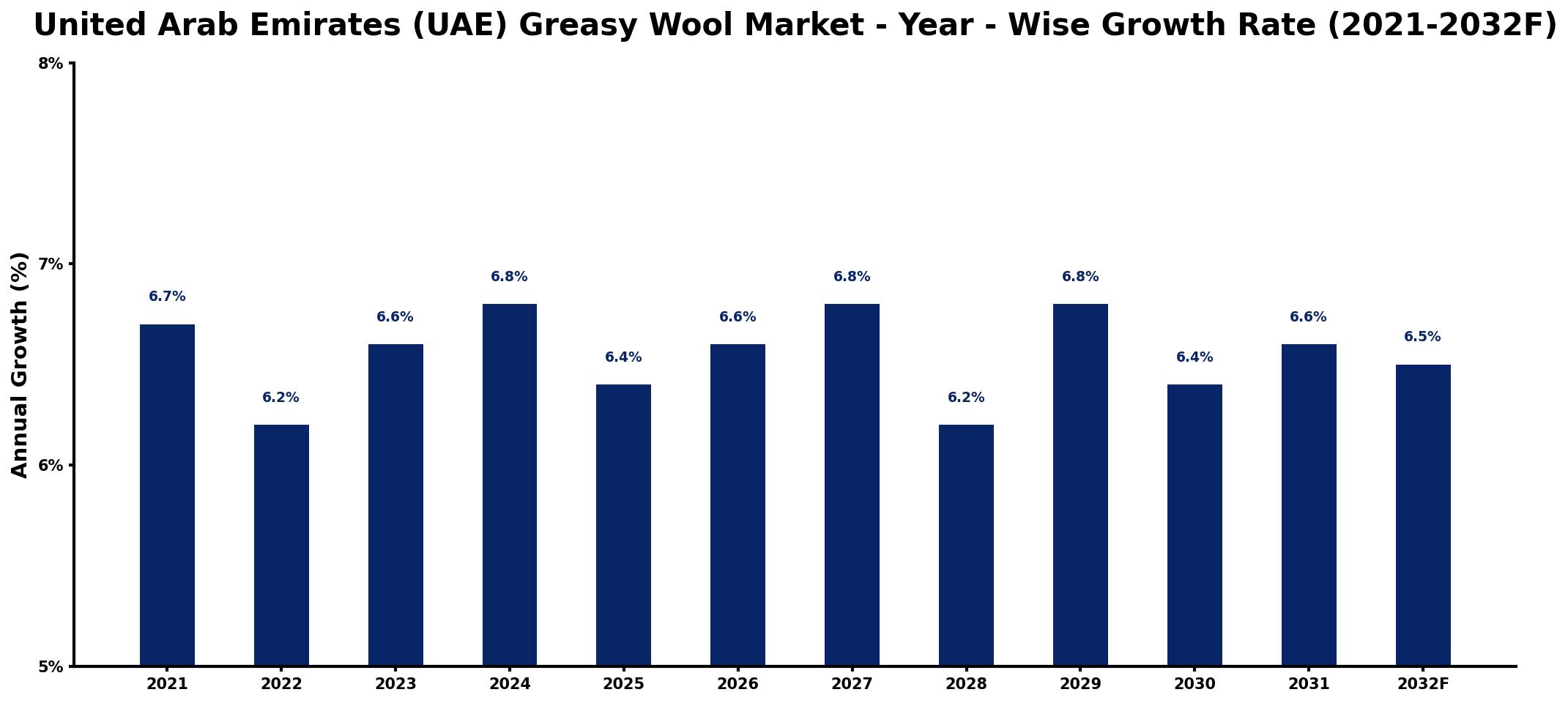
The table below presents the year‑wise growth rates along with the key drivers influencing the market
| Year | Growth Rate | Major Drivers |
| 2021 | 6.7% | Rising demand for sustainable textiles |
| 2022 | 6.2% | Expansion of local manufacturing facilities |
| 2023 | 6.6% | Increased investment in fiber technology |
| 2024 | 6.8% | Growth in eco-friendly fashion trends |
| 2025 | 6.4% | Surge in agricultural innovation funding |
| 2026 | 6.6% | Higher exports to international markets |
| 2027 | 6.8% | Boost in raw material sourcing |
| 2028 | 6.2% | Emergence of new processing techniques |
| 2029 | 6.8% | Strengthening partnerships with retailers |
| 2030 | 6.4% | rising export shipment volumes |
| 2031 | 6.6% | Development of niche market segments |
| 2032 | 6.5% | Increase in global trade agreements |
Note: Market size estimations and growth projections presented in this report are based on 6Wresearch's proprietary forecasting methodology, utilizing the latest available industry data, government publications, and primary research inputs.
United Arab Emirates (UAE) Greasy Wool Market Synopsis
In recent years, the UAE greasy wool market has gained momentum, firmly establishing its role within the local textile industry. Greasy wool serves as a fundamental raw material for various woolen products, catering to both domestic and export needs, thereby underpinning the nation's vibrant textile manufacturing landscape.
The reliance on imported greasy wool has become increasingly apparent, as local production is limited. However, this also highlights the market's resilience and adaptability in navigating global supply chains to meet the rising demands of the textile sector in the UAE.
United Arab Emirates (UAE) Greasy Wool Market Key Takeaways
- The UAE greasy wool market is projected to witness significant growth, reaching USD 2190 Million by 2032.
- Demand for greasy wool is driven by the expanding textile manufacturing sector and the need for cost-effective raw materials.
- The market is heavily reliant on international suppliers, impacting pricing and supply chain stability.
- Quality maintenance during transportation poses challenges due to the region's climatic conditions.
- The post-pandemic recovery of the textile sector is fostering renewed confidence in greasy wool trade.
Evaluation of Restraints in United Arab Emirates (UAE) Greasy Wool Market
Despite the robust growth trajectory of the UAE greasy wool market, several restraints pose significant challenges. The limited domestic production of raw wool means that the market is largely dependent on imports, which can lead to vulnerability against global price fluctuations. Additionally, trade regulations and supply chain disruptions can hinder smooth operations, making it essential for businesses to navigate these risks effectively. Furthermore, maintaining the quality of greasy wool during its transport and storage becomes a pressing concern, particularly in the face of the region's harsh climatic conditions.
United Arab Emirates (UAE) Greasy Wool Market Trends
Several trends are currently shaping the UAE greasy wool market. Increased focus on sustainable and ethically sourced materials in textile manufacturing is gaining traction, prompting local manufacturers to seek high-quality greasy wool that meets these criteria. Additionally, advancements in processing technologies are enabling more efficient transformation of greasy wool into finished products, enhancing production capabilities and offering competitive advantages. The revival of international trade post-COVID-19 is also paving the way for stronger partnerships between UAE textile manufacturers and global suppliers.
United Arab Emirates (UAE) Greasy Wool Market Opportunities
The UAE greasy wool market presents several growth and investment opportunities. As local textile manufacturers expand their product lines to meet diverse consumer preferences, there is a growing need for innovative greasy wool applications. Additionally, the burgeoning demand for eco-friendly textiles opens avenues for businesses that can offer sustainably sourced greasy wool. Enhancing local processing capabilities could also minimize import reliance, providing a competitive edge in the regional market. Collaboration with international suppliers may further stabilize supply chains and foster more predictable pricing structures.
Government Initiatives in the United Arab Emirates (UAE) Greasy Wool Market
The UAE government has undertaken several initiatives to bolster the textile industry, directly impacting the greasy wool market. Policies aimed at promoting local manufacturing and reducing reliance on imports are key focus areas. Furthermore, investments in infrastructure to support supply chain efficiency and trade facilitation play a vital role. Programs encouraging innovation and sustainability in textile production have the potential to benefit greasy wool suppliers as they seek to align with global standards.
Future Insights of the United Arab Emirates (UAE) Greasy Wool Market
Looking ahead to 2026-2032, the UAE greasy wool market is poised for substantial growth, driven by evolving consumer preferences and increasing demand for woolen products. The integration of advanced technology in processing and production will likely enhance the value chain, making it more efficient. Furthermore, a continued emphasis on sustainability in textile manufacturing is expected to shape sourcing strategies, positioning the UAE as a significant player in the global greasy wool supply chain.
United Arab Emirates (UAE) Greasy Wool Market Latest Developments (2025 - 2026)
Recent developments within the UAE greasy wool market indicate a gradual recovery in trade dynamics following the disruptions caused by the pandemic. Manufacturers are actively exploring partnerships with international suppliers to secure consistent quality and pricing of greasy wool. There is also a noticeable shift towards adopting sustainable practices, with many players investing in eco-friendly processing technologies. As the market adapts to these changes, growth prospects appear promising, supported by an increasing consumer demand for woolen products.
United Arab Emirates (UAE) Greasy Wool Market - Key Attractiveness of the Report
- 10 Years of Market Numbers
- Historical Data Starting from 2022 to 2025
- Base Year: 2025
- Forecast Data until 2032
- Key Performance Indicators Impacting the Market
- Major Upcoming Developments and Projects
Key Highlights of the Report:
- United Arab Emirates (UAE) Greasy Wool Market Outlook
- Market Size of United Arab Emirates (UAE) Greasy Wool Market, 2025
- Forecast of United Arab Emirates (UAE) Greasy Wool Market, 2032
- Historical Data and Forecast of United Arab Emirates (UAE) Greasy Wool Revenues & Volume for the Period 2022-2032F
- United Arab Emirates (UAE) Greasy Wool Market Trend Evolution
- United Arab Emirates (UAE) Greasy Wool Market Drivers and Challenges
- United Arab Emirates (UAE) Greasy Wool Price Trends
- United Arab Emirates (UAE) Greasy Wool Porter's Five Forces
- United Arab Emirates (UAE) Greasy Wool Industry Life Cycle
- Historical Data and Forecast of United Arab Emirates (UAE) Greasy Wool Market Revenues & Volume By Application for the Period 2022-2032F
- Historical Data and Forecast of United Arab Emirates (UAE) Greasy Wool Market Revenues & Volume By Apparel for the Period 2022-2032F
- Historical Data and Forecast of United Arab Emirates (UAE) Greasy Wool Market Revenues & Volume By Sports for the Period 2022-2032F
- Historical Data and Forecast of United Arab Emirates (UAE) Greasy Wool Market Revenues & Volume By Blazers for the Period 2022-2032F
- Historical Data and Forecast of United Arab Emirates (UAE) Greasy Wool Market Revenues & Volume By Jacketing for the Period 2022-2032F
- Historical Data and Forecast of United Arab Emirates (UAE) Greasy Wool Market Revenues & Volume By Others for the Period 2022-2032F
- Historical Data and Forecast of United Arab Emirates (UAE) Greasy Wool Market Revenues & Volume By Upholstery Fabrics for the Period 2022-2032F
- Historical Data and Forecast of United Arab Emirates (UAE) Greasy Wool Market Revenues & Volume By Blankets for the Period 2022-2032F
- Historical Data and Forecast of United Arab Emirates (UAE) Apparel Greasy Wool Market Revenues & Volume By Flooring for the Period 2022-2032F
- United Arab Emirates (UAE) Greasy Wool Import Export Trade Statistics
- Market Opportunity Assessment By Application
- United Arab Emirates (UAE) Greasy Wool Top Companies Market Share
- United Arab Emirates (UAE) Greasy Wool Competitive Benchmarking By Technical and Operational Parameters
- United Arab Emirates (UAE) Greasy Wool Company Profiles
- United Arab Emirates (UAE) Greasy Wool Key Strategic Recommendations






































