United Arab Emirates (UAE) Groceries Market Summary
The united arab emirates (uae) groceries market was estimated at USD 189 Million in 2025 and is projected to reach USD 250 Million by 2032, growing at a CAGR of 4.6% from 2026 to 2032.
United Arab Emirates (UAE) Groceries Market Year-wise Growth Rate and Key Drivers
This graph highlights how the United Arab Emirates (UAE) Groceries Market has steadily grown over the past five years, supported by major growth factors.
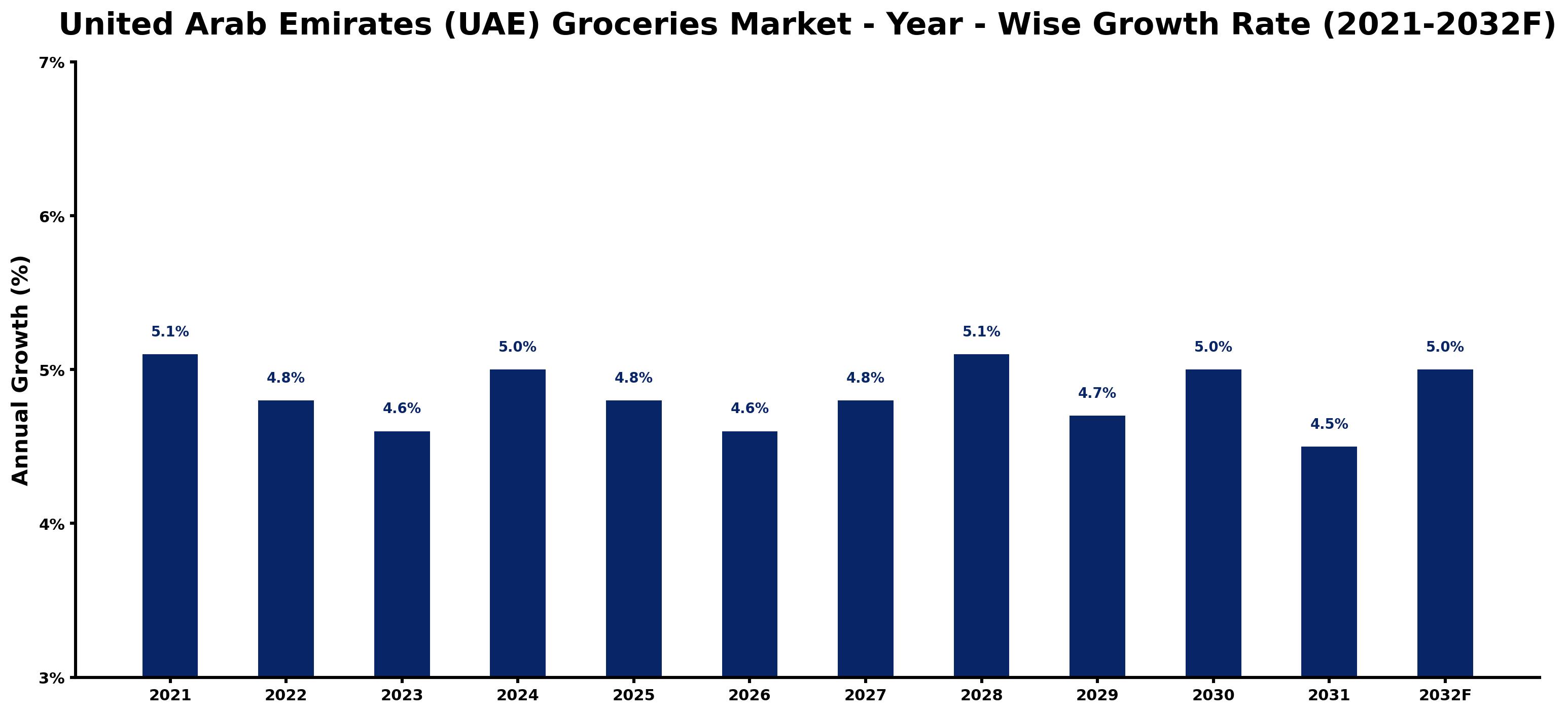
The table below presents the year wise growth rates along with the key drivers influencing the market
| Year | Growth Rate | Major Drivers |
| 2021 | 5.1% | E-commerce penetration reshaped grocery shopping habits across the UAE landscape significantly. |
| 2022 | 4.8% | Consumer preference shifted towards healthier, organic products as awareness increased. |
| 2023 | 4.6% | Major retailers invested heavily in digital transformation and omnichannel experiences. |
| 2024 | 5.0% | Regional events like Expo 2020 spurred higher demand for diverse food options. |
| 2025 | 4.8% | Local sourcing initiatives gained traction, impacting supply chain dynamics in grocery sectors. |
| 2026 | 4.6% | Sustainability practices became a focal point for retailers, influencing purchasing behaviors. |
| 2027 | 4.8% | Urbanization trends intensified, leading to the proliferation of convenience store formats. |
| 2028 | 5.1% | Technological innovations streamlined inventory management, reducing operational inefficiencies significantly. |
| 2029 | 4.7% | The competitive landscape transformed as new players entered the grocery market aggressively. |
| 2030 | 5.0% | Consumer loyalty programs and personalized marketing strategies redefined shopping experiences markedly. |
| 2031 | 4.5% | Rising disposable incomes allowed households to explore premium grocery product offerings. |
| 2032 | 5.0% | Health and wellness trends dictated grocery selections, emphasizing plant-based and functional foods. |
Note - Market size estimations and growth projections presented in this report are based on 6Wresearch's advanced forecasting approach, validated with industry datasets as of June 2026.
United Arab Emirates (UAE) Groceries Market Synopsis
The United Arab Emirates (UAE) Groceries Market is projected to reach 4.6% and witness significant growth during the forecast period (2026-2032). The market's expansion is largely attributed to the country's growing population, diverse consumer preferences, and the increased usage of online grocery shopping platforms. This evolution represents a paradigm shift in consumer behavior, moving from traditional stores to digital solutions, thus reshaping the grocery landscape in the UAE.
United Arab Emirates (UAE) Groceries Market Growth Drivers
Several compelling factors are propelling the demand for groceries in the UAE. First, the continuous growth of the population, characterized by a large expatriate community, necessitates a diverse assortment of grocery options that cater to various cultural and dietary requirements. Second, the fast-paced lifestyle of consumers has led to an increased preference for convenience, resulting in a surge in the establishment of both supermarkets and online grocery delivery services. Additionally, rising urbanization plays a crucial role, as more residents seek easy access to quality grocery products.
- The population growth in the UAE significantly influences grocery consumption, diversifying the types of products needed.
- Convenience-driven shopping habits lead to a higher demand for online grocery services, which are increasingly adopted by consumers.
- Urbanization trends are changing shopping patterns, with more people moving to cities where supermarkets and hypermarkets are more accessible.
- Changing dietary choices and health consciousness among consumers create opportunities for niche grocery markets.
- Technological advancements in supply chain management allow for better inventory and distribution, enhancing product availability.
United Arab Emirates (UAE) Groceries Market Challenges and Restraints
Despite the promising growth trajectory, the UAE groceries market faces several challenges. One notable concern is the price sensitivity among consumers. Although there is a growing demand for premium grocery items, consumers remain vigilant about pricing, which can exert pressure on retailers to maintain competitive pricing strategies. Additionally, fluctuations in global food prices and supply chain disruptions pose risks to market stability, necessitating robust contingency plans from stakeholders in the sector.
- Price sensitivity leads consumers to seek out competitive pricing, which challenges retailers' profit margins.
- Supply chain vulnerabilities, intensified by global events, can result in product shortages and increased costs.
- Consumer demand for sustainability and ethical sourcing complicates sourcing strategies for grocery retailers.
- Technological adaptation costs can be high, particularly for traditional retailers transitioning to e-commerce.
- Market entry barriers for new players can limit innovation and competition in the grocery sector.
United Arab Emirates (UAE) Groceries Market Government Investment and Initiatives
The UAE government plays a vital role in supporting the groceries market through various policies and initiatives aimed at bolstering food security and enhancing supply chain resilience. Investments in infrastructure and technology are pivotal, with the government encouraging the development of logistics hubs and distribution centers to streamline the supply chain. Furthermore, strategic partnerships with private sectors aim to enhance food security measures, ensuring that the population has access to essential grocery supplies at all times. Additionally, socioeconomic initiatives targeting sustainability efforts are gaining traction, promoting environmentally friendly practices throughout the grocery sector.
United Arab Emirates (UAE) Groceries Market Latest Developments (May 2025 - June 2026)
In recent months, the UAE groceries market has experienced transformative developments aimed at addressing the evolving needs of consumers. The rise of online grocery shopping continues to reshape market dynamics, with many retailers enhancing their digital platforms to accommodate increased customer traffic. Simultaneously, initiatives promoting local sourcing of groceries have gained momentum, driving efforts towards sustainability and resilience in food supply chains. Additionally, collaborative efforts among grocery retailers and logistics providers have been initiated to optimize the delivery processes, ensuring timely and efficient service for consumers.
United Arab Emirates (UAE) Groceries Market - Key Attractiveness of the Report
- 10 Years of Market Numbers
- Historical Data Starting from 2022 to 2025
- Base Year: 2025
- Forecast Data until 2032
- Key Performance Indicators Impacting the Market
- Major Upcoming Developments and Projects
Key Highlights of the Report:
- United Arab Emirates (UAE) Groceries Market Outlook
- Market Size of United Arab Emirates (UAE) Groceries Market, 2025
- Forecast of United Arab Emirates (UAE) Groceries Market, 2032
- Historical Data and Forecast of United Arab Emirates (UAE) Groceries Revenues & Volume for the Period 2022-2032F
- United Arab Emirates (UAE) Groceries Market Trend Evolution
- United Arab Emirates (UAE) Groceries Market Drivers and Challenges
- United Arab Emirates (UAE) Groceries Price Trends
- United Arab Emirates (UAE) Groceries Porter's Five Forces
- United Arab Emirates (UAE) Groceries Industry Life Cycle
- Historical Data and Forecast of United Arab Emirates (UAE) Groceries Market Revenues & Volume By Product Types for the Period 2022-2032F
- Historical Data and Forecast of United Arab Emirates (UAE) Groceries Market Revenues & Volume By Packaged Food for the Period 2022-2032F
- Historical Data and Forecast of United Arab Emirates (UAE) Groceries Market Revenues & Volume By Unpackaged Food for the Period 2022-2032F
- Historical Data and Forecast of United Arab Emirates (UAE) Groceries Market Revenues & Volume By Drinks for the Period 2022-2032F
- Historical Data and Forecast of United Arab Emirates (UAE) Groceries Market Revenues & Volume By Tobacco for the Period 2022-2032F
- Historical Data and Forecast of United Arab Emirates (UAE) Groceries Market Revenues & Volume By Household Products for the Period 2022-2032F
- Historical Data and Forecast of United Arab Emirates (UAE) Groceries Market Revenues & Volume By Others for the Period 2022-2032F
- Historical Data and Forecast of United Arab Emirates (UAE) Groceries Market Revenues & Volume By Distribution Channel for the Period 2022-2032F
- Historical Data and Forecast of United Arab Emirates (UAE) Groceries Market Revenues & Volume By Supermarkets & Hypermarkets for the Period 2022-2032F
- Historical Data and Forecast of United Arab Emirates (UAE) Groceries Market Revenues & Volume By Convenience Store for the Period 2022-2032F
- Historical Data and Forecast of United Arab Emirates (UAE) Groceries Market Revenues & Volume By Online for the Period 2022-2032F
- United Arab Emirates (UAE) Groceries Import Export Trade Statistics
- Market Opportunity Assessment By Product Types
- Market Opportunity Assessment By Distribution Channel
- United Arab Emirates (UAE) Groceries Top Companies Market Share
- United Arab Emirates (UAE) Groceries Competitive Benchmarking By Technical and Operational Parameters
- United Arab Emirates (UAE) Groceries Company Profiles
- United Arab Emirates (UAE) Groceries Key Strategic Recommendations






































