United Arab Emirates (UAE) Hams, Shoulders and Cuts of Swine Market Size, Share & Growth Rate
The United Arab Emirates (UAE) Hams, Shoulders and Cuts of Swine Market was estimated at USD 480 Million in 2025 and is projected to reach USD 679 Million by 2032, growing at a CAGR of 5.1% from 2026 to 2032. Despite the religious restrictions on pork consumption, the market exhibits growth driven by the increasing population of non-Muslim expatriates and a thriving tourism sector that seeks diverse culinary experiences. Specialty retailers and high-end supermarkets are capitalizing on this demand, offering a curated selection of imported pork products.
United Arab Emirates (UAE) Hams, Shoulders and Cuts of Swine Market Year-wise Growth Rate and Key Drivers
This graph highlights how the United Arab Emirates (UAE) Hams, Shoulders and Cuts of Swine Market has steadily grown over the years, supported by major growth factors.
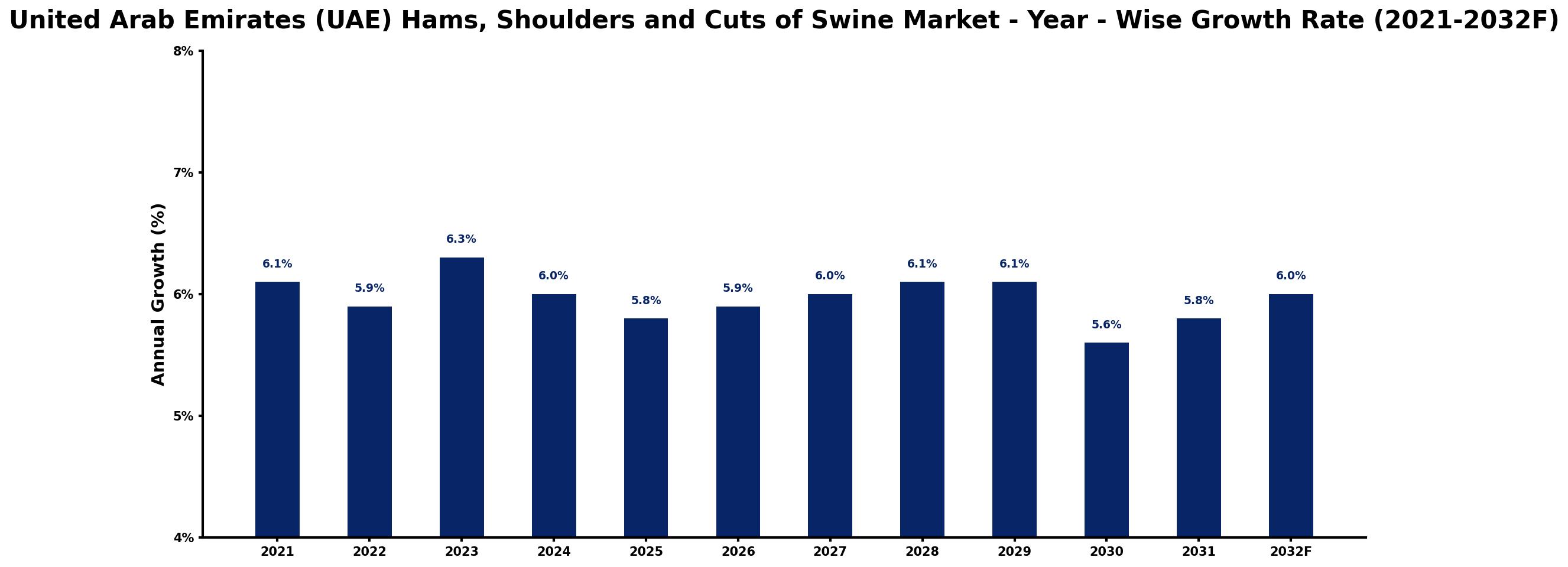
The table below presents the year‑wise growth rates along with the key drivers influencing the market
| Year | Growth Rate | Major Drivers |
| 2021 | 6.1% | Growing consumer preference for quality |
| 2022 | 5.9% | Increase in food service demand |
| 2023 | 6.3% | Expansion of retail distribution channels |
| 2024 | 6.0% | Rising popularity of gourmet products |
| 2025 | 5.8% | Growth in health-conscious eating trends |
| 2026 | 5.9% | increased production capacity utilization |
| 2027 | 6.0% | Development of new culinary applications |
| 2028 | 6.1% | Surge in local production facilities |
| 2029 | 6.1% | Enhanced marketing and branding efforts |
| 2030 | 5.6% | Stabilization of supply chains |
| 2031 | 5.8% | Increased investment in technology |
| 2032 | 6.0% | Diversification of product offerings |
Note: Market size estimations and growth projections presented in this report are based on 6Wresearch's proprietary forecasting methodology, utilizing the latest available industry data, government publications, and primary research inputs.
United Arab Emirates (UAE) Hams, Shoulders and Cuts of Swine Market Synopsis
The market for hams, shoulders, and cuts of swine in the UAE is characterized by its niche status, largely serving the needs of non-Muslim residents and tourists. Notably, premium imports from select countries dominate the offerings, catering to discerning consumers who seek authenticity and quality in their pork products.
As the market navigates cultural sensitivities, it remains a specialized segment within the broader meat market. Retailers often employ targeted marketing strategies, focusing on areas with high concentrations of expatriates to optimize reach and engagement, effectively creating a unique shopping experience around these products.
United Arab Emirates (UAE) Hams, Shoulders and Cuts of Swine Market Key Takeaways
- The UAE Hams, Shoulders and Cuts of Swine Market is predominantly driven by demand from expatriates and tourists.
- High-quality imports are essential for meeting consumer preferences in this niche market.
- Specialized marketing strategies are crucial for success due to the cultural and religious context.
- COVID-19 has reshaped consumer purchasing behavior, pushing for online and home delivery options.
- Leading retailers are positioning themselves to capture a growing segment of discerning consumers.
Evaluation of Restraints in United Arab Emirates (UAE) Hams, Shoulders and Cuts of Swine Market
The UAE Hams, Shoulders and Cuts of Swine Market faces significant restraints primarily due to cultural and religious prohibitions surrounding pork consumption. These restrictions limit the overall market potential, confining demand to a relatively small group of consumers. Furthermore, stringent import regulations and processing requirements hinder the entry of new players into this sector, creating a complex landscape for potential market entrants. The necessity for precise compliance with regulations adds another layer of challenge, which can deter investment in this niche.
United Arab Emirates (UAE) Hams, Shoulders and Cuts of Swine Market Trends
Current trends in the UAE market for hams, shoulders, and cuts of swine reveal a growing inclination towards gourmet and artisanal products. Consumers are increasingly seeking premium options and authentic flavors, prompting retailers to enhance their offerings with high-quality imports. Additionally, the rise of e-commerce platforms has created new avenues for distribution, allowing suppliers to reach consumers directly in the comfort of their homes. As demand evolves, brands are also focusing on transparency in sourcing and production practices to build consumer trust.
United Arab Emirates (UAE) Hams, Shoulders and Cuts of Swine Market Opportunities
There are notable opportunities for growth within the UAE Hams, Shoulders and Cuts of Swine Market. As the expatriate community continues to expand, coupled with the expected increase in tourism, the demand for pork products is likely to rise. Retailers could explore innovative ways to engage consumers, such as offering cooking classes or tasting events featuring pork dishes. Furthermore, enhancing online presence through digital marketing and social media could drive awareness and boost sales among the target demographic.
Government Initiatives in the United Arab Emirates (UAE) Hams, Shoulders and Cuts of Swine Market
Government initiatives focusing on trade liberalization and the diversification of the economy may indirectly benefit the market for hams, shoulders, and cuts of swine. Although specific policies regarding pork remain sensitive due to cultural norms, overall economic growth and improvements in retail infrastructure could enhance the distribution channels available for imported pork products. These initiatives may create a more favorable environment for businesses seeking to cater to the expatriate demographic.
Future Insights of the United Arab Emirates (UAE) Hams, Shoulders and Cuts of Swine Market
Looking ahead to the period from 2026 to 2032, the UAE Hams, Shoulders and Cuts of Swine Market is expected to see steady growth driven by ongoing demographic changes and evolving consumer preferences. As the expatriate population increases and tourism rebounds, retailers will likely expand their product offerings and improve accessibility. Innovations in online sales channels and an emphasis on quality and authenticity will be critical in shaping the market landscape, paving the way for sustainable growth.
United Arab Emirates (UAE) Hams, Shoulders and Cuts of Swine Market Latest Developments (2025 - 2026)
Recent developments within the UAE Hams, Shoulders and Cuts of Swine Market highlight a renewed focus on e-commerce, with more retailers enhancing their online platforms to meet changing consumer behaviors. Additionally, there has been an uptick in collaborations between specialty importers and local supermarkets, making gourmet pork products more accessible. Innovations in packaging and branding are also emerging, aimed at appealing to a sophisticated and quality-driven consumer base.
United Arab Emirates (UAE) Hams, Shoulders and Cuts of Swine Market - Key Attractiveness of the Report
- 10 Years of Market Numbers
- Historical Data Starting from 2022 to 2025
- Base Year: 2025
- Forecast Data until 2032
- Key Performance Indicators Impacting the Market
- Major Upcoming Developments and Projects
Key Highlights of the Report:
- United Arab Emirates (UAE) Hams, Shoulders and Cuts of Swine Market Outlook
- Market Size of United Arab Emirates (UAE) Hams, Shoulders and Cuts of Swine Market, 2025
- Forecast of United Arab Emirates (UAE) Hams, Shoulders and Cuts of Swine Market, 2032
- Historical Data and Forecast of United Arab Emirates (UAE) Hams, Shoulders and Cuts of Swine Revenues & Volume for the Period 2022-2032F
- United Arab Emirates (UAE) Hams, Shoulders and Cuts of Swine Market Trend Evolution
- United Arab Emirates (UAE) Hams, Shoulders and Cuts of Swine Market Drivers and Challenges
- United Arab Emirates (UAE) Hams, Shoulders and Cuts of Swine Price Trends
- United Arab Emirates (UAE) Hams, Shoulders and Cuts of Swine Porter's Five Forces
- United Arab Emirates (UAE) Hams, Shoulders and Cuts of Swine Industry Life Cycle
- Historical Data and Forecast of United Arab Emirates (UAE) Hams, Shoulders and Cuts of Swine Market Revenues & Volume By Product Type for the Period 2022-2032F
- Historical Data and Forecast of United Arab Emirates (UAE) Hams, Shoulders and Cuts of Swine Market Revenues & Volume By Processed Meat for the Period 2022-2032F
- Historical Data and Forecast of United Arab Emirates (UAE) Hams, Shoulders and Cuts of Swine Market Revenues & Volume By Frozen Meat for the Period 2022-2032F
- Historical Data and Forecast of United Arab Emirates (UAE) Hams, Shoulders and Cuts of Swine Market Revenues & Volume By Chilled Meat for the Period 2022-2032F
- Historical Data and Forecast of United Arab Emirates (UAE) Hams, Shoulders and Cuts of Swine Market Revenues & Volume By Canned Meat for the Period 2022-2032F
- Historical Data and Forecast of United Arab Emirates (UAE) Hams, Shoulders and Cuts of Swine Market Revenues & Volume By Fresh Meat for the Period 2022-2032F
- Historical Data and Forecast of United Arab Emirates (UAE) Hams, Shoulders and Cuts of Swine Market Revenues & Volume By Animal Type for the Period 2022-2032F
- Historical Data and Forecast of United Arab Emirates (UAE) Hams, Shoulders and Cuts of Swine Market Revenues & Volume By Cattle and Buffalo for the Period 2022-2032F
- Historical Data and Forecast of United Arab Emirates (UAE) Hams, Shoulders and Cuts of Swine Market Revenues & Volume By Pig for the Period 2022-2032F
- Historical Data and Forecast of United Arab Emirates (UAE) Hams, Shoulders and Cuts of Swine Market Revenues & Volume By Poultry for the Period 2022-2032F
- Historical Data and Forecast of United Arab Emirates (UAE) Hams, Shoulders and Cuts of Swine Market Revenues & Volume By Sheep and Goat for the Period 2022-2032F
- Historical Data and Forecast of United Arab Emirates (UAE) Hams, Shoulders and Cuts of Swine Market Revenues & Volume By Other Animals for the Period 2022-2032F
- Historical Data and Forecast of United Arab Emirates (UAE) Hams, Shoulders and Cuts of Swine Market Revenues & Volume By Distribution Channel for the Period 2022-2032F
- Historical Data and Forecast of United Arab Emirates (UAE) Hams, Shoulders and Cuts of Swine Market Revenues & Volume By Business to Consumers (B2C) for the Period 2022-2032F
- Historical Data and Forecast of United Arab Emirates (UAE) Hams, Shoulders and Cuts of Swine Market Revenues & Volume By Modern Groceries for the Period 2022-2032F
- Historical Data and Forecast of United Arab Emirates (UAE) Hams, Shoulders and Cuts of Swine Market Revenues & Volume By Wet & Butcher Shops for the Period 2022-2032F
- Historical Data and Forecast of United Arab Emirates (UAE) Hams, Shoulders and Cuts of Swine Market Revenues & Volume By Convenience Stores for the Period 2022-2032F
- Historical Data and Forecast of United Arab Emirates (UAE) Hams, Shoulders and Cuts of Swine Market Revenues & Volume By Business to Business (B2B) for the Period 2022-2032F
- Historical Data and Forecast of United Arab Emirates (UAE) Hams, Shoulders and Cuts of Swine Market Revenues & Volume By Other Channel for the Period 2022-2032F
- United Arab Emirates (UAE) Hams, Shoulders and Cuts of Swine Import Export Trade Statistics
- Market Opportunity Assessment By Product Type
- Market Opportunity Assessment By Animal Type
- Market Opportunity Assessment By Distribution Channel
- United Arab Emirates (UAE) Hams, Shoulders and Cuts of Swine Top Companies Market Share
- United Arab Emirates (UAE) Hams, Shoulders and Cuts of Swine Competitive Benchmarking By Technical and Operational Parameters
- United Arab Emirates (UAE) Hams, Shoulders and Cuts of Swine Company Profiles
- United Arab Emirates (UAE) Hams, Shoulders and Cuts of Swine Key Strategic Recommendations






































