United Arab Emirates (UAE) Hay Making Machinery Market Size, Share & Growth Rate
The United Arab Emirates (UAE) Hay Making Machinery Market was estimated at USD 156 Million in 2025 and is projected to reach USD 216 Million by 2032, growing at a CAGR of 4.8% from 2026 to 2032. This growth trajectory is driven by a combination of increasing agricultural sustainability initiatives and the evolving needs of livestock farmers who demand higher quality feed. As the market embraces technological advancements in haymaking equipment, the efficiency and effectiveness of fodder production continue to improve, addressing both environmental and operational concerns.
United Arab Emirates (UAE) Hay Making Machinery Market Year-wise Growth Rate and Key Drivers
This graph highlights how the United Arab Emirates (UAE) Hay Making Machinery Market has steadily grown over the years, supported by major growth factors.
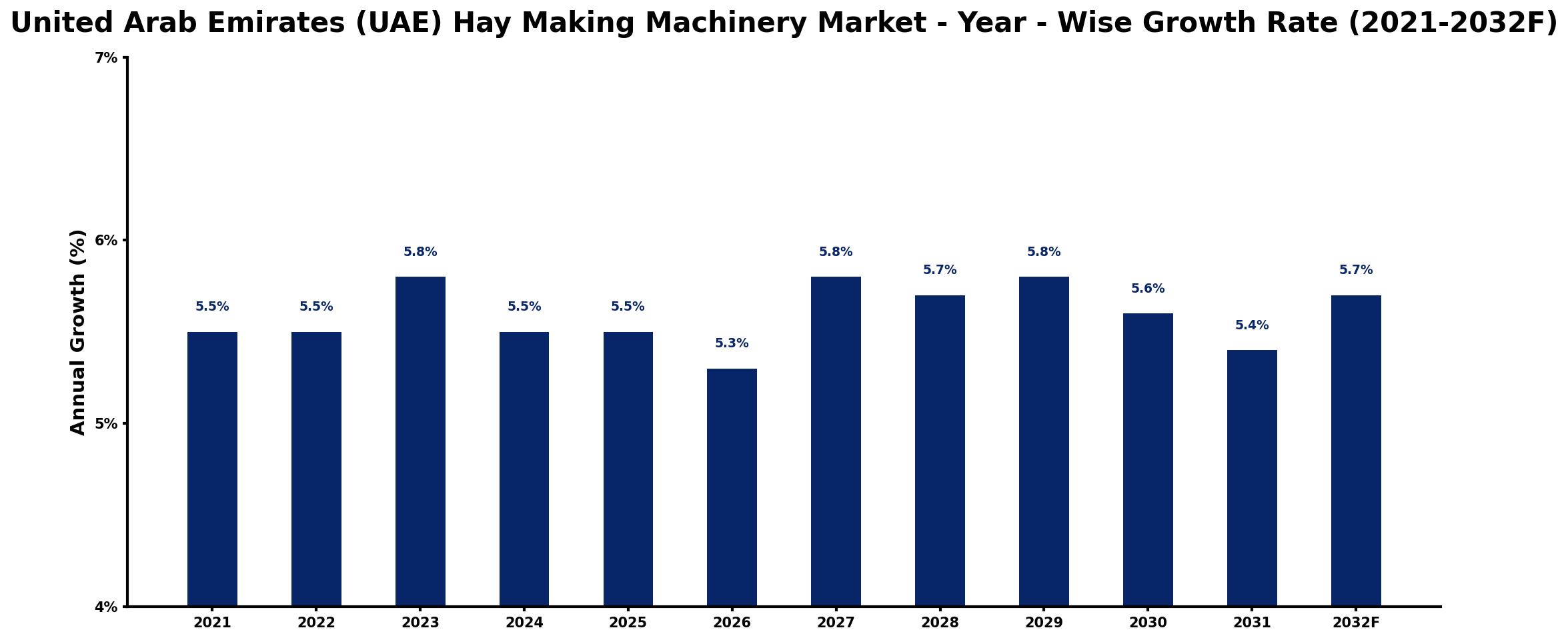
The table below presents the year‑wise growth rates along with the key drivers influencing the market
| Year | Growth Rate | Major Drivers |
| 2021 | 5.5% | Rising agricultural sector investments |
| 2022 | 5.5% | Increased demand for livestock feed |
| 2023 | 5.8% | Expansion of sustainable farming practices |
| 2024 | 5.5% | Growing mechanization in agriculture |
| 2025 | 5.5% | Higher efficiency in crop production |
| 2026 | 5.3% | Technological advancements in farming |
| 2027 | 5.8% | Surge in eco-friendly initiatives |
| 2028 | 5.7% | Increased focus on food security |
| 2029 | 5.8% | Rising export opportunities for products |
| 2030 | 5.6% | Growing interest in precision agriculture |
| 2031 | 5.4% | growing emerging market penetration |
| 2032 | 5.7% | Investment in agricultural research development |
Note: Market size estimations and growth projections presented in this report are based on 6Wresearch's proprietary forecasting methodology, utilizing the latest available industry data, government publications, and primary research inputs.
United Arab Emirates (UAE) Hay Making Machinery Market Synopsis
The demand for hay making machinery in the UAE is largely influenced by the region's commitment to enhancing agricultural productivity while conserving water resources. With a focus on producing high-quality fodder to support the growing livestock sector, farmers are increasingly investing in modern haymaking equipment that aligns with sustainable practices.
Furthermore, the UAE's strategic initiatives to diversify its economy away from oil dependency have led to increased investments in the agricultural sector. Innovations in machinery such as automated balers, efficient tedders, and advanced mowers are becoming indispensable tools in this dynamic landscape, ensuring farmers can meet both local and international demands effectively.
United Arab Emirates (UAE) Hay Making Machinery Market Key Takeaways
- The market is set to grow significantly due to rising demand for sustainable agriculture practices.
- Technological advancements are crucial for enhancing productivity and efficiency in haymaking processes.
- The livestock sector's growth is directly impacting the market for high-quality feed production machinery.
- Environmental regulations are pushing farmers towards eco-friendly machinery solutions.
- Investment in modern equipment is essential for adapting to climate challenges and water scarcity.
Evaluation of Restraints in United Arab Emirates (UAE) Hay Making Machinery Market
While the UAE Hay Making Machinery Market presents numerous opportunities, it also faces certain restraints. The region's arid climate poses inherent challenges to hay quality and overall yield, necessitating significant water management strategies. Moreover, growing environmental consciousness is influencing regulatory frameworks, compelling manufacturers to adapt and produce eco-friendly machinery which can increase operational costs. The competition from international brands that offer advanced technologies at competitive prices further complicates the market landscape, urging local players to innovate continuously.
United Arab Emirates (UAE) Hay Making Machinery Market Trends
Emerging trends in the UAE Hay Making Machinery Market include a shift towards automation and precision farming technologies. Farmers are increasingly adopting smart machinery that utilizes data analytics for optimal performance and resource allocation. Additionally, the integration of renewable energy sources, such as solar power, is becoming common in powering these machines, reflecting a broader trend towards sustainability. As the equestrian sports sector expands, specialized equipment is gaining traction, further diversifying the market.
United Arab Emirates (UAE) Hay Making Machinery Market Opportunities
The UAE presents various growth opportunities within the hay making machinery sector. As agricultural sustainability becomes a priority, there is a burgeoning demand for innovative solutions that reduce water use and improve efficiency. Additionally, the integration of technology like IoT and AI in machinery can create new avenues for operational improvements and cost savings. Investment in training programs for farmers on the use of advanced machinery also represents a significant opportunity, ensuring they can maximize productivity while adhering to eco-friendly practices.
Government Initiatives in the United Arab Emirates (UAE) Hay Making Machinery Market
The UAE government is actively promoting initiatives aimed at enhancing agricultural practices through various programs and incentives. This includes funding for research into sustainable farming techniques, subsidies for eco-friendly machinery, and grants for modernizing existing agricultural infrastructure. Furthermore, policies encouraging self-sufficiency in food production align with national goals, stimulating demand for hay making machinery that supports local farming efforts.
Future Insights of the United Arab Emirates (UAE) Hay Making Machinery Market
Looking ahead to 2026-2032, the UAE Hay Making Machinery Market is poised for robust growth as technological innovation continues to shape its landscape. Farmers are expected to increasingly prioritize machinery that can optimize productivity while minimizing resource use. Additionally, the growing emphasis on quality over quantity in fodder production will likely drive demand for high-efficiency equipment. As sustainability becomes an integral part of the agricultural narrative, the market will evolve, with opportunities for manufacturers to lead in creating solutions that address both economic and environmental imperatives.
United Arab Emirates (UAE) Hay Making Machinery Market Latest Developments (2025 - 2026)
Recent developments within the UAE Hay Making Machinery Market highlight a shift towards more integrated solutions, where machinery manufacturers are collaborating with technology firms to produce smarter equipment. Innovations such as enhanced telemetry for machine monitoring and advanced data analytics for yield optimization are gaining traction. Additionally, an uptick in strategic partnerships between local agricultural bodies and machinery manufacturers is fostering a more resilient agricultural sector, priming it for future challenges.
United Arab Emirates (UAE) Hay Making Machinery Market - Key Attractiveness of the Report
- 10 Years of Market Numbers
- Historical Data Starting from 2022 to 2025
- Base Year: 2025
- Forecast Data until 2032
- Key Performance Indicators Impacting the Market
- Major Upcoming Developments and Projects
Key Highlights of the Report:
- United Arab Emirates (UAE) Hay Making Machinery Market Outlook
- Market Size of United Arab Emirates (UAE) Hay Making Machinery Market, 2025
- Forecast of United Arab Emirates (UAE) Hay Making Machinery Market, 2032
- Historical Data and Forecast of United Arab Emirates (UAE) Hay Making Machinery Revenues & Volume for the Period 2022-2032F
- United Arab Emirates (UAE) Hay Making Machinery Market Trend Evolution
- United Arab Emirates (UAE) Hay Making Machinery Market Drivers and Challenges
- United Arab Emirates (UAE) Hay Making Machinery Price Trends
- United Arab Emirates (UAE) Hay Making Machinery Porter's Five Forces
- United Arab Emirates (UAE) Hay Making Machinery Industry Life Cycle
- Historical Data and Forecast of United Arab Emirates (UAE) Hay Making Machinery Market Revenues & Volume By Type for the Period 2022-2032F
- Historical Data and Forecast of United Arab Emirates (UAE) Hay Making Machinery Market Revenues & Volume By Mower for the Period 2022-2032F
- Historical Data and Forecast of United Arab Emirates (UAE) Hay Making Machinery Market Revenues & Volume By Balers for the Period 2022-2032F
- Historical Data and Forecast of United Arab Emirates (UAE) Hay Making Machinery Market Revenues & Volume By Tedder for the Period 2022-2032F
- Historical Data and Forecast of United Arab Emirates (UAE) Hay Making Machinery Market Revenues & Volume By Rakes for the Period 2022-2032F
- United Arab Emirates (UAE) Hay Making Machinery Import Export Trade Statistics
- Market Opportunity Assessment By Type
- United Arab Emirates (UAE) Hay Making Machinery Top Companies Market Share
- United Arab Emirates (UAE) Hay Making Machinery Competitive Benchmarking By Technical and Operational Parameters
- United Arab Emirates (UAE) Hay Making Machinery Company Profiles
- United Arab Emirates (UAE) Hay Making Machinery Key Strategic Recommendations






































