United Arab Emirates (UAE) Ingots Market Summary
The united arab emirates (uae) ingots market was estimated at USD 206 Million in 2025 and is projected to reach USD 289 Million by 2032, growing at a CAGR of 5.9% from 2026 to 2032.
United Arab Emirates (UAE) Ingots Market Year-wise Growth Rate and Key Drivers
This graph highlights how the United Arab Emirates (UAE) Ingots Market has steadily grown over the past five years, supported by major growth factors.
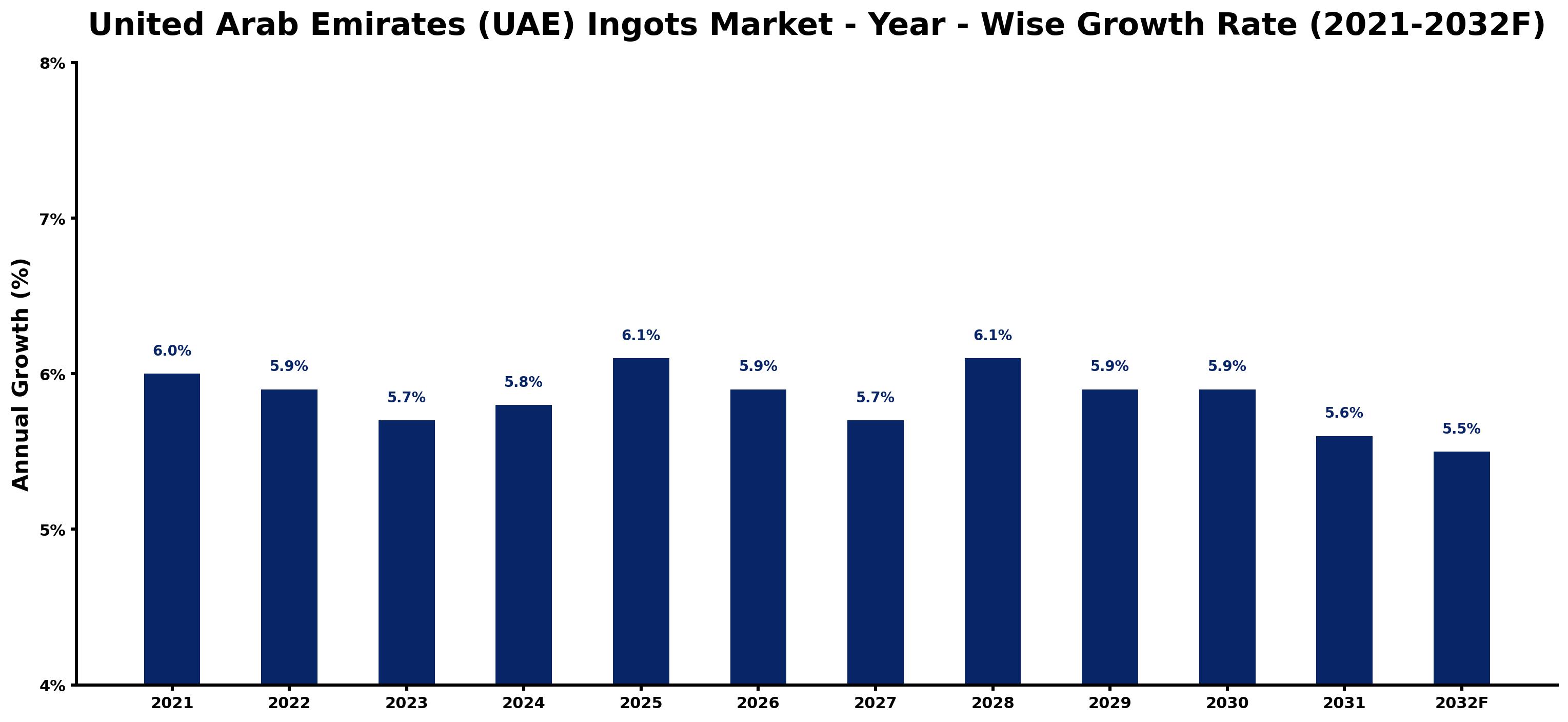
The table below presents the year wise growth rates along with the key drivers influencing the market
| Year | Growth Rate | Major Drivers |
| 2021 | 6.0% | Post-lockdown retail projects began to spur demand for metal materials across sectors. |
| 2022 | 5.9% | Heavy investments in infrastructure fueled a robust construction scene in the UAE. |
| 2023 | 5.7% | Localization efforts within the GCC encouraged domestic production of essential metal ingots. |
| 2024 | 5.8% | Emerging smart city projects increased requirements for high-quality building materials. |
| 2025 | 6.1% | Renewed focus on sustainability attracted investment in recyclable ingot production technologies. |
| 2026 | 5.9% | Cultural events like Expo 2020 stimulated significant demand for construction materials. |
| 2027 | 5.7% | Technological innovations improved efficiency in ingot manufacturing processes and reduced waste. |
| 2028 | 6.1% | Regional geopolitical stability fostered confidence in long-term industrial investments and growth. |
| 2029 | 5.9% | A surge in luxury real estate projects demanded premium quality steel ingots. |
| 2030 | 5.9% | Urbanization trends continued to drive demand for diverse construction materials in cities. |
| 2031 | 5.6% | Increased focus on energy efficiency influenced demand for lightweight ingot applications. |
| 2032 | 5.5% | Corporate shifts towards local sourcing emphasized the need for reliable supply chains. |
Note - Market size estimations and growth projections presented in this report are based on 6Wresearch's advanced forecasting approach, validated with industry datasets as of June 2026.
United Arab Emirates (UAE) Ingots Market Synopsis
The United Arab Emirates (UAE) Ingots Market is projected to reach 5.9% and witness significant growth during the forecast period (2026-2032). This growth is primarily driven by the increased demand for ingots in various industries such as manufacturing and construction, as well as for investment purposes. The UAE's strategic geographical location, coupled with easy access to raw materials and a favorable business environment, enhances the competitiveness of the ingots market. Furthermore, initiatives like the UAE Vision 2025 play a crucial role in fostering investments in technology and infrastructure projects that rely heavily on metals like copper and aluminum ingots.
United Arab Emirates (UAE) Ingots Market Trends and Opportunities
The United Arab Emirates (UAE) Ingots Market is currently witnessing transformative trends that enhance its growth trajectory. One significant trend is the increasing investment in sustainable and green technologies. As manufacturers respond to environmental concerns, there is a marked shift towards energy-efficient production processes. Companies are channeling investments into research and development, particularly in renewable energy technologies that utilize metals such as copper and silver ingots. The ongoing trading relationships between Middle Eastern nations present further opportunities for traders, augmenting cross-border transactions and enhancing the overall market dynamics.
United Arab Emirates (UAE) Ingots Market Growth Drivers
Several key factors are propelling the growth of the United Arab Emirates (UAE) Ingots Market. Among these are:
- The significant increase in both residential and commercial construction projects across the UAE, driven by government initiatives aimed at urban development.
- The governmental support focused on creating new urban centers which enhance the standard of living and generate job opportunities, thereby increasing demand for high-quality ingots.
- The availability of a skilled labor force from neighboring countries, which allows for the production of ingots at a lower cost while maintaining high quality.
- Growing foreign direct investment inflows into the UAE are boosting the local manufacturing capabilities, further increasing the consumption of ingots.
- The strategic partnerships and economic ties with other countries in the region are facilitating better access to markets, increasing trade volume in ingots.
United Arab Emirates (UAE) Ingots Market Challenges and Restraints
Despite the positive outlook, the United Arab Emirates (UAE) Ingots Market faces several challenges that could hinder its growth. Key among these are:
- Trade disputes among nations can disrupt supply chains, leading to fluctuations in prices and availability of certain types of ingots.
- The imposition of economic sanctions by certain governments can complicate import-export regulations, affecting the market's fluidity and product availability.
- Fluctuating currency values, particularly against the US dollar, may impact purchasing decisions and overall market sentiment among customers.
- Increased competition from alternative materials in construction and manufacturing could pose a threat to the ingot market's share.
- Environmental regulations may necessitate additional investments for compliance, potentially straining resources for some manufacturers.
United Arab Emirates (UAE) Ingots Market Government Investment and Initiatives
The government of the United Arab Emirates is actively promoting the ingots market through several strategic initiatives and investments. Programs aligned with the UAE Vision 2025 focus on enhancing infrastructure and building capabilities in manufacturing sectors, which directly relates to the demand for ingots. Public spending is directed towards sustainable urban development and technological advancements that require high-grade metals. Moreover, the government provides incentives for businesses engaging in innovative production practices that align with environmental sustainability goals, thereby fostering a conducive environment for growth in the ingots market.
United Arab Emirates (UAE) Ingots Market Latest Developments (May 2025 - June 2026)
In the period between May 2025 and June 2026, the United Arab Emirates (UAE) Ingots Market has seen noteworthy developments that underscore its evolving landscape. There has been a notable shift towards incorporating advanced manufacturing technologies aimed at optimizing production efficiency and minimizing energy consumption. The focus on green technology has amplified, with many firms exploring partnerships for sustainable metal sourcing. Additionally, evolving trade agreements within the Gulf Cooperation Council (GCC) region have facilitated smoother cross-border transactions, promoting increased trade in ingots. These developments have strategically positioned the UAE ingots market for sustained growth in the coming years.
United Arab Emirates (UAE) Ingots Market - Key Attractiveness of the Report
- 10 Years of Market Numbers
- Historical Data Starting from 2022 to 2025
- Base Year: 2025
- Forecast Data until 2032
- Key Performance Indicators Impacting the Market
- Major Upcoming Developments and Projects
Key Highlights of the Report:
- United Arab Emirates (UAE) Ingots Market Outlook
- Market Size of United Arab Emirates (UAE) Ingots Market, 2025
- Forecast of United Arab Emirates (UAE) Ingots Market, 2032
- Historical Data and Forecast of United Arab Emirates (UAE) Ingots Revenues & Volume for the Period 2022-2032F
- United Arab Emirates (UAE) Ingots Market Trend Evolution
- United Arab Emirates (UAE) Ingots Market Drivers and Challenges
- United Arab Emirates (UAE) Ingots Price Trends
- United Arab Emirates (UAE) Ingots Porter's Five Forces
- United Arab Emirates (UAE) Ingots Industry Life Cycle
- Historical Data and Forecast of United Arab Emirates (UAE) Ingots Market Revenues & Volume By Product Types for the Period 2022-2032F
- Historical Data and Forecast of United Arab Emirates (UAE) Ingots Market Revenues & Volume By Single Crystals for the Period 2022-2032F
- Historical Data and Forecast of United Arab Emirates (UAE) Ingots Market Revenues & Volume By Copper Alloys for the Period 2022-2032F
- Historical Data and Forecast of United Arab Emirates (UAE) Ingots Market Revenues & Volume By Material Types for the Period 2022-2032F
- Historical Data and Forecast of United Arab Emirates (UAE) Ingots Market Revenues & Volume By Aluminium for the Period 2022-2032F
- Historical Data and Forecast of United Arab Emirates (UAE) Ingots Market Revenues & Volume By Steel for the Period 2022-2032F
- Historical Data and Forecast of United Arab Emirates (UAE) Ingots Market Revenues & Volume By Gold for the Period 2022-2032F
- Historical Data and Forecast of United Arab Emirates (UAE) Ingots Market Revenues & Volume By Tin for the Period 2022-2032F
- Historical Data and Forecast of United Arab Emirates (UAE) Ingots Market Revenues & Volume By Others for the Period 2022-2032F
- Historical Data and Forecast of United Arab Emirates (UAE) Ingots Market Revenues & Volume By Applications for the Period 2022-2032F
- Historical Data and Forecast of United Arab Emirates (UAE) Ingots Market Revenues & Volume By Petroleum for the Period 2022-2032F
- Historical Data and Forecast of United Arab Emirates (UAE) Ingots Market Revenues & Volume By Oil & Gas for the Period 2022-2032F
- Historical Data and Forecast of United Arab Emirates (UAE) Ingots Market Revenues & Volume By Chemical for the Period 2022-2032F
- Historical Data and Forecast of United Arab Emirates (UAE) Ingots Market Revenues & Volume By Marine for the Period 2022-2032F
- Historical Data and Forecast of United Arab Emirates (UAE) Ingots Market Revenues & Volume By Others for the Period 2022-2032F
- United Arab Emirates (UAE) Ingots Import Export Trade Statistics
- Market Opportunity Assessment By Product Types
- Market Opportunity Assessment By Material Types
- Market Opportunity Assessment By Applications
- United Arab Emirates (UAE) Ingots Top Companies Market Share
- United Arab Emirates (UAE) Ingots Competitive Benchmarking By Technical and Operational Parameters
- United Arab Emirates (UAE) Ingots Company Profiles
- United Arab Emirates (UAE) Ingots Key Strategic Recommendations






































