United Arab Emirates (UAE) Kosher Food Market Size, Share & Growth Rate
The United Arab Emirates (UAE) Kosher Food Market was estimated at USD 219 Million in 2025 and is projected to reach USD 304 Million by 2032, growing at a CAGR of 4.8% from 2026 to 2032. This impressive growth trajectory is primarily driven by the rising Jewish expatriate community and the growing influx of tourists seeking kosher-certified options. Additionally, the UAE's strategic location as a global trade hub facilitates the importation and distribution of these products, further fueling demand.
United Arab Emirates (UAE) Kosher Food Market Year-wise Growth Rate and Key Drivers
This graph highlights how the United Arab Emirates (UAE) Kosher Food Market has steadily grown over the years, supported by major growth factors.
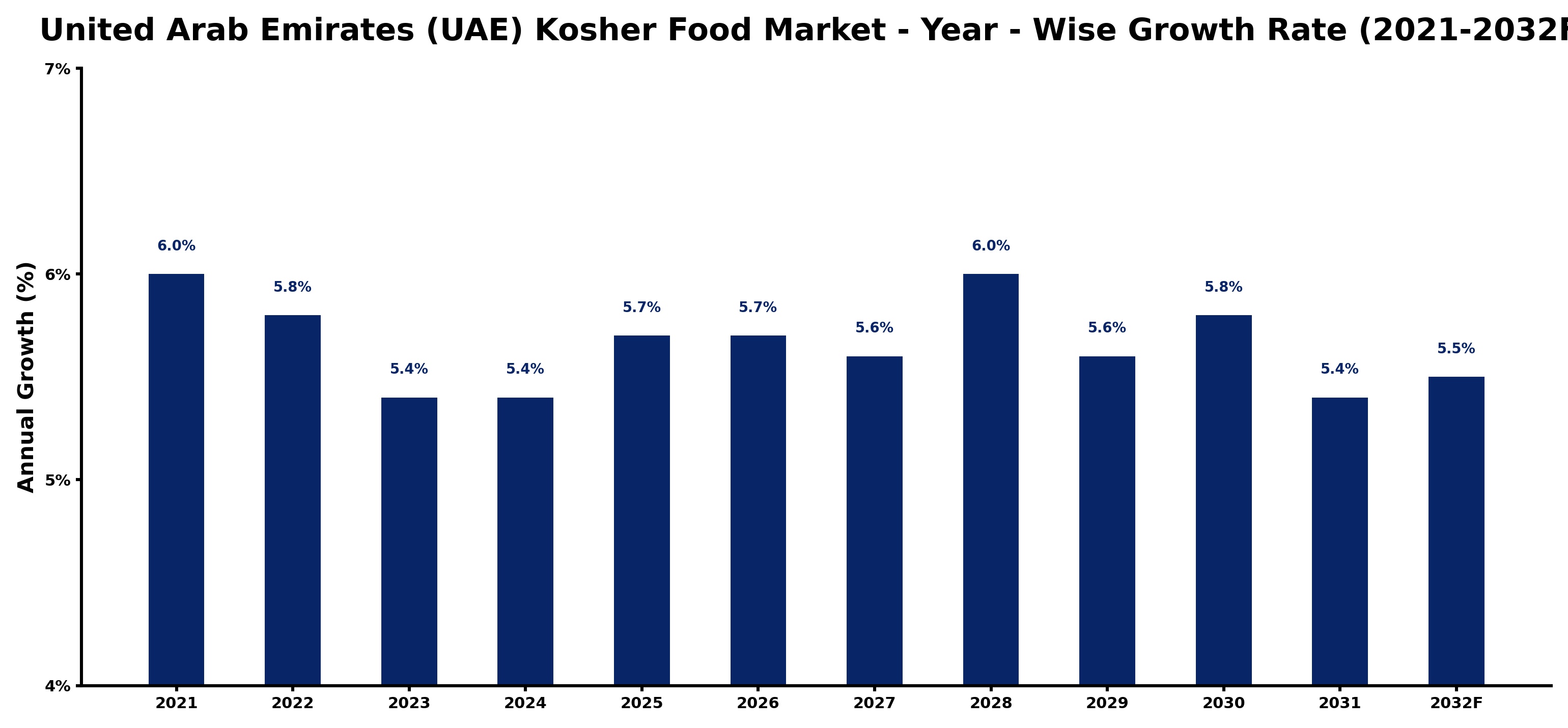
The table below presents the year‑wise growth rates along with the key drivers influencing the market
| Year | Growth Rate | Major Drivers |
| 2021 | 6.0% | Smart logistics technologies optimize kosher food supply chain efficiency |
| 2022 | 5.8% | Logistics upgrades enhanced efficiency in kosher food distribution networks |
| 2023 | 5.4% | Smart logistics integration boosted kosher food supply chain efficiency |
| 2024 | 5.4% | Smart manufacturing investments boost kosher food processing capabilities |
| 2025 | 5.7% | Smart logistics systems enhance supply chain efficiency for kosher foods |
| 2026 | 5.7% | Kosher certification demand boosts food processing plant expansions |
| 2027 | 5.6% | Technology integration in food processing improved kosher product quality assurance |
| 2028 | 6.0% | Kosher certification adoption boosts UAE food production capabilities |
| 2029 | 5.6% | Export driven logistics improvements enhanced kosher food supply chain efficiency |
| 2030 | 5.8% | Increased logistics efficiency enhanced kosher food supply chain capacity |
| 2031 | 5.4% | Smart logistics upgrades enhance supply chain efficiency for food production |
| 2032 | 5.5% | Export driven demand spurred investment in halal food processing facilities |
Note - Market size estimations and growth projections presented in this report are based on 6Wresearch's advanced forecasting approach, validated with industry datasets as of June 2026.
United Arab Emirates (UAE) Kosher Food Market Synopsis
The strongest force shaping the UAE kosher food market today is the increasing demand from both local residents and international visitors. As diplomatic and economic ties with Israel strengthen, the Jewish population in the UAE is expanding, which in turn drives the demand for authentic kosher options.
Moreover, government initiatives promoting religious tolerance have made it easier for kosher food producers and suppliers to thrive. This creates a vibrant market environment that not only caters to the needs of the Jewish community but also attracts diverse consumers interested in kosher products.
United Arab Emirates (UAE) Kosher Food Market Key Takeaways
- The market is experiencing significant growth due to an increasing Jewish expatriate population.
- A surge in Jewish tourism has fueled demand for kosher-certified food options.
- Strategic location and governmental support have facilitated the import and distribution of kosher products.
- Online shopping trends during the pandemic provided new channels for kosher food retailers.
- Maintaining authenticity in kosher certification remains a critical focus for producers.
Evaluation of Restraints in United Arab Emirates (UAE) Kosher Food Market
Despite its robust growth, the UAE kosher food market encounters significant restraints. Ensuring the authenticity and availability of kosher-certified products poses ongoing challenges for manufacturers and suppliers. The complexities of adhering to diverse dietary regulations while simultaneously meeting the strict standards of kosher certification can complicate operations. Furthermore, logistics issues associated with the import and distribution of kosher products may impact market accessibility, especially given the international sourcing involved in fulfilling consumer demands.
United Arab Emirates (UAE) Kosher Food Market Trends
Several key trends are shaping the UAE kosher food market. The rise of health-conscious consumers is prompting an increase in demand for organic and health-focused kosher options. Additionally, the growing popularity of online shopping and home delivery services is reshaping how consumers access kosher products, making them more convenient to obtain. The trend towards ethical consumption is also gaining traction, with more consumers interested in the sourcing and quality of their food, further amplifying the significance of kosher certification.
United Arab Emirates (UAE) Kosher Food Market Opportunities
The growth of the UAE kosher food market presents several lucrative opportunities for investors and businesses. Expanding product lines to include gourmet and specialty kosher items could cater to discerning consumers looking for unique culinary experiences. Additionally, increased collaboration with local restaurants and hotels can enhance market penetration and visibility. The ongoing development of infrastructure and logistics in the region further supports the efficient distribution of kosher products, paving the way for new entrants and innovative service offerings.
Government Initiatives in the United Arab Emirates (UAE) Kosher Food Market
The UAE government has implemented various initiatives aimed at enhancing religious tolerance and promoting cultural diversity, which significantly impacts the kosher food market. Efforts to streamline regulations around food importation and certification are also in place to support kosher producers. Public spending on tourism promotion, including outreach to international Jewish communities, further bolsters the demand for kosher products. These initiatives create a supportive environment that encourages growth in the kosher food segment.
Future Insights of the United Arab Emirates (UAE) Kosher Food Market
Looking ahead to 2026-2032, the UAE kosher food market is poised for continued expansion. Increased diplomatic engagement and cultural exchanges will likely enhance the Jewish community's presence and influence in the region. Coupled with evolving consumer preferences for healthier and ethically produced foods, the market will likely adapt to reflect these trends. Enhanced logistical capabilities and digital platforms will also foster accessibility, making kosher products more readily available and appealing to a broader audience.
United Arab Emirates (UAE) Kosher Food Market Latest Developments (May 2025 - June 2026)
Recent developments in the UAE kosher food market indicate a strong commitment to expanding product offerings and enhancing distribution networks. The growing collaboration between local suppliers and international brands signifies an effort to diversify available products. Furthermore, increasing consumer engagement through social media and targeted marketing campaigns has raised awareness and interest in kosher food, promoting a more vibrant market atmosphere.
United Arab Emirates (UAE) Kosher Food Market - Key Attractiveness of the Report
- 10 Years of Market Numbers
- Historical Data Starting from 2022 to 2025
- Base Year: 2025
- Forecast Data until 2032
- Key Performance Indicators Impacting the Market
- Major Upcoming Developments and Projects
Key Highlights of the Report:
- United Arab Emirates (UAE) Kosher Food Market Outlook
- Market Size of United Arab Emirates (UAE) Kosher Food Market, 2025
- Forecast of United Arab Emirates (UAE) Kosher Food Market, 2032
- Historical Data and Forecast of United Arab Emirates (UAE) Kosher Food Revenues & Volume for the Period 2022-2032F
- United Arab Emirates (UAE) Kosher Food Market Trend Evolution
- United Arab Emirates (UAE) Kosher Food Market Drivers and Challenges
- United Arab Emirates (UAE) Kosher Food Price Trends
- United Arab Emirates (UAE) Kosher Food Porter's Five Forces
- United Arab Emirates (UAE) Kosher Food Industry Life Cycle
- Historical Data and Forecast of United Arab Emirates (UAE) Kosher Food Market Revenues & Volume By Type for the Period 2022-2032F
- Historical Data and Forecast of United Arab Emirates (UAE) Kosher Food Market Revenues & Volume By Meat for the Period 2022-2032F
- Historical Data and Forecast of United Arab Emirates (UAE) Kosher Food Market Revenues & Volume By Dairy for the Period 2022-2032F
- Historical Data and Forecast of United Arab Emirates (UAE) Kosher Food Market Revenues & Volume By Pareve for the Period 2022-2032F
- Historical Data and Forecast of United Arab Emirates (UAE) Kosher Food Market Revenues & Volume By Application for the Period 2022-2032F
- Historical Data and Forecast of United Arab Emirates (UAE) Kosher Food Market Revenues & Volume By Seafood for the Period 2022-2032F
- Historical Data and Forecast of United Arab Emirates (UAE) Kosher Food Market Revenues & Volume By Processed Meat and Poultry for the Period 2022-2032F
- Historical Data and Forecast of United Arab Emirates (UAE) Kosher Food Market Revenues & Volume By Beverages for the Period 2022-2032F
- Historical Data and Forecast of United Arab Emirates (UAE) Kosher Food Market Revenues & Volume By Staples for the Period 2022-2032F
- Historical Data and Forecast of United Arab Emirates (UAE) Kosher Food Market Revenues & Volume By Snacks & Savoury for the Period 2022-2032F
- Historical Data and Forecast of United Arab Emirates (UAE) Kosher Food Market Revenues & Volume By Bakery and Confectionery for the Period 2022-2032F
- Historical Data and Forecast of United Arab Emirates (UAE) Kosher Food Market Revenues & Volume By Others for the Period 2022-2032F
- Historical Data and Forecast of United Arab Emirates (UAE) Kosher Food Market Revenues & Volume By Distribution Channel for the Period 2022-2032F
- Historical Data and Forecast of United Arab Emirates (UAE) Kosher Food Market Revenues & Volume By Supermarkets and Hypermarkets for the Period 2022-2032F
- Historical Data and Forecast of United Arab Emirates (UAE) Kosher Food Market Revenues & Volume By Grocery Stores for the Period 2022-2032F
- Historical Data and Forecast of United Arab Emirates (UAE) Kosher Food Market Revenues & Volume By Online Stores for the Period 2022-2032F
- United Arab Emirates (UAE) Kosher Food Import Export Trade Statistics
- Market Opportunity Assessment By Type
- Market Opportunity Assessment By Application
- Market Opportunity Assessment By Distribution Channel
- United Arab Emirates (UAE) Kosher Food Top Companies Market Share
- United Arab Emirates (UAE) Kosher Food Competitive Benchmarking By Technical and Operational Parameters
- United Arab Emirates (UAE) Kosher Food Company Profiles
- United Arab Emirates (UAE) Kosher Food Key Strategic Recommendations






































