United Arab Emirates (UAE) Ladders Market Size, Share & Growth Rate
The United Arab Emirates (UAE) Ladders Market was estimated at USD 264 Million in 2025 and is projected to reach USD 359 Million by 2032, growing at a CAGR of 4.5% from 2026 to 2032. This robust growth trajectory is primarily driven by the rapid urbanization and ongoing high-rise construction projects across the UAE, necessitating reliable access equipment for workers. Additionally, the increasing focus on workplace safety and adherence to global standards is compelling industries to invest in high-quality ladders that comply with stringent regulations.
United Arab Emirates (UAE) Ladders Market Year-wise Growth Rate and Key Drivers
This graph highlights how the United Arab Emirates (UAE) Ladders Market has steadily grown over the years, supported by major growth factors.
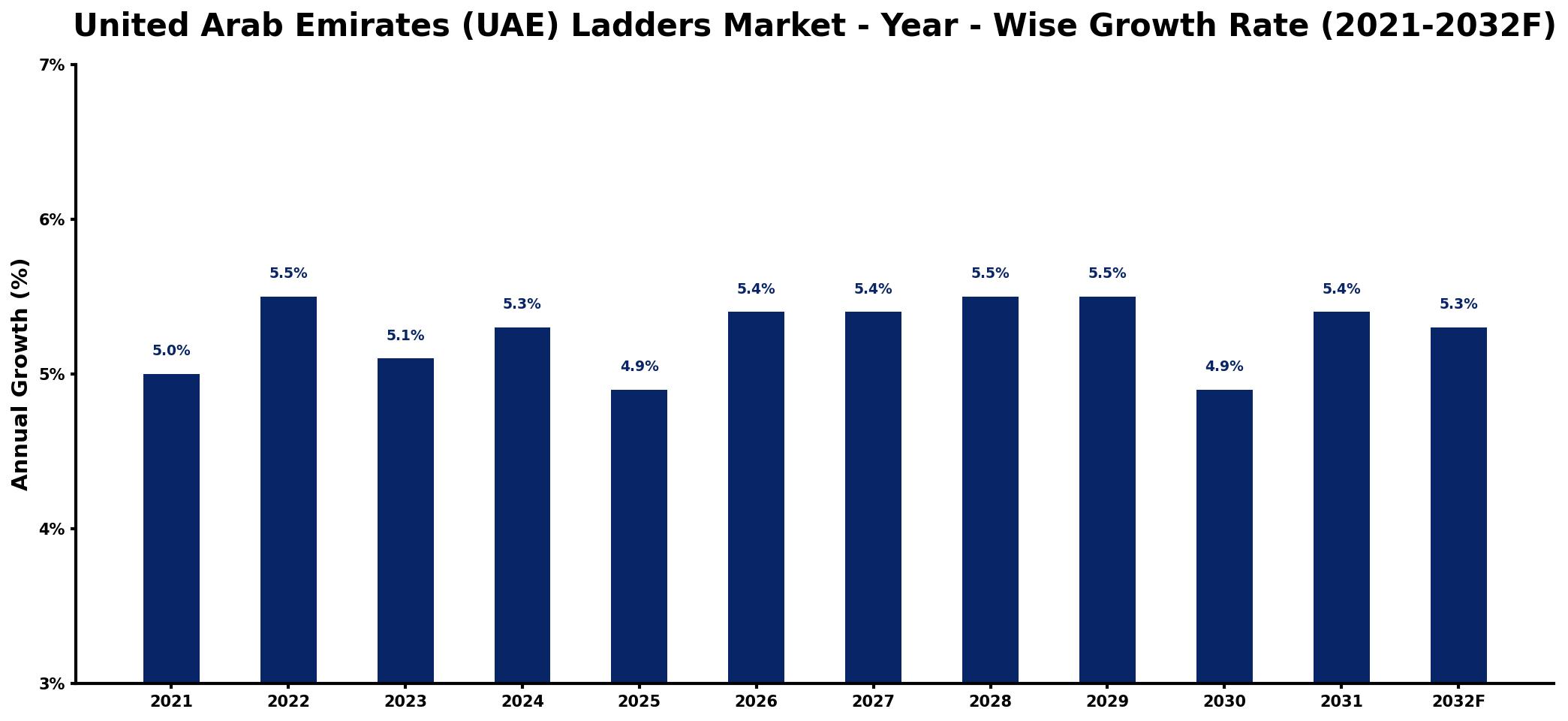
The table below presents the year‑wise growth rates along with the key drivers influencing the market
| Year | Growth Rate | Major Drivers |
| 2021 | 5.0% | Construction projects driving demand |
| 2022 | 5.5% | Increased home renovation activities |
| 2023 | 5.1% | Growing maintenance service requirements |
| 2024 | 5.3% | Expansion of retail infrastructure |
| 2025 | 4.9% | Rise in DIY home improvements |
| 2026 | 5.4% | Surge in commercial construction investments |
| 2027 | 5.4% | Technological advancements in construction |
| 2028 | 5.5% | Increased safety regulations enforcement |
| 2029 | 5.5% | Growing e-commerce logistics needs |
| 2030 | 4.9% | Rising urbanization and population growth |
| 2031 | 5.4% | Enhanced export market opportunities |
| 2032 | 5.3% | Sustainable building practices adoption |
Note: Market size estimations and growth projections presented in this report are based on 6Wresearch's proprietary forecasting methodology, utilizing the latest available industry data, government publications, and primary research inputs.
United Arab Emirates (UAE) Ladders Market Synopsis
In recent years, the UAE has witnessed a dramatic rise in construction activities, fueled by its ambitious vision for urban development and infrastructure expansion. The demand for ladders has escalated, particularly in sectors such as construction and maintenance, where they serve as vital tools for ensuring safe access to elevated work areas.
The versatility and durability of ladders make them essential across various applications, from residential projects to large-scale industrial operations. As the market continues to evolve, the focus on innovative ladder designs and safety features remains paramount, reflecting the commitment of industry stakeholders to meet the diverse needs of users.
United Arab Emirates (UAE) Ladders Market Key Takeaways
- Significant growth driven by urbanization and high-rise construction projects.
- Strong emphasis on safety standards influences ladder purchasing decisions.
- Competition from alternative access solutions is reshaping the market landscape.
- Market stability is challenged by economic fluctuations impacting construction activities.
- Increased awareness of safety features and quality standards among end-users.
Evaluation of Restraints in United Arab Emirates (UAE) Ladders Market
While the UAE ladders market demonstrates notable growth potential, several restraints could impede its progress. Compliance with evolving safety regulations and standards presents a significant challenge for manufacturers. The industry must continuously adapt its products to meet stringent guidelines, requiring investment in research and development.
Moreover, competition from alternative access solutions, such as scaffolding systems, can divert market interest and investment. Economic fluctuations also pose a risk, as changes in the construction landscape directly affect ladder demand, leading to potential market instability.
United Arab Emirates (UAE) Ladders Market Trends
Current trends in the UAE ladders market indicate a shift towards lightweight, portable ladder designs that facilitate ease of transport and use. Innovations in materials technology have led to the development of durable yet lightweight ladders, enhancing user experience without compromising safety. Furthermore, the integration of smart technology in access equipment, such as safety sensors and enhanced stability features, is gaining traction as companies prioritize safety and efficiency.
Sustainability is also emerging as a critical focus, with manufacturers exploring eco-friendly materials and production methods. This trend reflects the broader commitment of the UAE to sustainable development, aligning ladder production practices with national goals for environmental conservation.
United Arab Emirates (UAE) Ladders Market Opportunities
Opportunities in the UAE ladders market are abundant, particularly with the ongoing urban development initiatives and mega construction projects slated for the coming years. As the demand for versatile access equipment grows, there is a pressing need for manufacturers to innovate and provide specialized ladder solutions tailored to specific industries. The increasing focus on safety and the push for compliance with international standards create a favorable environment for investment in high-quality ladder products.
Moreover, the expansion of maintenance and industrial sectors in the UAE presents further avenues for growth, as businesses seek reliable access solutions for day-to-day operations. This evolving landscape underscores the potential for collaboration between manufacturers and end-users to develop customized solutions that address specific market needs.
Government Initiatives in the United Arab Emirates (UAE) Ladders Market
The UAE government has actively encouraged safety and quality standards across all industrial sectors, which has had a ripple effect on the ladders market. Various public spending initiatives aimed at infrastructure development underscore the commitment to advancing safety practices in construction. Furthermore, government regulations pertaining to workplace safety compel businesses to invest in compliant access equipment, including ladders, stimulating demand for high-quality products that adhere to established guidelines.
Future Insights of the United Arab Emirates (UAE) Ladders Market
Looking ahead to the 2026-2032 period, the UAE ladders market is poised for sustained growth, buoyed by the countrys commitment to infrastructural development and safety. The shift towards smart technologies and eco-friendly solutions will likely redefine product offerings, making them more appealing to safety-conscious consumers. Additionally, as urbanization continues to expand, the demand for high-quality, versatile ladders will rise, reinforcing the need for innovative manufacturing approaches that prioritize both safety and user experience.
United Arab Emirates (UAE) Ladders Market Latest Developments (2025 - 2026)
The ladders market in the UAE has experienced several noteworthy developments, as manufacturers respond to the evolving landscape of safety regulations and technological advancements. Companies are increasingly focused on product innovation, with new designs and materials emerging that enhance usability and comply with international standards. The market is witnessing a surge in demand for ladders equipped with advanced safety features, reflecting an industry-wide shift towards prioritizing worker protection and efficiency.
United Arab Emirates (UAE) Ladders Market - Key Attractiveness of the Report
- 10 Years of Market Numbers
- Historical Data Starting from 2022 to 2025
- Base Year: 2025
- Forecast Data until 2032
- Key Performance Indicators Impacting the Market
- Major Upcoming Developments and Projects
Key Highlights of the Report:
- United Arab Emirates (UAE) Ladders Market Outlook
- Market Size of United Arab Emirates (UAE) Ladders Market, 2025
- Forecast of United Arab Emirates (UAE) Ladders Market, 2032
- Historical Data and Forecast of United Arab Emirates (UAE) Ladders Revenues & Volume for the Period 2022-2032F
- United Arab Emirates (UAE) Ladders Market Trend Evolution
- United Arab Emirates (UAE) Ladders Market Drivers and Challenges
- United Arab Emirates (UAE) Ladders Price Trends
- United Arab Emirates (UAE) Ladders Porter's Five Forces
- United Arab Emirates (UAE) Ladders Industry Life Cycle
- Historical Data and Forecast of United Arab Emirates (UAE) Ladders Market Revenues & Volume By Application for the Period 2022-2032F
- Historical Data and Forecast of United Arab Emirates (UAE) Ladders Market Revenues & Volume By Industrial for the Period 2022-2032F
- Historical Data and Forecast of United Arab Emirates (UAE) Ladders Market Revenues & Volume By Domestic for the Period 2022-2032F
- Historical Data and Forecast of United Arab Emirates (UAE) Ladders Market Revenues & Volume By Commercial for the Period 2022-2032F
- United Arab Emirates (UAE) Ladders Import Export Trade Statistics
- Market Opportunity Assessment By Application
- United Arab Emirates (UAE) Ladders Top Companies Market Share
- United Arab Emirates (UAE) Ladders Competitive Benchmarking By Technical and Operational Parameters
- United Arab Emirates (UAE) Ladders Company Profiles
- United Arab Emirates (UAE) Ladders Key Strategic Recommendations






































