United Arab Emirates (UAE) Lighting equipment Market Summary
The united arab emirates (uae) lighting equipment market was estimated at USD 187 Million in 2025 and is projected to reach USD 263 Million by 2032, growing at a CAGR of 5.8% from 2026 to 2032.
United Arab Emirates (UAE) Lighting equipment Market Year-wise Growth Rate and Key Drivers
This graph highlights how the United Arab Emirates (UAE) Lighting equipment Market has steadily grown over the past five years, supported by major growth factors.
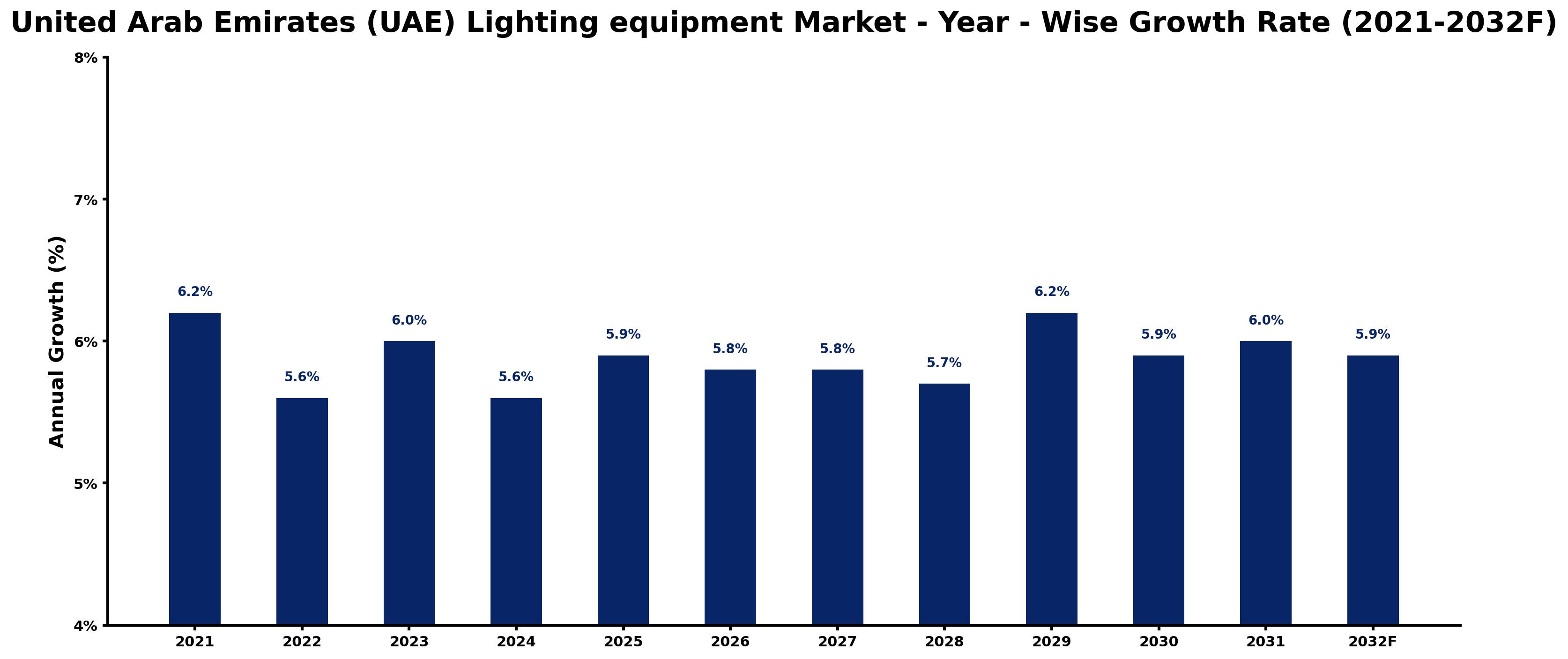
The table below presents the year wise growth rates along with the key drivers influencing the market
| Year | Growth Rate | Major Drivers |
| 2021 | 6.2% | Post-pandemic recovery spurred infrastructure projects, enhancing demand for lighting solutions. |
| 2022 | 5.6% | Luxury real estate developments showcased advanced lighting technologies, attracting high-end consumers. |
| 2023 | 6.0% | Sustainability goals prompted investments in energy-efficient lighting across commercial sectors. |
| 2024 | 5.6% | Smart city initiatives led to increased integration of IoT lighting systems in urban planning. |
| 2025 | 5.9% | Technological innovations in LEDs and smart controls improved system efficiency and lifespan. |
| 2026 | 5.8% | Expansion of tourism infrastructure generated higher lighting needs for hospitality businesses. |
| 2027 | 5.8% | Local manufacturing initiatives reduced import dependency, boosting the domestic lighting industry. |
| 2028 | 5.7% | The shift toward green buildings emphasized eco-friendly lighting solutions in new projects. |
| 2029 | 6.2% | Retail sectors increasingly focused on ambiance, driving demand for decorative lighting solutions. |
| 2030 | 5.9% | Construction regulations favored energy efficiency, necessitating advanced lighting installations across projects. |
| 2031 | 6.0% | Corporate sustainability commitments prompted businesses to upgrade lighting systems for efficiency. |
| 2032 | 5.9% | Public-private partnerships fostered infrastructure developments, enhancing overall market appeal and growth. |
Note - Market size estimations and growth projections presented in this report are based on 6Wresearch's advanced forecasting approach, validated with industry datasets as of June 2026.
United Arab Emirates (UAE) Lighting equipment Market Synopsis
The United Arab Emirates (UAE) Lighting equipment Market is projected to reach 5.8% and witness significant growth during the forecast period (2026-2032). The upward trajectory of this market can be largely attributed to rapid urbanization, sustained infrastructural development initiatives, and a pronounced shift toward energy-efficient lighting solutions. Furthermore, the increasing adoption of smart lighting technologies has become a pivotal driver, enhancing the demand across various sectors including residential, commercial, and public projects.
United Arab Emirates (UAE) Lighting equipment Market Growth Drivers
Growth within the UAE lighting equipment market is heavily influenced by several interrelated factors. Urbanization, a key driver, has led to the construction of new residential and commercial establishments, generating heightened demand for diverse lighting products. Government initiatives focusing on sustainable and energy-efficient solutions further catalyze this demand by promoting modern lighting technologies.
- Increased urbanization has necessitated the development of modern infrastructure, including roads, bridges, and public facilities, creating a substantial demand for lighting equipment.
- The UAE government has been actively promoting energy-saving initiatives, encouraging the transition to LED lighting solutions, known for their lower energy consumption and environmental benefits.
- The hospitality sector has seen rapid expansion, leading to a surge in hotel constructions and renovations that require advanced lighting solutions to enhance guest experiences.
- Technological advancements in smart lighting solutions are paving the way for integrated systems that provide improved energy management and user control.
- Public events and festivals in the UAE are increasingly utilizing sophisticated lighting setups, further driving demand within the market.
United Arab Emirates (UAE) Lighting equipment Market Challenges and Restraints
While the UAE lighting equipment market appears robust, it faces several challenges that can impede its growth trajectory. One notable barrier is the high initial cost often associated with the adoption of LED and smart lighting solutions. Though these options provide long-term savings, the upfront investment can be restrictive for some consumers and businesses.
- The presence of low-cost imports from various countries poses competitive pressure on local manufacturers and suppliers, potentially impacting their profitability and market share.
- Despite growing awareness of energy-efficient solutions, a segment of the population remains hesitant to transition from traditional lighting due to cost concerns.
- The ongoing fluctuations in global supply chains can impact the availability of essential raw materials for lighting equipment manufacturing.
- Regulatory challenges, including compliance with energy efficiency standards, can create barriers for new entrants in the market.
- Post-pandemic adjustments, including shifts in consumer spending and project timelines, continue to create uncertainty within the construction sector that can affect lighting demand.
United Arab Emirates (UAE) Lighting equipment Market Government Investment and Initiatives
The UAE government has been instrumental in shaping the lighting equipment market through various investments and initiatives aimed at fostering sustainable urban development. Significant public spending is directed toward major infrastructure projects, which include the installation of modern lighting solutions.
- The government has implemented policies encouraging the shift towards renewable energy sources and efficient energy use, impacting the type of lighting solutions being adopted.
- Investment in smart city projects is driving the introduction of advanced lighting systems that incorporate IoT technologies for better energy management.
- Incentives for businesses adopting energy-efficient lighting solutions have been introduced, which may include tax benefits and financial aid.
- Public campaigns raising awareness about the benefits of LED lighting have contributed to a shift in consumer preferences toward energy-efficient products.
- Partnerships with private sectors to promote innovation in lighting technology have led to the development of customized solutions tailored to local needs.
United Arab Emirates (UAE) Lighting equipment Market Latest Developments (May 2025 - June 2026)
Between May 2025 and June 2026, the UAE lighting equipment market has seen several noteworthy developments reflecting the industry's dynamic nature. A significant focus has been placed on smart lighting solutions, with an increasing number of projects integrating IoT capabilities to improve energy efficiency and user experience.
- New strategies have emerged to address the challenges of supply chain disruptions, with local manufacturers working to enhance their production capacities.
- Government-led initiatives aimed at increasing awareness about energy-efficient lighting have gained momentum, resulting in various seminars and public discussions.
- Investment in R&D across the sector has led to innovations in lighting technology, enhancing product offerings available in the market.
- Collaborative frameworks between government bodies and private enterprises have become prominent, with shared goals of sustainability and energy efficiency.
- Market participants are increasingly focusing on e-commerce platforms to meet the changing demands of consumers in light of recent global trends.
United Arab Emirates (UAE) Lighting equipment Market - Key Attractiveness of the Report
- 10 Years of Market Numbers
- Historical Data Starting from 2022 to 2025
- Base Year: 2025
- Forecast Data until 2032
- Key Performance Indicators Impacting the Market
- Major Upcoming Developments and Projects
Key Highlights of the Report:
- United Arab Emirates (UAE) Lighting equipment Market Outlook
- Market Size of United Arab Emirates (UAE) Lighting equipment Market, 2025
- Forecast of United Arab Emirates (UAE) Lighting equipment Market, 2032
- Historical Data and Forecast of United Arab Emirates (UAE) Lighting equipment Revenues & Volume for the Period 2022-2032F
- United Arab Emirates (UAE) Lighting equipment Market Trend Evolution
- United Arab Emirates (UAE) Lighting equipment Market Drivers and Challenges
- United Arab Emirates (UAE) Lighting equipment Price Trends
- United Arab Emirates (UAE) Lighting equipment Porter's Five Forces
- United Arab Emirates (UAE) Lighting equipment Industry Life Cycle
- Historical Data and Forecast of United Arab Emirates (UAE) Lighting equipment Market Revenues & Volume By ?Application for the Period 2022-2032F
- Historical Data and Forecast of United Arab Emirates (UAE) Lighting equipment Market Revenues & Volume By General Purpose Lighting for the Period 2022-2032F
- Historical Data and Forecast of United Arab Emirates (UAE) Lighting equipment Market Revenues & Volume By Vehicle/Automobile Lighting for the Period 2022-2032F
- Historical Data and Forecast of United Arab Emirates (UAE) Lighting equipment Market Revenues & Volume By Backlighting for the Period 2022-2032F
- Historical Data and Forecast of United Arab Emirates (UAE) Lighting equipment Market Revenues & Volume By Others? for the Period 2022-2032F
- Historical Data and Forecast of United Arab Emirates (UAE) Lighting equipment Market Revenues & Volume By Technology for the Period 2022-2032F
- Historical Data and Forecast of United Arab Emirates (UAE) Lighting equipment Market Revenues & Volume By Conventional Lighting/Non-Environment Friendly Lighting for the Period 2022-2032F
- Historical Data and Forecast of United Arab Emirates (UAE) Lighting equipment Market Revenues & Volume By Environment Friendly Lighting for the Period 2022-2032F
- Historical Data and Forecast of United Arab Emirates (UAE) Lighting equipment Market Revenues & Volume By SSL (Solid State Lighting) for the Period 2022-2032F
- Historical Data and Forecast of United Arab Emirates (UAE) Lighting equipment Market Revenues & Volume By LED (Light Emitting Diodes) for the Period 2022-2032F
- Historical Data and Forecast of United Arab Emirates (UAE) Lighting equipment Market Revenues & Volume By OLED (Organic Light Emitting Diodes) for the Period 2022-2032F
- Historical Data and Forecast of United Arab Emirates (UAE) Lighting equipment Market Revenues & Volume By PLED (Polymer Light Emitting Diodes)? for the Period 2022-2032F
- Historical Data and Forecast of United Arab Emirates (UAE) Lighting equipment Market Revenues & Volume By ?End Users for the Period 2022-2032F
- Historical Data and Forecast of United Arab Emirates (UAE) Lighting equipment Market Revenues & Volume By Industrial for the Period 2022-2032F
- Historical Data and Forecast of United Arab Emirates (UAE) Lighting equipment Market Revenues & Volume By Commercial for the Period 2022-2032F
- Historical Data and Forecast of United Arab Emirates (UAE) Lighting equipment Market Revenues & Volume By Others? for the Period 2022-2032F
- United Arab Emirates (UAE) Lighting equipment Import Export Trade Statistics
- Market Opportunity Assessment By ?Application
- Market Opportunity Assessment By Technology
- Market Opportunity Assessment By ?End Users
- United Arab Emirates (UAE) Lighting equipment Top Companies Market Share
- United Arab Emirates (UAE) Lighting equipment Competitive Benchmarking By Technical and Operational Parameters
- United Arab Emirates (UAE) Lighting equipment Company Profiles
- United Arab Emirates (UAE) Lighting equipment Key Strategic Recommendations






































